

What if the most innovative watch in your collection wasn't an octagonal icon from the 1970s, but a multi-layered masterpiece that defines the next century of horology? You likely remember the polarizing debut of the code 11.59 back in 2019, when many collectors weren't sure where this complex case architecture fit into the brand's storied legacy. It's completely natural to feel overwhelmed by the sheer variety of 2026 releases, ranging from the ivory-toned Flying Tourbillon to the striking 38mm natural stone dials. This guide will help you decode the architectural nuances and movement variations of the collection so you can find your perfect timepiece with absolute confidence.
We'll explore the evolution of the 38mm and 41mm configurations, compare the secondary market potential of stainless steel versus gold and ceramic, and show you how to source the most elusive high-complication models through an expert concierge service. Whether you're eyeing a smoked blue chronograph or a rare Grande Sonnerie, you'll gain the clarity needed to choose a modern icon that resonates with your personal style and investment goals.
Key Takeaways
- Master the architectural nuances of the three-piece case, including the hidden octagonal middle section that pays homage to AP's design heritage.
- Evaluate the technical differences between the self-winding Calibre 4302 and the integrated flyback chronograph movements to match your functional needs.
- Confidently select the right code 11.59 for your collection by comparing the bold 41mm models with the refined 38mm configurations.
- Identify the investment potential of specific materials like ceramic and gold when diversifying a portfolio alongside other high-end timepieces.
- Learn how a dedicated watch sourcing service provides direct access to hard-to-find 2026 complications and authenticated inventory.
Defining the Audemars Piguet Code 11.59 Collection
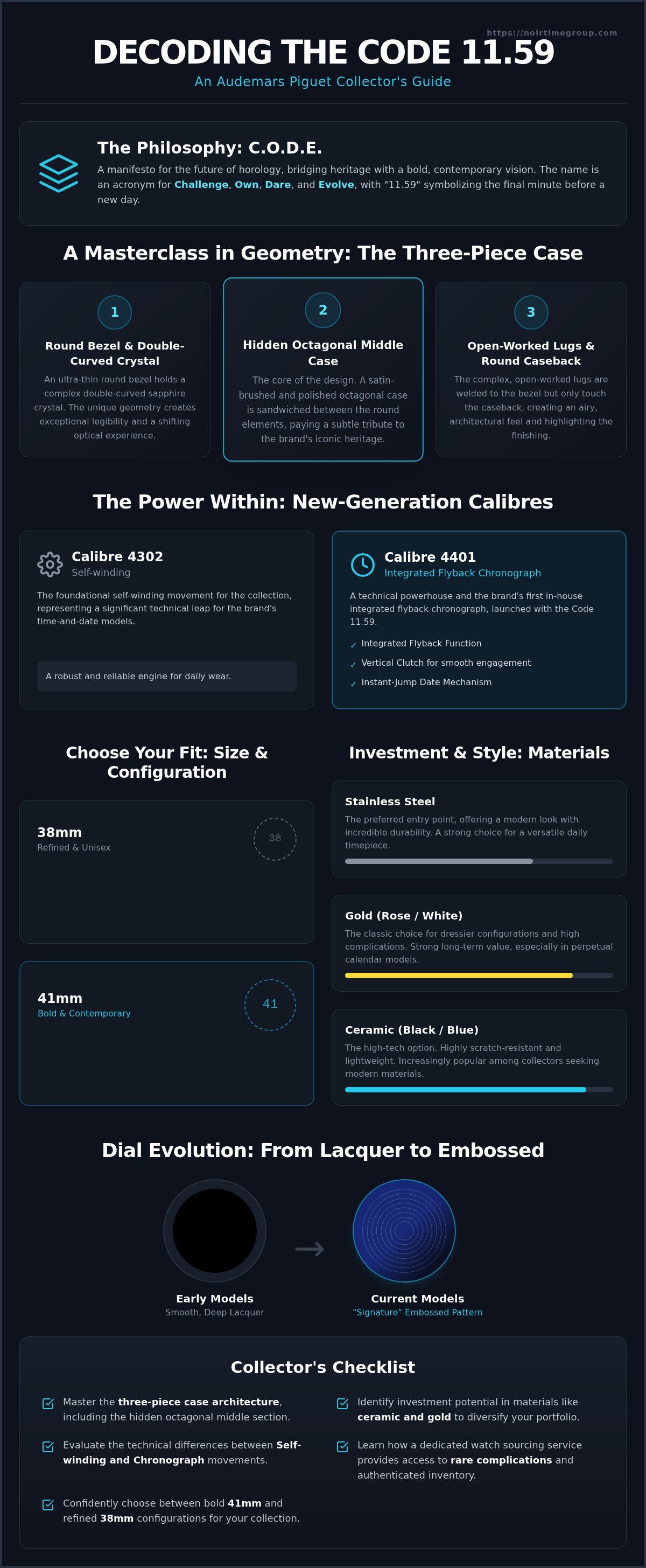
The launch of the Audemars Piguet Code 11.59 Collection in 2019 was a defining moment for one of the world's most prestigious watchmakers. It wasn't just a new product line; it was a manifesto for the brand's future. The name itself is an acronym for Challenge, Own, Dare, and Evolve, while "11.59" refers to the final minute before a new day begins. This title reflects the brand's intent to bridge the gap between their heritage and a bold, contemporary vision. While the Royal Oak remains a cultural icon, the 11.59 was created to offer something entirely different, filling the space between the octagonal sportiness of the Royal Oak and the experimental, oval shapes of the Millenary.
What started as a controversial debut has matured into a horological staple. Collectors have come to appreciate that this collection represents the brand's most significant investment in new movements in decades. It wasn't merely a case design exercise. Instead, the collection served as the launchpad for a new generation of high-performance calibres that now power the brand's most prestigious complications. It's a collection built for those who value technical depth and architectural complexity over sheer name recognition.
The Philosophy of the 11.59
The design philosophy centers on a unisex, contemporary aesthetic that breaks away from traditional round cases. At first glance, the case looks round, but a closer look reveals a complex three-piece construction. The octagonal middle case is sandwiched between a round bezel and caseback, paying a subtle tribute to the brand's history. This collection also introduced the Calibre 4401, which is the brand's first in-house integrated flyback chronograph movement. It's a powerhouse that features a vertical clutch and an instant-jump date mechanism, proving that the code 11.59 is as much about what's inside as what's outside.
Market Position and Value in 2026
By 2026, the market position of the collection has stabilized significantly. It has become the primary choice for serious collectors who want an Audemars Piguet that doesn't feel like a repeat of the 1970s. Steel and ceramic models have emerged as the preferred entry point, offering a modern look that's incredibly durable. Unlike the Royal Oak, which often carries massive premiums on the secondary market, the code 11.59 presents a unique opportunity for buyers to acquire high-level finishing at prices that align more closely with retail values. For those looking toward the high end, the Perpetual Calendar and Tourbillon models are increasingly viewed as strategic additions to collections that are already heavy on Patek or Rolex pieces.
The Architectural Design: Why Code 11.59 is a Masterclass in Geometry
The code 11.59 isn't just a round watch; it's a structural masterpiece that reveals its secrets upon closer inspection. The architecture relies on a complex three-piece construction. A hidden octagonal middle case is sandwiched between a thin, round bezel and a matching caseback. This design creates a visual bridge to the brand's most famous silhouette while maintaining a distinct identity. The lugs add another layer of complexity. They're open-worked and meticulously welded to the bezel, yet they only lean against the caseback. This engineering feat allows light to pass through the case, highlighting the alternating satin-brushed and polished finishes.
One of the most striking features is the double-curved sapphire crystal. The internal surface is shaped like a dome, while the external surface is curved vertically from 6 to 12 o'clock. This unique geometry creates an optical experience that enhances legibility and creates shifting perspectives of the dial. It's this level of detail that makes the collection technically brilliant and sets it apart from traditional dress watches. Every angle of the case is finished with the same rigor applied to the movements inside.
Dial Evolution: From Lacquer to Embossed
Early models featured smooth, deep lacquered dials, but the collection has evolved toward more intricate textures. The new "Signature" embossed pattern features concentric circles that ripple outward, catching the light in a way that flat lacquer simply can't. You can see the visual impact of this change in models like the Perpetual Calendar 26494BC, where the smoked blue dial provides a rich backdrop for the complications. Even the logo is a feat of micro-engineering. The 24-carat gold "Audemars Piguet" script is applied using galvanic growth, a chemical deposition process that creates a logo so thin it must be applied by hand.
Case Materials: Gold, Steel, and Ceramic
While the collection launched in precious metals, the introduction of stainless steel has broadened its appeal. The Selfwinding 15210ST offers a more rugged, daily-wear option without sacrificing high-end finishing. For those seeking something truly unique, the 18-carat Sand Gold found in the Flying Tourbillon 26665SG provides a hue that sits between white and pink gold. Many collectors now prefer the hybrid cases that pair gold or steel with black or blue ceramic middles. These combinations offer superior scratch resistance and a lighter feel on the wrist. If you're looking to explore these material variations, focusing on the ceramic-middle models provides the best balance of modern tech and classic luxury.
Comparing Movements: Selfwinding, Chronograph, and Grand Complications
The heart of any code 11.59 timepiece lies in its movement architecture. While the case design is revolutionary, the calibres inside represent a massive leap in engineering. The Calibre 4302 is the foundational selfwinding powerhouse, offering a generous 70-hour power reserve that allows you to set the watch down on Friday and pick it up on Monday without missing a beat. For those seeking more complexity, the Calibre 4401 integrated chronograph provides a seamless flyback function and an instant-jump date mechanism. This movement was designed specifically for this collection, ensuring the sub-dials are perfectly balanced within the larger 41mm case diameter, a feat that older modular movements couldn't achieve.
The Practicality of the Selfwinding Models
Models like the 15210ST in steel or the 15210OR in gold are the quintessential daily-wear options. They offer a clean aesthetic that transitions easily from a boardroom to a casual dinner. One point of discussion among enthusiasts is the date window placed at 4 o'clock. While some prefer a 3 or 6 o'clock position, this placement maintains the symmetry of the numerals and the embossed dial pattern. Maintenance for the Calibre 4302 is straightforward, but it's vital to use certified repair services to protect the intricate finishing of the oscillating weight. Regular servicing ensures that the movement remains accurate and that the seals protecting the complex case architecture remain intact.
The Prestige of High Complications
At the peak of the collection, you'll find high complications that showcase the brand's technical mastery. The Perpetual Calendar, powered by the legendary Calibre 5134, remains the gold standard for AP complications, tracking the day, date, month, and leap year with incredible precision. The Flying Tourbillon is another visual centerpiece, especially when paired with the new sand gold embossed dial. For the ultimate auditory experience, the Supersonnerie technology provides the clarity of a pocket watch's chime within a modern, water-resistant wrist case. The Grande Sonnerie Carillon Supersonnerie 26397QS is a particular standout, featuring three gongs and hammers that strike the hours, quarters, and minutes with musicality rarely heard in modern horology.
Pricing reflects this exclusivity, moving from the $27,000 entry level for steel models to over $350,000 for a Grande Sonnerie at Noir Time Group. Sourcing these high-complication pieces often requires a specialized concierge service due to their limited production runs and high demand in the global market.
How to Choose Your Perfect Code 11.59: Size, Material, and Dial
Selecting the right code 11.59 requires a balance between technical appreciation and daily wearability. Unlike the Royal Oak, which has a very specific integrated fit, this collection offers a more traditional lug structure that interacts differently with various wrist sizes. To find your ideal match, follow this four-step framework:
- Determine your size based on wrist circumference and desired presence.
- Select a complication that matches your lifestyle, from daily selfwinding models to sporty chronographs.
- Choose your dial texture between the classic depth of lacquered finishes or the modern Signature embossed patterns.
- Pick your material that fits your aesthetic, whether it's the versatility of steel or the architectural edge of ceramic.
The 38mm vs 41mm Decision
The introduction of the 38mm Selfwinding models, such as the 77410OR, has transformed the collection's appeal. While the 41mm version is the original standard, its bold architectural lugs can feel imposing on wrists under 6.5 inches. The 38mm variant offers a more refined, unisex appeal that captures the same complex case geometry in a more compact footprint. It's not just about the diameter; the lug-to-lug distance is significantly more manageable on the 38mm, allowing the watch to sit flush against the skin. Conversely, the 41mm provides a commanding wrist presence. Its open-worked lugs are more visible at this scale, making it the better choice for those who want the watch's geometry to be the focal point of their outfit.
Dial Colors and Strap Pairings
Your choice of dial and strap can completely change the character of a code 11.59. The grey embossed dial (26393ST) is arguably the most versatile, pairing well with almost any attire. For those who want to lean into the collection's contemporary roots, the purple alligator strap found on the 15210OR gold models offers a high-fashion look that stands out in a sea of black and brown leather. If you lead an active lifestyle, the rubber-coated straps found on the Chronograph models are essential. They provide the durability of high-tech materials while maintaining the sophisticated texture of a luxury timepiece.
When you're ready to see these configurations in person or need help deciding which reference suits your collection, you can browse our curated inventory of Code 11.59 models to find your perfect match.
Investing in the Future of AP at Noir Time Group
Adding a code 11.59 to a collection dominated by the Patek Philippe Nautilus or the Rolex Submariner is a strategic move for the forward-thinking collector. While those icons represent the pinnacle of 20th-century design, this collection represents the architectural future of horology. It offers a distinct aesthetic that doesn't compete with your heritage pieces but rather complements them by showcasing what's next. As market trends shift toward technical complexity and material innovation, owning a piece that bridges these worlds is essential for a well-rounded portfolio.
Sourcing these timepieces through a specialized New York concierge like Noir Time Group ensures you avoid the common pitfalls of the open market. High-value Audemars Piguet watches, especially those with grand complications, require rigorous authentication and a complete set of original box and papers to maintain their long-term value. Our team focuses on securing pieces that meet these strict standards, providing you with peace of mind for high-value acquisitions. If you're looking to upgrade, our trade-in service allows you to leverage your current timepiece toward a new 2025 or 2026 model, making the transition to modern luxury seamless.
Standout Models at Noir Time Group
We've identified several references that currently define the collection's prestige. The Selfwinding Chronograph in Blue Ceramic (26439NB) has quickly become a modern grail for its bold use of high-tech materials and deep color profile. For those who prioritize mechanical mastery, the White Gold Perpetual Calendar (26494BC) stands as the ultimate complication, offering a level of finishing that rivals the finest grand complications in the world. Meanwhile, the 38mm Pink Gold Blue Dial (77410OR) provides a masterclass in understated luxury, perfect for collectors who prefer a refined wrist presence without sacrificing technical depth.
Your Next Steps to Ownership
Your journey toward owning a piece of AP's future starts with expert guidance. You can explore the full Audemars Piguet Code 11.59 Collection through our curated inventory, where each piece is vetted for quality and provenance. If you're searching for rare 150th Anniversary references or specific high-complication models, inquire about our professional sourcing service. Our New York-based luxury watch concierge service specializes in finding those hard-to-find complications that rarely hit the public market. For those in the area, we invite you to visit our New York location for a private viewing of the latest inventory, where you can experience the architectural nuances of the code 11.59 firsthand.
Secure Your Place in the Next Era of Horology
The code 11.59 has successfully transitioned from a bold experiment to a cornerstone of modern watchmaking. By mastering the nuances of its three-piece case architecture and selecting a movement that aligns with your lifestyle, you ensure your collection remains ahead of the curve. You now understand that this collection isn't just a round alternative to the Royal Oak; it's a platform for Audemars Piguet's most ambitious complications and material innovations.
As a New York based luxury retailer, Noir Time Group provides the expertise needed to navigate this complex market. We offer expert sourcing for rare complications and ensure that authenticity is guaranteed for every timepiece in our inventory. Whether you're looking to trade in a current piece or source a rare 2026 release, our concierge service is ready to assist. You can Shop the Curated Audemars Piguet Code 11.59 Collection today to find a masterpiece that reflects your personal style. Your journey into the future of luxury watchmaking starts with a single, decisive choice.
Frequently Asked Questions
Is the Audemars Piguet Code 11.59 a good investment compared to the Royal Oak?
The Royal Oak generally commands higher premiums on the secondary market due to its iconic status. However, the code 11.59 offers a different value proposition, as it's often available closer to its retail price. This makes it a strategic choice for collectors who prioritize technical innovation and in-house movements over pure market hype. It's a long-term play on the brand's future direction and architectural evolution.
What does the name Code 11.59 actually mean?
The name is an acronym for Challenge, Own, Dare, and Evolve. The numerical part, 11.59, represents the final minute before a new day begins. It symbolizes the brand's commitment to staying ahead of the curve and pushing the boundaries of traditional watchmaking. It's a constant reminder that Audemars Piguet is looking toward the next century of horology rather than just resting on its heritage.
Does the Code 11.59 come in a smaller size than 41mm?
Yes, a 38mm version was introduced to the collection in 2023 to offer a more refined, unisex option. While the original launch focused exclusively on the 41mm case, the 38mm models provide a more compact footprint that suits smaller wrists perfectly. These smaller references maintain the same complex three-piece case architecture as their larger counterparts, ensuring you don't lose any of the signature architectural detail.
Are the dials on the Code 11.59 made of real gold?
While the dial bases vary between lacquer, embossed patterns, and aventurine, the "Audemars Piguet" logo is made of 24-carat gold. It's created through a process called galvanic growth, which involves chemical deposition. This allows for a logo that's incredibly thin yet structurally sound. Some high-complication models also feature dials made from solid gold or natural stones like turquoise and lapis lazuli for added exclusivity.
Can I change the strap on my Code 11.59 to a metal bracelet?
No, the code 11.59 was specifically designed for integrated straps and doesn't currently support a traditional metal bracelet. The unique lug architecture, where the lugs are welded to the bezel but lean against the caseback, creates a specific gap that fits leather or rubber-coated straps. This design choice emphasizes the contemporary aesthetic of the case and keeps the focus on its complex, multi-layered geometry.
What is the water resistance of the Audemars Piguet Code 11.59?
Most models in the collection are water-resistant to 30 meters, which is approximately 100 feet. This rating means the watch can handle light splashes or rain but shouldn't be worn while swimming or diving. Given the complexity of the three-piece case and the high-end finishing, it's best to treat these pieces as luxury dress or sports-chic watches rather than rugged tools meant for the water.
How often should I service my Code 11.59 Chronograph?
You should have your chronograph serviced every three to five years to ensure the Calibre 4401 movement remains accurate. Because this is an integrated flyback chronograph, the movement's lubricants and seals require regular inspection to prevent mechanical wear. Using certified repair services is essential for these models to maintain the water resistance and the intricate finishing on the open-worked gold oscillating weight.
Why is the sapphire crystal on the Code 11.59 curved?
The sapphire crystal features a double-curved geometry to enhance legibility and create a unique optical experience. The internal surface is shaped like a dome, while the external surface is curved vertically from 6 to 12 o'clock. This design minimizes reflections and provides a clear view of the dial from almost any angle. It also adds a layer of visual depth that complements the watch's complex architectural case.
