

Entrusting a high-grade timepiece to an unqualified bench can instantly erase decades of horological provenance. For serious collectors, securing expert mechanical watch repair and restoration isn't just about making the hands turn; it's about safeguarding the rare, original components and tight mechanical tolerances that establish an asset's secondary market standing.
You've likely experienced that uneasy hesitation when handing over an investment-grade watch for maintenance. The anxiety surrounding generic replacement parts, heavy-handed case polishing that softens factory chamfers, or opaque workshop procedures is entirely justified. When dealing with complex calibers, standard commercial repair practices simply fall short.
In this guide, you'll discover how to evaluate master watchmakers and select certified specialists who respect the delicate balance between mechanical performance and historic preservation. We break down the technical differences between routine movement overhauls and full restorations, the verification standards required for independent versus authorized ateliers, and the exact vetting criteria you need to protect your collection.
Key Takeaways
- Understand how expert mechanical watch repair and restoration differs from standard retail overhauls, focusing on caliber-specific tolerances and authentic component preservation.
- Distinguish between routine movement servicing and full historic restoration to avoid unnecessary structural intervention that can diminish collector value.
- Apply a four-step vetting framework to evaluate independent horologists and authorized ateliers by assessing credentials, tooling, and diagnostic procedures.
- Identify destructive red flags, such as aggressive case polishing and non-original replacement parts, that permanently harm secondary market desirability.
- Discover how comprehensive intake authentication and documented provenance protect your high-horology investments throughout their operational lifecycle.
Defining Expert Mechanical Watch Repair and Restoration
High-horology servicing is miles apart from simple retail counter fixes like battery replacements or link removals. At its core, expert mechanical watch repair and restoration requires a complete teardown of the movement down to its smallest screws, wheels, and springs. Each component undergoes ultrasonic cleaning, meticulous microscopic inspection, specialized lubrication, and multi-position regulation. While modern luxury brands use advanced industrial robotics for initial manufacturing, servicing complicated calibers still demands the traditional bench skills of a trained watchmaker. Without specialized micromechanical attention every five to seven years, high-end timepieces face severe mechanical degradation that uncertified hands can compound into irreversible damage.
The Mechanics of High-Grade Calibers
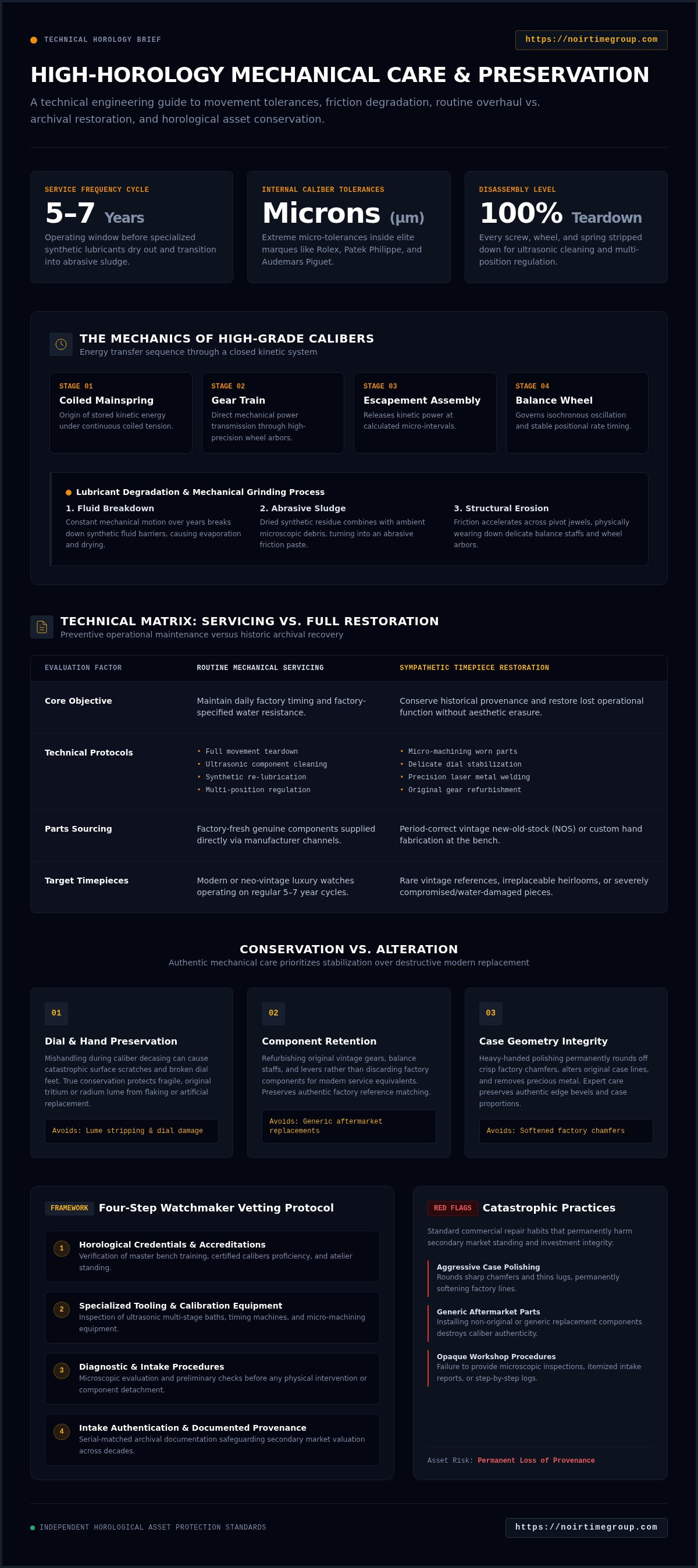
A luxury mechanical movement operates as a closed kinetic system. Power flows from the coiled mainspring through the gear train directly to the escapement assembly, which releases energy in micro-intervals governed by the oscillating balance wheel. Inside elite calibers from marques like Rolex, Patek Philippe, and Audemars Piguet, operating tolerances are measured in mere microns.
Over several years of constant motion, specialized synthetic lubricants dry out and break down. This degradation turns essential oils into abrasive sludge. Friction accelerates across delicate pivot jewels, wearing down balance staffs and wheel arbors. Regular mechanical intervention restores these vital fluid barriers before precious metal surfaces grind themselves down.
Why Provenance and Value Depend on Proper Maintenance
Collectors view mechanical luxury watches as both functional art and capital assets. A watch's historical integrity dictates its standing on the secondary market. Documented service histories from accredited specialists prove that a watch has been preserved according to strict technical standards, protecting its auction and private resale value over decades.
Crucially, genuine expert mechanical watch repair and restoration prioritizes conservation over aggressive alteration. Unskilled technicians often make the catastrophic mistake of replacing aged, original components with generic aftermarket parts or mishandling delicate vintage dials. Authentic mechanical care focuses on stabilizing the movement while respecting the watch's original aesthetic character:
- Dial and Hand Preservation: Preventing scratches, loss of original tritium or radium lume, and dial foot damage during caliber decasing.
- Component Retention: Refurbishing original vintage gears and levers rather than discarding factory components for modern service replacements.
- Case Integrity: Avoiding unauthorized metal polishing that dulls crisp factory bevels and alters original case lines.
Routine Mechanical Servicing vs. Full Timepiece Restoration
Collectors often confuse basic preventive maintenance with true archival recovery. While both fall under the broad umbrella of expert mechanical watch repair and restoration, their objectives and technical executions are fundamentally distinct. Routine servicing preserves a healthy caliber, whereas restoration rescues compromised, obsolete, or physically damaged mechanisms without sacrificing their historical identity.
| Factor | Routine Mechanical Servicing | Sympathetic Timepiece Restoration |
|---|---|---|
| Core Objective | Maintain daily factory timing and water resistance | Conserve historical provenance and restore lost function |
| Techniques | Teardown, ultrasonic cleaning, synthetic re-lubrication | Micro-machining, dial stabilization, laser metal welding |
| Parts Sourcing | Factory-fresh genuine components | Period-correct vintage stock or custom hand fabrication |
| Target Timepiece | Modern or neo-vintage watches on regular cycles | Rare vintage references, heirlooms, or water-damaged pieces |
The Scope of a Standard Mechanical Overhaul
A standard overhaul focuses on operational longevity. The watchmaker fully strips the movement, cleans each plate and jewel in specialized ultrasonic baths, and applies targeted synthetic lubricants and epilame barriers to minimize friction. The caliber is then regulated across multiple positions and temperatures on timing machines to guarantee chronometric precision. Finally, the case receives fresh gaskets and undergoes vacuum and pressure testing to verify factory depth ratings.
The Art of Sympathetic Horological Restoration
When working on rare historic references, standard servicing protocols can be catastrophic. Modern factory centers frequently replace aged hands or original dials, destroying collector interest in the process. Sympathetic restoration demands traditional micromechanical techniques honed through rigorous formal watchmaking education.
Instead of discarding damaged movement parts, a master restorer uses a watchmaker's lathe to turn replacement balance staffs or cut individual gear teeth by hand. On the exterior, historic conservation prioritizes gentle stabilization over refinishing. Flaking dials are sealed against further decay rather than reprinted, and honest patina remains intact. For rare calibers, entrusting your watch to Noir Time Group for certified watch repair guarantees that preserving originality remains the chief priority.
How to Choose an Expert Watchmaker: A Buyer's Decision Framework
Selecting an atelier for expert mechanical watch repair and restoration requires looking beyond casual customer reviews. A 5-star rating for a battery swap tells you nothing about a technician's ability to service a free-sprung balance or rebuild an automatic chronograph. Discerning collectors use a systematic four-step framework to evaluate horological competence before handing over a high-value timepiece:
- Verify Credentials: Demand formal certifications and specialized training on your watch's specific brand or complication tier.
- Audit the Workshop: Confirm the presence of clinical-grade diagnostic, regulation, and pressure-testing machinery.
- Inspect Parts Sourcing: Insist on genuine manufacturer or period-correct components rather than generic aftermarket substitutes.
- Examine Intake Protocols: Look for detailed physical condition documentation, photographic records, and explicit service warranties.
Watchmaker Credentials and Specialized Training
Look for credentials backed by rigorous, practical examinations. Certifications such as the AWCI Certified Watchmaker 21st Century (CW21) and diplomas from WOSTEP (Watchmakers of Switzerland Training and Educational Program) prove a technician's grasp of micromechanics and dynamic poise. The Horological Society of New York continually champions these demanding benchmarks across the industry. When dealing with high-complication calibers like perpetual calendars or split-seconds chronographs, ask for direct proof of bench experience on marques like Rolex, Patek Philippe, and Audemars Piguet.
Workshop Diagnostic Equipment and Environment
Elite horology cannot exist in a dusty backroom. Cleanroom conditions are essential; a single stray dust fiber trapped during recasing will stop a train wheel dead. Top workshops use laminar flow benches with HEPA filtration to keep air completely sterile.
Diagnostic equipment must be equally sophisticated. Watchmakers rely on Witschi chronocomparators to evaluate rate deviation, balance amplitude, and beat error across multiple positions. For case reassembly, the workshop should feature both dry vacuum testers and hydrostatic wet pressure chambers to prove hermetic integrity before returning the piece.
Component Authenticity and Sourcing Integrity
Every internal part must match the original technical blueprint. For modern references, demand genuine OEM components sealed in factory blister packs. For discontinued vintage calibers where factory parts no longer exist, a master horologist must demonstrate the artisan skill to hand-turn replacement pinions or balance staffs on a lathe. Working with established specialists like Noir Time Group ensures your mechanical timepiece receives certified care that safeguards authenticity, provenance, and investment performance.
Critical Red Flags and Mistakes to Avoid in Watch Repair
The secondary market shows little mercy to altered timepieces. A single careless service can wipe out thousands of dollars in equity, turning an unblemished reference into an uncollectible assembly of mixed parts. True expert mechanical watch repair and restoration demands restraint, yet countless commercial jewelers routinely commit destructive blunders under the guise of aesthetic improvements.
Before submitting any timepiece for maintenance, watch out for these telltale service warnings:
- Vague intake documentation: Workshops that fail to issue macro-photographs, serial checks, and itemized component condition reports upon intake.
- Unsolicited cosmetic overhauls: Estimates that automatically bundle dial repainting, reluming, or aggressive case refinishing into a movement service.
- Refusal to return old components: Technicians who keep replaced parts rather than returning every worn gear, gasket, or screw to the owner.
The Threat of Over-Polishing and Case Degradation
Aggressive wheel polishing ruins more investment watches than outright water damage. When an inexperienced repairer presses a case against a high-speed buffing wheel, precious metal vanishes. Sharp factory chamfers blur, lug holes become shallow craters, and crisp satin brushing dissolves into wavy, mirror-like distortions.
Restoring true factory geometry requires specialized lapidary lapping machines, which cut flat planes without rounding acute edges. Unless a contemporary timepiece has sustained deep structural gouges, collectors should explicitly instruct the workshop to leave the case unpolished. Original factory metal lines always command higher market premiums than overly polished symmetry.
Aftermarket Parts and Unauthorized Replacements
Compromising on internal components is equally hazardous. Installing generic balance staffs, mainsprings with improper torque curves, or third-party crystals disrupts precision timekeeping and flags the watch as compromised during future authentications. Even worse, unscrupulous repair operations sometimes harvest authentic vintage parts, substituting generic alternatives while quietly reselling the rare factory originals.
Always demand an itemized invoice detailing every single replacement component by its exact factory reference number. Every replaced original part should come back to you in sealed, labeled envelopes. If you need vetted horological maintenance that respects originality and guarantees genuine components, consult Noir Time Group for certified mechanical care.
Certified Care and Provenance Preservation with Noir Time Group
Operating from New York's luxury market center, Noir Time Group bridges the gap between traditional Swiss benchcraft and active secondary market intelligence. Mechanical horology at the highest level requires deep familiarity with the distinct architectural nuances of elite calibers. Whether managing a self-winding Audemars Piguet Royal Oak, an ultra-thin Patek Philippe Nautilus, or a gold Rolex Submariner Date 126618LN, certified technical oversight ensures every gear train operates to factory-backed specifications without eroding historical authenticity.
Comprehensive Horological Diagnostics in New York
Mechanical preservation begins with objective diagnostics. Upon arrival, every timepiece undergoes an exhaustive intake assessment that leaves zero room for guesswork. Technicians evaluate balance wheel amplitude, beat error, and timing deviation across five static positions before performing dry and hydrostatic hermetic seal tests.
Transparency drives the diagnostic phase. Detailed high-resolution macro-photography captures the exact state of the dial, case edges, hands, and caliber plates prior to any mechanical intervention. Rather than issuing standard overhauls, the workshop presents a tailored service plan that aligns functional performance with your personal conservation objectives.
Seamless Concierge Service and After-Sales Care
Collector relationships rarely end when a movement is recased. A properly maintained service history directly influences future asset value, establishing an unbroken paper trail of certified mechanical care. Noir Time Group integrates technical servicing with complete collection lifecycle support:
- Proven Provenance Tracking: Service and authentication records document every component inspection, providing verified evidence for future private sales or appraisals.
- Integrated Sourcing and Acquisitions: Detailed caliber diagnostics feed directly into our watch sourcing service, ensuring subsequent acquisitions meet identical mechanical standards.
- Portfolio Consultation: Mechanical overhauls integrate smoothly with trade-in opportunities and collection rebalancing across premier Swiss marques.
Protecting mechanical integrity demands an uncompromising commitment to horological ethics. Rather than risking your investment with general retail counters, discover how provenance-first care protects your assets. Explore dedicated certified care with Noir Time Group today for your finest timepieces.
Safeguard Your Horological Investment for Generations
Preserving an exceptional mechanical timepiece requires more than occasional maintenance. It demands an uncompromising commitment to original factory specifications, pristine dial preservation, and sympathetic benchcraft. Distinguishing between a routine caliber overhaul and delicate historical conservation is what keeps an asset's provenance intact. When executed properly, expert mechanical watch repair and restoration protects both daily chronometric performance and secondary market desirability across generations.
Don't leave your most valuable calibers to unvetted retail counters. Operating in the heart of New York, our specialists offer proven mastery across premier marques like Rolex, Patek Philippe, and Audemars Piguet. From high-resolution intake diagnostics to comprehensive authentication and certified after-sales care, we treat every piece as a milestone of horological engineering. Entrust your luxury timepiece to Noir Time Group to safeguard its mechanical integrity, historical authenticity, and collector value today.
Frequently Asked Questions
How often does a mechanical luxury watch need routine servicing?
Most mechanical calibers require a comprehensive overhaul every five to seven years. Some modern manufactures, such as Rolex, engineer specific newer calibers that operate up to ten years between service intervals. Even if a watch appears to keep reliable time, microscopic lubricants gradually dry out. Routine maintenance prevents friction from wearing down pivot jewels and fine wheel arbors over extended wear.
What is the difference between mechanical watch servicing and full restoration?
Routine servicing involves taking down a functional movement, cleaning components in ultrasonic baths, renewing synthetic lubricants, and replacing basic wearable seals. Full timepiece restoration focuses on heavily damaged, deteriorated, or obsolete historic calibers. Restoration often requires micro-machining bespoke components from raw steel, stabilizing peeling dial varnish, or rebuilding worn case profiles without altering the original factory architecture.
Can polishing my luxury watch lower its market value?
Yes, aggressive polishing can significantly diminish resale value. Collectors pay high premiums for unpolished watches featuring crisp factory bevels, intact brushed graining, and well-defined lug profiles. Standard hand-held buffing wheels strip away precious metal and round off sharp case lines. Unless deep structural dings are repaired using precise laser welding and lapidary lapping machines, leaving honest case wear untouched protects long-term market interest.
What happens if a watchmaker uses non-original parts in my movement?
Non-original components disrupt chronometric precision and trigger immediate red flags during secondary market authentication. Aftermarket mainsprings or generic balance staffs rarely match factory torque curves and micromechanical tolerances. In the worst cases, brand service centers will refuse to touch an altered caliber until every non-authentic part is replaced at substantial expense, entirely compromising the watch's integrity and value.
Is it better to send my watch to the manufacturer or an expert independent specialist?
The best choice depends on the age and rarity of your watch. Brand service centers excel with modern catalog references but routinely replace original vintage hands, dials, and faded bezels during service. Choosing an independent specialist committed to expert mechanical watch repair and restoration ensures vintage components remain preserved, providing customized, sympathetic horological care that factory production lines rarely offer.
Can water resistance be restored to factory specifications during service?
Yes, certified technicians restore water resistance by replacing deteriorated case back gaskets, crystal rings, and crown tube seals with genuine components. After reassembly, the watch must pass both dry vacuum and wet hydrostatic pressure tests. These tests prove the case can withstand specified depth ratings before the piece ever encounters moisture or real-world aquatic environments.
How can I verify the qualifications of an expert mechanical watchmaker?
Verify practical horological credentials such as an AWCI CW21 certification or a WOSTEP diploma. Inquire about cleanroom standards, including laminar flow benches and professional Witschi timing equipment. Finally, confirm the workshop specializes in premier calibers from makers like Patek Philippe, Audemars Piguet, and Rolex, and ensure they provide transparent intake macro-photography alongside itemized documentation for all replaced parts.
