

If you believe a watch is merely a tool for tracking minutes, you haven't yet experienced the mechanical synergy of a true masterpiece. A masterpiece among grand complications is not just a list of features; it's a symphony where the whole must exceed the sum of its parts. You likely recognize that entering the world of high horology feels daunting, especially when technical jargon and volatile market shifts make every decision feel like a high stakes gamble. It's natural to worry about overpaying or failing to see how different complications work together to create lasting value.
This guide will demystify these intricate machines, teaching you how to evaluate movement finishing and select a piece that holds its value. You'll master the art of high horology and discover how to prioritize features when investing in these mechanical wonders. We'll explore the distinction between "grand" and "complicated" while showcasing how the Noir Time Group collection of 110 curated pieces sets the standard for modern excellence. From the music of chiming watches to the precision of perpetual calendars, you'll gain the confidence to choose your next horological grail.
Key Takeaways
- Learn the specific technical criteria that elevate a watch from merely "complicated" to the elite status of grand complications.
- Discover how to use a loupe to inspect hand-polished bevels and mirror-polished screws to verify superior movement finishing.
- Understand why platinum remains the preferred metal for high-end horology and which complications offer the strongest investment stability.
- Identify the essential five-year specialist servicing protocols required to protect the mechanical integrity of your timepiece.
- Explore how to navigate a diverse collection of 110 unique pieces to find a balance between rare heritage and modern innovation.
Defining the Grand Complication: The Pinnacle of Horology
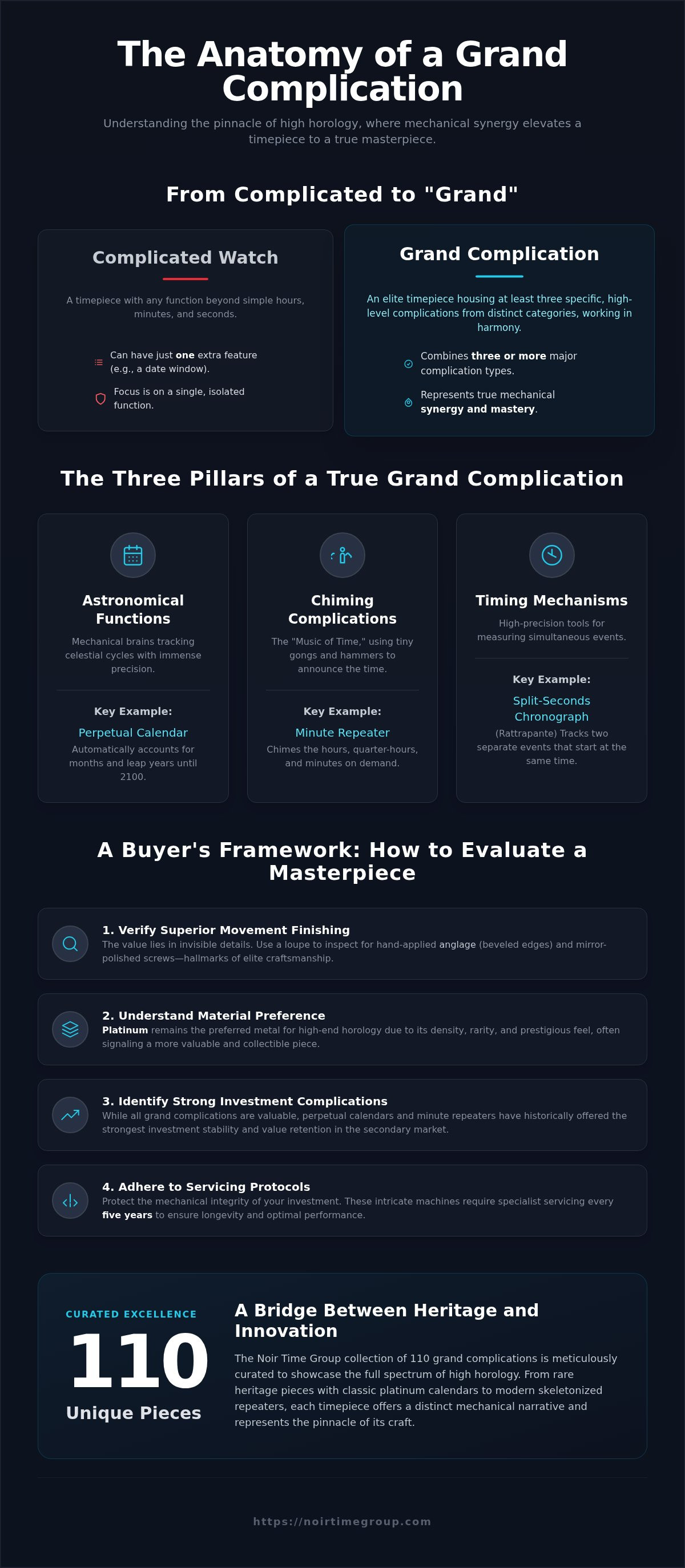
In the world of high watchmaking, the term "complicated" often gets tossed around loosely. Any function beyond simple timekeeping is technically a horological complication. However, the label of "Grand" is a protected title reserved for the elite. To qualify, a timepiece traditionally must house at least three specific types of complications working in mechanical harmony. It's not just a high feature count; it's the specific synergy between astronomical, chiming, and timing mechanisms. For the serious collector, grand complications represent the "end game." They aren't just tools. They're miniature mechanical brains that track the stars, sing the hours, and measure simultaneous events with surgical precision. This combination creates a mechanical synergy where the whole truly exceeds the sum of its parts.
The Three Pillars of a True Grand Complication
A true masterpiece generally draws from three distinct pillars of complexity. First are the astronomical functions. These include perpetual calendars that account for leap years until the year 2100 and celestial charts that mirror the night sky on your wrist. Second is the "Music of Time," or chiming complications. This category includes minute repeaters and grande sonneries that use tiny, hand-tuned hammers and gongs to announce the time. Finally, the timing pillar features split-seconds, or rattrapante, chronographs. These movements allow you to track two separate events starting at the same time. Managing the energy required for these three systems to run simultaneously is the ultimate test for any master watchmaker.
Why the 'Grand' Label Matters in 2026
Modern collectors have shifted their focus from mere status symbols to genuine mechanical appreciation. In the 2026 market, the "Grand" label signifies a level of rarity that mass-produced luxury simply cannot match. Many of these pieces see production limits of fewer than 10 units per year because of the extreme labor involved in their assembly. The value lies in the invisible details, like hand-applied anglage (beveled edges) and perlage (circular graining) that can only be appreciated under a loupe. At Noir Time Group, our curated collection of 110 grand complications serves as a bridge between these rare heritage pieces and modern horological innovations. Whether you're seeking a classic platinum calendar or a skeletonized repeater, understanding these technical thresholds ensures you're investing in a genuine pinnacle of horology. It's about finding that perfect balance where technical mastery meets artistic expression.
The Pillars of Complexity: Perpetual Calendars, Chronographs, and Chimes
True mastery in horology is measured by how a movement manages energy across multiple high-drain functions. In the world of grand complications, three specific pillars stand above the rest. The perpetual calendar acts as a mechanical brain, the split-seconds chronograph serves as a high-precision tool, and the minute repeater provides the "Music of Time." While many brands offer these features individually, the challenge lies in the integration. When you combine these into a single case, the mechanical load increases exponentially. You can find a deeper dive into these specific hierarchies in this guide to watch complications, which highlights how certain lineages have perfected this balance over centuries.
The split-seconds, or rattrapante, chronograph is perhaps the most visually captivating of the timing complications. It uses two superimposed seconds hands to track two simultaneous events. Stopping one hand to record a lap while the other continues requires an immense amount of torque. At the extreme end of this spectrum lies the "Supercomplication." These are rare mechanical titans that integrate 10 or more functions into a single movement. They represent the absolute limit of what can be achieved within the confines of a wrist-mounted case. Our collection of 110 unique pieces at Noir Time Group focuses heavily on these rare configurations, ensuring every piece offers a distinct mechanical narrative.
The Perpetual Calendar: Engineering Eternity
A perpetual calendar is designed to track the date, day, month, and leap year cycle without intervention until the year 2100. While selecting a piece, consider the display style. Analog sub-dials offer a classic, layered look, while aperture windows provide cleaner legibility for daily use. Modern innovations have introduced instantaneous date changes, where all displays jump precisely at midnight. However, owners must respect the "danger zone." You shouldn't adjust the calendar between 9 PM and 3 AM. During these hours, the gears are already engaged for the nightly transition. Forcing a change can damage the delicate teeth of the calendar wheels.
Chiming Mechanisms: The Acoustic Signature
The minute repeater is often cited as the most difficult complication to master. Unlike a Sonnerie, which strikes the hours automatically, a repeater only chimes when you activate a slide or pusher. The acoustic quality depends heavily on the case material. While rose gold is known for its warm, resonant tone, platinum is denser and often produces a crisper, though quieter, strike. When evaluating a piece, listen for the tempo and pitch of the gongs. The strikes should be rhythmic and clear, without mechanical drag. If you're ready to hear these masterpieces in person, we invite you to explore our curated collection of chiming watches and astronomical wonders.
How to Evaluate a Grand Complication: A Buyer’s Framework
Evaluating grand complications requires shifting your perspective from the price tag to the mechanical soul of the timepiece. While many buyers focus on brand prestige, the true value lies in movement architecture and finishing. You should first determine if the caliber is a true in-house development or a modified base movement. In high horology, an integrated movement designed from the ground up to house specific complications is always superior to a modular "sandwich" approach. This architectural integrity ensures better energy distribution and longevity. If you're still curious about the foundational criteria, understanding what makes a watch a grand complication provides the necessary baseline for these high-level comparisons.
Ergonomics also play a vital role in your selection. A masterpiece that sits 17mm high on the wrist won't fit under a shirt cuff, regardless of its mechanical pedigree. The best grand complications manage to pack their complexity into a slim profile, often through the use of micro-rotors or ultra-thin perpetual calendar modules. Our experts at Noir Time Group curate our 110-piece collection with this balance in mind, ensuring that even the most complex movements remain wearable for the modern gentleman.
Step 1: Assessing Movement Finishing (The Haute Horlogerie Standard)
The loupe is your most important tool. When inspecting the movement, look for "interior angles." These are sharp, V-shaped corners on the bridges that machines simply cannot replicate; they require a master finisher to hand-carve with a file. You'll also encounter various quality marks like the Geneva Seal or brand-specific standards like the Patek Philippe Seal. While the Geneva Seal focuses on finishing within the Canton of Geneva, brand-specific seals often guarantee the performance of the entire cased watch. Don't forget the "Black Polish" test. This involves checking steel components for a perfectly flat surface that reflects light so purely it appears black from certain angles.
Step 2: Dial Complexity and Legibility
A grand complication dial must balance massive amounts of data with aesthetic elegance. Grand Feu enamel dials offer a glass-like, permanent luster that never fades, while Guilloché provides a textured, light-catching pattern. Beware the "cluttered dial" trap. If you can't read the date at a glance because the chronograph sub-dials are too large, the design has failed its primary purpose. Regarding luminous material, it's no longer a faux pas. Modern collectors often prefer Super-LumiNova on platinum pieces to ensure the watch remains functional in low-light environments, bridging the gap between a museum piece and a daily companion.
Standout Timepieces: Exploring the Noir Time Group Collection
While many market guides focus exclusively on a single manufacturer, the reality of high horology in 2026 is far more diverse. Our curated collection of 110 unique pieces serves as a bridge between rare heritage designs and modern mechanical breakthroughs. Within this selection, you'll find everything from classic platinum perpetual calendars to skeletonized repeaters that reveal every gear. Platinum remains the preferred choice for these grand complications because its density provides a reassuring weight on the wrist. It's the "noble metal" that signals prestige without the flash of yellow gold, offering a subtle luster that doesn't tarnish over time.
For technical enthusiasts, the split-seconds chronograph represents a different kind of mastery. It's a favorite for those who appreciate the sheer mechanical force required to track two simultaneous events. Meanwhile, our astronomical pieces feature celestial dials that bring the night sky to your wrist. These charts aren't just decorative; they're precise mechanical maps of the stars that mirror the heavens in real-time. You can view our full range of horological innovations to see how these different complications interact across various case materials and dial designs.
The Collector's Choice: Perpetual Calendar Chronographs
Many experts consider the perpetual calendar chronograph the "sweet spot" of grand complications. It combines the daily utility of a calendar that accounts for leap years with the interactive nature of a stopwatch. In our 110-piece selection, we compare vintage-inspired designs that favor smaller case diameters with modern, large-format pieces that prioritize legibility. The choice often comes down to your personal style; some prefer the understated elegance of a 38mm platinum case, while others opt for 42mm skeletonized versions that showcase the movement architecture we discussed in previous sections.
The Rarest of the Rare: Chiming Masterpieces
Minute repeaters are the crown jewels of our collection. These pieces represent the "Music of Time" and require hundreds of hours of hand-tuning by a master watchmaker to achieve the perfect pitch. Interestingly, we're seeing a rise in the "Stealth Wealth" approach. This involves housing a high-end chiming movement in a white metal case, such as white gold or even stainless steel. To the untrained eye, it looks like a standard timepiece, but the slide on the side of the case reveals its true identity. If you're ready to find your own horological grail, you can Browse our exclusive collection of 110 Grand Complications to see the current availability of these rare chiming masterpieces.
Navigating the Acquisition: Investment, Care, and Authenticity
Acquiring a masterpiece is less of a purchase and more of a stewardship. In the 2026 market, investment stability is driven by mechanical rarity and historical significance. While heritage brands remain the bedrock of many portfolios, we've seen a significant shift toward independent watchmakers who push the boundaries of traditional horology. Protecting these high-value assets requires a multi-layered approach to security. This includes specialized insurance that accounts for market appreciation and climate-controlled storage to prevent gasket degradation. Authentication has also evolved; ensuring the provenance of an item from a curated 110-piece collection now involves both physical documentation and digital verification to prevent fraud in a volatile secondary market.
The complexity we explored in previous sections comes with a maintenance reality. A grand complication is a high-performance machine that requires a specialist "spa" roughly every five years. This isn't a standard oil change. It involves the complete disassembly of hundreds of parts, many of which are thinner than a human hair. Neglecting this cycle can lead to catastrophic mechanical failure, particularly in chiming watches where the strike governor requires precise lubrication to maintain its tempo. Specialist servicing ensures that the delicate balance of torque and energy distribution remains perfect for decades.
The Secondary Market in 2026: Trends and Values
The 2026 secondary market heavily favors the "Full Set." If you're looking to exit a position or trade up, having the original box, stamped papers, and service records is non-negotiable. It can mean a 20% to 30% difference in realized value. We've also seen the rise of "Independents" in the grand complications space, where low production numbers often drive prices above original retail. Liquidity varies by type; while perpetual calendar chronographs move quickly due to high demand, niche astronomical pieces may require a more patient, targeted collector base. Noir Time Group acts as the bridge here, providing the expertise needed to navigate these high-stakes transactions with confidence.
Caring for Your Masterpiece
Manual-wind pieces require a gentle, consistent touch. You should wind them at the same time each day to ensure the mainspring provides a steady flow of torque to the complications. For automatic perpetual calendars, a high-quality watch winder is essential. It keeps the calendar synchronized, saving you from the "danger zone" adjustment risks we mentioned earlier. A winder also ensures that the lubricants stay distributed, preventing the movement from "gumming up" during long periods of non-wear. Ready to start your journey? Find your next legacy timepiece in the Noir Time Group collection and secure a masterpiece that will endure for generations.
Securing Your Horological Legacy
Choosing a masterpiece requires looking past the brand name to the mechanical synergy within. You've learned how to identify hand-finished interior angles and why the integration of multiple functions defines a true "Grand" title. Protecting these assets through specialist servicing every five years ensures your investment remains mechanically sound for generations. Entering the world of grand complications is about more than just wealth; it's about appreciating the peak of human engineering and craftsmanship.
Noir Time Group provides the bridge to these rare treasures. With our curated selection of 110 rare timepieces, expert authentication, and secure global delivery, your acquisition journey is supported by specialists at every step. We focus on the music of time and astronomical wonders to help you find the perfect entry or grail piece for your collection. Explore the 110-Piece Grand Complications Collection at Noir Time Group and discover a timepiece that reflects your own pursuit of excellence. Your path to owning a mechanical wonder starts today.
Frequently Asked Questions
What is the difference between a complication and a grand complication?
A complication is any function on a watch that goes beyond simple timekeeping, such as a date window or a power reserve indicator. To be classified as a grand complication, a timepiece must traditionally feature at least three specific types of complications working in harmony. These must include an astronomical function like a perpetual calendar, a chiming function like a minute repeater, and a timing function such as a split-seconds chronograph.
Which watch brand is most famous for grand complications?
Patek Philippe is historically the most recognized name for these mechanical masterpieces. They've produced some of the most complex wristwatches ever made, though other elite houses like Vacheron Constantin and Audemars Piguet are equally respected. In the current market, collectors also look to independent watchmakers who offer innovative takes on these traditional pillars of high horology.
How much should I expect to spend on a grand complication in 2026?
Market values for these timepieces vary significantly based on brand heritage, mechanical rarity, and the specific combination of features. You'll find that pieces featuring rare chiming mechanisms or split-seconds chronographs sit at the highest end of the valuation spectrum. Factors like case material and the presence of original box and papers also play a critical role in determining the final acquisition cost.
Are grand complications good investments?
These timepieces are often viewed as stable assets because their extreme rarity and high labor costs prevent mass production. While certain grand complications from heritage brands have a strong track record of value retention, they shouldn't be treated as purely liquid assets. Their value lies in their status as mechanical art, and liquidity depends on the current demand for specific rare configurations within the collector community.
How often does a grand complication watch need to be serviced?
A specialist service is recommended every five years to maintain mechanical integrity. Because these movements contain hundreds of microscopic parts, the lubricants must be replaced regularly to prevent friction and wear. Noir Time Group emphasizes this protocol to protect the longevity of our 110-piece collection. Neglecting this cycle can lead to costly repairs, especially for the delicate hammers and gongs found in chiming watches.
Can I wear a grand complication watch every day?
You can wear them daily if you choose a robust case material and respect the movement's limits. While modern engineering has made these watches more durable, they remain sensitive to extreme shocks and magnetic fields. A platinum perpetual calendar is a sophisticated daily companion, but you should always avoid the "danger zone" for calendar adjustments as we discussed in our earlier buyer's framework.
What is a minute repeater and why is it so expensive?
A minute repeater is a complication that chimes the hours, quarters, and minutes on demand using tiny hammers and gongs. It's exceptionally expensive because the gongs must be hand-tuned by a master watchmaker to achieve a perfect musical pitch. This process can take weeks of trial and error, making it one of the most labor-intensive and technically challenging features in all of horology.
Why are most grand complications made of platinum or gold?
Precious metals are chosen for their weight, prestige, and specific physical properties. Gold is prized for its acoustic resonance, which makes it an ideal material for chiming watches. Platinum is favored for its density and "stealth wealth" appeal, as it doesn't tarnish and offers a distinctive luster. Most grand complications use these noble metals to reflect the extreme level of craftsmanship housed within the movement.
