

Would you drive a high-performance supercar for a full decade without ever changing the oil? Most collectors treat their mechanical movements with far less discipline than their vehicles, yet they expect these tiny engines to retain their value forever. The question of how often should you service a luxury watch isn't just about precise timekeeping; it's about shielding a significant financial asset from preventable internal wear. It's completely normal to feel hesitant when you're faced with conflicting advice from manufacturer manuals and internet forums. You might worry about the high costs of neglect or feel anxious about handing over a forty thousand dollar Patek Philippe for weeks at a time.
This 2026 maintenance guide cuts through the noise to provide a clear, brand-specific roadmap for your collection. We'll reveal the current recommended intervals for icons like the Rolex Submariner and Audemars Piguet Royal Oak, while highlighting the critical warning signs that mean your movement needs immediate professional attention. By the end of this article, you'll understand how a documented service history serves as a high-yield investment, ensuring your timepiece remains a liquid asset for years to come.
Key Takeaways
- Learn exactly how often should you service a luxury watch based on current 2026 manufacturer standards, ranging from 3 years for complications to 10 years for modern Rolex calibers.
- Identify the red-alert warning signs, such as moisture under the crystal or accuracy drift, that indicate your movement requires immediate professional intervention to prevent permanent damage.
- Discover why maintaining a documented service history is a strategic investment that can increase the resale value of your timepiece by 10-15%.
- Understand the comprehensive nature of a professional overhaul, which involves disassembling over 100 components to ensure every gear is cleaned and lubricated.
- Gain clarity on why high-complication pieces from brands like Patek Philippe and Audemars Piguet require more frequent maintenance cycles than standard sports watches.
The Science of Friction: Why Luxury Watches Require Servicing
A luxury watch is a marvel of micro-engineering, but it's also a mechanical engine subject to the unrelenting laws of physics. Many collectors ask how often should you service a luxury watch because they view their timepiece as a static piece of jewelry rather than a high-performance machine. In reality, a professional service is a comprehensive mechanical overhaul. Over several years, the synthetic oils designed to reduce friction between jewels and steel pivots begin to evaporate or migrate. When these lubricants lose their effectiveness, the movement's delicate components begin to rub against each other, creating microscopic metal shavings.
A professional artisan who makes and repairs watches will warn you that waiting until a watch stops ticking is a multi-thousand dollar mistake. By the time a movement fails, the internal friction has likely caused irreversible wear on the pivots and gear teeth. This neglect turns a standard maintenance procedure into a complex restoration requiring the replacement of expensive, proprietary parts. Beyond the movement, you must consider the gaskets. These rubber or silicon seals protect the interior from moisture and dust, but they perish over time regardless of whether the watch is running. A watch that keeps perfect time can still suffer catastrophic internal corrosion if a dry gasket fails during a simple hand-wash.
The Anatomy of a Mechanical Movement
The heartbeat of your watch is the escapement, which is the highest-friction area in the entire caliber. This component oscillates tens of thousands of times per day, with the pallet stones striking the escape wheel teeth in a constant rhythm. When lubricants fail here, the resulting debris mixes with the remaining oil to create a "grinding paste" that rapidly erodes the movement's precision. The mainspring is the coiled torsion spring that serves as the primary power source for the entire mechanical caliber by storing and releasing energy. If this power delivery is uneven due to internal grit, your watch's accuracy will suffer long before the movement actually stops.
Environmental Stressors in New York
Living in New York City presents unique challenges for high-value assets like a Rolex Submariner or a Patek Philippe Nautilus. The extreme humidity of a Manhattan summer followed by the bone-dry air of radiator-heated apartments in the winter puts immense stress on a watch's seal integrity. These temperature fluctuations cause materials to expand and contract at different rates, which can compromise water resistance over time. Magnetism is another silent enemy in a modern office environment. Laptops, tablets, and even magnetic handbag clasps can magnetize the hairspring, causing the watch to run erratically.
Your lifestyle also dictates how often should you service a luxury watch. A "Safe Queen" that sits idle for months faces different risks than a daily wearer. In an idle watch, lubricants can pool or settle in one area, leaving other components bone-dry when you finally decide to wind it. Whether you are wearing an Audemars Piguet Royal Oak every day or keeping it for special occasions, the chemical breakdown of oils and the degradation of seals remain constant threats to your horological investment.
Manufacturer Guidelines vs. Reality: Brand-Specific Intervals
Many collectors still rely on the traditional five-year rule, but modern horology has changed the landscape significantly. If you are wondering how often should you service a luxury watch in 2026, the answer depends heavily on the logo on the dial and the technology inside the case. Rolex now officially recommends a service interval of approximately 10 years for most of its modern watches. This shift is a testament to the brand's engineering, yet it often contradicts the "every five years" advice found on vintage forums. For owners of a Rolex Submariner Date 126613LN, this extended window provides peace of mind, provided the watch isn't subjected to extreme conditions.
In contrast, high-complication brands like Patek Philippe and Audemars Piguet maintain stricter timelines. Patek Philippe officially recommends a full service every 3 to 5 years, while Audemars Piguet suggests 4 to 5 years for their mechanical movements. These calibers are often more intricate, featuring hundreds of micro-components that require frequent lubrication checks to ensure optimal performance. Beyond mechanical health, a documented service history is a major financial asset. Research indicates that watches with a complete service history can command a 10-25% higher resale value compared to those without, making maintenance a key part of your investment strategy.
Modern Innovations in Horology
Modern manufacturing tolerances have extended the "safe" window between overhauls. The introduction of silicon components, which are impervious to magnetism and require significantly less lubrication, has revolutionized movement longevity. However, owners must distinguish between a minor regulation and a full overhaul. A regulation simply adjusts the timing if the watch is running fast or slow, while a full overhaul involves complete disassembly. If you're unsure about your watch's current state, the specialists at Noir Time Group can provide a professional assessment of your caliber's health.
The Vintage Exception
Vintage timepieces from the 1970s and earlier operate under a different set of rules. Older movements often relied on organic oils that degrade much faster than modern synthetics, necessitating a checkup every 3 years. Neglecting a vintage Patek Philippe or Rolex can be a permanent mistake. Some parts for these legacy calibers are no longer in production, and excessive wear can make a watch unrepairable. When you do send a vintage piece for service, explicitly instruct the watchmaker to preserve the patina on the dial and hands. Replacing these original elements with modern service parts can accidentally slash the watch's market value by half.
5 Critical Signs Your Watch Needs Service Immediately
Manufacturer calendars provide a baseline, but your watch often communicates its distress through physical symptoms. Understanding how often should you service a luxury watch becomes less about the date on your warranty card and more about the performance on your wrist when specific red flags appear. If you notice any of the following five signs, your timepiece requires professional attention regardless of its last service date.
- Accuracy Drift: A COSC-certified chronometer, like a Rolex Submariner, should maintain high precision. If your watch suddenly starts gaining or losing more than five seconds a day, the internal regulation is failing or the movement is magnetized.
- The "Fog" Factor: Any sign of condensation or misting under the sapphire crystal is a catastrophic emergency. This indicates a total gasket failure. Moisture will oxidize steel components and ruin a dial within hours.
- Power Reserve Depletion: If your Audemars Piguet Royal Oak used to run for 60 hours but now stops after only 20, internal friction is likely robbing the mainspring of its energy.
- Mechanical Feedback: You should never feel grittiness or resistance when winding the crown. Similarly, a rattling or scraping sound from the oscillating rotor suggests a loose screw or a worn bearing.
- Hand Misalignment: If the hour and minute hands don't align perfectly at twelve o'clock, or if the seconds hand "jumps" erratically, the gear train or cannon pinion may be damaged.
Diagnostic Timing Tests at Home
You don't need a laboratory to check your watch's vitals. Several smartphone apps now function as basic "Timegraphers" by using the phone's microphone to listen to the movement's beat rate. The most important metric to watch is amplitude. Amplitude measures the degree of rotation in the balance wheel's swing. A healthy movement typically shows an amplitude between 270 and 310 degrees. If your reading drops below 250 degrees, it's a definitive sign that the "grinding paste" of dried oil and dust is slowing down the heartbeat of your caliber. You should also check for positional error by testing the watch in different orientations, such as "dial up" versus "crown down," to see if gravity is affecting the worn pivots unevenly.
Visual and Tactile Inspections
A weekly physical inspection can prevent a five-figure repair bill. Start by checking the crown. A crown that doesn't screw down smoothly or feels loose compromises the entire case's water resistance. Look closely at the edges of the dial for "dial sweat," which is a faint, oily residue that often precedes visible condensation. This is a subtle hint that the seals are perishing. Finally, don't ignore the hardware. During a professional Certified Watch Repair, a technician will check every bracelet screw and spring bar. At home, you should ensure these haven't backed out due to daily vibrations, as a failed spring bar is the leading cause of "dropped" watches in New York's fast-paced environment.
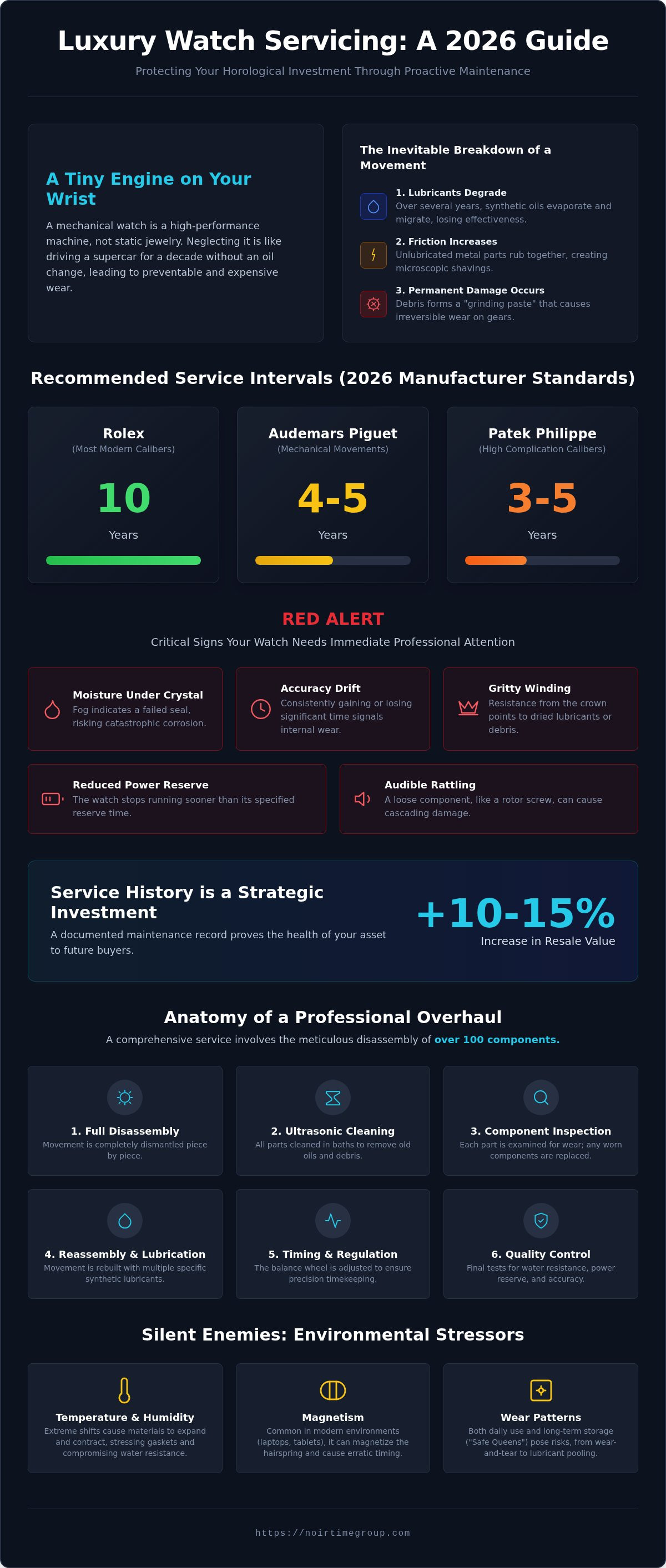
The Anatomy of a Professional Luxury Watch Service
Understanding how often should you service a luxury watch is only half the battle; the other half is knowing what happens once your timepiece enters the workshop. A professional service is a meticulous, multi-week process that mirrors the original assembly in Switzerland. It is not a simple "cleaning" but a surgical overhaul of a micro-ecosystem. For a complex piece like the Patek Philippe Nautilus, this involves five distinct stages of horological expertise.
- Complete Disassembly: The watchmaker carefully strips the movement down to its base plate. This involves removing over 100 individual components, from the smallest hairspring to the mainspring barrel.
- Ultrasonic Cleaning: Every part is placed in specialized chemical baths. Ultrasonic vibrations remove microscopic debris and the "grinding paste" of aged lubricants.
- Parts Inspection: Under high-power magnification, the technician identifies worn pivots, chipped gear teeth, or flattened jewels. Any component that doesn't meet manufacturer tolerances is replaced.
- Precision Lubrication: This is the most critical phase. Different friction points require specific synthetic oils, such as Moebius. A watchmaker might use four or five distinct types of oil to ensure the caliber runs smoothly for another decade.
- Reassembly and Regulation: The movement is rebuilt and adjusted for timing accuracy. Finally, the case is resealed and subjected to rigorous pressure testing to verify water resistance.
Why Certified Repair Matters
The gap between a local jeweler and a specialist is immense. A standard repair shop often lacks access to genuine parts for an Audemars Piguet Royal Oak or a Rolex Submariner Date 126613LN. Manufacturers like Rolex and Patek Philippe strictly control their supply chains, only providing proprietary components to authorized or certified centers. Using generic parts can void your warranty and significantly decrease the resale value of your asset. If your timepiece is due for maintenance, trust the experts at Noir Time Group for Certified Watch Repair to ensure your investment remains factory-spec.
The Testing and QC Phase
Quality control is what separates a professional overhaul from a quick fix. After reassembly, the watch undergoes a "6-position" timing test. This ensures the caliber maintains its accuracy whether it is sitting dial-up on a nightstand or crown-down in a pocket. Technicians also perform power reserve verification, running the watch until it stops to confirm it meets the original manufacturer specifications. The final stage is the aesthetic check. Collectors often face the dilemma of whether to polish the case. While a light refinishing restores the factory luster, over-polishing can round off the sharp edges of a Rolex Submariner Date 126618LN, potentially hurting its long-term collectability. A certified watchmaker will always consult with you before making these permanent changes.
Maximizing Resale Value: The Role of Maintenance Records
A luxury watch is more than a tool; it's a portable asset. While collectors often ask how often should you service a luxury watch to maintain its mechanical health, the financial implications are just as significant. A documented service history from a certified facility acts as a seal of authenticity and care. For a Rolex Submariner, having a clear paper trail of professional maintenance can add 10-15% to the final resale price compared to a "naked" watch with an unknown history. Buyers in the secondary market are willing to pay a premium for the certainty that they won't inherit a multi-thousand dollar repair bill.
The concept of a "Full Set" has expanded beyond the original box and warranty card. Modern collectors prize service pouches, itemized invoices, and replaced parts as proof of a movement's integrity. When you bring a piece to Noir Time Group for a trade-in or sale, we evaluate the caliber's health as part of our appraisal. A watch that has been recently overhauled is a much more attractive prospect for our Watch Sourcing Service. In many cases, performing a service right before listing a high-value piece like an Audemars Piguet Royal Oak provides a clear return on investment by speeding up the sale and justifying a higher asking price.
Managing Your Collection Health
If you own multiple pieces, keeping track of different manufacturer requirements can be difficult. We recommend creating a digital maintenance log to record the last service date and accuracy readings for each caliber. This is especially important for collections that include both modern pieces and vintage icons. You might also wonder if watch winders help maintain your service interval. While they keep complications like perpetual calendars ready to wear, they also keep the movement running 24/7, which can lead to faster lubricant depletion. For most collectors, it's better to let a watch rest occasionally rather than keeping it in perpetual motion. Sourcing your next timepiece through a reputable dealer like Noir Time Group ensures you start your ownership with a verified history and a movement that has been professionally vetted.
Expert Consultation in New York
New York's watch community is one of the most sophisticated in the world. Local collectors trust specialists who understand the nuances of high-horology trades and the specific demands of the NYC market. Whether you are holding a Patek Philippe Nautilus or a Rolex Submariner Date 126618LN, a professional movement health check is the first step in protecting your equity. Our team provides detailed appraisals that go beyond a simple visual check to assess the actual mechanical state of your caliber. For peace of mind and professional results, contact Noir Time Group for certified repair and sourcing services today.
Protecting Your Horological Legacy
Maintaining a high-end timepiece requires a balance of following brand-specific guidelines and staying vigilant for physical performance changes. While modern engineering has extended the timeframe for how often should you service a luxury watch, your specific environment and wearing habits remain the ultimate deciders. Keeping a documented service history isn't just about ensuring smooth gears; it's a strategic financial move that secures the trade-in value of your Patek Philippe or Rolex for years to come.
As certified NYC watch repair specialists, Noir Time Group ensures every piece in our inventory meets the highest standards of mechanical health. We provide guaranteed authenticity on all Rolex, Patek, and AP timepieces, alongside an exclusive sourcing service for rare models. Browse our curated collection of serviced luxury timepieces to find your next investment-grade watch. Your collection represents a significant milestone, and proactive care is the best way to ensure it continues to tick perfectly for the next generation.
Frequently Asked Questions
Is it okay to wait until my watch stops before servicing it?
No, waiting until a movement stops is a costly mistake that often leads to higher repair bills. By the time a caliber fails, internal components like pivots and gears have likely suffered irreversible wear from metal-on-metal friction. Regular maintenance prevents the "grinding paste" effect of dried oils. This proactive approach protects your investment from expensive parts replacements that transform a standard overhaul into a complex restoration.
Do quartz luxury watches need to be serviced as often as mechanical ones?
No, quartz watches generally require less frequent movement servicing but still need regular seal and battery checks. While they lack the complex gear train of a mechanical caliber, quartz watches have gaskets that perish over time. You should check the water resistance every two years. Additionally, old batteries can leak acid, causing catastrophic damage to the circuit board if they aren't replaced promptly every 2 to 3 years.
How much does a full service for a Rolex or Patek Philippe typically cost?
Service costs vary significantly based on the brand, movement complexity, and the specific model. A standard overhaul for a modern sports watch generally starts at several hundred dollars, while grand complications from Patek Philippe can reach much higher amounts. Prices depend on whether you use an independent watchmaker or an authorized service center. Always request a detailed estimate before authorizing work to understand the full scope of parts and labor involved.
Will polishing my watch during a service decrease its value?
Yes, over-polishing or aggressive refinishing can significantly decrease a watch's market value. Collectors prize the original "sharp" lines and chamfers of the case. Removing too much metal rounds off these edges, particularly on icons like the Audemars Piguet Royal Oak. If you choose to polish, request a light aesthetic refresh rather than a deep restoration to preserve the watch's silhouette and its long-term collectability on the secondary market.
Can any watchmaker service a high-complication Patek or AP?
No, high-complication timepieces require specialized training and access to proprietary parts. Brands like Patek Philippe and Audemars Piguet strictly control the distribution of their components. A general watchmaker may not have the technical diagrams or the specific tools required for these intricate calibers. It is essential to use a certified specialist who understands the nuances of how often should you service a luxury watch from these elite horological houses.
What happens if I never service my luxury watch?
Neglecting service leads to mechanical failure, moisture intrusion, and massive depreciation of your asset. Lubricants eventually turn into an abrasive sludge that eats away at delicate steel parts. Gaskets will dry out, allowing humidity to enter the case and corrode the dial and hands. Eventually, the watch will lose its accuracy and stop entirely, resulting in a repair bill that could have been avoided with simple preventative care.
How long does a professional watch service take in 2026?
A professional overhaul typically takes between four and twelve weeks depending on the brand and model complexity. This timeline accounts for the complete disassembly, ultrasonic cleaning, and meticulous reassembly of the movement. A significant portion of this time is dedicated to the quality control phase. During this period, the watch is tested in multiple positions and monitored for power reserve consistency to ensure it meets factory specifications.
Does water resistance expire even if I don’t wear the watch in water?
Yes, water resistance is dependent on rubber or silicon gaskets that degrade over time regardless of use. Factors like temperature fluctuations, UV exposure, and simple aging cause these seals to become brittle and lose their integrity. This is why determining how often should you service a luxury watch must include a pressure test every 12 to 24 months. A dry gasket is the most common cause of unexplained internal moisture damage.
