

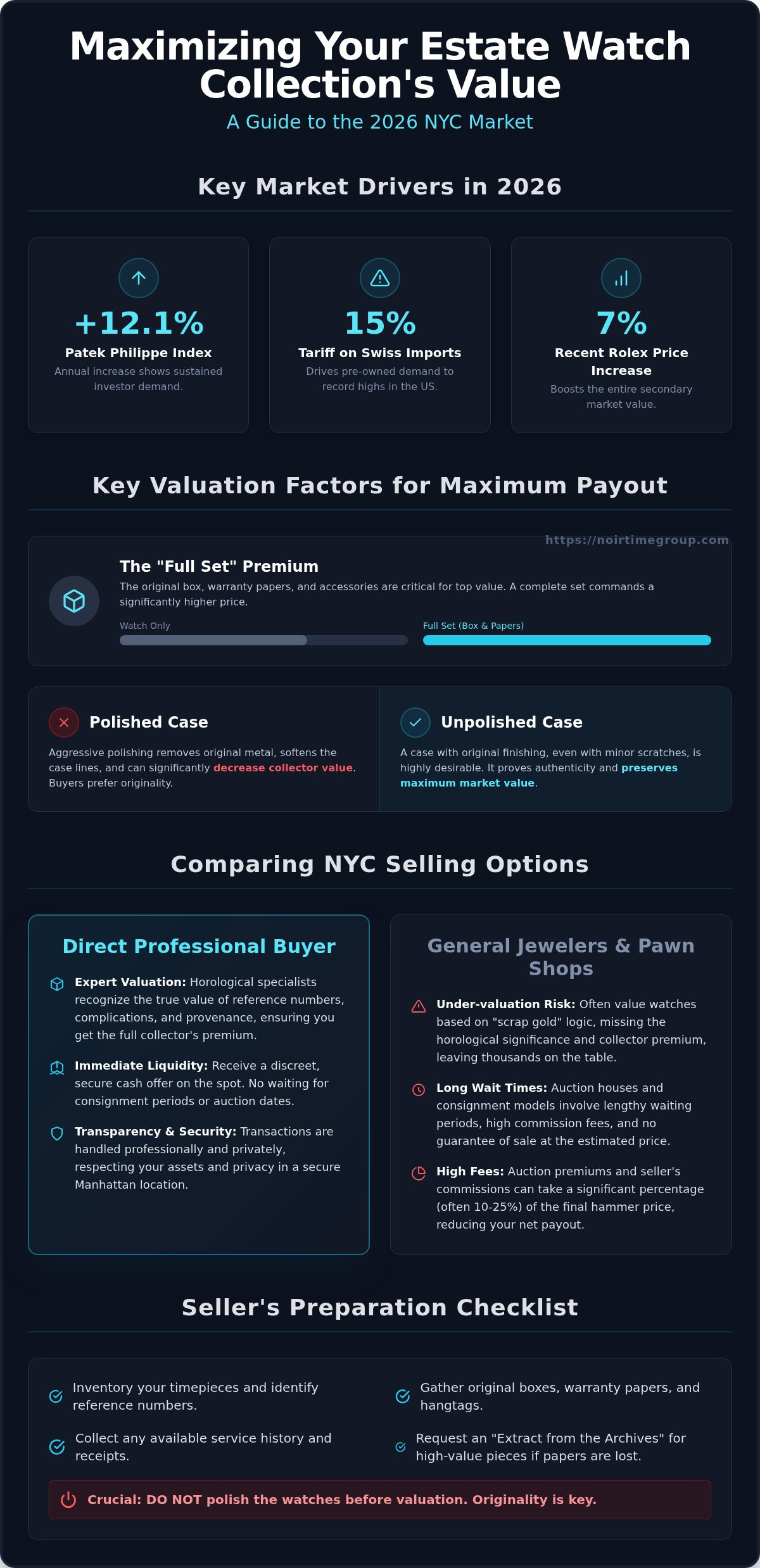
The local pawn shop or general jeweler is often the most expensive place to sell your luxury timepieces because of the thousands in potential value they leave on the table. With the Patek Philippe index rising 12.1% this year and a 15% tariff on Swiss imports driving pre-owned demand to record highs, learning how to sell an estate watch collection NYC experts will value correctly is essential. You've worked hard to curate or inherit these pieces, and it's natural to feel protective of their legacy while worrying about the security of transporting high-value assets through Manhattan.
We understand that you want a transaction that respects both the horological significance of your collection and your need for immediate liquidity. This guide explains the exact process for liquidating luxury assets in 2026 for maximum market value. You'll learn how to navigate the recent 7% Rolex price increases and secure a discreet cash offer without the long wait times associated with consignment. We'll preview the current market landscape, the benefits of direct professional acquisition, and how to ensure your transaction is handled with the highest level of expertise.
Key Takeaways
- Understand how the 2026 NYC market treats estate collections as high-value investment assets rather than just vintage items.
- Discover why "full set" documentation and specific condition details like unpolished cases can significantly increase your final payout.
- Learn how to sell an estate watch collection NYC residents trust by comparing the speed of direct professional buyers against the high fees of auction houses.
- Get a practical checklist for inventorying your timepieces and gathering essential accessories to streamline the professional valuation process.
- See how specialized horological expertise and real-time market data help you secure a fair, transparent offer for brands like Rolex and Patek Philippe.
Evaluating the NYC Estate Watch Market in 2026
An estate watch collection in 2026 is rarely just a box of dusty relics. Modern collectors often view their portfolios as liquid assets, blending vintage heirlooms with contemporary icons like the Rolex Submariner Date 126618LN or the Audemars Piguet Royal Oak. Understanding how to sell an estate watch collection NYC experts will actually value requires a shift in perspective. You aren't just selling "used" goods; you're trading in a high-performance secondary market that has seen significant shifts this year.
National online "buy-back" websites often rely on rigid algorithms that fail to capture the nuances of the Manhattan market. NYC remains a global hub for horological trade, offering a level of liquidity that digital-only platforms can't match. Relying on outdated book values is a mistake in 2026. Real-time secondary market data, driven by global demand and local scarcity, is the only accurate way to determine what your collection is worth today. Prices move fast, and local expertise is the only way to catch the wave.
The Shift in Luxury Watch Liquidity
The 2026 market is defined by a sharp divide between "hype" models and classic complications. While the Patek Philippe Nautilus continues to command a massive premium, the overall Patek Philippe index has risen 12.1% according to the April 2026 Knight Frank Luxury Investment Index. This growth is bolstered by a 15% tariff on Swiss imports, which has significantly increased demand for pre-owned watches already located within the United States. NYC serves as the primary gateway for this domestic trade. Sellers often see a seasonal surge in liquidity during the autumn months as local collectors prepare for end-of-year acquisitions.
Why General Jewelry Buyers Often Underpay
Most generalist jewelry buyers in the city operate on "scrap gold" logic. They look at the weight of the precious metal rather than the horological significance of the timepiece. This approach is disastrous for sellers of high-end brands. A generalist might miss the value of a rare dial variation or a specific reference number that collectors crave. Specialized knowledge is particularly vital for Patek Philippe complications, where a single mechanical feature can add tens of thousands of dollars to the offer. Without an expert who understands movement architecture and provenance, you risk losing the "collector's premium" that defines true market value. Specialized retailers treat these pieces as assets, not just metal.
Key Valuation Factors for High-End Timepieces
Valuation in the luxury sector is a technical exercise rather than a simple appraisal. When you research how to sell an estate watch collection NYC, you'll find that two identical-looking watches can have wildly different price tags. The difference usually lies in the reference number and the completeness of the "set." A professional buyer doesn't just glance at the watch; they verify the movement's health and the authenticity of every component. In the 2026 market, direct cash offers from dealers are typically 15% to 25% below current retail market values, reflecting the cost of immediate liquidity and the dealer's risk in a fluctuating market.
- Reference Numbers: A Rolex Submariner Date 126618LN in solid gold commands a significantly higher price than the two-tone Rolex Submariner Date 126613LN. Even within the same model line, specific reference numbers from certain years can be worth double their successors due to rarity or discontinued features.
- The "Full Set" Premium: Having the original box, warranty papers, and even the plastic hangtags is vital. A "naked" watch without documentation often sells for significantly less than a complete set.
- Service History: Documentation from a certified center proves the watch hasn't been modified with "aftermarket" parts. Originality is everything in high-horology.
The Impact of Provenance and Documentation
Provenance is the documented history of the watch. Original sales receipts from authorized dealers in Manhattan provide a clear paper trail that builds buyer confidence and speeds up the transaction. If you've lost the papers over the years, it isn't the end of the road. For Patek Philippe Nautilus models or other high-complication pieces, you can often request an "Extract from the Archives" to verify the production date and original configuration. This document is essential for accurate valuation when original papers are missing.
Physical Condition: Polished vs. Unpolished
Many sellers assume a shiny, polished watch is worth more. In the collector world, the opposite is often true. Over-polishing rounds off the sharp edges of the lugs and thins the metal, which can decrease the value of an Audemars Piguet Royal Oak. Collectors prefer "honest" wear because it preserves the original geometry of the case. If you're unsure about your collection's condition, our certified watch repair experts can provide a technical assessment of the movement's internal health. This ensures your valuation is based on verifiable technical data rather than a surface-level inspection.
Comparing NYC Selling Options: Direct Buyers vs. Auctions
Deciding where to liquidate your assets is as important as the valuation itself. When you research how to sell an estate watch collection NYC offers three primary paths: direct professional buyers, global auction houses, and local consignment services. Each has a different impact on your final payout and your peace of mind. While the allure of a record-breaking auction price is tempting, the reality of the 2026 market often favors the certainty of a direct sale.
Direct professional buyers specialize in immediate liquidity. For an Audemars Piguet Royal Oak or a Patek Philippe Nautilus, a specialist retailer provides a fixed offer based on real-time market data. This eliminates the "hammer price" gamble. Consignment, by contrast, requires you to leave your high-value assets in a third party's hands for weeks or months without a guaranteed sale. Pawn shops should generally be avoided for luxury horology; they lack the niche expertise to value a Rolex Submariner Date 126618LN as anything more than its weight in gold.
The True Cost of Auction Fees in NYC
Auctions require a long-term commitment that many estate executors find impractical. Major houses like Christie’s and Sotheby’s typically charge a buyer's premium of 26% on the first $1 million. While seller’s commissions are negotiable and can sometimes be waived for high-value collections, you are still facing a timeline of four to six months from initial appraisal to final payment. You also face the risk of a "buy-in," where your item fails to meet its reserve price. A watch that fails at auction is often viewed as "stale" by the collector community, which can diminish its market value for years to come.
Security and Discretion in the Transaction
Discretion is a luxury in itself. Many sellers are rightfully wary of the "sidewalk" experience in the Diamond District, where high-value transactions sometimes happen in crowded, public-facing storefronts. A private boutique appointment offers a secure, controlled environment for your appraisal. This professional setting ensures your collection is never exposed to unnecessary risk during the process. When you choose a direct buyer, the transaction concludes with an immediate wire transfer or certified check. You don't have to wait for an auction house to collect funds from a third-party buyer before you see your payment. This immediate closure is often the most secure way to handle a high-value estate liquidation in Manhattan.
Step-by-Step Guide to Selling Your Collection
Preparing a high-value collection for sale requires more than just a quick trip to Midtown. To maximize your return, you must approach the process with the same precision used to build the collection. Knowing how to sell an estate watch collection NYC sellers can be proud of starts with organization. Clear documentation and a logical workflow help you avoid the pressure of lowball offers and ensure you're dealing from a position of strength.
- Inventory Every Piece: Create a master list including the brand, model name, and specific reference number.
- Gather the "Full Set": Locate original boxes, extra bracelet links, and warranty cards. These items significantly bolster the "collector's premium."
- Perform Market Research: Look at 2026 listings for models like the Rolex Submariner Date 126613LN. Remember that Rolex implemented a 7% price increase on January 1, 2026, which has pushed secondary market values higher.
- Schedule Professional Appraisals: Avoid walk-in counters. Book appointments with specialized retailers who understand the nuances of high-horology.
Documenting Your Collection for Initial Quotes
Before you even step into a boutique, you should have a digital portfolio of your collection. Take high-quality, clear photos in natural light. Focus on the dial, the case back, and the serial number usually found between the lugs or on the rehaut. If you're unsure how to identify these details, you can sell your luxury watch collection by starting with a professional consultation. Include these photos in a spreadsheet to track initial quotes and model details. This organization prevents confusion when comparing offers from multiple NYC buyers.
Vetting Your NYC Watch Buyer
A buyer's reputation is just as important as the dollar amount they offer. Look for established businesses with a physical presence in Manhattan and a history of handling brands like Patek Philippe and Audemars Piguet. Ask direct questions about their authentication process. If a buyer refuses to explain the logic behind their valuation or uses high-pressure "today only" tactics, it's a major red flag. A professional buyer will always provide a transparent breakdown of how they reached their offer based on current market data and technical condition.
Once you accept an offer, the finalization process should be straightforward. Most professional transactions in NYC are completed via secure wire transfers or certified checks. Ensure you receive a formal bill of sale that clearly outlines the terms of the transaction. This document is essential for your records, especially when dealing with the federal annual gift tax exclusion, which stands at $19,000 per recipient for 2026. Following these steps ensures a clean, legal, and profitable exit from your investment.
The Noir Time Group Advantage: Expert Watch Acquisition
Selling a multi-generational or high-value investment portfolio requires a partner who treats the transaction with the gravity it deserves. Noir Time Group specializes in the acquisition of the world's most prestigious brands, specifically Rolex, Patek Philippe, and Audemars Piguet. When you're determining how to sell an estate watch collection NYC experts will handle with precision, the choice of buyer determines whether you receive a scrap price or a true horological valuation. We provide immediate liquidity for entire collections, regardless of size, bypassing the months of uncertainty associated with auction houses or consignment.
Our process is rooted in transparency and technical accuracy. We don't just provide a number; we show you the real-time market data supporting our offer. Because we maintain an in-house certified watch repair department, we can accurately assess the internal health and authenticity of complex movements. This technical expertise allows us to offer higher payouts for well-maintained complications and vintage references that generalist jewelry buyers would likely overlook. We view your watches as mechanical masterpieces rather than just precious metal.
Sourcing Expertise That Benefits the Seller
Our role as a premier retailer with a global watch sourcing service provides a unique advantage to estate sellers. Because we have an active network of collectors looking for specific references, we can often pay a premium for rare pieces that are in high demand. We're particularly interested in acquiring investment-grade models such as the Rolex Submariner Date 126618LN and the Patek Philippe Nautilus. For those who aren't ready to exit the market entirely, we also offer professional trade-in options. This allows you to liquidate an inherited collection while upgrading your personal rotation to a modern icon like the Audemars Piguet Royal Oak.
A Private, Professional NYC Experience
Safety and discretion are the cornerstones of our service. We invite you to schedule a private appraisal at our New York office, where your collection can be evaluated in a secure, professional environment. This controlled setting is a world away from the crowded, public-facing storefronts of the Diamond District. We handle every step of the authentication and payment process with absolute confidentiality, ensuring you leave with immediate funds and total peace of mind. Schedule a professional evaluation for your estate collection today to experience a transparent, expert-led liquidation process that respects the true value of your timepieces.
Securing the Future of Your Horological Legacy
Liquidating a high-value collection in the 2026 market requires a blend of real-time data and technical precision. You've seen how original documentation and movement integrity dictate value, and why the slow timelines of major auction houses often don't align with the needs of estate executors. Navigating how to sell an estate watch collection NYC residents can trust means moving beyond general jewelry buyers and partnering with specialists who understand the intrinsic value of every complication. By focusing on specialized horological expertise, you ensure that your pieces are treated as the significant assets they are.
Noir Time Group provides the direct, discreet service needed for such a significant transaction. As specialists in Rolex, Patek Philippe, and Audemars Piguet, we offer immediate liquidity with no consignment delays. Our certified repair expertise allows us to verify and value your timepieces accurately, providing you with a fair market offer based on current global demand. Don't leave your collection's value to chance in a crowded marketplace. Get a professional valuation for your estate watch collection today and close your transaction with confidence and total transparency.
Frequently Asked Questions
How is the value of an estate watch collection determined in NYC?
Value is determined by a combination of the specific reference number, physical condition, and real-time market demand. In the 2026 market, experts analyze brand-specific indices, such as the 12.1% rise in Patek Philippe values, alongside current availability. A professional buyer also examines the movement's health and the originality of all parts. This technical approach ensures you receive a valuation based on horological merit rather than just the weight of precious metals.
Is it better to sell a watch collection at auction or to a direct buyer?
Direct buyers are generally better for those seeking immediate liquidity and price certainty. While an auction might occasionally result in a high outlier, you must subtract a buyer's premium of up to 26% and wait four to six months for payment. When you learn how to sell an estate watch collection NYC experts will buy directly, you benefit from a fixed cash offer and a transaction that concludes in days rather than months.
Do I need the original box and papers to sell my Rolex or Patek Philippe?
You don't need the original box and papers to complete a sale, though having them creates a "full set" that commands a higher price. Documentation acts as a verified provenance that builds buyer confidence. If papers are lost, specialists can often authenticate the piece through internal movement inspections or by requesting an Extract from the Archives for specific high-end brands. Most professional buyers frequently purchase "naked" watches that lack their original packaging.
How do I safely transport a high-value watch collection in Manhattan?
Safety is best managed by scheduling a private, discreet appointment at a professional office rather than walking into a public storefront. Avoid carrying high-value assets in obvious luxury bags; use a non-descript, secure container instead. Reputable buyers in the city provide a controlled environment with professional security. This approach ensures your collection is never exposed to the risks associated with the crowded sidewalks of the Diamond District or other high-traffic areas.
Will a buyer purchase a watch that is not currently running?
Yes, a specialized buyer with in-house certified repair expertise will often purchase non-running timepieces. They can assess whether the issue is a simple battery replacement or a complex mechanical failure requiring a full overhaul. While a non-running condition will impact the offer price, it doesn't disqualify the watch from being a valuable asset. The valuation will simply account for the estimated cost of restoring the movement to its original manufacturer specifications.
How long does the process of selling a watch collection typically take?
A direct professional sale typically takes between 24 and 48 hours from the initial appraisal to the final payment. This timeline includes a thorough authentication of each piece and a review of current market data. In contrast, consignment or auction routes can take several months to finalize. If you're looking for immediate liquidity, a direct buyer in Manhattan offers the fastest path to receiving a wire transfer or certified check for your assets.
Can I sell just one watch, or does it have to be a full collection?
You can sell a single timepiece or a large multi-generational collection with equal ease. While this guide focuses on liquidating entire estates, professional buyers are always looking for individual icons like the Rolex Submariner or Audemars Piguet Royal Oak. Whether you have one high-value investment piece or a dozen inherited watches, the valuation process remains the same. Each item is appraised on its own merits to ensure you receive the maximum market value.
What payment methods should I expect from a reputable NYC watch buyer?
Reputable buyers primarily use secure wire transfers or certified bank checks to ensure a transparent and verifiable paper trail. You should expect to receive a formal bill of sale that documents the transaction for your financial records. Avoid buyers who insist on cash-only deals without documentation, as this can create security risks and legal complications. A professional transaction always concludes with a payment method that provides immediate, cleared funds into your designated account.
