
What if the most stable part of your portfolio wasn't sitting in a brokerage account, but strapped to your wrist? Many collectors and first-time buyers are asking is a Rolex a good investment as we move into 2026, especially after years of dramatic price shifts in the secondary market. You might worry about buying at the peak of a price bubble or feel overwhelmed by the technical details that separate a true asset from a simple luxury purchase. It's a common concern, as the line between a wearable piece of history and a speculative gamble has never been thinner.
We agree that the current market requires a more disciplined approach than the buying frenzy of previous years. This analysis provides the data-driven reality of Rolex as an asset class, helping you move past the hype to find genuine value. You'll learn how to identify specific models that act as inflation hedges and gain a clear framework for distinguishing investment-grade pieces from overpriced trends. We'll examine the brand's long-term stability and show you how to protect your capital while enjoying a world-class timepiece on your journey toward wealth preservation.
Key Takeaways
- Learn how Rolex functions as a wearable asset by comparing its historical performance against traditional benchmarks like gold and the S&P 500.
- Discover the key factors that help you answer the question, is a Rolex a good investment, based on historical data and current market trends.
- Identify which specific collections, from stainless steel sports watches to classic dress models, offer the highest potential for long-term wealth preservation.
- Calculate the true cost of ownership to ensure your timepiece remains a profitable asset rather than a liability due to maintenance and market fluctuations.
- Master the strategic acquisition process by weighing the benefits of authorized dealers against the immediate availability and risks of the secondary market.
Understanding Rolex as an Alternative Asset Class
The conversation around whether is a Rolex a good investment has shifted significantly as we enter 2026. For decades, luxury watches were seen as status symbols or family heirlooms. Today, they're increasingly categorized as alternative assets, sitting alongside fine art, vintage cars, and rare spirits. Unlike traditional equities or bonds, a Rolex provides a tangible form of wealth that you can carry with you. While a stock certificate represents a claim on future earnings, a watch represents a finite physical resource with global demand.
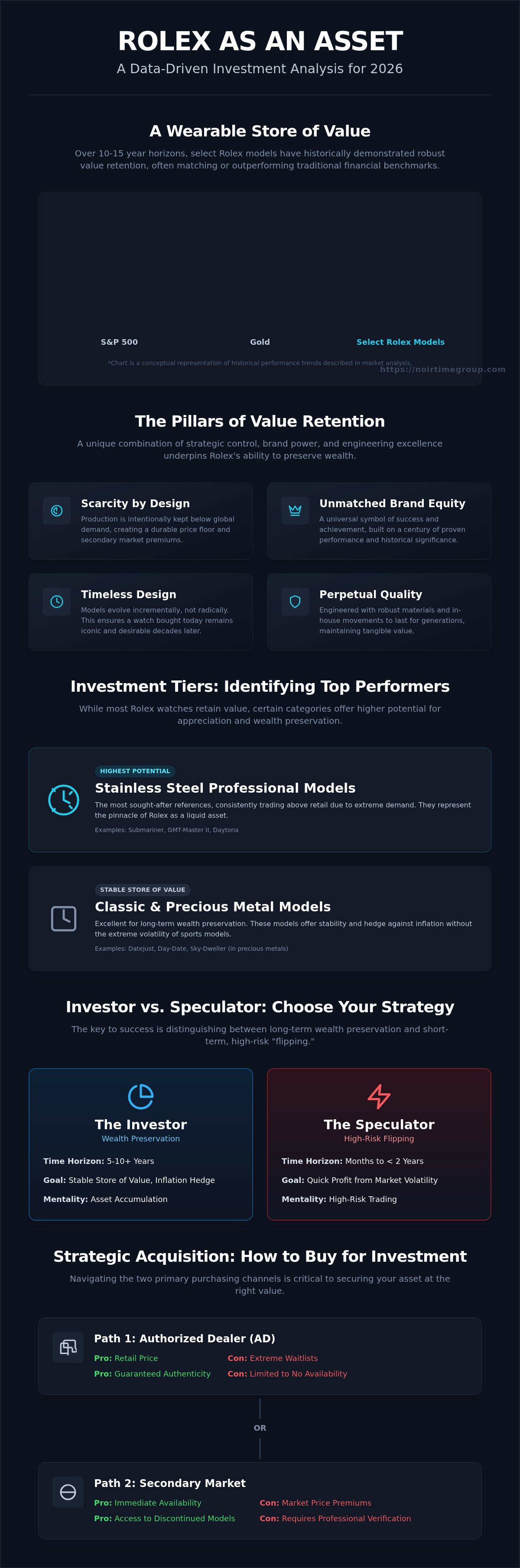
Historical data suggests that certain luxury timepieces have kept pace with or even outperformed traditional benchmarks like the S&P 500 and gold over ten to fifteen year horizons. This performance isn't driven by corporate profits, but by a unique combination of brand prestige and mechanical longevity. Investors often turn to the Rolex company history to understand this endurance. The brand's consistent focus on incremental improvement rather than radical change ensures that a model purchased today won't look obsolete in twenty years. This consistency makes the brand a reliable hedge against currency devaluation and inflation, as the replacement cost of these precision instruments continues to climb.
The Difference Between Wealth Preservation and Speculation
It's vital to distinguish between "flipping" for a quick profit and long term wealth preservation. The speculative bubble of the early 2020s saw many buyers treat watches like volatile crypto assets, leading to disappointment when prices corrected. A wearable asset is a physical commodity that provides utility through use while maintaining significant resale value in the secondary market. If you view your watch as a five to ten year hold, it functions as a stable store of value. It won't vanish during a market crash, and it doesn't rely on a digital network to exist.
Rolex Market Dynamics in 2026
The secondary market remains resilient in 2026 because Rolex maintains a strict "scarcity by design" production model. Even as global economic shifts impact consumer spending, the demand for the most iconic models consistently outstrips the supply coming out of Switzerland. This imbalance creates a price floor that protects owners from the steep depreciation seen in other luxury goods. Rolex remains the most liquid luxury watch brand in the world. You can sell a genuine Submariner or GMT-Master II in almost any major city on earth within hours, often for a price that reflects its status as a global currency. When asking is a Rolex a good investment, this liquidity is often the most compelling part of the answer.
Why Do Rolex Watches Hold Their Value So Well?
Understanding why is a Rolex a good investment requires looking at the "Veblen Good" effect. In standard economics, demand usually drops as prices rise. Luxury watches defy this logic. Higher price points often signal increased exclusivity and prestige, which actually drives demand higher among affluent buyers. Rolex manages this by strictly controlling their retail network and implementing consistent, predictable price increases. This strategy prevents the "discounting" that often destroys the resale value of other luxury brands.
The psychological impact of the waitlist also plays a massive role in value retention. By keeping supply intentionally below global demand, Rolex has created a secondary market where pre-owned watches frequently sell for more than their original retail price. A major financial publication recently noted that the brand effectively rules the luxury market through strategic retail acquisitions and a century-long reputation for waterproof reliability. This dominance isn't just about clever marketing. It's about a "Perpetual" philosophy of quality that ensures every watch is built to last multiple lifetimes without losing its mechanical integrity.
Brand Equity and Cultural Significance
Rolex has become the universal symbol of professional success and personal achievement. From the summit of Everest to the deepest parts of the ocean, the brand's presence at historical milestones builds a narrative of peak performance. Unlike brands that chase fleeting fashion trends, Rolex maintains incredible design consistency. A Submariner from forty years ago is still instantly recognizable today. This means your watch won't go out of style, which is a critical factor when evaluating if is a Rolex a good investment for your specific financial goals. If you're looking to build a collection that holds value, focusing on these iconic, culturally significant designs is a proven strategy.
Vertical Integration and Material Innovation
The brand doesn't just assemble watches; they create the very materials used in the process. They utilize Oystersteel, a 904L alloy usually reserved for the aerospace and chemical industries because of its superior corrosion resistance and unique polish. They even operate their own foundry for proprietary gold alloys like Everose. Modern innovations like Cerachrom bezels are virtually scratch-proof and won't fade under UV light. This prevents the "aging" that traditionally hurts the value of vintage items. Because these watches are so durable and supported by a global network of service centers, they remain functional assets for decades.
Which Rolex Models Are the Best Investments?
Determining which specific model to buy is the next step in answering is a Rolex a good investment. While the brand as a whole maintains value, certain categories outperform others. The Professional range, consisting of stainless steel sports watches, has historically led the market in terms of percentage growth. These pieces are designed for specific tasks like diving, racing, or global travel. They benefit from the highest liquidity because they appeal to both hardcore collectors and casual enthusiasts. When you look at the secondary market, Full Set watches, which include the original box, papers, and tags, command a significant premium. Losing these items can reduce a watch's resale value by 10% to 20% because collectors view the paperwork as a guarantee of provenance.
The Holy Trinity of Rolex Investment
The Cosmograph Daytona remains the undisputed king of appreciation. It's the model most likely to trade for double or triple its retail price on the secondary market. The Submariner serves as the blue chip entry point. It's a foundational piece for any serious collection because its demand is constant across all demographics. If you're looking for a watch that's easy to sell at any moment, the Submariner is the gold standard. The GMT-Master II, particularly the Pepsi and Batman bezel variations, has seen massive premiums due to its distinct aesthetics and functional dual-time zone movement. These three models form the backbone of most high-performing watch portfolios.
The Rising Value of Classic Models
While sports models grab the headlines, the Classic range offers surprising stability. The Datejust has evolved from a daily wearer into a legitimate asset. Some industry reports suggest that the 36mm and 41mm versions have seen substantial price increases over the last 15 years, often outperforming the inflation rate for luxury goods. The Day-Date, or Presidential, acts as a store of value primarily through its use of precious metals like 18k gold and platinum. Even the Oyster Perpetual, once considered the entry-level option, has become a hype piece with certain dial colors trading far above their MSRP. This shift shows that long term value depends as much on the specific dial and configuration as it does on the model name.
A powerful catalyst for value growth is the End of Life cycle. When Rolex announces that a specific reference is being discontinued, prices on the secondary market often spike overnight. Collectors scramble to secure the last remaining units, turning a standard production model into a rare collectible. This scarcity is a fundamental reason why many experts believe is a Rolex a good investment for those who track production cycles closely. By identifying models nearing the end of their run, you can position yourself to benefit from the immediate appreciation that follows a discontinuation announcement.
The Risks and Realities of Watch Investing
While the upside is compelling, asking is a Rolex a good investment requires a cold look at the hidden costs and market risks. A watch isn't a digital ticker on a screen. It's a physical object that demands upkeep. Many new buyers calculate their potential profit based solely on the purchase price versus the current market value. They often forget the Total Cost of Ownership (TCO). If you hold a watch for a decade, you'll face expenses that eat into your margins. These include insurance premiums, secure storage, and the inevitable mechanical service. If you don't account for these, your "investment" might actually be a net loss when you finally decide to exit.
Secondary market volatility is another reality check. Prices for some stainless steel models dropped significantly between early 2022 and late 2023. This correction reminded everyone that prices don't move in a straight line forever. Liquidity is also a factor to consider. While Rolex is the most liquid brand, you can't click a button and have cash in seconds. Selling through a reputable dealer takes time, and selling to a quick-buy site usually means accepting a price well below market value. To navigate these risks, you need a partner who understands the nuances of the secondary market. You can consult with experts at Noir Time Group to ensure you're making a calculated move rather than a reactive one.
The threat of "Super-Fakes" has reached an all-time high in 2026. These counterfeits use cloned movements and genuine-looking materials that can deceive even seasoned collectors. Buying from an unverified source to save a few hundred dollars is the fastest way to lose your entire principal. Expert authentication is no longer optional. It's a requirement for any investment-grade purchase when evaluating whether is a Rolex a good investment for your portfolio.
Maintenance, Insurance, and Storage
Keeping a watch in unpolished condition is vital for resale value. Every time a watch is buffed to remove scratches, metal is removed. Collectors prefer original "scars" over a shiny, over-polished case that has lost its sharp edges. Rolex recommends a full service approximately every 10 years to maintain the movement's precision. While this ensures longevity, it's a recurring cost you must factor into your ROI. Insurance is equally critical. Typically, specialized policies cost between 1% and 2% of the watch's appraised value annually. Over 10 years, that can account for up to 20% of the watch's initial value spent just on protection.
Market Timing and the "Hype" Trap
Social media often creates artificial hype around specific dial colors or minor reference changes. Buying during a trend-driven price spike is a recipe for disaster. You want to look for organic growth based on historical demand, not a 48-hour viral cycle. Market corrections are healthy for long-term asset stability. They flush out speculators and return the focus to the intrinsic value of the timepiece. Avoid the temptation to buy at the peak of a social media trend just because a specific model is currently "trending" among influencers.
Strategic Acquisition: How to Buy for Investment
Buying a Rolex for investment requires a different mindset than purchasing a simple lifestyle accessory. When you ask is a Rolex a good investment, the answer often depends on your acquisition strategy. Buying through an Authorized Dealer (AD) is the gold standard because you pay the manufacturer's suggested retail price. This guarantees immediate equity if the watch trades higher on the secondary market. However, waitlists for professional models can stretch into years, and many dealers prioritize customers with extensive purchase histories. The secondary market offers immediate access but usually requires paying a market premium. To succeed here, you must vet your dealer meticulously. Look for established reputations, transparent authentication processes, and a clear return policy to protect your capital.
While data should drive your financial decisions, don't ignore the "Buy What You Love" rule. If the market experiences a temporary dip, you're still left with a world-class timepiece that you enjoy wearing. This emotional utility acts as a psychological safety net, preventing the panic selling that often plagues speculative investors. Building a horological portfolio takes time and patience. By working with experts to source high-quality pieces, you can ensure that your collection remains both a source of personal pride and a stable financial asset.
The Importance of Provenance
In the world of high-end watch collecting, provenance is everything. Original warranty papers and matching serial numbers can be worth thousands of dollars. A "naked" watch without its original documentation is significantly harder to sell and often trades at a 10% to 15% discount. Every component matters, from the original bracelet links to the green hangtags. Documenting your collection and keeping every piece of original packaging ensures that you can prove the watch's history when it's time to exit your position. This attention to detail is what separates a casual owner from a serious investor.
Final Verdict: Is Rolex a Good Investment in 2026?
As we move through 2026, the case for Rolex as a conservative wealth preservation tool remains strong. While the era of "instant overnight flips" has largely cooled, the brand's long-term stability continues to outpace many traditional luxury goods. Rolex functions as a reliable hedge against inflation and currency devaluation because its global demand is decoupled from any single economy. If you approach the market with a five to ten year horizon and focus on iconic, stainless steel professional models, the answer to is a Rolex a good investment remains a resounding yes. Ready to start your journey? Explore our curated selection of investment-grade Rolex watches at Noir Time Group and secure a piece of horological history today.
Building Your Horological Legacy
Transitioning from a casual buyer to a strategic collector requires a shift in perspective. You've seen how specific models like the Submariner and Daytona act as pillars of stability, while the brand's vertical integration ensures long-term mechanical value. When you evaluate if is a Rolex a good investment, remember that success lies in the details of provenance, condition, and market timing. These watches aren't just accessories; they're historical artifacts that maintain their relevance through shifting economic cycles. By focusing on iconic designs and "full set" offerings, you protect your capital while enjoying a masterpiece of Swiss engineering.
Navigating the complexities of the 2026 market doesn't have to be a solo journey. You can secure your next investment timepiece at Noir Time Group, where we specialize in sourcing investment-grade stainless steel sports models. Every piece in our collection undergoes expert authentication to ensure your peace of mind. We also provide global shipping with fully insured logistics, so your asset arrives safely no matter where you're located. Start building a portfolio that combines timeless craftsmanship with financial resilience. Your future self will thank you for choosing a tangible asset you can wear and appreciate every single day.
Frequently Asked Questions
Is a Rolex better than a savings account?
A Rolex offers the potential for capital appreciation that far exceeds the interest rates of a standard savings account, but it comes with higher risk. Savings accounts are liquid and insured, while a watch is a physical asset subject to market fluctuations and maintenance costs. Historically, iconic models have acted as a better hedge against inflation over a decade. However, you shouldn't put money into a watch that you might need for an emergency next month.
Which Rolex model appreciates the most?
The Cosmograph Daytona is the historical leader in terms of percentage appreciation. Its extreme scarcity at the retail level and massive demand on the secondary market create a significant price gap that favors the seller. While other professional models like the Submariner are stable, the Daytona often trades for multiples of its original retail price. This makes it the primary target for collectors looking for aggressive growth rather than just wealth preservation.
Should I buy a new or pre-owned Rolex for investment?
Buying new from an Authorized Dealer is the ideal scenario because you capture the immediate value gap between retail and market prices. Since waitlists make this difficult for most, buying pre-owned allows you to target specific discontinued models that have already shown market resilience. When asking is a Rolex a good investment, the answer often depends on whether you're paying a fair market price for a piece with a proven track record.
Does a Rolex lose value if I wear it every day?
No, wearing your watch doesn't necessarily destroy its investment potential as long as you avoid catastrophic damage. Rolex watches are engineered for durability and can handle the rigors of daily use without losing their mechanical integrity. While "New Old Stock" condition commands a premium, a well-cared-for watch with honest surface scratches remains highly liquid. Enjoying the asset while it appreciates is one of the unique benefits of this asset class.
How do I know if a Rolex is authentic when buying pre-owned?
Verification requires a thorough inspection of the serial numbers, movement finishing, and dial printing by a trained professional. High-quality counterfeits can mimic the external weight and feel, but they rarely replicate the precision of a genuine caliber. Always buy from dealers who provide a lifetime authenticity guarantee and have a physical presence. If a deal seems too good to be true, it's likely a counterfeit or a "franken-watch" with non-original parts.
What happens to the value of a Rolex if it is polished during service?
Polishing generally decreases the resale value because it removes a thin layer of metal and rounds off the original sharp edges of the case. Serious collectors prize "unpolished" examples that retain their original factory lines and proportions. If you're maintaining a piece for investment, instruct your watchmaker to perform a movement service only. Preserving the case's original geometry is essential for long-term value retention in the secondary market.
Are vintage Rolexes better investments than modern ones?
Vintage watches offer higher potential rewards but come with significantly higher risks regarding part originality and condition. Modern Rolexes are more predictable and easier to maintain, making them a better starting point for those exploring is a Rolex a good investment for their portfolio. Vintage pieces require deep technical knowledge to ensure every component, from the hands to the bezel insert, is period-correct. Modern models provide a safer entry point with broader global appeal.
How much does it cost to insure a Rolex watch?
Most specialized jewelry insurance policies cost between 1% and 2% of the watch's appraised value annually. For a timepiece valued at $15,000, you can expect to pay roughly $150 to $300 each year for comprehensive coverage. These policies usually protect against theft, loss, and accidental damage worldwide. It's a necessary expense for protecting your principal, even though it slightly lowers your overall net return over a long holding period.
