
What if a watch that’s losing time needs more than a timing adjustment? Mechanical movement lubrication and adjustment services address different aspects of a watch’s performance: regulation changes its rate, while lubrication supports the movement’s moving components. Understanding the difference can help you make sense of a service recommendation and decide what questions to ask before approving work.
It’s reasonable to want a clear explanation before authorizing service, especially when your watch is valuable and technical descriptions can be hard to interpret. Regulation changes a movement’s rate; lubrication is part of caring for its moving components, while a full service covers broader maintenance. The right next step depends on the watch’s condition and the findings, not a one-size-fits-all recommendation.
This guide explains the difference between regulation, lubrication, and a full service, and what diagnostic findings can help you make an informed decision. You’ll also learn what to look for in a service explanation and after-sales support. Noir Time Group provides certified watch repair and servicing, with manufacturer-backed warranties for repair services and a 1-year service warranty through after-sales support.
Key Takeaways
- Mechanical movement lubrication and adjustment services address different needs: lubrication manages friction, while regulation tunes the movement’s rate.
- A watchmaker’s diagnosis and observed timekeeping behavior help determine whether an adjustment, lubrication, or broader maintenance is appropriate.
- Recording timing changes, winding or setting issues, power reserve, complications, and service history can make a service assessment more informative.
- Clear findings and a defined scope of work help you understand what’s being recommended before approving service.
- Noir Time Group provides certified repair and servicing for luxury timepieces, with manufacturer-backed warranties for repair services and a 1-year service warranty through after-sales support.
What Mechanical Movement Lubrication and Adjustment Services Are For
Lubrication and regulation both support a mechanical watch’s performance, but they address different needs. Lubrication means applying appropriate oils to designated contact points inside the movement to manage friction as components move against one another. Adjustment, also called regulation, means tuning the movement’s rate so its timekeeping aligns with the specifications that apply to that watch.
That distinction matters if a watch starts gaining or losing time. A change in rate is a reason to have its behavior assessed, not proof that it simply needs regulating. Lubricant condition, wear, impact, or another movement issue may also affect performance. Diagnosis helps identify what the observed behavior suggests before deciding on the scope of work.
How lubrication supports a mechanical movement
A mechanical movement transfers energy through a network of small, interacting components. Their contact needs to be managed: excessive friction can hinder movement and contribute to wear, while appropriate lubrication helps components move as intended. The mechanical watch lubrication overview provides useful context on the mechanism and why its parts require skilled care.
Lubricant can age or become contaminated, making its condition a consideration during a service assessment. That possibility alone doesn’t establish that lubrication is the cause of a timekeeping problem. The appropriate lubricant and its placement depend on the movement, so the watch needs to be assessed on its own rather than treated with a generic solution.
What adjustment changes in a watch
Before regulating a watch, a watchmaker assesses its rate and relevant movement behavior. The balance wheel swings back and forth, while the hairspring helps control the timing of those oscillations. Together, they play a central role in how the movement keeps time. Regulation tunes the rate; it doesn’t renew lubricant or address every potential source of poor performance.
There isn’t one accuracy target that applies to every mechanical watch. Applicable tolerances depend on the watch and its manufacturer’s specifications. A reading outside an expected range can guide further assessment, but it needs to be understood in context rather than treated as an automatic instruction to adjust.
In practical terms, lubrication concerns the movement’s operating condition, while regulation concerns how quickly or slowly it runs. They can be relevant to the same watch, but one doesn’t automatically mean the other is needed. A watch that loses time might need its rate assessed, yet the cause could call for a different scope of attention. Conversely, a watchmaker may find a rate adjustment appropriate without concluding that lubrication is the issue.
That’s why mechanical movement lubrication and adjustment services should begin with observed performance and a watch-specific assessment. A clear explanation should distinguish the timing concern from any findings about the movement’s condition. This helps owners understand why a recommendation fits the watch, instead of assuming every timekeeping change calls for the same repair.
What Happens During Mechanical Watch Lubrication and Adjustment
A service assessment should connect the watch’s symptoms to a clearly explained scope of work. Mechanical movement lubrication and adjustment services aren’t necessarily a fixed sequence: the procedures depend on the watch, its condition, and the concern being investigated. A limited regulation is different from comprehensive movement maintenance, and an initial assessment helps establish which kind of work may be appropriate.
Diagnosis before movement work
The process starts with your account of what changed, when it began, and how the watch has been behaving. Service history and relevant functions, such as winding, setting, power reserve, or complications, add useful context. A watchmaker may assess timekeeping behavior and take diagnostic readings. These findings guide the recommendation, but one reading alone doesn’t prove a specific cause.
This distinction helps keep the proposed work proportionate. If the concern appears limited to the rate, an adjustment may be considered after assessment. If findings point to broader movement concerns, additional maintenance may be discussed. A complicated movement can require procedures suited to its functions and construction, so its diagnosis and handling should reflect the specific caliber rather than follow a generic checklist. The American Watchmakers-Clockmakers Institute offers horology education and technical resources that reflect the specialized knowledge behind watchmaking practices.
Lubrication, regulation, and post-service checks
A comprehensive movement service may involve disassembly, inspection, cleaning, lubrication, reassembly, and regulation. These are possible stages, not a promise that every assessment or repair includes each one. Cleaning and relubrication belong to broader movement work; they’re distinct from a limited rate adjustment. The watch’s condition and the recommended scope determine which work is relevant.
Regulation follows assessment. It aims to tune timekeeping against specifications applicable to that watch, but it can’t guarantee identical results in every wearing condition. Position, activity, and how the watch is used can affect observed performance, so results should be interpreted in context rather than as a single universal figure. Model-specific tolerances should be based on the manufacturer’s specifications.
After work, relevant functional checks help assess the watch’s operation and whether the reported concern has been addressed. The service explanation should distinguish findings from recommendations: what was observed, what work was carried out, and what you should understand about the result. Make sure you know whether the scope was limited to regulation or involved broader maintenance, and keep the service record for future reference.
Noir Time Group provides certified repair and servicing for luxury timepieces. Explore certified watch repair and servicing to discuss your watch’s service needs and after-sales support.
Lubrication, Adjustment, or Full Service: How the Work Differs
A watch that runs fast or slow doesn’t automatically need the same fix as another watch with a similar symptom. Regulation changes the movement’s rate; lubrication supports how moving parts interact; a full service covers broader maintenance. The right discussion depends on diagnostic findings, the movement’s condition, service history, and applicable manufacturer guidance, not just whether the watch gains or loses time.
| Option | Purpose | Typical scope | Concern it may address |
|---|---|---|---|
| Adjustment or regulation | Tune the rate of the movement. | Assessment of timekeeping followed by rate adjustment if appropriate. | A timekeeping change where findings support regulation. |
| Lubrication | Manage friction at designated movement contact points. | Lubricant condition is considered as part of movement care; work depends on the movement and findings. | Maintenance concerns involving the condition of lubricants or movement components. |
| Full service | Address broader movement maintenance. | May include disassembly, inspection, cleaning, lubrication, reassembly, and regulation. | A need for more comprehensive attention based on condition, history, and manufacturer guidance. |
The table describes general distinctions, not a prescribed package. A full service may involve several stages, but those operations aren’t automatically included in every repair or assessment. The National Association of Watch & Clock Collectors offers resources on timekeeping and horology, helpful context for understanding why lubrication is one part of specialized movement care rather than a simple fix in isolation.
When adjustment may be the relevant service discussion
If a watch’s timekeeping changes, record what you observe over several days during ordinary use. Note whether it consistently gains or loses time, how often you wear it, and any recent change in behavior. A repeated pattern gives a watchmaker more context than a single check, though it still doesn’t identify the cause on its own. Assessment can establish whether regulation is relevant or whether further investigation is needed.
When broader servicing may be considered
Service history, the watch’s condition, and manufacturer guidance help shape a discussion about broader maintenance. Lubrication belongs within appropriate movement care, not a do-it-yourself attempt to add oil without knowing the caliber’s requirements. A watchmaker’s findings determine whether additional work is warranted and how its scope differs from a limited adjustment.
Before approving work, look for an explanation that links the reported concern to the recommended scope. Ask what was observed, whether the proposal is for regulation or broader maintenance, and what the work is intended to address. That distinction makes mechanical movement lubrication and adjustment services easier to evaluate without assuming every timing symptom calls for a full overhaul, or that a quick adjustment resolves every underlying issue.
How to Prepare for a Mechanical Movement Service
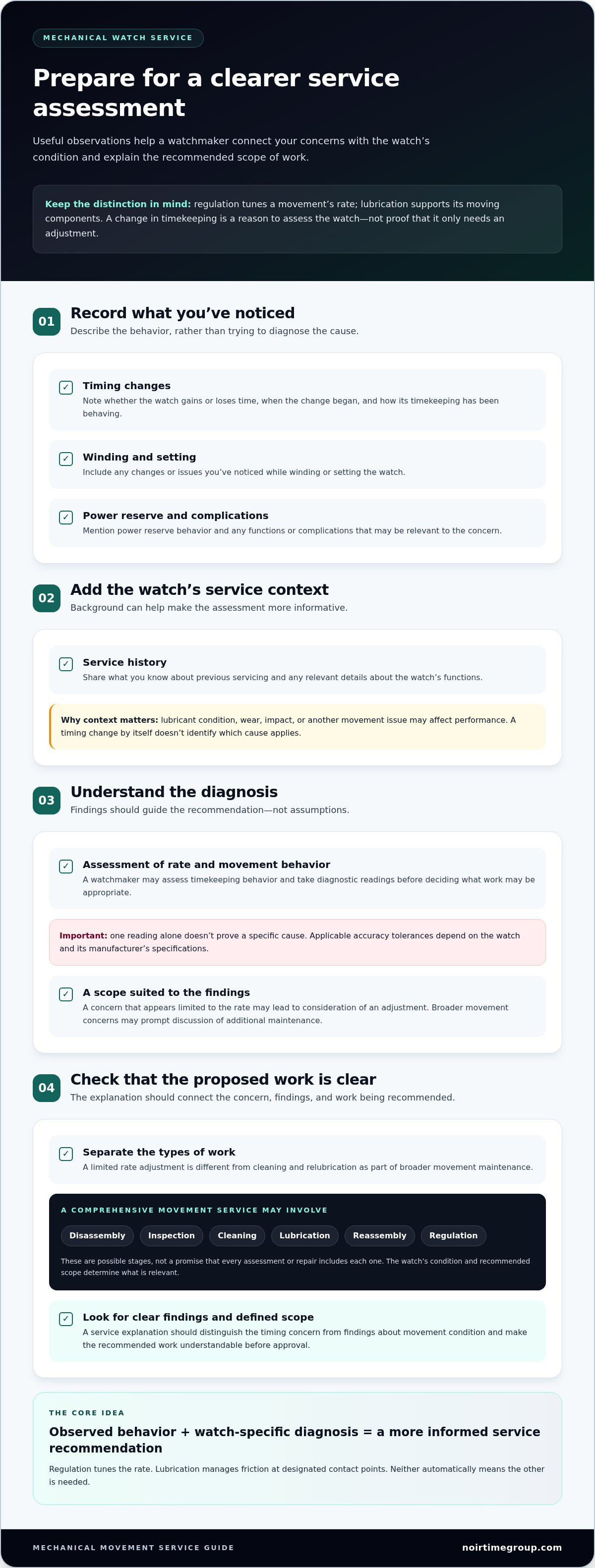
A useful service assessment starts with a clear account of what you’ve noticed. You don’t need to diagnose the cause or use technical terms. Describe what changed, when it began, and whether it happens consistently. For mechanical movement lubrication and adjustment services, these details help the service team compare your observations with the watch’s condition and determine what needs further attention.
Information to share at intake
Before bringing in your watch, gather any service records you have and jot down observations while they’re fresh. A short log can be more useful than relying on memory, especially if the issue comes and goes. Include changes in use or handling that may help explain when the behavior began.
- Timekeeping: Note whether the watch seems to gain, lose, or vary in time, and when you first noticed it. If possible, record observations consistently rather than relying on a single check.
- Winding and setting: Describe any change in how winding or setting feels or behaves. Don’t force a crown or attempt to open the watch.
- Power reserve: Explain whether the watch seems to stop sooner than you expect, and under what circumstances you noticed it.
- Functions: Mention any issue with the date, GMT display, chronograph, or other complication. Be specific about what happens when you use it.
- History and handling: Bring available service records and note relevant changes, such as a long period without wear or an impact around the time symptoms appeared.
Stick to what you observed, even if it seems minor. For example, “the date didn’t change as expected” gives a clearer starting point than guessing that a particular part is faulty. Intake details won’t prove a cause, but they can help the watchmaker assess the reported concern alongside diagnostic findings.
Questions to discuss before approving work
Before work proceeds, make sure you understand the connection between the findings and the proposed scope. A clear explanation helps distinguish a limited adjustment from broader maintenance and makes it easier to decide whether the recommendation addresses your concern.
- What did the assessment indicate about the watch’s condition and timekeeping behavior?
- Which proposed work addresses the reported symptom, and is the recommendation for regulation or broader servicing?
- How will findings and completion checks be communicated, and what manufacturer guidance applies to this movement?
Keep the conversation focused on your individual watch. Its functions, service history, and applicable manufacturer guidance matter more than a generic checklist or an assumed fix. If you’re preparing a luxury timepiece for assessment, contact Noir Time Group about certified watch repair and share the observations and records that can help inform the service discussion.
Certified Mechanical Watch Repair and Support from Noir Time Group
Knowing the difference between regulation, lubrication, and a full service helps you describe your concern. The next step is having the watch assessed in context. Noir Time Group provides certified repair and servicing for luxury timepieces, with knowledgeable guidance to help owners understand their watch’s needs. The aim is to connect the reported issue with an appropriate service discussion, rather than assume every change in timekeeping calls for the same work.
What Noir Time Group brings to luxury-watch care
Mechanical movement lubrication and adjustment services involve decisions that depend on the individual watch and its condition. Noir Time Group provides certified repair and servicing for luxury timepieces, with findings and proposed scope discussed in relation to your watch. Repair services include manufacturer-backed warranties, and after-sales support includes a 1-year service warranty.
Warranty support can add reassurance after repair, while a clear explanation of findings helps you understand what the work addresses. Keep your observations and service records close at hand, and use them to frame the discussion around your watch. That context can help clarify whether the recommendation relates to timekeeping, broader movement care, or another repair need, without assuming a specific procedure or result in advance.
For discerning owners, personalized guidance matters as much as technical language. A useful service conversation should make the scope understandable and leave room for questions about the recommendation and the support that follows. Noir Time Group’s after-sales support, including its 1-year service warranty, provides a defined point of reassurance without implying that every repair or service includes the same operations.
Taking the next step in New York
Noir Time Group’s showroom is at 15 W 47th St # 306, New York, NY 10036, United States, in the Diamond District. Private appointments are available for owners who prefer a personal showroom touchpoint to discuss a luxury timepiece and its service needs.
Before your appointment, note what the watch is doing, when you first noticed the change, and any relevant service history. You can then describe the concern and discuss the findings and proposed scope in relation to your specific watch. This keeps the conversation focused on useful information, rather than a presumed fix.
Explore certified repair and servicing with Noir Time Group, or arrange a private appointment at the New York showroom to discuss your mechanical watch.
Take the Next Step With Confidence
Your next move doesn’t need to start with choosing a specific repair. Start with a clear account of what you’ve noticed and an open discussion about what the assessment shows. A recommendation for mechanical movement lubrication and adjustment services should make sense for your watch’s condition and the concern you’ve reported, so you can consider the proposed scope with confidence.
Noir Time Group provides certified repair and servicing for luxury timepieces, with manufacturer-backed warranties and after-sales support that includes a 1-year service warranty. For a personal service touchpoint, private appointments are available at the New York Diamond District showroom.
Bring your questions, relevant service records, and any observations about how the watch behaves. A thoughtful conversation can help turn uncertainty into a practical plan for your timepiece, without assuming the same solution fits every watch.
Explore certified luxury-watch repair and servicing with Noir Time Group and arrange a private appointment at the New York showroom to discuss your watch.
Frequently Asked Questions
How often should a mechanical watch be serviced?
There isn’t one service interval that suits every mechanical watch. Follow the guidance for your specific model, and consider its service history, condition, and observed performance rather than relying only on a general calendar rule. If records are missing or you’re unsure what applies, a professional assessment can help determine the next step. The timing of mechanical movement lubrication and adjustment services should be based on watch-specific guidance, not treated as a guarantee.
Can magnetism make a mechanical watch run fast?
Yes, magnetism can affect some movement components and may contribute to a sudden gain in time. It’s only one possible cause, though, so a fast-running watch shouldn’t be diagnosed from that symptom alone. Note when the change began and mention any likely exposure to magnetic objects, such as a clasp or speaker. Don’t open the case or attempt a movement repair yourself; professional evaluation can identify an appropriate next step.
What does amplitude mean in a mechanical watch movement?
Amplitude is the angle through which the balance wheel swings during its oscillation. A watchmaker may interpret this measurement alongside other diagnostic readings, the movement’s specifications, and the watch’s condition. There’s no single ideal figure that applies to every caliber or testing situation. Owners don’t need specialist equipment to report a concern: describing changes in timekeeping or function gives a service professional useful context for assessment.
What is beat error in a mechanical watch?
Beat error describes a difference in timing between a movement’s alternating beats. It’s one measurement used in assessing a movement, not a complete verdict on its health or accuracy. Its significance depends on the caliber and the conditions in which the watch is tested. Avoid trying to adjust anything inside the case based on a reading from a device or app; leave measurement and any adjustment to a qualified watch service professional.
How can I track my mechanical watch’s accuracy at home?
Compare the displayed time with a reliable reference at consistent times over several days, and note whether the watch gains or loses time. Keep your usual wear and winding habits reasonably consistent, and record dates alongside observations so a pattern is easier to interpret. This log can help explain what you’ve noticed, but it isn’t a professional movement test. Don’t change how you handle the watch just to chase a particular reading.
Does a mechanical watch need attention if it still runs?
A watch that continues to run can still have an unknown service history or internal condition, so operation alone doesn’t establish whether maintenance is due. Changes in winding, setting, timekeeping, or a complication’s behavior are useful reasons to request an assessment. If it seems to run normally, use the manufacturer’s recommendations and any available records to guide your decision rather than treating a running watch as proof that no attention is needed.
