

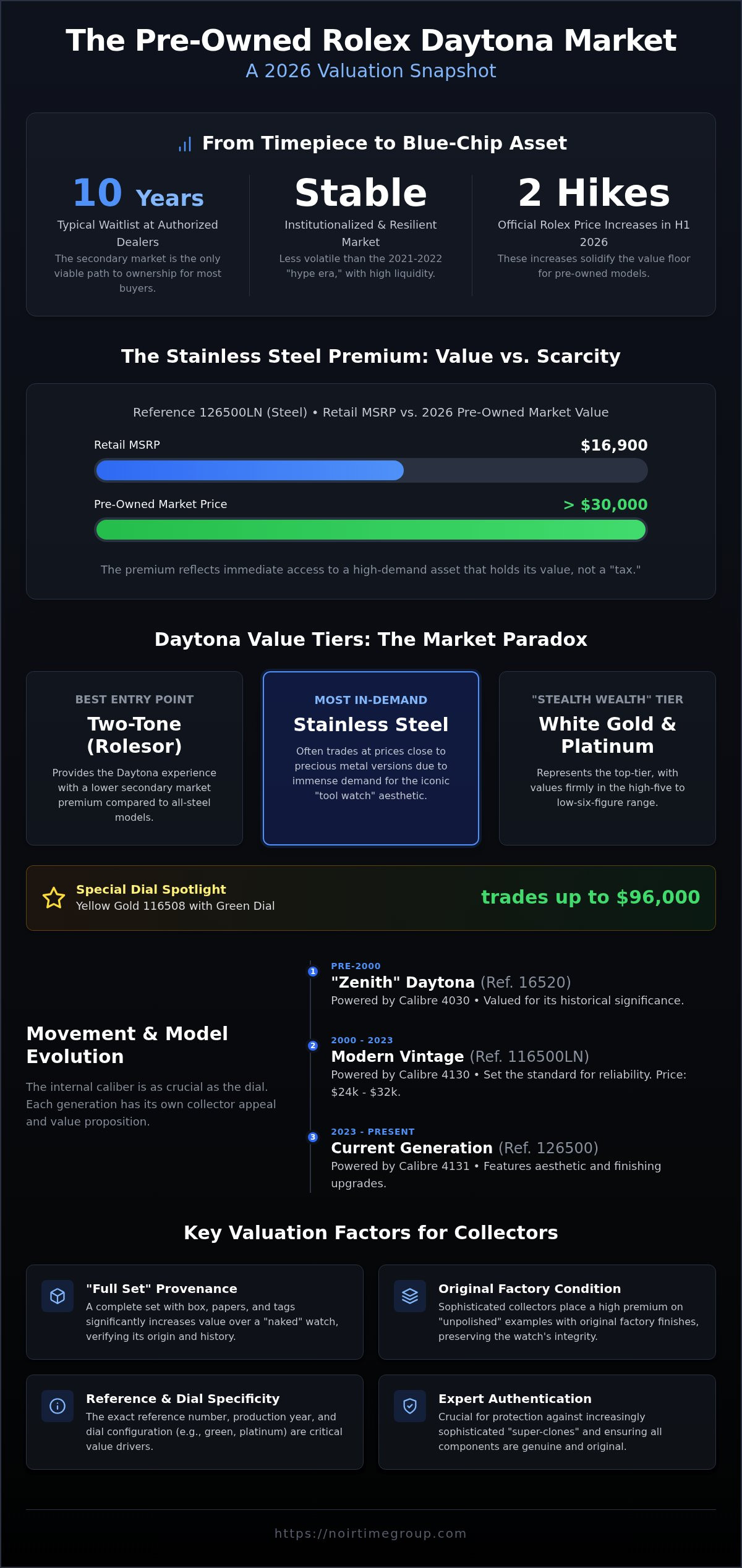
Would you wait a full decade just for the privilege of buying a watch at retail? With official waitlists for a new chronograph now stretching up to ten years, the pre-owned Rolex Daytona price has become the true benchmark of value in 2026. Following two significant Rolex price hikes this year alone, buying in the secondary market requires more than just a passing interest. It demands a sharp eye for detail and an understanding of why a steel 126500 still commands over $30,000, which is nearly double its retail MSRP.
You're likely feeling the pressure of rising costs while worrying about the growing sophistication of "super-clone" counterfeits that threaten even seasoned collectors. It's frustrating when the price gap between stainless steel and precious metal models seems to shift overnight. This analysis will clarify the current 2026 price tiers and explain how the newer 126-series references are reshaping the valuation of discontinued models. We'll examine critical factors like set completeness and movement generation so you can secure a high-condition timepiece with total confidence.
Key Takeaways
- Understand how 2026 price increases and institutional growth have transformed the Daytona from a mere timepiece into a blue-chip horological asset.
- Learn how to evaluate the pre-owned Rolex Daytona price based on movement generations, from legendary Zenith references to the latest in-house calibers.
- Identify the specific value difference between "full set" watches and "naked" pieces to avoid overpaying for incomplete provenance.
- Discover why stainless steel models often command higher premiums than precious metal references and where to find the best market entries.
- Gain confidence in your purchase by learning how expert curation and authentication protect you from high-quality replicas and non-original components.
The 2026 Pre-Owned Rolex Daytona Market Landscape
The Rolex Cosmograph Daytona has officially transcended its status as a mere luxury watch. In 2026, it's recognized globally as a "blue-chip" horological asset. This isn't the same market we saw during the post-pandemic "hype" era of 2021 and 2022. Back then, prices swung wildly based on social media trends. Today, the market is more institutionalized and stable. High secondary market liquidity ensures that the pre-owned Rolex Daytona price remains resilient, even as other luxury goods face volatility. This resilience is backed by two official Rolex price increases in the first half of 2026, which pushed retail costs higher and solidified the floor for used models.
Why does this specific chronograph dominate the industry? It's a combination of scarcity and heritage. A deep dive into the Rolex Daytona History shows a lineage of mechanical excellence that collectors find irresistible. With waitlists at authorized dealers still stretching toward the ten-year mark, the secondary market isn't just an alternative; for most, it's the only viable way to own one. This persistent supply-demand imbalance makes the Daytona the most sought-after chronograph in the world.
The Impact of the 126-Series Launch on Secondary Prices
The introduction of the 126-series references, featuring the updated Calibre 4131 movement, has fundamentally shifted buyer behavior. Rather than making older models obsolete, the new generation has turned the previous 116500LN into a "modern vintage" icon. In 2026, we're seeing the 116500LN ceramic bezel models stabilize between $23,999 and $31,999. Collectors often prefer the slightly bolder aesthetic of the discontinued 116-series over the more refined, "jewelry-like" finish of the 126-series. This preference keeps prices for older steel references remarkably close to their newer counterparts.
Market Sentiment: Investment vs. Personal Enjoyment
The 2026 collector is more sophisticated than the speculators of five years ago. There's a renewed focus on "unpolished" examples and original factory finishes. Buyers don't just want a watch; they want a preserved piece of history. While the retail MSRP for a steel 126500 sits at $16,900, the reality of the pre-owned Rolex Daytona price is often double that, frequently exceeding $30,000. This premium isn't seen as a "tax" by the market. Instead, it's viewed as the fair market value for immediate access to a high-condition timepiece that holds its value over the long term.
Key Factors Determining Pre-Owned Daytona Valuation
Determining a fair pre-owned Rolex Daytona price requires looking beyond the brand name and into the specific reference number and dial configuration. For instance, a yellow gold 116508 with a green dial can trade as high as $96,000 in 2026, while a standard black dial version of the same reference might sit significantly lower. Many financial analysts now view certain Watches as a Timeless Investment, citing the Daytona’s historical ability to outpace traditional market indices. Production years also play a vital role; early serial numbers or "transitional" models that bridge two generations often command a premium from collectors who value rarity over modern features.
The Steel vs. Gold Value Proposition
The Daytona market presents a unique paradox. While gold usually commands a premium in other Rolex lines, stainless steel Daytona models often trade at prices remarkably close to their precious metal siblings. This is due to the immense demand for the "tool watch" aesthetic. If you're looking for an entry point, the "Two-Tone" (Rolesor) models are often the most accessible. They provide a mix of 904L steel and 18k gold at a lower secondary market premium than all-steel models. On the opposite end, platinum and white gold references represent the "stealth wealth" tier. These pieces, like the 126509, have seen their official retail prices climb to €58,400 as of June 2026, keeping their secondary market value firmly in the high-five to low-six-figure range.
The Movement Evolution: 4030 vs. 4130 vs. 4131
A watch's internal heart is just as important as its dial color. The "Zenith Daytona" (Ref. 16520), powered by the Calibre 4030, remains a favorite because of its historical significance as the first automatic Daytona. However, the Calibre 4130, introduced in 2000, set the standard for reliability with its vertical clutch and reduced component count. The 2026 market has also begun to digest the impact of the new Calibre 4131 found in the 126-series. While the 4131 offers aesthetic improvements like the "Côtes de Genève" finish, the technical rarity of older movements keeps their prices climbing. When browsing the curated selection at Noir Time Group, you'll find that we prioritize these movement-specific nuances to ensure your investment stands the test of time.
Navigating Daytona Price Tiers: From Entry-Level to Rare Finds
Understanding the pre-owned Rolex Daytona price requires categorizing these timepieces into distinct financial tiers. The market has settled into a predictable rhythm following the 60th-anniversary releases of 2023. By August 2026, the speculative "hype" of previous years has been replaced by a calculated valuation system based on rarity and wear. While a reference number provides a baseline, the final sale price is often dictated by the condition of the case and the presence of original factory finishing.
- Entry-Level: Often found in the Rolesor (two-tone) models like the 116503 or older stainless steel 116520 examples with moderate signs of use. These offer the Daytona experience without the extreme premiums of ceramic models.
- Mid-Tier: This is the "sweet spot" for many collectors, consisting of modern ceramic bezel 116500LN references. These watches offer a perfect balance of modern technology and market resilience.
- High-Tier: Investment-grade pieces including discontinued precious metal references, rare dial configurations like the "John Mayer" green dial, or platinum models.
Stainless Steel: The 116500LN and 116520
The 116500LN remains the king of the secondary market, even with the newer 126-series in full production. Its ceramic bezel is virtually scratch-proof, making it the ideal choice for those who want to wear their investment. For purists, the older 116520 represents the last of the steel-bezel Daytonas, offering a more monochromatic, classic look that has seen a resurgence in 2026. In the 116500LN series, the white "Panda" dial typically commands a $2,000 to $4,000 premium over the black dial version due to its higher visual demand among collectors.
Precious Metals and the Oysterflex Revolution
Gold Daytonas have seen significant movement in 2026 following two major Rolex price increases. As of June 2026, the official retail price for a white gold Daytona on an Oysterflex strap (126519LN) has climbed to €44,300. This has naturally pushed secondary market prices higher, particularly for popular "Chocolate" and "Sundust" dial variations. The Oysterflex bracelet changed the pricing dynamics of the gold market; it offers a more sporty, accessible way to own precious metal compared to the heavy, full-gold bracelets. The legacy of the "John Mayer" 116508 green dial continues to influence the market, as its peak pricing of $96,000 has set a high psychological ceiling for what collectors are willing to pay for rare gold configurations.
When evaluating these tiers, curation is everything. At Noir Time Group, we focus on high-condition grade inventory because we know that a "bargain" Daytona often carries hidden costs in the form of over-polished cases or replaced parts. Choosing a curated piece ensures that your entry into any of these tiers is backed by expert authentication and long-term value retention.
Condition, Provenance, and the "Full Set" Premium
When you're browsing for a chronograph, you'll often see two identical-looking watches with price tags thousands of dollars apart. The difference usually lies in what's inside the box, or if there's a box at all. A "full set" consists of the original box, warranty card, manual, and hangtags. In the 2026 market, these items aren't just accessories; they're financial certificates. A missing warranty card can slash the pre-owned Rolex Daytona price by 10% to 15%. For a premium reference like the 116500LN, that can represent a $3,000 to $4,500 difference. While "naked" watches offer a lower entry price, they lack the airtight provenance that institutional buyers and serious investors demand.
Evaluating condition requires a tiered approach. "New Old Stock" (NOS) pieces are the unicorns of the market. These are watches that have never been worn, often still retaining factory stickers. Most buyers look for "High Condition" examples with minimal bracelet stretch and sharp case lines. "Daily Wear" watches show visible scratches and scuffs. However, as long as the mechanical integrity is verified by a Rolex Service Center (RSC) document, they remain liquid assets. Be wary of prices that seem too good to be true. A price significantly below the July 2026 market range of $23,999 to $31,999 for a ceramic model often indicates hidden damage or missing internal components.
The Importance of an Unpolished Case
Collectors in 2026 are increasingly obsessed with "unpolished" cases. Every time a watch is polished to remove scratches, a microscopic layer of metal is removed. Over time, the sharp chamfers and lugs lose their original factory shape. A Daytona that has been over-polished looks "soft" and carries significantly less value than a scratched but original example. Serious collectors pay a premium for original factory finishes because they represent the watch in its truest form. Identifying professional restoration requires a loupe to check for rounded edges where there should be crisp, mirror-polished transitions.
Verifying Authenticity in a Complex Market
The rise of "super-clones" has made authentication a high-stakes game. These fakes are so precise that even the bezel font and sub-dial spacing can fool an untrained eye. You must look for consistency in movement engravings and the specific weight of the 904L steel or precious metal. Because generic marketplaces often lack the technical expertise to catch these high-end replicas, sourcing from a specialist is the only way to mitigate risk. A professional authentication report is now a non-negotiable requirement for any serious buyer. To ensure you're getting a timepiece that meets these rigorous standards, browse the authenticated inventory at Noir Time Group where we prioritize condition and provenance above all else.
Why Source Your Rolex Daytona from Noir Time Group?
Choosing the right partner for your acquisition is just as critical as selecting the right reference number. In a market where the pre-owned Rolex Daytona price is influenced by microscopic details, working with a specialist boutique offers a level of security that large-scale aggregators simply can't match. Many marketplaces prioritize transaction volume over horological integrity. At Noir Time Group, we take the opposite approach. Our philosophy centers on quality, authenticity, and expert curation. We don't just list watches. We source and vet them as if they were for our own private collections.
Our specialization in iconic Rolex sports models means we understand the nuances that drive long-term value. We maintain a strict focus on high-condition grade inventory, ensuring that every piece we offer retains the sharp lines and mechanical precision that collectors demand. Transparency is the cornerstone of our process. When we evaluate a timepiece, we provide clear reporting on its condition and provenance, removing the guesswork from your investment. You won't have to wonder if a case has been over-polished or if the dial is a later service replacement. We've already done that work for you.
A Personalized Procurement Experience
Acquiring a Daytona is often a milestone event. Whether you're searching for a specific "birth year" Zenith reference or a rare discontinued precious metal model, our team provides the expertise needed to navigate these complex waters. We don't believe in a one-size-fits-all approach. Instead, we offer a verified, expert-led transaction process that prioritizes your peace of mind. Our collectors appreciate the ongoing support and advice we provide as their portfolios grow. We help you understand how shifts in the 2026 market might affect your specific holdings, ensuring your collection remains a source of both pride and financial stability.
Secure Your 2026 Daytona Today
The market for the Cosmograph Daytona moves quickly, and the most exceptional examples rarely stay available for long. If you're ready to move beyond the uncertainty of generic marketplaces, we invite you to start a consultation with our specialists. We'll help you identify the reference that fits your aesthetic preferences and investment goals. Our curated selection represents the pinnacle of modern and neo-vintage Rolex watchmaking, authenticated to the highest industry standards. Take the first step toward owning a piece of horological history by browsing our current inventory.
Explore the Noir Time Group Rolex Collection
Secure Your Horological Legacy
The 2026 market demonstrates that the Cosmograph Daytona is more than just a luxury timepiece; it's a resilient financial asset. Success in this landscape depends on your ability to distinguish between a "bargain" and true value. As we've explored, the pre-owned Rolex Daytona price is driven by a complex mix of movement rarity, set completeness, and the preservation of original factory finishes. Prioritizing unpolished cases and airtight provenance will protect your investment from the volatility of generic marketplaces.
At Noir Time Group, we specialize in sourcing rare, high-condition Rolex references that meet the standards of the most discerning collectors. Every timepiece in our inventory undergoes an expert authentication process to ensure its integrity. We complement our curated selection with secure, insured global shipping for your luxury assets. You don't have to navigate this intricate market alone. Our team is here to provide the transparency and expertise required for a confident acquisition.
Browse Our Curated Selection of Pre-Owned Rolex Daytona Watches and take the next step toward a collection that stands the test of time.
Frequently Asked Questions
Why is the pre-owned Rolex Daytona price often higher than the retail price?
The pre-owned Rolex Daytona price is often higher than retail because of extreme scarcity and ten-year waitlists at authorized dealers. This supply-demand imbalance makes the secondary market the only way most buyers can actually acquire the watch without a decade-long wait. For example, the steel 126500 often trades at or above $30,000 in August 2026, despite having a new MSRP of only $16,900.
Which Rolex Daytona reference is considered the best investment in 2026?
In 2026, the discontinued 116500LN and the yellow gold 116508 with a green dial are standout investments. The 116500LN has maintained incredible resilience since the new 126-series debuted. Meanwhile, the green dial reference has seen examples trading as high as $96,000. These models are favored for their fixed supply and iconic status among global collectors who prioritize long-term appreciation over short-term trends.
How much value does the original box and papers add to a pre-owned Daytona?
A "full set" including the original box and warranty papers typically adds 10% to 15% to the watch's valuation. This documentation is vital for proving provenance and ensuring a smooth resale in the future. For a high-value reference, missing papers can result in a price drop of several thousand dollars. Collectors in 2026 increasingly view complete sets as the gold standard for investment-grade timepieces.
Is it better to buy a stainless steel or a gold Rolex Daytona for value retention?
Stainless steel models typically offer superior percentage-based value retention because their secondary market price is often double the retail MSRP. However, precious metal models are gaining ground. Following the June 1, 2026, price increase, retail for gold references like the 126505 rose to €58,400. Steel remains the high-liquidity choice, while gold attracts those seeking "stealth wealth" assets with high intrinsic value.
What is the difference between a Zenith Daytona and a modern Daytona in terms of price?
The primary difference is that the Zenith Daytona (Ref. 16520) is valued for its rarity and historical movement, while modern models are valued for technical perfection. A modern 116500LN currently ranges between $23,999 and $31,999. In contrast, Zenith models often command higher premiums from purists because they represent the first generation of automatic Daytonas. Their prices vary significantly based on specific dial variations and case condition.
How can I verify the authenticity of a pre-owned Rolex Daytona?
Verifying authenticity involves a deep technical inspection of the movement engravings, bezel typography, and dial printing. Because "super-clone" replicas have become so sophisticated, simple visual checks aren't enough. It's essential to work with specialists like Noir Time Group who use an expert authentication process. We examine every detail under magnification to ensure the watch is factory-original, protecting you from the risk of high-quality counterfeits.
Does a service history from Rolex increase the resale value of the watch?
Documented service history from a Rolex Service Center (RSC) definitely increases resale value. It acts as a verified record of maintenance and serves as a secondary confirmation of the watch's authenticity. Buyers are often willing to pay a premium for a watch that has been recently serviced by the manufacturer. It eliminates the immediate need for a costly overhaul and ensures the movement is performing to factory specifications.
Should I buy a discontinued 116500LN or the new 126500LN model?
Buying the discontinued 116500LN is often the better value play in 2026 because its price has stabilized after the initial 126-series hype. It's a verified icon that many collectors prefer for its classic bezel design. The new 126500LN is technically superior with the Calibre 4131, but its pre-owned Rolex Daytona price remains highly inflated due to novelty. Both are excellent, but the 116500LN offers an established track record.
