

Is a ten-second daily drift in your Rolex Submariner a quirk of mechanical character or a warning of an impending mechanical failure? Many collectors ignore the subtle signs your luxury watch needs servicing because they fear high costs or worry that opening the case will devalue a Patek Philippe Nautilus. It's natural to feel anxious about shipping a $30,000 asset or trusting a technician with a piece that represents a major life milestone.
However, waiting for a watch to stop completely is often a very expensive mistake. This guide helps you identify critical performance shifts and physical warnings like moisture under the crystal or a gritty crown. You'll learn how to distinguish between normal operation and the red flags that signal a need for professional care. We'll provide a clear checklist to determine if your Audemars Piguet Royal Oak requires immediate attention and explain how a trusted NYC-based expert can preserve your watch's precision without compromising its provenance.
Key Takeaways
- Identify the specific tactile and visual signs your luxury watch needs servicing, ranging from a gritty crown feel to erratic timekeeping deviations.
- Learn why the "if it ain't broke" mentality is a myth and how dried synthetic oils cause silent, permanent wear on internal pivots.
- Understand the difference between a basic regulation and a full movement overhaul to ensure your high-complication timepiece receives the correct level of care.
- Discover how proactive maintenance and a documented service history can help preserve the resale value of assets like the Rolex Submariner or Patek Philippe Nautilus.
- See why professional NYC experts prioritize a 10-step disassembly process and genuine parts to protect the long-term provenance of your collection.
What is Luxury Watch Servicing and Why is it Necessary?
Luxury watch servicing is more than a simple tune-up; it's a critical preservation process for mechanical art. While a basic regulation might only involve adjusting the balance wheel to correct a minor timekeeping drift, a full overhaul is a complete teardown of the movement. Understanding the signs your luxury watch needs servicing starts with recognizing that these machines operate under extreme physical stress. A mechanical timepiece like the Patek Philippe Nautilus relies on specialized synthetic oils to reduce friction. Over time, these oils dry out or migrate away from critical contact points. When lubrication fails, the movement's 200 plus components begin to grind against one another, turning microscopic metal shavings into an abrasive paste that accelerates wear.
Recognizing the early signs your luxury watch needs servicing allows you to intervene before a minor lubrication issue becomes a total movement failure. Unlike quartz watches that rely on a battery and a simple circuit, a mechanical masterpiece is a symphony of tension and release. A certified watchmaker understands that even if a watch appears to be running, the internal components might be suffering from "dry running." This is why proactive maintenance is essential for any serious collector.
The Anatomy of a High-End Movement
The heart of your timepiece is the escapement and balance wheel, which oscillate thousands of times per hour. This constant motion puts immense pressure on the pivots, the tiny axles that hold the gears in place. If the lubrication fails, these pivots can wear down, directly reducing the power reserve and accuracy. Beyond the gears, the gaskets and seals act as the first line of defense. These rubber or silicone components prevent moisture and dust from entering the case. Over several years, they become brittle and lose their ability to maintain a vacuum seal, risking catastrophic water damage to the dial and movement.
Investment Protection vs. Basic Repair
For owners of a Rolex Submariner Date 126618LN or an Audemars Piguet Royal Oak, service history is a matter of financial provenance. A documented record of professional maintenance can significantly increase the resale value of a piece. It transforms the watch from a "used" item into a "well-maintained asset." There's a clear distinction between preventative horology and restorative repair. Preventative service replaces worn parts before they fail, while restorative repair often involves sourcing rare, expensive components to fix damage that could have been avoided. Noir Time Group emphasizes that using genuine manufacturer parts is non-negotiable for maintaining the integrity and authenticity of high-value watches in the NYC market.
Timekeeping and Power Reserve Red Flags
The most obvious signs your luxury watch needs servicing often appear directly on the dial. While some general guides suggest that a watch losing 30 seconds a day is acceptable, this is a dangerously low bar for high-end horology. A modern Rolex, for example, is regulated to Superlative Chronometer standards of +/- 2 seconds per day. If your Submariner or Datejust begins drifting by 5 or 10 seconds, it indicates that internal friction is finally impacting the balance wheel’s amplitude. This drift is rarely linear; it's a symptom of a movement struggling to maintain its rhythm.
Erratic behavior is an even greater concern than a consistent daily drift. If your watch gains several minutes one day but loses time the next, you aren't just dealing with a regulation issue. You likely have a loose component, a magnetized hairspring, or debris interfering with the gear train. Complications provide additional diagnostic data. A date window that hangs halfway between days or a chronograph second hand that fails to snap back perfectly to the zero position are clear indicators that the complex lever systems inside are failing. These high-complication movements require specialized knowledge to calibrate correctly.
Tracking Your Watch's Accuracy
You don't need a professional laboratory to monitor your timepiece. Many collectors use timegrapher apps or compare their watch against atomic time over a 48-hour period. Pay close attention to "positional error." This occurs when a watch keeps perfect time while dial-up on a nightstand but loses significant time when worn on the wrist. This discrepancy often points to worn pivots or a balance staff that needs professional attention. For those interested in the deeper science of these measurements, the Horological Society of New York offers incredible resources on the technical standards of modern timekeeping and the evolution of chronometric precision.
Power Reserve and Mainspring Health
A healthy movement should meet its manufacturer-stated power reserve, which for many modern calibers ranges from 48 to 72 hours. If your watch stops overnight despite being worn all day, the automatic winding rotor may be sluggish or the mainspring bridle may be slipping prematurely. A weakened mainspring cannot provide the consistent torque necessary for accurate timekeeping as the power winds down.
Perform an "overnight test" for diagnostic clarity:
- Manually wind the watch fully, typically 30 to 40 turns of the crown.
- Note the exact time and leave the watch dial-up on a flat surface.
- Check when it stops to see if it reaches the rated reserve capacity.
If the watch fails this test, it is one of the definitive signs your luxury watch needs servicing. Should you notice these performance dips in your collection, seeking expert diagnostic support early can prevent a full mechanical collapse and more costly repairs later.
Tactile and Visual Warnings You Shouldn't Ignore
While accuracy is a data-driven metric, the physical feedback your watch provides is often the first indicator of trouble. If you notice a "gritty" sensation when winding the crown, you're feeling more than just surface dust. This sand-like resistance often points to the breakdown of internal lubricants or the presence of microscopic metal particles within the winding works. Ignoring these tactile signs your luxury watch needs servicing can lead to a snapped mainspring or damaged winding gears that require a much more extensive overhaul.
Listen closely to the movement of the automatic rotor. In a high-complication piece like an Audemars Piguet Royal Oak or a Patek Philippe Nautilus, the rotor should glide with a faint, consistent whir. A scraping sound or a heavy "clunk" when you move your wrist suggests the rotor axle has developed play or the bearing is failing. If the rotor begins to touch the movement bridges or the case back, it can shave off metal fragments that migrate into the delicate escapement. This mechanical interference is a serious warning that physical damage is already occurring inside the case.
The way the hands respond to your input is another vital diagnostic clue. When setting the time, the hands should move with smooth, deliberate resistance. If the hands feel loose or "slip" when you turn the crown, the friction spring or cannon pinion is likely worn. This makes it difficult to set the time accurately and can eventually lead to the hands overlapping and catching on each other, potentially damaging the dial or the handset itself.
The Crown and Stem Interface
Specific models like the Rolex Submariner Date 126613LN rely on a specialized screw-down system to maintain water resistance. If you feel the threads "skipping" or if the crown becomes difficult to screw down fully, the threads may be stripped. A mushy sensation when jumping between date-set and time-set positions is another red flag. These issues usually stem from dry internal gaskets that have lost their elasticity, creating friction that makes the crown feel stiff or unresponsive. A certified technician in NYC can replace these seals to restore the buttery-smooth operation expected of a luxury timepiece.
Moisture Intrusion and Gasket Failure
Condensation under the sapphire crystal is the ultimate horological emergency. Even a faint "fog" that disappears after a few minutes indicates that the watch's environmental seal has been breached. Once moisture enters the case, it creates an acidic environment that can cause catastrophic rust on steel components within 48 hours. This invisible degradation of O-rings and sapphire seals is why professional pressure testing is vital for any piece worn near water. Noir Time Group treats moisture intrusion as a priority because the cost of preventative gasket replacement is a fraction of the cost required to restore a rusted movement.
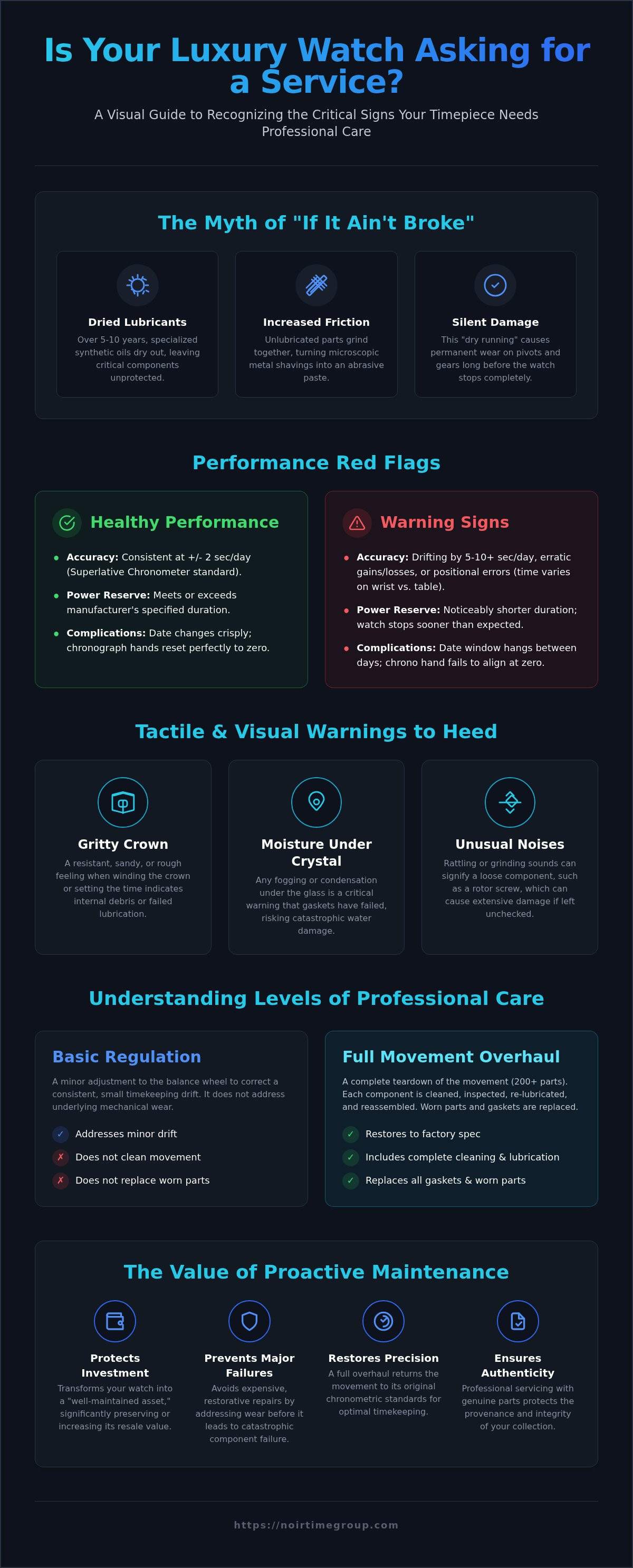
The 5-to-10 Year Rule: Why 'If it Ain't Broke' is a Myth
Many collectors believe that if their Patek Philippe Nautilus is still ticking accurately, it doesn't need attention. This is a dangerous myth. In the world of high-end horology, the absence of obvious signs your luxury watch needs servicing doesn't guarantee mechanical health. Modern Rolex models are built to such high tolerances that they can keep perfect time even as their internal lubricants have completely evaporated. This is the "silent killer" of luxury movements: a watch that continues to run while its steel pivots slowly grind their brass bushings into dust.
Manufacturer recommendations vary based on the complexity of the movement. Rolex currently suggests a service interval of approximately 10 years for modern watches, though they note that a 5 to 7 year cycle is beneficial for pieces worn daily. Patek Philippe advises a more conservative 3 to 5 year interval to protect their intricate complications. Vintage pieces are even more demanding; because they lack modern gaskets and use older movement architectures, they generally require professional care every 3 to 5 years to prevent irreversible wear. If you've surpassed these windows, you're essentially gambling with the long-term value of your asset.
The Evolution of Lubricants
The transition from organic to synthetic oils in the last decade has significantly extended service lives, but it hasn't made movements immortal. Synthetic oils don't gum up like old whale oils, but they do evaporate. When a watch sits in a safe for years without running, these lubricants can migrate away from the escapement. This makes "old stock" watches particularly risky. A timepiece that has been sitting for five years without use may need a full overhaul just as badly as one that has been worn every day in a humid environment.
Watch Winders: Pro or Con for Service Intervals?
Think of a watch winder like a car's odometer. While a winder keeps your Audemars Piguet Royal Oak ready to wear, it also keeps the gears in constant motion, accelerating the wear on the automatic winding system. For simple three-hand watches, letting the movement rest when not in use can actually extend the time between services. However, for complex perpetual calendars, the risk of damaging the movement while manually resetting the complications often outweighs the wear from a winder. Balancing convenience with mechanical longevity is key to maintaining a high-value collection. If you aren't sure where your timepiece sits on the maintenance curve, it's best to consult with the experts at Noir Time Group for certified watch repair in NYC.
Professional Servicing: What to Expect from an Expert Overhaul
Once you've identified the signs your luxury watch needs servicing, the next step is understanding the rigorous standards of a professional overhaul. A master watchmaker doesn't just "fix" a watch; they perform a precise 10-step restoration. This begins with a complete disassembly of the movement, where every screw and gear is inspected under high magnification for microscopic wear. Components then undergo a multi-stage ultrasonic cleaning process to remove old, acidic lubricants and any metallic debris that has accumulated over years of operation.
Re-assembly is where technical expertise meets manufacturer specifications. Each pivot and jewel is re-lubricated using brand-specific oiling charts that dictate different synthetic oils for high-pressure and high-speed contact points. For investment-grade pieces like the Patek Philippe Nautilus or the Rolex Submariner Date 126618LN, using genuine manufacturer parts is essential to maintain the movement's integrity. After assembly, the watch undergoes multi-position timing tests over a period of several days and a final pressure test to certify water resistance before it's cleared for return.
Choosing the Right Service Center in NYC
Collectors in NYC face a choice between high-volume Authorized Service Centers and specialized independent masters. While both have their merits, a boutique approach often provides the personalized attention required for high-value assets. Brands like Audemars Piguet require specialized tooling that generic shops don't possess. Noir Time Group bridges this gap by offering Certified Watch Repair that combines technical precision with a deep understanding of the collector market's demands for documentation and care.
To Polish or Not to Polish?
The decision to polish a case is the ultimate collector's dilemma. While aesthetic perfection is tempting, over-polishing can permanently devalue a piece. For a vintage Rolex Submariner, the sharp lines of the lugs and the original "chamfers" are critical to its provenance. Removing metal through aggressive polishing softens these features, signaling to future buyers that the watch has been heavily handled. Noir Time Group advocates for "sympathetic restoration," focusing on cleaning and movement health while preserving the original case geometry. This philosophy ensures that even after you've addressed the signs your luxury watch needs servicing, the timepiece retains the character and value that made it a mechanical masterpiece in the first place.
Preserving the Precision of Your Horological Collection
Owning a mechanical masterpiece like a Rolex Submariner or Patek Philippe Nautilus is a commitment to stewardship. We've explored how identifying the subtle signs your luxury watch needs servicing, such as a slight drop in power reserve or a gritty crown, can save you from costly restorative repairs. Remember that even a watch keeping perfect time may be suffering from dried lubricants. Proactive maintenance is the only reliable way to ensure long-term precision and value preservation for your investment-grade assets.
Don't wait for a mechanical failure to compromise your timepiece's provenance. Our team provides the specialized care required for high-complication pieces. Protect your investment—schedule a certified service consultation at Noir Time Group NYC. With expert NYC-based horologists specializing in Rolex, Patek, and AP, we provide certified repair services and a total authenticity guarantee for every timepiece. Your collection deserves the highest standard of technical excellence to remain a legacy for years to come.
Frequently Asked Questions
How much does it cost to service a luxury watch in 2026?
Service costs vary based on the manufacturer, the movement's complexity, and whether you choose an authorized center or a certified independent master. Complications like perpetual calendars or chronographs generally require more intensive labor and specialized parts. While industry ranges exist for various brands, the most accurate way to determine the cost is to have a professional evaluate the movement's current condition and the specific components required for restoration.
Can I wait until my watch stops completely before servicing it?
Waiting for a complete mechanical failure is a high-risk strategy that often leads to significantly higher repair bills. By the time a movement stops, internal components like pivots and gears have likely suffered permanent wear due to dry lubricants. Recognizing early signs your luxury watch needs servicing, such as a drop in power reserve, allows for preventative maintenance that preserves the movement's integrity and prevents the need for expensive part replacements.
Does a Rolex really need a service every 10 years if it's keeping time?
Yes, because accuracy is not the only indicator of a movement's health. Modern Rolex calibers are engineered to maintain precision even when internal synthetic oils have evaporated. If you ignore the 10-year recommendation, you risk a "dry run" scenario where steel parts grind against one another. This internal friction causes microscopic damage that eventually compromises the caliber's longevity and can negatively impact the resale value of the timepiece.
What happens if moisture gets inside my Patek Philippe?
Moisture intrusion is a critical emergency that requires immediate intervention by a professional technician. Water, especially salt water, creates a corrosive environment that can cause rust on steel components within 48 hours. This damage can ruin the dial, hands, and the movement's delicate escapement. If you notice fogging under the crystal, have the watch opened and dried immediately to prevent a total loss of the asset's value.
Will servicing my watch at an independent shop void my warranty?
In the United States, consumers are generally protected when using independent service providers. However, luxury brands often have specific requirements for maintaining their international warranties. Using a certified watch repair expert who uses genuine manufacturer parts is the best way to ensure your watch remains in factory-spec condition. Always check the specific terms of your warranty before proceeding with any major mechanical work on a modern piece.
How long does a professional luxury watch service typically take?
Turnaround times depend on the specific brand and the availability of replacement parts. Authorized service centers typically take 8 to 12 weeks for a full overhaul. Certified independent masters in NYC can often complete the same high-quality work in 2 to 4 weeks if they have the necessary components in stock. Rare vintage pieces or high-complication models may take longer if parts must be sourced directly from the manufacturer in Switzerland.
Is it normal for my automatic watch to make a whirring sound?
A faint whirring or spinning sound is usually normal, as it indicates the automatic winding rotor is moving. However, any scraping, grinding, or loud clunking noises are definitive signs your luxury watch needs servicing. These sounds suggest that the rotor axle is worn or the bearings have failed. If left unaddressed, the rotor can begin to strike the movement bridges or the case back, creating metallic debris that will migrate into the gear train.
Do I need to service my watch if I never wear it?
Yes, because synthetic lubricants can migrate or evaporate over time even if the gears aren't in motion. A watch that sits in a safe for five years may still require a service to ensure the gaskets haven't become brittle and the oils are still correctly positioned on the jewels. Regular maintenance every 5 to 10 years ensures that when you do decide to wear the piece, it performs with the precision expected of a luxury caliber.
