

What if the best restoration is the one that leaves the dial untouched? A worn dial can carry the marks of a watch’s history, while a movement that isn’t running properly may need attention to function as intended. Swiss watch dial and movement restoration involves two distinct decisions. Treating visible age as a defect can risk changing qualities collectors value.
It’s understandable to want a cherished watch to look and run its best. The challenge is balancing appearance, function, originality, and your goals as an owner. This guide explains how dial work differs from movement repair, how to weigh preservation against refinishing, and how to prepare for an assessment. Noir Time Group provides certified watch repair and after-sales care, helping collectors consider a timepiece’s condition before deciding what work is appropriate.
Key Takeaways
- Swiss watch dial and movement restoration address different concerns: the dial affects appearance and legibility, while the movement governs timekeeping.
- Record visible dial changes separately from timekeeping symptoms. A symptom is a clue, not a diagnosis or confirmed repair plan.
- Compare preservation, repair, refinishing, and replacement by the condition each addresses, the visual change involved, and the originality that may be affected.
- Prepare for an assessment by documenting the watch, noting symptoms and priorities, and gathering model details, service history, and available provenance records.
- Use your priorities to guide a discussion with Noir Time Group’s certified watch repair team about the watch’s condition, proposed scope, and preservation goals.
Swiss watch dial and movement restoration: what each part of the work addresses
Dial restoration concerns the watch face: its surface, markings, and legibility. Movement work concerns the mechanism inside the watch, which drives the hands and keeps time. These are separate areas to assess, even when a watch has concerns with both. A dial can show age while the movement works as expected, or the dial may look clear while timekeeping has changed.
Restoration is condition-led work that weighs what a watch needs against what should be preserved. A visible change doesn’t automatically call for cosmetic work, and a timekeeping symptom doesn’t identify its cause. Assessing each area separately helps shape a plan around evidence and ownership priorities rather than appearance alone.
What does watch dial restoration address?
Dial concerns can include fading, marks, surface damage, or reduced legibility. These observations describe what’s visible, but a photograph may not show the dial’s full condition or explain why a change occurred. Reflections, lighting, and image quality can also affect how details appear. An in-person assessment can consider visible concerns alongside the watch’s originality and overall condition.
Possible approaches are not interchangeable. Cleaning may address surface dirt; repair may address a specific area of damage; refinishing changes the dial’s appearance; replacement substitutes another dial. Each can have different implications for originality and visual character. The appropriate option depends on the dial’s condition and your preservation priorities, not simply on whether it looks aged.
What does movement restoration address?
Movement work focuses on mechanical operation and timekeeping, not the dial’s appearance. A watch that stops, loses time, or behaves inconsistently gives you a reason to investigate, but the symptom alone doesn’t confirm a diagnosis or dictate a repair. Inspection, correction, and parts repair are possible types of movement work, not steps every watch necessarily requires.
The balance wheel and mainspring help explain how the mechanism works. The balance wheel oscillates as part of the movement’s timekeeping system, while the mainspring stores energy that powers the mechanism. Wear or a problem with a component may affect performance, but assessment is needed to establish what’s happening in a particular watch. For more background, Wikipedia’s overview of mechanical watch components and history explains how parts work together.
For a collector, the practical takeaway is to describe dial observations and movement symptoms separately. A watch may need attention in one area, both, or neither. Noir Time Group’s certified watch repair and after-sales care provide a starting point for discussing condition and preservation priorities without assuming that refinishing or a particular mechanical intervention is the right choice.
How dial condition and movement performance shape a restoration plan
A useful assessment starts with two separate records: what you see on the dial and what you notice while the watch is running. This helps prevent a cosmetic concern from being mistaken for a mechanical fault, or a timekeeping symptom from becoming a reason to alter an original dial. In Swiss watch dial and movement restoration, the scope should reflect the watch’s condition, how you intend to wear it, and what you want to preserve.
A visible mark is an observation, not a movement diagnosis. Likewise, a watch that stops has a symptom to investigate, not proof that a particular part has failed. Keeping those distinctions clear makes discussion of next steps more focused.
Which signs point to a dial concern?
Record visible discoloration, fading, surface damage, unclear or missing markings, and changes in legibility. Note where each concern appears and whether it affects your ability to read the time or mainly changes the dial’s appearance. Avoid deciding from a photograph that a blemish can be removed or repaired. Images can help describe the watch, but they don’t establish its full condition or the right approach.
Photographs taken in clear, even light can create a useful visual record. Gather any earlier service records or provenance documents you have, especially if they describe past work or the dial’s history. This context can help frame preservation priorities, but it doesn’t replace an assessment of the watch itself.
Which signs point to a movement concern?
Inconsistent timekeeping, a watch that stops, or performance that changes noticeably during ordinary wear are symptoms worth recording and having professionally assessed. Note when the issue occurs and, if you can, how the watch was being worn or stored. Don’t infer from one episode that the balance wheel, mainspring, or another specific component has failed.
Accuracy can be influenced by factors such as magnetism, temperature, and the position of the watch. The same symptom can therefore have different possible explanations, making a clear description more useful than a guessed repair plan. For background on the craft and its professional community, consult the American Watchmakers-Clockmakers Institute.
Then consider the watch’s role in your life. A piece worn regularly may call for a different balance of function and appearance than one kept primarily for its original condition. If the dial has age-related changes but remains legible and the watch performs as expected, preservation may be your priority. If timekeeping is inconsistent, a mechanical assessment can help clarify the issue without assuming cosmetic work is needed. These are priorities to discuss, not diagnoses to make from symptoms alone.
For a careful review of condition and priorities, Noir Time Group’s certified watch repair and after-sales care can support an informed discussion about the appropriate scope.
Restoration or preservation? Compare the options before authorizing dial work
Dial work can preserve existing character, address a localized concern, change the finish, or replace the dial. These choices respond to different conditions and can produce different visual results. Before authorizing work, consider whether the concern affects legibility or use, or whether the dial’s age simply differs from the appearance you prefer.
Originality can matter to collectors, but there isn’t one preference that applies to every watch or owner. A dial with visible age may suit one collector’s goals, while another owner may prioritize readability for regular wear. No approach guarantees a particular effect on collector appeal or resale value. The right choice depends on the specific watch, its condition, and your priorities.
| Approach | Condition addressed | Likely visual change | Preservation consideration |
|---|---|---|---|
| Preservation | The dial is retained in its present condition. | Little or no intended change. | May suit an owner who values existing character and wishes to avoid unnecessary intervention. |
| Repair | A specific concern that may affect the dial’s condition or legibility. | May be localized; the extent depends on the issue and proposed work. | Review the scope carefully, since even targeted work can affect original material. |
| Refinishing | Condition or appearance that leads the owner to consider changing the dial’s finish. | A more noticeable change to the dial’s appearance is possible. | Weigh the desired look against the value you place on the existing surface and character. |
| Replacement | A dial condition for which substitution is being considered. | The dial’s appearance may change substantially. | Consider how replacing the existing dial fits with your goals for originality and the watch’s history. |
When might preservation be the priority?
Preservation may fit a watch whose dial remains readable and whose wear forms part of the character you want to keep. Fading or other visible age doesn’t automatically mean refinishing is needed. Before deciding, gather available provenance records and service history, including notes about past dial work. That background can put the current condition in context and clarify what you hope to retain.
When might repair or refinishing be considered?
Repair or refinishing may enter the discussion if a documented condition affects legibility or how you use the watch. Separate that concern from aesthetic preference: wanting a fresher appearance is a valid personal goal, but it isn’t the same as identifying a functional need. Discuss the proposed scope and expected visual change in relation to the watch’s present condition. Don’t assume the result will preserve originality or increase resale value.
With Swiss watch dial and movement restoration, consider dial decisions on their own terms rather than automatically bundling them with mechanical work. A preservation-minded plan starts by identifying what condition needs attention, what change the work may bring, and what matters most to you as the owner. Noir Time Group’s certified watch repair and expert guidance can help frame those considerations around the individual timepiece.
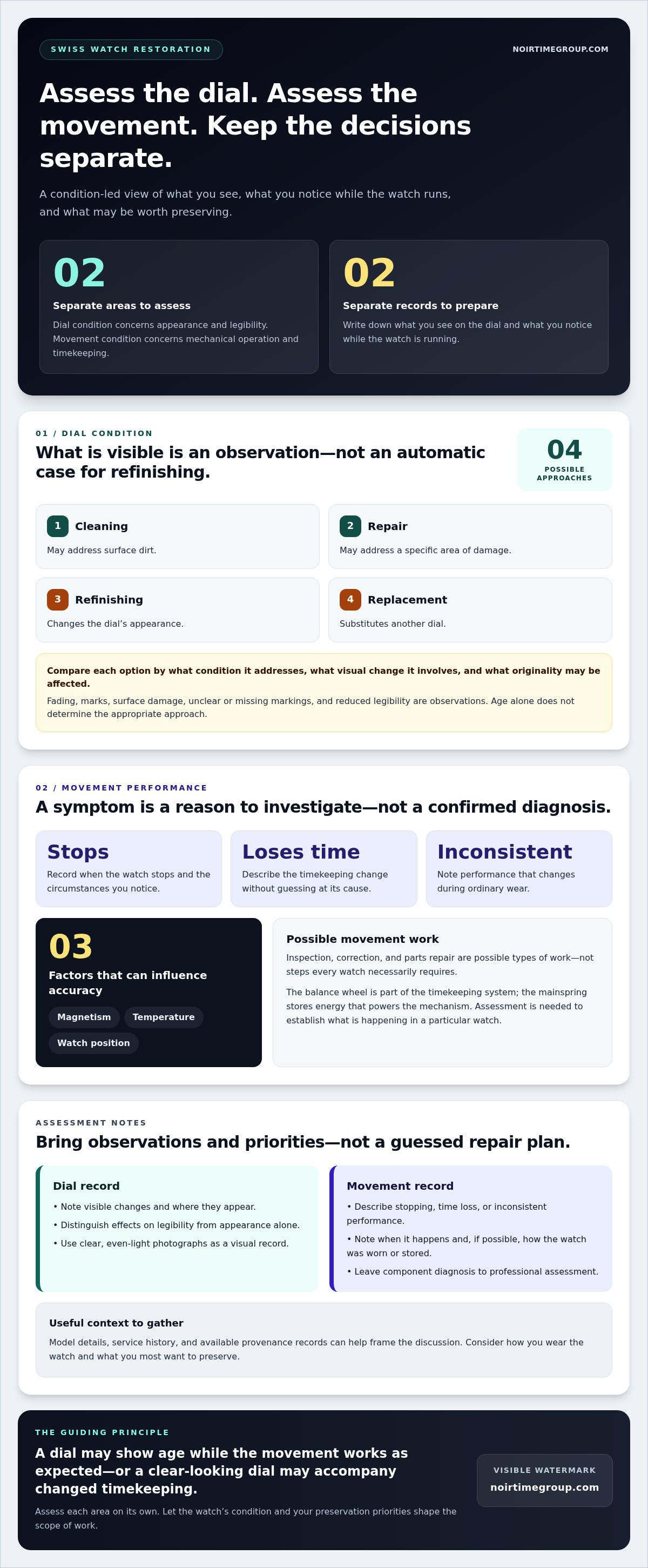
Prepare for Swiss watch restoration with a clear assessment checklist
A concise, organized brief makes it easier to keep dial concerns, timekeeping symptoms, and preservation goals distinct. Before discussing Swiss watch dial and movement restoration, take four steps: document the watch, note what you’ve observed, set priorities, and review the proposed scope. You don’t need to identify a fault or recommend a repair. Clear observations are enough to begin a useful assessment.
- Document the watch. Gather the model details you know, purchase information, service history, and any available provenance records. Include paperwork that may help explain the watch’s ownership or previous work.
- Note symptoms and visible changes. Photograph the dial in clear light and write down what you see, such as discoloration or a legibility concern. Separately record timekeeping issues, including when the watch stops or seems inconsistent.
- Set your priorities. Decide whether preservation, legibility, or reliable daily use matters most to you. You can rank these rather than treating them as competing all-or-nothing goals.
- Review the proposed scope. Understand what work is being considered, what condition it addresses, and what outcome it is intended to achieve. Keep a written record of the agreed scope and any service terms provided.
What information should an owner gather?
Start with details you can report confidently. Note the model information you know, how the watch is usually worn, and the circumstances around any performance changes. For example, record whether it stopped during wear or after being set aside, without assuming what caused the issue. Take photographs as a visual reference, but use them to describe the dial, not diagnose it. Prior service documents and provenance records can add helpful context.
How should restoration priorities be communicated?
Put your goals in order. If retaining the dial’s existing character matters most, say so. If clearer legibility or dependable everyday use comes first, explain that too. Then review the proposed work in plain language: what it addresses, what change is intended, and how its scope relates to your priorities. Noir Time Group’s certified watch repair and expert guidance can help keep the discussion focused on the individual watch’s condition and preservation goals.
A written summary helps avoid confusion later. Keep the assessment notes, proposed work, agreed scope, and any stated service terms together with the watch’s records. This gives you a clear reference for what was discussed and lets you compare the intended work with your original goals.
With your notes and priorities ready, Explore Noir Time Group’s watch services as a next step toward a careful assessment.
Noir Time Group certified watch repair: choose a careful next step
A restoration decision doesn’t have to begin with choosing a treatment. Start with a clear conversation about the watch as it is now, how you use it, and what you want to preserve. Bring your observations and priorities to Noir Time Group’s certified watch repair and after-sales care. Expert guidance can help you understand the watch’s condition, consider the proposed scope, and keep the discussion aligned with your goals.
This matters because “make it look newer” and “help it keep time consistently” describe different aims. The first is a cosmetic preference; the second relates to mechanical performance. Either can be worth discussing, but one shouldn’t be treated as evidence for the other. Keeping these points distinct helps you consider each recommendation on its own merits.
What to expect from a considered repair discussion
A useful discussion connects observed condition with intended use. A watch worn regularly may raise different priorities from one mainly kept as part of a collection. Share what you notice and what matters most, then review the proposed work in plain language: what it addresses, why it’s being considered, and what change is intended. Understanding the scope before proceeding helps you decide without assuming a particular result.
Keep cosmetic preferences separate from mechanical symptoms and assessment findings. Wanting a cleaner-looking dial doesn’t establish a movement problem, and inconsistent timekeeping doesn’t by itself call for dial work. If both areas are being considered, treat them as separate parts of the discussion. This makes it easier to understand which proposed work relates to each concern and how the overall scope reflects your preservation priorities.
Why specialist guidance matters for luxury watches
High-end timepieces combine mechanical function, design details, and personal history. Even watches from the same manufacturer may differ in condition and ownership goals, so a considered decision should be tied to the individual piece rather than a one-size-fits-all idea of restoration. Noir Time Group specializes in luxury brands including Rolex, Patek Philippe, and Audemars Piguet, and offers certified watch repair as part of its after-sales care.
For Swiss watch dial and movement restoration, guidance can help you weigh what’s visible, what the watch is doing, and what you hope to retain. It doesn’t mean every concern requires intervention. Sometimes the most useful outcome of an assessment is greater clarity about the condition and the choices in front of you. The decision should be grounded in the watch itself and your reasons for keeping or wearing it.
- Bring your notes: Share the observations and records that help explain the watch’s history and current condition.
- State your priorities: Say whether preservation, legibility, or regular use matters most to you.
- Review the scope: Make sure you understand what the proposed work addresses before deciding how to proceed.
For a measured next step, Explore Noir Time Group and its certified watch repair and after-sales care.
Make your next restoration decision with confidence
The next step doesn’t need to be a commitment to restoration. It can be a focused conversation that helps you decide what deserves attention, what you want to preserve, and what can remain as it is. Keep your priorities at the center of any discussion about Swiss watch dial and movement restoration, and let the watch’s assessed condition guide the scope instead of assuming every sign of age needs correction.
Noir Time Group offers certified watch repair and after-sales care, with expert guidance for luxury watches including Rolex, Patek Philippe, and Audemars Piguet. As a New York-based retailer, the team can help you consider your watch’s condition and ownership goals. Take the next step: Explore Noir Time Group’s watch services. A thoughtful assessment can give you a clearer path forward while keeping preservation in view.
Frequently Asked Questions
Is watch dial restoration the same as replacing a dial?
No. Restoration can describe different kinds of work on an existing dial, while replacement means fitting a different dial. Before approving either, make sure the proposed scope identifies whether the current dial will remain with the watch and what change is intended. That distinction is especially useful if the dial has documented history or retaining original components is important to your collecting goals.
Can a watch movement be restored without refinishing its dial?
Yes. Movement work can be considered on its own, leaving the dial’s appearance unchanged. For example, a watch with a clear, original-looking dial might still need assessment because it stops or keeps inconsistent time. Describe those mechanical symptoms separately, and make clear that you aren’t requesting cosmetic changes. This helps keep the discussion focused on function rather than treating all restoration work as one combined package.
How long does Swiss watch dial and movement restoration take?
There isn’t one reliable timeline for every watch. The schedule can depend on the condition found, the agreed scope, and whether parts or specialist work are needed. Discuss timing for the specific timepiece alongside the proposed work before proceeding. If the watch has a particular occasion or intended use in mind, mention that early so it can inform the conversation.
What happens if a watch runs inaccurately after restoration?
Inaccuracy calls for assessment, not an assumption about which component is at fault. Record how the watch performs over time, including when it was last set and when you notice a change. Note relevant circumstances, such as how it was positioned or whether conditions varied. Share those observations and the service history with the repair team so they can evaluate the movement rather than rely on guesswork.
Does the word Swiss mean restoration must take place in Switzerland?
No. “Swiss” may refer to a watch’s origin or its connection to Swiss watchmaking; it doesn’t, by itself, specify where repair work takes place. Noir Time Group is based in New York and offers certified watch repair. Consider the actual service, the watch’s condition, and the proposed scope rather than inferring a workshop’s location or authorization from the word “Swiss.”
Should an original watch dial always be preserved?
No single choice fits every watch. An owner who wears a watch regularly may weigh readability differently from a collector focused on retaining its existing character. Provenance and records of earlier work can also inform the decision. Consider what matters most before choosing an approach, and avoid assuming preservation, refinishing, or replacement will have a predictable effect on collector appeal or resale value.
