

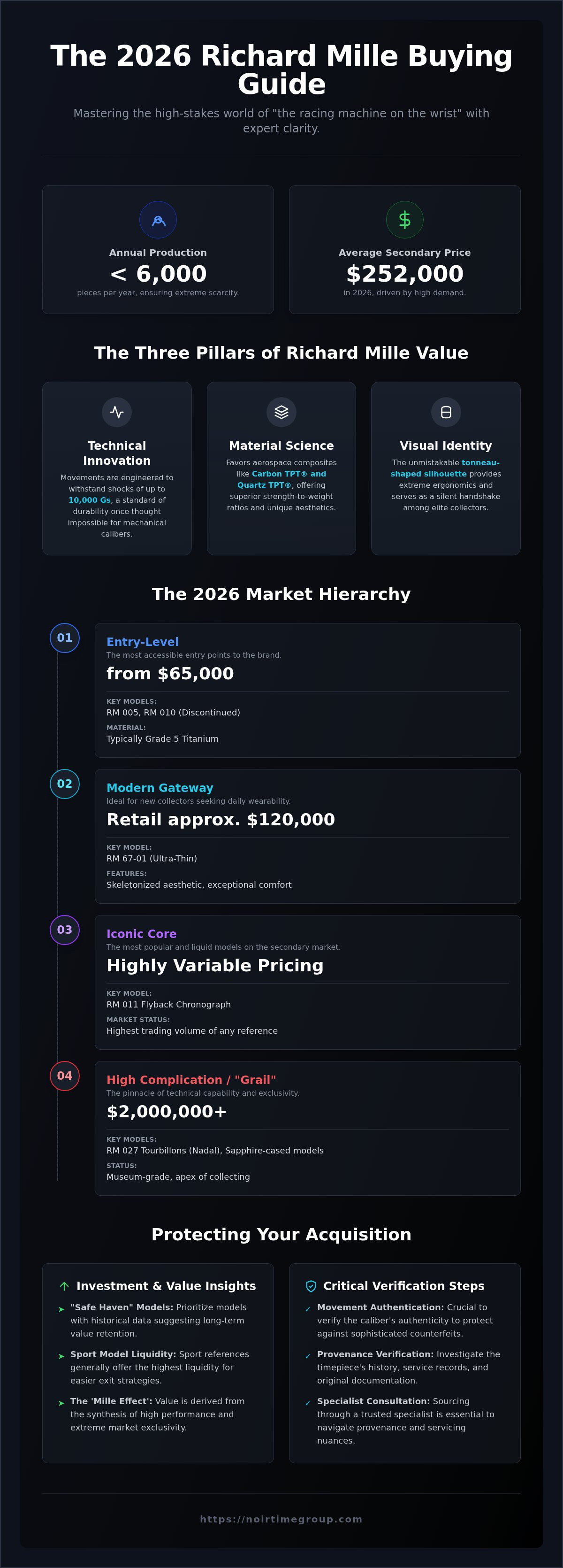
Did you know the average secondary market price for a Richard Mille has climbed to approximately $252,000 in 2026, even though the brand produces fewer than 6,000 pieces a year? This extreme scarcity creates a high-stakes environment where a single misstep can cost a fortune. If you've felt overwhelmed by opaque pricing or the risk of sophisticated counterfeits, you're in the right place. This Richard Mille buying guide provides the expert clarity you need to master this complex landscape and make an informed acquisition.
You likely agree that the secondary market feels increasingly difficult to read without a dedicated advisor. We promise to help you cut through the noise by identifying the only true paths to value retention: material scarcity and movement complexity. We'll preview the 2026 market tiers, explaining the difference between entry-level titanium models starting at $65,000 and the high-complication sapphire cases that exceed $2 million. You'll gain a deep understanding of TPT materials and learn how to secure a verified timepiece through a specialist who understands the nuances of provenance and factory servicing lead times.
Key Takeaways
- Identify specific entry-level and iconic references to navigate the brand's complex model hierarchy with confidence.
- Master the technical differences between Carbon TPT and Grade 5 Titanium to understand how material innovation impacts structural rigidity and aesthetics.
- Use this Richard Mille buying guide to pinpoint "safe haven" models that historical data suggests offer the best long-term value retention.
- Evaluate the liquidity of various sport models to ensure your acquisition strategy aligns with your intended investment or exit timeline.
- Learn the critical steps for movement authentication and provenance verification to protect your capital when sourcing through the secondary market.
The Richard Mille Philosophy: Why It Remains the 'Racing Machine on the Wrist'
Since its inception in 2001, Richard Mille has redefined luxury horology by treating watchmaking like Formula 1 engineering. Every component, from the baseplates to the spline screws, undergoes rigorous testing to ensure it functions under extreme stress. This isn't just marketing fluff. It's a fundamental design ethos where weight is the enemy and performance is the only metric that matters. When researching your own Richard Mille buying guide, understanding the Richard Mille company history reveals a brand that never intended to compete with traditional Swiss maisons. Instead, they created a new category of "wearable engineering."
The brand's signature tonneau case isn't just for show. It's designed to follow the natural curve of the wrist, making even the largest models feel weightless. This extreme ergonomics, combined with a production cap of roughly 5,900 units annually, ensures that demand always outstrips supply. While other brands scale up, Richard Mille remains intentionally small. This scarcity, validated by elite athletes who wear these tourbillons during professional matches, cements the brand's global prestige. It's a rare instance where celebrity validation is backed by genuine technical necessity.
The Three Pillars of Richard Mille Value
- Technical Innovation: Movements are engineered to withstand shocks of up to 10,000 Gs. This level of durability was once thought impossible for mechanical calibers, yet it's now a standard for the brand's sport-focused references.
- Material Science: The brand has largely moved away from heavy precious metals. They favor aerospace composites like Carbon TPT and Quartz TPT, which offer superior strength-to-weight ratios and a unique, layered aesthetic.
- Visual Identity: The unmistakable tonneau-shaped silhouette is recognizable from across a room. It serves as a silent handshake among the world's most elite collectors, signifying an appreciation for modern engineering over classical tradition.
Why 2026 is a Pivotal Year for Collectors
In 2026, the market has matured beyond the "hype buying" seen in previous years. Collectors now prioritize merit, focusing on specific production eras and technical milestones rather than just brand recognition. As the company celebrates its 25th anniversary this year, interest in early references from the early 2000s has surged, driving up prices for original RM 001 and RM 002 models. The 'Mille Effect' describes a phenomenon where a luxury asset's value is derived from its ability to function as a high-performance tool while maintaining extreme exclusivity in the secondary market.
The Richard Mille Hierarchy: Decoding the Model Categories
Navigating the Richard Mille catalog requires more than just capital; it requires a map of the brand's tiered structure. While every piece carries the same engineering DNA, the distinction between a daily wearer and a museum-grade tourbillon is vast. This Richard Mille buying guide categorizes the landscape into four primary tiers. It helps you identify where your interest aligns with current market availability. Discontinued references like the RM 005 and RM 010 represent the most accessible entry points. Their secondary market prices often start around $65,000 for titanium versions. In contrast, current production models like the ultra-thin RM 67-01 retail for approximately $120,000.
At the center of the brand's identity is the RM 011 Flyback Chronograph. It remains the most popular model on the secondary market, seeing the highest trading volume of any reference. For those seeking the pinnacle of technical capability, the high-complication tier includes the RM 027 Nadal tourbillons and sapphire-cased models. These pieces frequently exceed $2 million to $3 million. Even the ladies' collection, specifically the gem-set colored ceramic RM 07-01 starting at $163,000, has seen its investment and resale values climb as collectors recognize these pieces as independent assets rather than just jewelry.
Entry-Level vs. Mid-Tier: Where to Start?
The RM 67-01 is often the best gateway for new collectors. Its ultra-thin profile makes it incredibly wearable for daily use, yet it retains the skeletonized aesthetic that defines the brand. If you prefer a more substantial presence, the RM 011 series offers the iconic tonneau shape and mechanical complexity that collectors expect. When choosing between case shapes, don't overlook the rectangular RM 016. While the tonneau RM 010 is more famous, the RM 016 offers a distinct, slim alternative that fits comfortably under a shirt cuff. If you're looking to acquire a specific reference, consulting with a specialized dealer can help you bypass the volatility of the open market.
The 'Grail' Pieces: Rafael Nadal and Bubba Watson Editions
Athlete collaborations represent the highest level of brand prestige and value retention. The RM 35-02 and 35-03, known as the "Baby Nadal" series, offer the aesthetic of the tourbillon models but with a chronofiable movement designed for extreme shock resistance. Similarly, the RM 055 Bubba Watson in white ceramic has maintained a cult following due to its striking visual contrast and association with high-performance golf. These limited editions have shown historical appreciation of 25% to 400% on the secondary market. Buyers are paying closer attention to these specific references because they represent the intersection of material innovation and sports history.
Material Science: TPT, NTPT, and the Engineering of Luxury
A central pillar of any Richard Mille buying guide is understanding that price premiums aren't driven by precious metal weight. Instead, the brand's value is rooted in the research and development of aerospace-grade materials. While a traditional gold watch relies on intrinsic material value, an RM model's worth comes from its ability to withstand extreme environments. This transition from gold and platinum to carbon nanotubes and silicon nitrides redefined the luxury market. It shifted the collector's focus from "jewelry" to "high-performance equipment."
Grade 5 titanium is the foundation of this engineering. It's used not just for cases, but for the baseplates and bridges of skeletonized movements. This provides the rigidity necessary to maintain chronometric precision under high G-forces. For exterior protection, the brand utilizes advanced ceramics like ATZ (Alumina Toughened Zirconia) and TZP (Tetragonal Zirconia Polycrystal). These materials are virtually scratch-proof and offer permanent color stability. Interestingly, on the secondary market, Carbon TPT variants often command higher premiums than their 18k gold counterparts because they better represent the brand's technical identity. For a deeper look into these proprietary composites, the history of Material Science: TPT and NTPT reveals how Richard Mille adapted sail-making technology for the wrist.
Carbon TPT vs. Quartz TPT: Which is Better?
The manufacturing of TPT (Thin Ply Technology) involves stacking over 600 layers of carbon or silica fibers, each no more than 30 microns thick. These layers are saturated with resin and woven at 45-degree angles before being heated under pressure. This process creates a "damascene" effect, ensuring no two cases have the same grain pattern. Carbon TPT is prized for its extreme lightness and matte finish. Quartz TPT, however, allows for vibrant colors like white, blue, or red by using silica layers. If you want the lightest possible "on-wrist" experience, Carbon TPT is the superior choice, as it feels nearly weightless during active use.
The Rise of Sapphire Cases
The RM 56 series represents the absolute pinnacle of material difficulty. Machining a tonneau-shaped case from a single block of synthetic sapphire is an industrial nightmare. It requires over 1,000 hours of precision milling and polishing. The failure rate is exceptionally high; a single microscopic crack during the final stages of production means the entire case must be scrapped. While these pieces are the ultimate "grail" for collectors, they require specialized care. Maintenance for full sapphire timepieces is critical, as servicing costs can range from $5,000 to $20,000 depending on the complexity of the movement and the integrity of the sapphire seals.
The 2026 Secondary Market: Investment Trends and Valuation
In 2026, the secondary market has shifted toward selective demand. While the average secondary market price sits at approximately $252,000, informed buyers are no longer purchasing based on brand name alone. They're scrutinizing production eras and material combinations. This Richard Mille buying guide emphasizes that "Safe Haven" references like the RM 11-03 Flyback Chronograph continue to dominate trading volume. Liquidity remains high for titanium sport models, allowing collectors to exit positions relatively quickly. However, high-complication sapphire models require a more patient approach due to their $2 million price tags. Regional variances also play a role; New York's Diamond District often sees different inventory flows compared to the high-volume hubs of Dubai and Hong Kong.
The expansion of factory-certified pre-owned programs has brought more transparency to the market. These pieces often carry a price premium, but they provide a baseline for valuation across the industry. In 2026, the market is rewarding substance over novelty. Collectors are moving away from "hype" and toward models with documented athlete associations and verified service histories. Sourcing through a specialist who understands these global price fluctuations is essential to avoid overpaying in a market where demand remains high despite low annual production of roughly 5,900 units.
Authenticity and the 'Franken-Watch' Risk
The risk of "Franken-watches," which are genuine timepieces modified with aftermarket or non-matching parts, is a growing concern. While Richard Mille's skeletonized movements are notoriously difficult to replicate, sophisticated counterfeiters often target external components like bezels or straps. A "Full Set" including the original box, papers, and warranty card is non-negotiable for preserving value. When inspecting a pre-owned piece, use this checklist:
- Verify the movement serial number against the physical warranty card.
- Inspect the spline screws for signs of improper tool usage or marring.
- Check the consistency of the TPT layering across the case and bezel.
- Confirm the service history; remember that 2026 factory lead times can be significant.
Valuation Drivers: Production Years and Limited Series
We're seeing a notable resurgence in "Series 1" models of the RM 011. Collectors are looking back at the brand's roots, viewing these early iterations as historical milestones. Boutique-only editions also command a 15% to 20% premium over standard production runs due to their restricted initial distribution. Navigating these nuances requires more than just a search engine. To ensure you're securing an investment-grade piece at a fair valuation, contact Noir Time Group for expert secondary market advisory. We specialize in identifying individual references that offer the best balance of iconic design and long-term value retention.
Acquiring a Richard Mille: The Noir Time Group Advantage
Buying a Richard Mille isn't like buying any other watch. It's a high-stakes capital allocation that requires more than just a large bank balance. This Richard Mille buying guide has outlined the technical and market complexities, but the final hurdle is the acquisition itself. Noir Time Group serves as a trusted advisor, navigating a global network of private collectors to find specific references that never reach public listings. We don't just sell inventory; we manage the entire lifecycle of your collection. Our expertise in sourcing rare RM references ensures you aren't limited to what's currently sitting in a display case.
Our due diligence protocol is exhaustive. Every timepiece undergoes a rigorous provenance check and movement authentication. We verify the "Full Set" status and ensure the watch meets the highest 2026 standards for mechanical integrity. This is crucial because factory servicing costs can range from $5,000 to $20,000. Knowing the exact condition of a movement before you buy prevents unexpected financial burdens later. We also provide post-purchase support, helping you manage insurance requirements and future trade-ins as your collection evolves.
The 5-Step Acquisition Framework
We guide our clients through a structured process to ensure long-term satisfaction. First, we define your objective. Are you looking for a daily wearer like the RM 67-01 or a "vault-queen" investment? Second, we budget for the total cost of ownership. This includes specialized insurance and future maintenance costs. Third, we tap into our verified global network to source the best available example. Fourth, we perform a final, multi-point authentication. Finally, we manage the secure, insured delivery to your location, providing a private concierge-level service for HNW collectors.
Why Work with a Specialist Consultant?
Generalist luxury marketplaces often lack the technical depth to spot sophisticated "Franken-watches" or subtle movement issues. By working with a specialist, you gain access to off-market pieces and private allocations that stay away from the volatility of public auctions. We understand the nuances of the 2026 market, where production remains capped at approximately 5,900 units annually. This scarcity means the best pieces are often traded privately. If you're ready to secure a specific reference or need assistance evaluating a potential purchase, contact Noir Time Group for a private consultation. We'll help you navigate this high-stakes market with professional clarity and discretion.
Mastering the Future of Your Horological Collection
You've seen how the 2026 market rewards those who prioritize technical merit over mere brand recognition. From the shock-resistant engineering of the "Nadal" series to the microscopic precision of sapphire cases, the stakes for collectors have never been higher. This Richard Mille buying guide highlights that success in this landscape requires a blend of deep material knowledge and access to off-market inventory. With annual production still capped at approximately 5,900 units, the competition for the finest references remains fierce.
Don't leave your acquisition to chance in a secondary market where the average price exceeds $250,000. Noir Time Group offers expert authentication of high-complication timepieces and a global sourcing network for rare RM references that simply don't appear in public listings. By choosing an asset-focused horological advisory, you're protecting your capital while securing a piece of wearable engineering history. Whether you're seeking your first titanium reference or a museum-grade tourbillon, professional guidance is the ultimate complication.
Start your Richard Mille acquisition with a Noir Time consultation today. Your collection's next milestone is within reach when you have the right expertise by your side.
Frequently Asked Questions
What is the cheapest Richard Mille model for a first-time buyer?
Discontinued titanium models like the RM 005 or RM 010 are generally the most accessible entry points for new collectors. On the secondary market, these references typically start around $65,000. While they don't have the ultra-thin profile of the newer RM 67-01, they provide the essential skeletonized aesthetic that defines the brand. This makes them a popular starting point for those following a Richard Mille buying guide for the first time.
Why are Richard Mille watches significantly more expensive than Patek Philippe or Rolex?
Extreme material innovation and intentionally low production volume drive these high price points. While Rolex produces roughly one million watches annually, Richard Mille forecasted only 5,900 pieces for 2024. The brand uses aerospace-grade composites and labor-intensive skeletonized movements that are far more complex to manufacture than traditional steel or gold luxury watches. You're paying for wearable engineering rather than just brand heritage or precious metal weight.
How often does a Richard Mille need to be serviced, and what is the cost?
A Richard Mille watch generally requires a full service every three to five years to maintain its performance. The cost for this maintenance typically ranges from $5,000 to $20,000 depending on the movement's complexity and required parts. In 2026, factory lead times remain significant, so you should plan for your timepiece to be away for several months. Regular servicing is vital for maintaining the watch's water resistance and long-term chronometric precision.
Is a Richard Mille a good investment in 2026?
Select models remain strong assets in 2026, but the market now favors technical merit over brand hype. Limited editions and athlete collaborations, such as the Rafael Nadal series, have historically shown appreciation between 25% and 400% on the secondary market. Buyers should focus on specific references with documented historical importance. Using a professional Richard Mille buying guide helps you identify which models offer the best balance of iconic design and value retention.
What does 'TPT' stand for in Richard Mille watches?
TPT stands for Thin Ply Technology, which is a proprietary composite material originally used in Formula 1 and aerospace industries. The process involves stacking hundreds of microscopic layers of carbon or silica fibers at varying angles before curing them under high pressure. This creates a unique grain pattern on every case, ensuring that no two watches are identical. It's prized by collectors for being exceptionally light, durable, and shock-resistant.
How can I tell if a Richard Mille RM 011 is authentic?
Authentication starts with the movement's architecture and the consistency of the TPT layering across the case. Counterfeiters often struggle with the depth and finish of skeletonized baseplates or the specific shape of the spline screws. You must also verify the "Full Set," which includes the physical warranty card and original box. Because the RM 11-03 is the most traded model, sourcing through a specialist with a rigorous verification protocol is essential.
Can I wear my Richard Mille for sports and high-impact activities?
Yes, Richard Mille watches are specifically engineered to withstand high-impact activities and extreme environments. Many models are tested to survive shocks of up to 10,000 Gs, which is why elite athletes wear them during professional tennis matches and golf tournaments. The use of Grade 5 titanium for baseplates ensures the movement stays rigid during intense physical movement. They are designed to be high-performance tools that actually function under pressure.
Does Richard Mille hold its value better than other luxury brands?
Richard Mille often outperforms traditional luxury brands on the secondary market due to its extreme scarcity and high demand. With an average secondary market price of roughly $252,000, the brand maintains a very high floor for valuation. While some specific Rolex or Patek Philippe models also appreciate, the sheer rarity of RM pieces often leads to higher percentage gains for sought-after references. The market's selective demand in 2026 continues to support these valuations.
