

That inherited wooden box on your desk isn't just a collection of family heirlooms; it is a high-stakes portfolio of mechanical assets that requires immediate, expert triage. Whether you've discovered a vintage Rolex or a rare Patek Philippe, the pressure to make the right decision can feel heavy. It's common to feel overwhelmed by technical jargon while worrying that one wrong move could devalue a piece worth thousands. You want to honor the legacy of the previous owner, but you also need to know exactly what to do with an inherited watch collection to protect your interests in the 2026 market.
We understand the emotional and financial weight of this responsibility. This guide provides the professional clarity you need to handle valuation, preservation, and potential sale. You'll learn how to identify market rarity, how to avoid storage mistakes that lead to costly repairs, and how to choose the right path forward. Whether that involves a private sale to a NYC specialist or a meticulous restoration, you'll find the answers here. By the end of this article, you will have a clear roadmap for handling these timepieces with the confidence and precision they deserve.
Key Takeaways
- Learn to identify high-value assets from brands like Patek Philippe and Audemars Piguet while distinguishing between mechanical and quartz movements.
- Understand the essential preservation protocol, including why you must never polish a vintage timepiece before a professional consultation.
- Discover the critical differences between insurance appraisals and fair market value to ensure you aren't misled by unrealistic asking prices online.
- Gain a clear framework for what to do with an inherited watch collection by weighing restoration costs against current 2026 market demand.
- See why partnering with a verified New York luxury specialist provides the security and authentication necessary for high-stakes watch transactions.
The Triage Phase: Identifying What You Have Inherited
The initial discovery of a family timepiece is often a mix of nostalgia and anxiety. Determining what to do with an inherited watch collection starts with a cold, clinical assessment of every piece in the box. You aren't just looking at jewelry; you're looking at mechanical assets that require a specific identification process before they can be valued or sold. Taking the time to inventory these items correctly prevents the accidental loss of value that occurs when high-stakes pieces are treated like common fashion accessories.
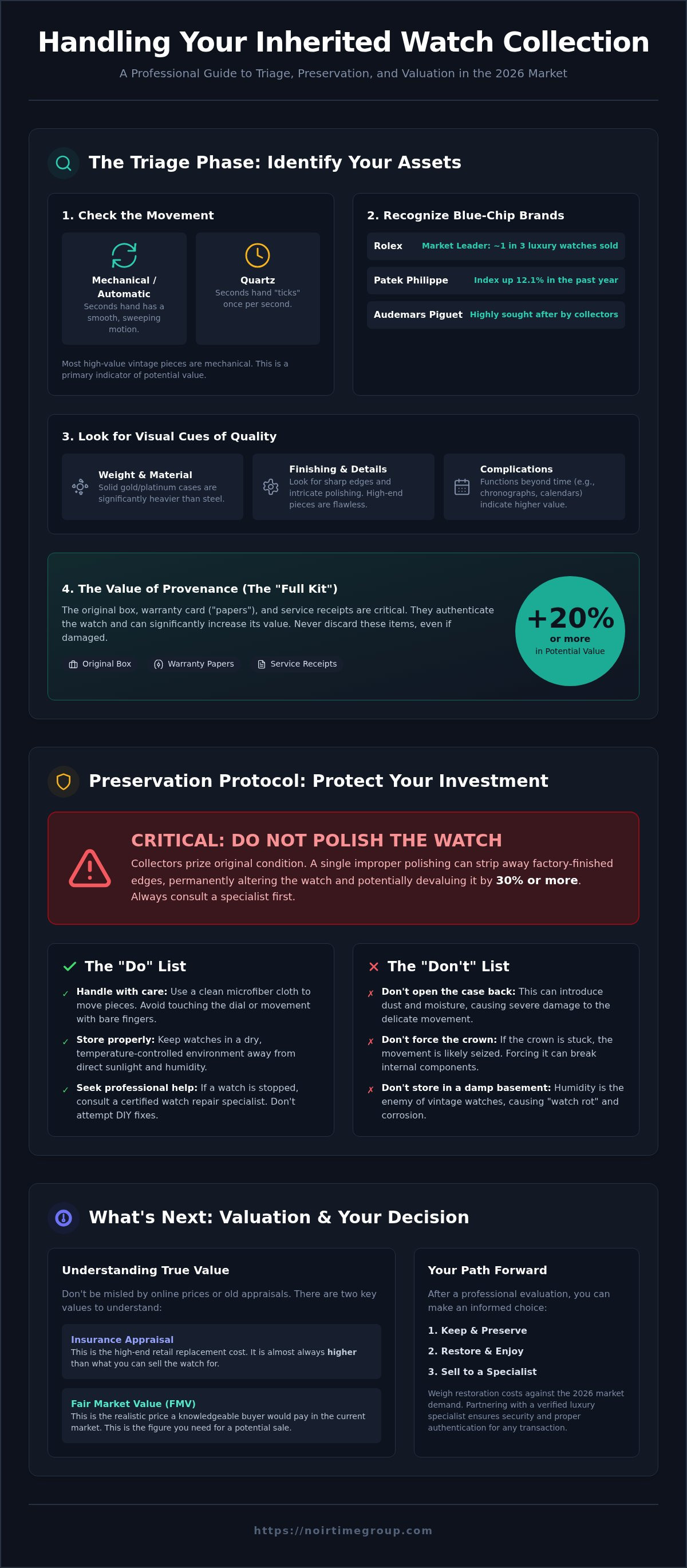
Start with the movement. Most high-value pieces from the 'Big Three,' specifically Rolex, Patek Philippe, and Audemars Piguet, are mechanical. If the seconds hand sweeps smoothly rather than ticking once per second, you likely have a mechanical or automatic movement. Identifying the reference and serial numbers is the next step. These are usually engraved between the lugs, where the strap meets the case, or on the case back. Avoid opening the case yourself. This can introduce dust or moisture that damages the delicate internal components; instead, use a jeweler's loupe to read the external engravings.
Recognizing Blue-Chip Luxury Brands
Luxury brands hold their value because of their engineering and heritage. In 2026, Rolex remains the market leader, accounting for approximately one in every three luxury watches sold globally. If you find a Rolex Submariner Date 126613LN or a Patek Philippe Nautilus, you're handling a blue-chip asset. The Patek Philippe index has seen a 12.1% increase over the past year, making these pieces highly sought after by serious NYC collectors.
High-end horology is distinguished by specific visual cues:
- Weight: Solid gold or platinum cases feel significantly heavier than steel or plated fashion watches.
- Finishing: Look for sharp, clean edges and intricate polishing on the movement if the case back is transparent.
- Complications: Understanding watch complications, or the functions a watch performs beyond telling time, helps you identify rarity. A perpetual calendar or a chronograph on an Audemars Piguet Royal Oak can drastically change its market position compared to a standard model.
The Value of Documentation and Provenance
In the collector's market, the 'kit' is nearly as important as the watch itself. This includes the original box, the warranty card or 'papers,' and any service receipts. Finding these items can increase a watch's value by 20% or more. They provide a clear history of ownership and maintenance, which is vital for authentication. Without these, a buyer has to assume a higher level of risk, which naturally lowers your potential return.
Service records are especially critical. They prove the watch was maintained by certified professionals and hasn't been tampered with by amateurs. Even if the original box is damaged or peeling, don't throw it away. Collectors prize the original packaging because it completes the provenance of the piece. This documentation is your best defense against being 'low-balled' during a sale, as it verifies the watch's journey from the original retailer to your hands.
Preservation Protocol: How to Handle High-Value Timepieces
The first impulse when deciding what to do with an inherited watch collection is often to "clean it up." This is a mistake that can cost you thousands of dollars in resale value. While you might want to see a shiny, like-new surface, collectors in the 2026 market prize original condition above all else. A single improper polishing can strip away the sharp edges of a Rolex Submariner's case, permanently altering its silhouette and devaluing the piece by 30% or more. This is the most critical rule of preservation: never polish a vintage luxury watch before a professional consultation.
Handling these items requires a specific etiquette. Use a clean microfiber cloth to move pieces. Avoid touching the dial or the movement with bare fingers, as skin oils are acidic and can cause permanent staining over time. If a watch has stopped, don't force the crown if it feels stuck. A seized movement often indicates that the internal lubricants have dried into a concrete-like substance. Forcing it can snap delicate gears. Instead, seek certified watch repair services to safely assess the internal state of the timepiece.
The 'Golden Rules' of Watch Storage
Proper storage is the only way to prevent "watch rot," a term for the internal corrosion caused by humidity. If you're storing pieces long-term, avoid damp basements or areas with direct sunlight, which can fade dials and dry out gaskets. Modern electronics also pose a hidden threat. Magnetic fields from speakers, tablets, and even some smartphone cases can magnetize a mechanical hairspring, causing the watch to run wildly fast or stop entirely. When organizing for transport to an appraiser, wrap each watch individually in soft cloth to prevent metal-on-metal scratching.
Why Original Condition Beats 'Like New'
In the world of high-end horology, there's a distinct difference between "patina" and "damage." Patina, such as the gradual color shift on a vintage Patek Philippe dial, is evidence of a watch's history and is highly desirable. Damage, like deep gouges or water entry, is a liability. Collectors look for the "unpolished" premium, where the factory-original finish remains intact despite minor scratches. Original parts are always more valuable than service replacements. Replacing a faded bezel or a worn dial with a modern service part may make the watch look newer, but it destroys the historical integrity that drives value.
Preserving this value is critical not just for the sale, but for understanding your financial position. Because the tax implications of selling depend on the value at the time of the previous owner's passing, you should review the IRS rules on basis of inherited assets to see how a "stepped-up basis" might apply to your situation. Maintaining the watch in its original state ensures you have the highest possible starting point for any future transaction.
Determining Market Value in the 2026 Luxury Climate
Determining what to do with an inherited watch collection requires a sharp eye for market data and an understanding of how 2026 economic trends affect luxury assets. The secondary watch market grew by 5.1% over the past year, but value isn't uniform across all brands. While the Patek Philippe index is up 12.1% according to recent 2026 reports, other models may not see the same trajectory. You must distinguish between what a watch is worth on paper and the actual cash liquidity it represents in a professional transaction.
Appraisal vs. Real-World Liquidity
Professional valuations generally fall into three distinct categories. An insurance appraisal calculates the replacement value, which is the cost to buy the same watch at retail today. In 2026, contemporary watch appraisals typically cost between $170 and $250 per item, while a dedicated Rolex appraisal often runs about $150. Fair market value is the price a private collector might pay you in an open market. Liquidation value is the immediate cash price a dealer offers to take the asset off your hands.
You should expect a dealer spread. A specialist in New York must account for authentication, certified repair, and the risk of holding a high-value asset in inventory. You likely won't receive 100% of the retail price because the dealer provides the immediate liquidity and security you lack in a private sale. Current market trends, such as the continued demand for integrated bracelets found on the Patek Philippe Nautilus or the Audemars Piguet Royal Oak, can narrow this spread for the right pieces.
Tools for Preliminary Research
Start your research by looking at "Sold" listings on reputable platforms rather than "Asking" prices. Anyone can list a Rolex Submariner Date 126613LN for an ambitious price, but only completed transactions reveal the true market ceiling. Use serial number databases to date your collection precisely. This helps identify "Frankenwatches," which are genuine watches that have been reconstructed with mismatched or incorrect parts. A vintage case paired with a later service dial is a common discovery in inherited collections, and it can significantly reduce collector interest.
If you find yourself confused by the nuances of "Full Set" status or the impact of original documentation, it's time to stop the DIY research. High-stakes valuations in a volatile market are best handled by a verified New York specialist. Dealing with a physical retailer provides a level of security that anonymous online buyers cannot match, ensuring your family's legacy is valued accurately and handled with professional care.
Decision Time: Keep, Restore, or Sell?
Once you've cataloged the inventory, the real challenge begins: deciding what to do with an inherited watch collection in a way that respects both the family legacy and your financial future. It's easy to assume the best path is keeping everything for the next generation, but luxury watches are mechanical machines, not static jewelry. They require active, expensive management. If you aren't prepared for the ongoing cost of ownership, holding onto a dozen high-end pieces might lead to their eventual deterioration. Navigating the emotions of selling a parent's or grandparent's collection is difficult, but letting a machine fail through neglect is rarely the better tribute.
The Realities of Watch Maintenance
High-tier brands like Patek Philippe and Audemars Piguet typically require a full movement service every five to eight years. When a watch sits in a safe for decades, the specialized lubricants inside the movement dry out. Running a watch with "dry" lubricants is like driving a car without oil; the metal gears will grind against each other, leading to catastrophic failure. Restoration is often a smart investment for a single heirloom piece, but restoring an entire collection can quickly reach five figures. You have to ask if the emotional value of each piece justifies the recurring investment in its mechanical health.
Strategic Liquidation Options
If the maintenance costs feel overwhelming, partial liquidation is a common and practical path. You might choose to sell the assets you have no emotional connection to, using those funds to pay for the certified watch repair of the one or two pieces you truly want to wear. When you decide to sell, you have two primary routes. A direct sale to a New York specialist offers immediate cash and closure. Consignment might net a higher percentage, but it can take months to find a buyer. In 2026, many reputable consignors charge between 8% and 10% of the final sale price for watches over $15,000.
Another sophisticated move is "trading up." If you've inherited several smaller pieces that don't fit your style, you can trade them toward a single iconic model like a Rolex Submariner Date 126618LN or a Patek Philippe Nautilus. This consolidates your inherited value into one highly liquid, easily maintained asset. Dealing with a verified New York retailer ensures you aren't navigating these high-stakes trades alone. It provides a level of security and authentication that anonymous online marketplaces simply can't match, allowing you to transition the collection into something that fits your life today.
Partnering with a New York Luxury Specialist
New York is the undisputed heart of the global luxury watch trade. In December 2025, the New York Watch Auction XIII set a historic record with a total of $43.5 million, proving that the city remains the primary destination for high-stakes horology. When you're deciding what to do with an inherited watch collection, tapping into this local expertise is the only way to ensure your assets are treated with the precision they require. A generalist jeweler or a local coin shop might recognize a gold watch, but they often lack the deep market data needed to value a Patek Philippe Nautilus or a specific vintage Audemars Piguet Royal Oak correctly.
Noir Time Group provides a white-glove approach that prioritizes security and professional authentication. We specialize in high-value brands, dealing in timepieces that typically range from $18,000 to over $42,000. Our NYC-based expertise offers a physical presence and a level of accountability that anonymous online marketplaces can't match. Through our watch sourcing service and extensive network of private collectors, we identify market rarity that generalists often miss. Whether you're handling a Rolex Submariner Date 126618LN or a rare independent maker, our team ensures every piece is verified for its movement, condition, and provenance.
The Advantage of Professional Sourcing and Sales
Working with a specialist provides a significant advantage when handling rare or "neo-vintage" models. Our network allows us to understand current 2026 market trends, such as the rising interest in smaller 36-39mm case sizes and expressive dial colors. This specialized knowledge prevents you from selling a high-potential asset too early or for too little. We're committed to transparency, helping you understand why a "full set" with original papers is vital for a high-stakes transaction. Dealing with a verified New York retailer protects you from the logistical risks and fraudulent schemes often found in the anonymous digital secondary market.
How to Get Started with Your Collection
Taking the first step doesn't have to be overwhelming. Start by preparing a basic inventory list. Include the brand, model, and any reference numbers you've found between the lugs. Note the presence of original boxes or service receipts, as these documents are essential for proving the watch's history. We offer both secure remote evaluations and in-person consultations at our NYC location to accommodate your needs. This professional oversight is the most reliable way to determine exactly what to do with an inherited watch collection while maximizing its legacy. Contact Noir Time Group for a professional assessment of your inherited collection to begin the process with a trusted partner.
Securing Your Family's Horological Legacy
Handling a high-value timepiece collection is a significant responsibility that balances emotional heritage with financial strategy. You've learned how to identify blue-chip assets, why original condition is paramount, and how the 2026 luxury market rewards those who prioritize provenance. Deciding exactly what to do with an inherited watch collection doesn't have to be a solitary burden. Whether you choose to keep a single heirloom or liquidate a diverse portfolio, the key is acting with precision rather than haste.
Noir Time Group stands ready to assist in the heart of New York's luxury market. Our specialization in Rolex, Patek Philippe, and Audemars Piguet ensures your collection receives the expert attention it requires. We offer a secure environment where authenticity is guaranteed and valuations are transparent. Taking the next step with a professional partner provides the peace of mind that your family's legacy is in the right hands.
Request a Professional Evaluation for Your Inherited Collection
Your journey from discovery to a confident decision starts with expert guidance. We look forward to helping you navigate the complexities of these exceptional machines.
Frequently Asked Questions
Is it better to clean an inherited watch before showing it to a dealer?
No, you shouldn't clean or polish an inherited watch before showing it to a specialist. Collectors in the 2026 market specifically look for "unpolished" watches that retain their original factory finish and sharp case edges. Harsh cleaning agents or DIY polishing can permanently damage the metal and the dial, significantly reducing the resale value. Simply use a soft, dry microfiber cloth to remove surface dust and let the professional dealer handle any deep assessment.
How do I know if the Rolex I inherited is real or a high-quality replica?
Professional authentication is the only definitive way to verify a Rolex. While high-quality replicas can mimic the look, they rarely replicate the substantial weight of solid gold or the intricate finishing of a genuine movement. A specialist will examine the engravings between the lugs and the internal components to confirm authenticity. If you're unsure about what to do with an inherited watch collection, starting with a certified NYC specialist ensures you aren't misled by a sophisticated fake.
What are the tax implications of inheriting a high-value watch collection?
Tax implications depend on the total value of the estate and your specific location. In 2026, the federal estate tax exemption is $15 million, while the New York state exemption is between $7.16 million and $7.35 million. New York has a "cliff" provision that eliminates the exemption if the estate exceeds 105 percent of the threshold. You should consult a tax professional regarding the "stepped-up basis" rules for inherited assets to avoid unexpected liabilities.
Does a watch lose value if it isn't running?
A watch that isn't running will lose some value, but it remains a significant financial asset. Most non-running luxury watches simply have dried lubricants or a broken mainspring, which are fixable issues for a professional. Do not attempt to force the crown to wind a seized watch, as this can break delicate internal gears. A specialist will factor the cost of a certified repair into their offer, allowing you to sell the piece in its current condition.
Should I get my inherited watch serviced before I try to sell it?
Generally, you shouldn't service a watch immediately before selling it. Dealers and specialists often have their own certified repair networks and can perform the service more cost-effectively than a private individual. Additionally, a buyer might prefer to see the watch in its original, untouched state to verify its history. If you're deciding what to do with an inherited watch collection, it's usually more profitable to sell the pieces as they are and let the professional handle the restoration.
What is the difference between a reference number and a serial number?
A reference number identifies the specific model and configuration, while a serial number is a unique identifier for that individual watch. For example, a Rolex Submariner Date 126613LN is a reference number shared by all watches of that specific style. The serial number is a one-of-a-kind code engraved on the case that allows you to track the specific production date. Both numbers are essential for an accurate professional valuation and the authentication process.
Can I sell an inherited watch if I don't have the original box or papers?
Yes, you can sell an inherited watch without the original box or papers, though the market value will be lower. These documents, known as the "full set," can add 20 percent or more to the final price because they provide a clear provenance. However, highly desirable models like a Patek Philippe Nautilus or an Audemars Piguet Royal Oak remain extremely valuable even as "naked" watches. A specialist can still authenticate these pieces through their internal serial numbers.
How long does the professional appraisal and sale process usually take?
The professional appraisal and sale process typically takes between three to seven business days. This timeframe allows the specialist to conduct a thorough physical inspection, verify the movement, and research current 2026 market trends. While some online buyers claim same-day service, a reputable New York retailer takes the necessary time to ensure the valuation is accurate. This process provides the security and transparency needed for high-stakes transactions involving luxury mechanical timepieces.
