

The biggest Yacht-Master isn’t automatically the right one for you. A 44 mm Yacht-Master II serves a different purpose from the time-and-date Yacht-Master, which comes in 37, 40, and 42 mm sizes. If the references, materials, and features start to blur together, that’s understandable: small differences can change how a watch wears and what it offers.
To choose a yacht-master, start with purpose, then compare fit, material, and movement. This guide distinguishes the Yacht-Master from the Yacht-Master II, explains how case size, bezel, dial, and bracelet or Oysterflex strap shape each configuration, and outlines the 2026 Yacht-Master II updates. Use these practical priorities to narrow your shortlist, whether you want a discreet fit, a precious-metal finish, or a dedicated regatta countdown function.
The collection offers distinct configurations rather than one signature look. Noir Time Group guarantees the authenticity of every timepiece and offers expert guidance, so you can compare references and focus on the Yacht-Master that fits your wrist, style, and priorities.
Key Takeaways
- Distinguish the time-and-date Yacht-Master from the Yacht-Master II’s regatta-focused features before comparing references.
- Shortlist a yacht-master by intended wear, wrist fit, preferred case size, and the balance of materials and dial contrast.
- Compare the steel-and-platinum 40 mm 126622 with the Everose 40 mm 126621 to see how metal tone changes the watch’s overall impression.
- Use the buyer checklist to weigh bezel, function, and bracelet or Oysterflex strap style against your priorities.
- Compare configurations with expert guidance and the authenticity guarantee that comes with every timepiece.
What Makes the Rolex Yacht-Master Different?
The Rolex Yacht-Master is a nautical-inspired sports-watch family with time-and-date models in varied sizes, metals, dials, bezels, and bracelet or strap configurations. Its maritime design gives it a distinct character, while the range lets you choose between an everyday look and a more precious-metal-forward style.
The Yacht-Master is a family of configurations, not one fixed design. Its history includes the introduction of additional sizes and materials, followed by the Yacht-Master II. For background on how the line developed, see this overview of Rolex Yacht-Master history.
Yacht-Master vs. Yacht-Master II: What Is the Difference?
The standard Yacht-Master has a bidirectional bezel with a graduated 60-minute scale. Rotate it to track elapsed time; the bezel is both a practical feature and a defining design detail.
The Yacht-Master II is a larger, more specialized regatta chronograph with a programmable countdown function for timing a race start. In the 2026 generation, the countdown is programmed using the lower pusher, and the hands move counter-clockwise. The two families suit different feature preferences, not a simple better-or-worse ranking.
The Design Details That Define the Collection
Material is one of the clearest ways to distinguish configurations. Options include Oystersteel, platinum, Everose gold, yellow gold, and white gold. Rolesium is Rolex’s term for a combination of Oystersteel and platinum, pairing a steel case with a platinum bezel.
Bezel material and finish also shape the watch’s overall impression. Some Yacht-Master bezels use precious metal, while Cerachrom refers to Rolex’s ceramic bezel material. Dial colour can add contrast or keep the look restrained. The bracelet or Oysterflex strap completes the design, from the classic appearance of a metal bracelet to a sportier, flexible style.
When building a yacht-master shortlist, first separate the countdown-focused Yacht-Master II from the standard time-and-date models. Then compare case presence, metal tone, dial, bezel, and strap or bracelet together rather than choosing on the basis of one feature.
Yacht-Master Sizes, Materials, and Features to Compare
Case size sets the first impression, but it’s only one part of the decision. The table maps the requested sizes to representative configurations. The 35 mm size belongs to earlier references; the other examples include current models described in the 2026 collection information.
| Size | Example | What to compare |
|---|---|---|
| 35 mm | Earlier Yacht-Master references | A more compact historical option; check the specific reference for its material and features. |
| 37 mm | 268622 Rolesium; 268621 Everose Rolesor; 268655 Everose gold | Compare steel and platinum, two-tone warmth, and solid-gold presence. |
| 40 mm | 126622 Rolesium; 126621 Everose Rolesor; 126655 Everose gold | A larger standard Yacht-Master size, with Oysterflex available on the 126655. |
| 42 mm | 226659 white gold; 226658 yellow gold; 226627 RLX titanium | Notice how precious metal or lightweight titanium changes the feel and appearance. |
| 44 mm | 126680 Oystersteel; 126688 yellow gold | These Yacht-Master II examples pair a larger case with the regatta countdown function. |
Which Yacht-Master Case Size Should You Choose?
The 37 mm and 40 mm models offer different levels of wrist presence within the standard Yacht-Master family. The 42 mm Yacht-Master and 44 mm Yacht-Master II make a bolder visual statement, and the Yacht-Master II adds a distinct function. Diameter alone doesn’t determine comfort: wrist shape, lug-to-lug span, and bracelet or strap fit matter too. If possible, try comparable sizes on your wrist and notice whether the case feels balanced and stays comfortable as you move your hand.
How Metal, Dial, Bezel, and Strap Change the Look
Rolesium combines Oystersteel with a platinum bezel, while Everose Rolesor pairs Oystersteel and Everose gold. Solid yellow, white, and Everose gold create a more precious-metal-forward impression; RLX titanium offers another material choice. Dial examples include blue, dark rhodium, chocolate, black, and white. Standard Yacht-Master bezels use a bidirectional 60-minute scale. Yacht-Master II models use a Ring Command bezel associated with the regatta function, while the 2026 generation programs the countdown through the lower pusher. Oysterflex gives the watch a sportier strap profile, while an Oysterlock bracelet offers a metal-bracelet look. Compare the full combination of size, metal, dial, bezel, and strap to decide whether a yacht-master feels compact, bold, understated, or more luxurious.
Compare the available Yacht-Master configurations against these priorities.
Which Yacht-Master Configuration Fits Your Priorities?
Start with the impression you want on your wrist: balanced and versatile, warm with precious-metal accents, or bold with a distinctive strap or specialist function. Reference examples can narrow the field, but wrist proportions and personal style matter more than a one-size-fits-all recommendation.
For a Versatile, Balanced Everyday Look
The 40 mm Yacht-Master 126622 combines Oystersteel with a platinum bezel, a pairing known as Rolesium. With a blue or dark rhodium dial, it keeps a cool-toned look. Blue adds colour, while dark rhodium keeps the contrast restrained. The 40 mm 126621 pairs Oystersteel with Everose gold and comes in black or chocolate dial examples. Its warm gold accents stand out against the steel. These are style distinctions, not measures of which model is a better investment.
For Precious Metals, Distinctive Straps, or Regatta Timing
For a stronger precious-metal presence with a flexible strap, consider the 42 mm white-gold Yacht-Master with black dial and Oysterflex, reference 226659. The 40 mm Everose gold 126655 also pairs precious metal with Oysterflex. By contrast, the 126621 uses a steel-and-Everose bracelet configuration, carrying the metal contrast from the case onto the wristband. The 44 mm Yacht-Master II references 126680 in Oystersteel and 126688 in yellow gold meet a different priority: their programmable regatta countdown is a functional distinction, not simply another styling choice.
Use this quick matrix to create a shortlist, then compare how each case and strap wears on your wrist.
| Priority | Reference to explore | Why it may fit |
|---|---|---|
| Cool-toned, balanced look | 126622, blue or dark rhodium dial | Steel and platinum keep the palette restrained. |
| Warm accents with a bracelet | 126621, black or chocolate dial | Everose adds contrast to the steel configuration. |
| Precious metal with Oysterflex | 226659 or 126655 | White gold or Everose paired with a flexible strap. |
| Regatta countdown function | 126680 or 126688 | Yacht-Master II functionality in steel or yellow gold. |
To narrow your yacht-master shortlist, decide whether wrist presence, metal tone, dial contrast, strap style, or countdown functionality matters most. With that priority set, you can make the next comparison more focused.
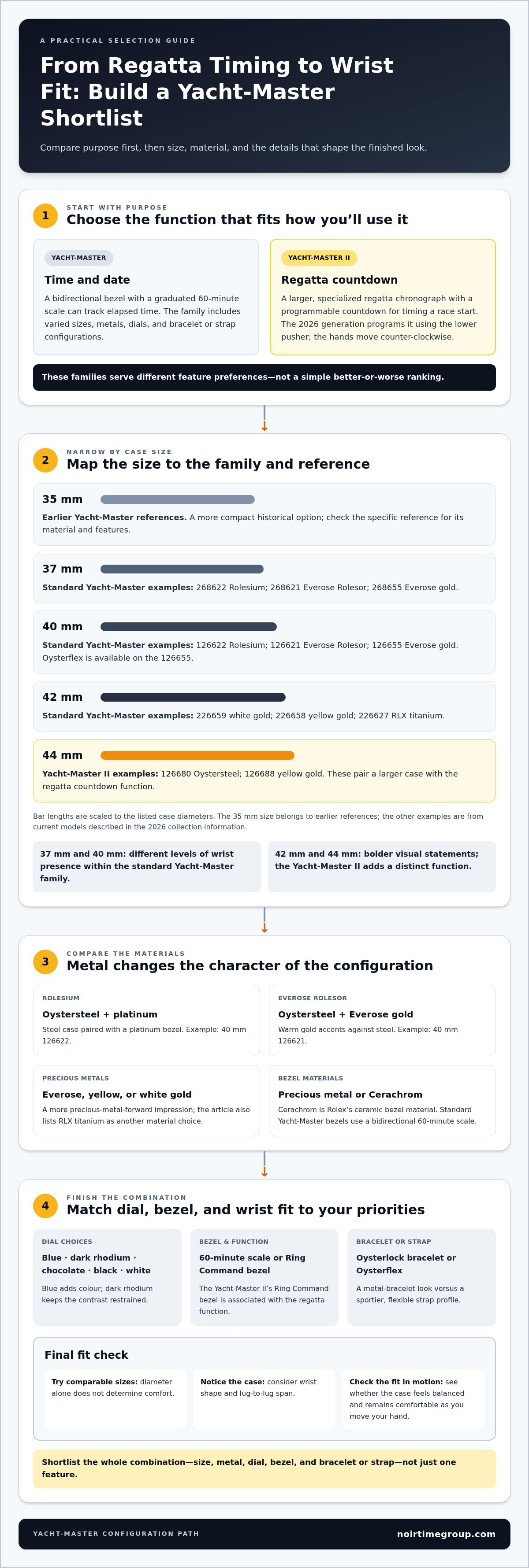
How to Choose a Yacht-Master: A Practical Buyer Checklist
A clear shortlist keeps your attention on the details that matter, rather than on a reference number or striking photograph alone. Work through these five steps before deciding.
A Five-Step Yacht-Master Shortlisting Process
- Decide which family fits your priorities. Choose a standard Yacht-Master for its time-and-date display and bidirectional 60-minute bezel. Consider the Yacht-Master II if you want its programmable regatta countdown.
- Set your case-size preference. Start with how you plan to wear the watch and how it fits your wrist. Then compare the 37 mm, 40 mm, or 42 mm standard models with the 44 mm Yacht-Master II. Try similar sizes on your wrist when possible; photos can’t show how a case’s proportions feel.
- Narrow the design. Decide on metal tone, dial colour, bezel, and bracelet or Oysterflex strap. For example, compare the cooler steel-and-platinum look with the warmer steel-and-Everose combination.
- Compare reference details. Check that the reference number, case size, material, dial, bezel, and strap or bracelet in the listing match the specific watch shown.
- Review condition and documentation. Read the condition description carefully and review the available documentation. Treat documents as useful supporting information, not a substitute for assessing the watch itself.
Authenticity and Condition: Details Worth Reviewing
Small mismatches matter. Check that the reference corresponds with the stated configuration and that the visible materials, dial, and features match the description. Noir Time Group guarantees the authenticity of every timepiece and provides expert guidance to help you compare references. If you’re looking for a particular configuration, the watch sourcing service can help you pursue it.
Common Yacht-Master Buying Mistakes to Avoid
Don’t choose a case size from online images alone or assume a model’s reputation means it will suit your wrist. Don’t confuse the standard Yacht-Master’s 60-minute bezel with the Yacht-Master II countdown function. And don’t assume a precious-metal case, a particular dial, or an Oysterflex strap is right for every buyer. The best match depends on your priorities, not a universal ranking or promised resale performance.
What to Expect from a Specialist Retailer
Expert guidance can make reference and configuration comparisons clearer. Noir Time Group also offers certified watch repair and after-sales care, supporting buyers beyond the initial selection.
Before you buy, confirm that the reference, materials, features, condition, and documentation match the specific watch you’re considering. Use your shortlist to explore the Yacht-Master collection.
Explore Yacht-Master Models at Noir Time Group
The Yacht-Master range is easier to compare by looking at specific references instead of treating it as one standard design. Differences in case size, metal, dial, strap, and function create distinct options, from 37 mm models to the larger Yacht-Master II.
Standout Yacht-Master Examples to Compare
The 40 mm 126622 is a steel-and-platinum Rolesium example, often paired with a blue dial. For a smaller case, compare the 37 mm 268622 in steel and platinum with the 37 mm 268621 in Oystersteel and Everose gold. The first has a cooler metal contrast; the second brings warmer gold accents. These examples help clarify your preferred size and metal tone without suggesting one style suits every wrist.
Oysterflex adds another point of comparison. The 40 mm Everose gold 126655 and 42 mm white-gold 226659 pair precious-metal cases with this flexible strap. The 226659 is a standard Yacht-Master, not a Yacht-Master II. For shoppers drawn to timing functionality, the 44 mm Yacht-Master II includes Oystersteel reference 126680 and yellow-gold reference 126688. The earlier steel 116680 is a previous-generation reference with a programmable regatta countdown, distinct from the current-generation models.
Use the reference as a starting point, then compare the individual watch’s stated size, materials, dial, strap or bracelet, and function. This keeps your shortlist grounded in details that affect both appearance and use.
Take the Next Step Toward Your Shortlist
Before browsing, revisit your priorities: preferred case size, metal tone, dial contrast, strap style, and whether you want the standard Yacht-Master or the Yacht-Master II countdown function. Noir Time Group guarantees the authenticity of every timepiece and offers expert guidance to compare references and configurations.
Ready to narrow your options? Browse Yacht-Master watches and compare individual listings against your shortlist.
Choose Your Yacht-Master with Confidence
Start with what matters most: the watch’s purpose, how its case wears, and the combination of metal, dial, bezel, and strap that suits your style. Keep the standard Yacht-Master and Yacht-Master II distinct in your shortlist because their functions serve different preferences. Then use reference details and condition information to compare specific watches.
A thoughtful yacht-master search doesn’t require choosing the boldest metal or most specialized feature. It means finding a configuration that fits your wrist and the way you plan to wear it. Noir Time Group guarantees the authenticity of every timepiece and offers expert guidance, sourcing support, and certified watch repair.
Browse the Yacht-Master collection to compare individual listings against your priorities. With a clear shortlist, you can make your next choice with confidence.
Frequently Asked Questions
What is the difference between a Rolex Yacht-Master and Yacht-Master II?
The standard Yacht-Master is a time-and-date watch with a bidirectional 60-minute graduated bezel, while the Yacht-Master II is a larger regatta chronograph with a programmable countdown function. They suit different priorities rather than representing a better-or-worse choice. For a nautical sports watch for everyday use, compare standard Yacht-Master sizes and materials. If race-start timing matters to you, explore the Yacht-Master II’s specialized function.
Which Yacht-Master size should I choose?
Choose a size that feels balanced on your wrist and suits how much presence you want. Standard Yacht-Master examples include 37 mm, 40 mm, and 42 mm cases, while the Yacht-Master II measures 44 mm. A 37 mm model has a more compact look than a 40 mm example, while the larger sizes make a stronger visual statement. Try comparable cases on your wrist when possible, since proportions matter as much as diameter.
Is the Yacht-Master suitable for everyday wear?
Yes, a standard Yacht-Master can suit everyday wear if its size, materials, and strap or bracelet fit your routine and personal style. The range includes varied configurations, from steel-and-platinum examples to precious-metal models and Oysterflex straps. Consider how you’ll wear and care for the watch, and review the specific reference’s features before choosing. Everyday suitability depends on your preferences, not on one configuration being right for everyone.
What is Rolesium on a Rolex Yacht-Master?
Rolesium is Rolex’s name for a combination of Oystersteel and platinum. On Yacht-Master examples such as the 40 mm 126622 and 37 mm 268622, the case and bracelet use Oystersteel while the bezel is platinum. This pairing creates a cool-toned contrast without the warmer colour of Everose gold. Compare it with Everose Rolesor models if you’re deciding between platinum accents and a two-tone steel-and-gold appearance.
How does the Yacht-Master II countdown function work?
The Yacht-Master II’s programmable countdown is designed for timing a regatta start. On the 2026 generation, the countdown is programmed exclusively using the lower pusher, and the countdown hands move counter-clockwise for reading. This differs from the standard Yacht-Master’s bidirectional 60-minute bezel, which tracks elapsed time. When comparing references, check the generation and its operating details, since the 2026 models include a redesigned countdown function.
Can you swim with a Rolex Yacht-Master?
Whether a particular Yacht-Master is suitable for swimming depends on its exact reference, condition, and water resistance. Don’t rely on appearance or age as proof that a watch is ready for water. Before swimming, check the official specifications for the reference and have the watch’s water resistance assessed, especially if it’s pre-owned or its service history is unclear. Keep the crown and pushers secured according to the model’s instructions.
What should I check when buying a pre-owned Yacht-Master?
Check that the reference number matches the stated case size, metal, dial, bezel, and bracelet or strap. Read the condition description closely, compare listing details with clear photographs, and review available documentation. Don’t assume documents alone establish a watch’s condition or authenticity. Noir Time Group guarantees the authenticity of every timepiece and offers expert guidance. Certified watch repair is also available for after-purchase care.
