

In the high-stakes world of luxury horology, you aren’t just buying a timepiece; you’re buying the integrity of the seller’s reputation. Whether you’re eyeing a Rolex Submariner 126618LN or a Patek Philippe Nautilus, understanding the mistakes to avoid when buying a pre-owned watch is essential for any serious collector. The fear of accidentally purchasing a "frankenwatch" with non-original parts or overpaying due to market confusion is a real concern. You want the prestige of a high-end watch without the risk of a costly error.
This guide promises to help you master the secondary market and protect your investment. We’ll outline 12 critical pitfalls so you can manage the purchase process with complete confidence. You will learn a clear framework for vetting sellers, how to identify technical red flags, and why a physical presence in hubs like NYC matters for high-value trades. By the end, you’ll have the knowledge needed to secure an authentic timepiece that holds its value for years to come.
Key Takeaways
- Learn the crucial distinction between modern pre-owned pieces and vintage models to align your purchase with your long-term investment goals.
- Discover how to perform a macro-inspection of dials and hands to spot non-original components that devalue a luxury timepiece.
- Identify the most common mistakes to avoid when buying a pre-owned watch, including the hidden risks of opting for unverified private forum sales.
- Master a professional checklist for verifying serial numbers and the importance of securing a "Full Set" with original papers and tags.
- Understand why a physical NYC showroom and professional sourcing services offer the highest level of security for high-ticket horological trades.
The High-Stakes World of Pre-Owned Luxury Watches in 2026
The luxury watch market has shifted dramatically. By 2026, the secondary market is no longer just a place for bargains; it's the primary engine for high-end horology. One of the primary mistakes to avoid when buying a pre-owned watch is confusing "pre-owned" with "vintage." While vintage pieces are typically 20 to 30 years old and prized for their aged patina, pre-owned watches include modern icons like the Rolex Submariner Date 126618LN that someone else simply owned first. For many, the secondary market is the only gateway to acquire a Patek Philippe Nautilus or an Audemars Piguet Royal Oak, as retail waitlists for these models can stretch into years.
Spending $20,000 to $50,000 on a piece of micro-engineering carries immense emotional and financial weight. It's often a milestone purchase, representing a career peak or a legacy for the next generation. Because the stakes are so high, the industry mantra remains: "Buy the seller, not the watch." You aren't just inspecting a dial; you're vetting the integrity of the person or business standing behind the timepiece.
The Rise of the "Super-Clone" and Frankenwatch
Modern manufacturing has made fakes incredibly difficult to spot. Gaining a deep understanding the counterfeit watch market is now a prerequisite for any serious collector. We've seen the rise of "super-clones" that look perfect to the naked eye. Even more dangerous is the "frankenwatch," which uses an original case but hides a swapped movement or a refinished dial. Even "verified" marketplace listings can be compromised if the platform doesn't have a physical inspection process. This is why our NYC based sourcing service focuses on rigorous physical authentication before any transaction occurs.
Market Volatility and the "Hype Watch" Trap
Investors must distinguish between investment grade pieces and temporary trend watches. Many buyers fall into the trap of artificial price inflation on platforms like Chrono24, where asking prices don't always reflect actual sales. Spotting these trends requires historical price charting for brands like Rolex and Patek. If a watch's value has spiked 40% in three months without a clear reason, you're likely looking at a hype bubble. Professional sourcing helps you avoid these inflated peaks, ensuring your $42,000 solid gold Rolex is a stable asset rather than a volatile gamble.
Technical Red Flags: What Most Buyers Miss During Inspection
Authentication goes far beyond checking a serial number. One of the most common mistakes to avoid when buying a pre-owned watch is relying on paperwork alone. Forged documents are easier to produce than a flawless movement. Real verification requires a loupe and a keen eye for macro-details. Inspect the dial for "bleeding" text or uneven lume application. Look closely at the hands; scratches or dust under the crystal often indicate that the watch was opened by an uncertified technician. These small details can drastically affect the value of high-ticket items like an Audemars Piguet Royal Oak.
The "feel" of the watch is your best diagnostic tool. Winding a caliber should be a smooth, consistent experience. If the crown feels gritty or requires excessive force, it's a sign of internal wear or lack of lubrication. Similarly, the bracelet should feel tight. Hold the watch by the case and let the bracelet hang horizontally. Excessive "stretch" or sagging suggests the internal pins are worn, which could eventually lead to the bracelet snapping. If you're unsure about these technical nuances, our watch sourcing service provides an expert layer of protection by vetting every mechanical detail before you buy.
The Heart of the Matter: Movement and Complications
A watch that "runs" isn't necessarily a watch that's healthy. Always ask for a timegrapher reading to check the amplitude and beat error. A healthy movement should have an amplitude between 270 and 310 degrees. For modern Rolex 3235 calibers, perform the "instant date flip" test. The date should jump crisply at midnight. If it hangs or transitions slowly, the movement likely has a mechanical fault. When dealing with complex Patek Philippe movements, ensure no non-factory parts were substituted during previous repairs, as this can void future manufacturer service and tank the resale value.
Case Integrity and Water Resistance
Over-polishing is a silent value killer in the secondary market. Collectors prize "sharp" cases with clear, defined edges. If the lugs look "soft" or rounded, the watch has been excessively refinished to hide scratches. This process removes metal and permanently alters the watch's silhouette. Some sellers use laser-welding to fill deep dents, which can be nearly invisible to the untrained eye. Additionally, never assume a diver's watch is still waterproof. A pressure test is mandatory for any pre-owned Submariner. Gaskets degrade over time; a failed seal can lead to a total loss of the movement if moisture enters the case.
Seller Vetting: Private Sales vs. Professional Dealers
Buying a high-ticket item from a private individual on a forum or marketplace carries inherent risks that go beyond authenticity. While a private seller might offer a $500 discount compared to a professional dealer, that initial savings can vanish instantly if the movement requires a full overhaul. One of the primary mistakes to avoid when buying a pre-owned watch is failing to account for the "service gap." A professional specialist ensures the watch is running within manufacturer specs before it reaches your wrist. Don't let a small discount lead to a $5,000 repair bill later.
The physical presence of a NYC based showroom offers a critical trust signal. Dealing with a specialist like Noir Time Group allows you to bypass the uncertainty of public marketplaces. Our sourcing service focuses on "off-market" gems, finding pieces that never hit public listings. This approach protects you from the bidding wars and lack of transparency common on large platforms. Understanding the difference between a high-volume "grey market" dealer and a curated pre-owned specialist is vital. Specialists prioritize the watch's condition and provenance over sheer turnover. They curate inventory specifically for collectors who value long-term quality.
The Red Flags of a Shady Seller
Identifying a problematic seller early saves time and money. Be wary of any listing that lacks a verifiable physical business address or a working phone number. If a seller resists third-party authentication or refuses to meet at an Authorized Dealer (AD), walk away. Don't risk it. Another common tactic involves using stolen or generic stock photos. Always request a timestamp photo, which is a picture of the watch next to a handwritten note with the current date, to ensure they actually possess the timepiece.
The Dealer Advantage: Warranties and Service History
Professional dealers provide a safety net that private individuals can't match. A dealer-backed warranty is essential for older pieces where manufacturer coverage has expired. Access to certified watch repair ensures your investment is maintained properly. It's about trust. Whether trading a Rolex Submariner Date 126613LN for a Patek Philippe Nautilus or upgrading your collection, a trusted dealer provides the expertise to guide those transitions safely. They understand the market nuances and help you avoid the common mistakes to avoid when buying a pre-owned watch.
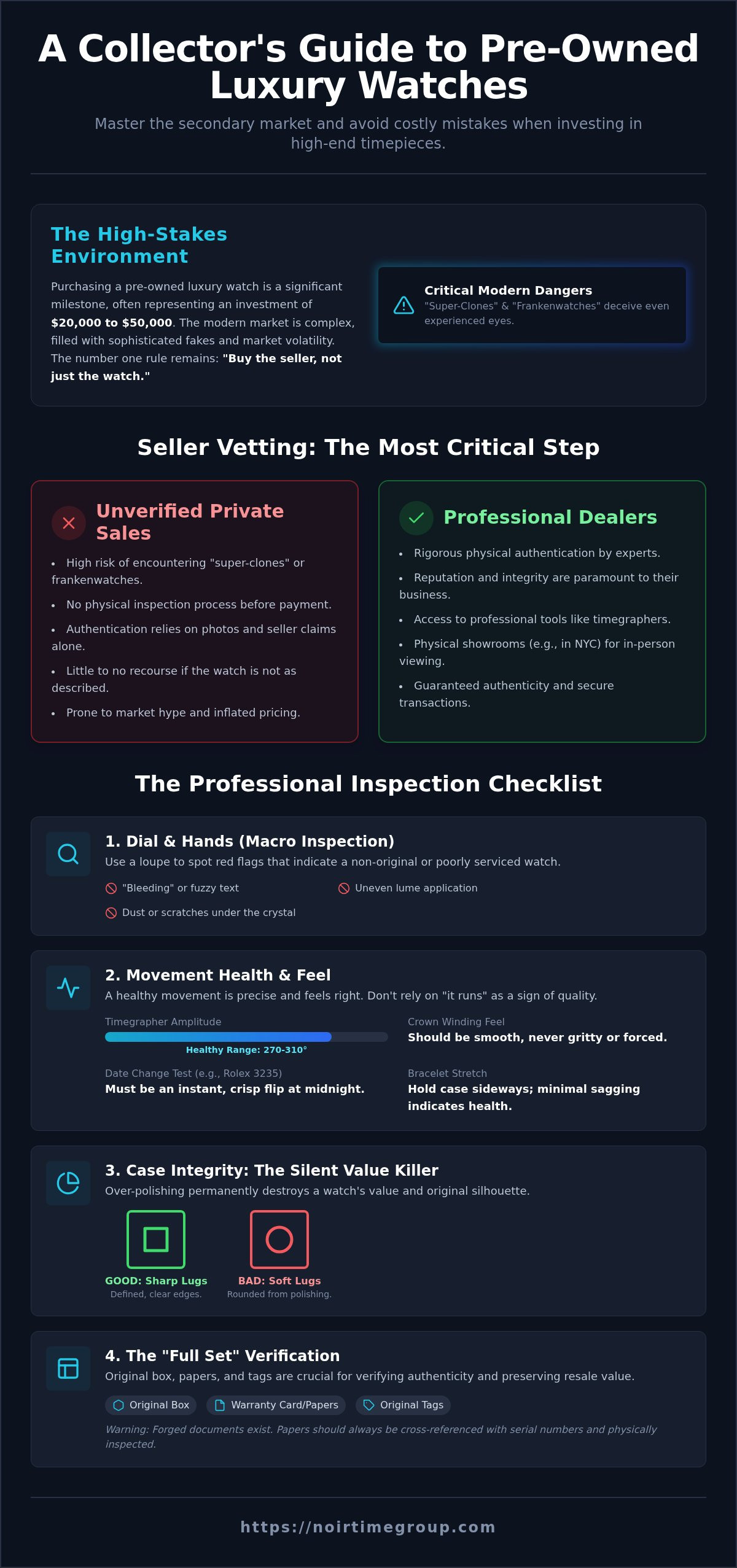
The Ultimate Pre-Owned Watch Buying Checklist
A rigorous inspection process is the only way to ensure your capital is protected. When you're dealing with high-ticket items like a Rolex Submariner Date 126618LN, the margin for error is zero. Follow this five-step framework to identify the critical mistakes to avoid when buying a pre-owned watch before you wire any funds.
- Verify Serial and Reference Alignment: Ensure the reference number on the case matches the paperwork exactly. Mismatched numbers are an immediate deal-breaker.
- Inspect the "Full Set": A true collector's set includes the original box, warranty papers, and hangtags. Missing components can reduce the value of a Patek Philippe Nautilus by thousands of dollars.
- Perform Macro-Photo Analysis: Use high-resolution photos to check dial printing. Letters should be crisp with no bleeding. Lume plots must be consistent and show no signs of moisture damage.
- Audit the Service History: Ask for invoices from certified watch repair centers. Identify if factory components, like hands or dials, were replaced during service; "service parts" often lower a watch's collectible value compared to original components.
- Confirm Physical Presence: Verify the seller has a brick-and-mortar location. Our NYC showroom serves as a physical trust signal for clients conducting high-value trades.
Provenance: The Paper Trail of a Patek or Rolex
Papers are essentially the watch's birth certificate. For a Patek Philippe, you might encounter an "Extract from the Archives." While useful for confirming production dates, it doesn't replace the original sales papers in terms of market value. Modern forgers have become adept at faking warranty cards. Look for high-quality printing and correct font weights. If the card looks flimsy or the ink seems smudged, it's a red flag. Authenticity isn't just about the metal; it's about the documented history of the piece.
The Final Verification Call
Before finalizing a $20,000+ transaction, insist on a timegrapher test. A healthy movement should show high amplitude and a beat error close to zero. If the seller refuses to provide these metrics, they may be hiding a movement that requires an immediate, expensive overhaul. Always use secure payment methods that offer some level of recourse. If you want to skip the stress of self-vetting, you can contact Noir Time Group to handle the entire sourcing and authentication process for you.
Why Noir Time Group is the Preferred Choice for NYC Collectors
Finding a reliable partner is the final step in securing a high-value timepiece. At Noir Time Group, we specialize in high-ticket assets like the Rolex Submariner Date 126618LN and the Audemars Piguet Royal Oak. Our curated inventory is selected based on strict criteria for condition, provenance, and mechanical health. By working with a specialist, you eliminate the most common mistakes to avoid when buying a pre-owned watch, such as falling for a polished-over wreck or a piece with non-factory internal parts. We focus on the integrity of the asset so you don't have to.
Our NYC-based concierge service is designed for collectors who demand more than what's available on public marketplaces. We don't just wait for watches to come to us; we actively find the pieces you can't see online through a global network of trusted partners. Every timepiece we handle undergoes a rigorous authentication process by our master watchmakers. This guarantee ensures that whether you're buying a Patek Philippe Nautilus or trading in your current collection, the integrity of the transaction is never in question. We maximize the value of your trades by understanding the real-time market for solid gold Rolex models and rare steel sports watches.
Sourcing the Impossible: Nautilus and Royal Oak
Acquiring a modern icon often means facing years-long waitlists at retail boutiques. Our professional network allows us to bypass these hurdles, securing mint-condition pieces for our clients. Before any sourced watch reaches you, it undergoes a multi-point vetting process. We recently sourced a mint-condition Patek Philippe for a private client that had been tucked away in a safe for years, complete with all original documentation. This level of access is what separates a professional sourcing service from a standard dealer. We handle the technical scrutiny so you can focus on the enjoyment of the watch.
NYC White-Glove Service
A physical presence in New York City provides a level of security that digital-only platforms can't replicate. Our location allows for in-person inspections, giving you the chance to feel the weight of a $42,000 solid gold Rolex before finalizing the trade. We also provide certified watch repair to ensure your collection remains in peak condition for years. If you're looking to maximize the value of your current collection, our seamless trade-in process offers a transparent way to upgrade. View our current curated inventory or request a sourcing consultation today to experience a higher standard of horological service.
Secure Your Next Horological Investment with Confidence
Mastering the secondary market requires a blend of technical knowledge and extreme skepticism. You've learned that the most significant mistakes to avoid when buying a pre-owned watch involve ignoring the "service gap" or failing to verify the alignment of reference and serial numbers. Whether you're pursuing a solid gold Rolex or a rare Royal Oak, the integrity of the seller remains your greatest protection against "frankenwatches" and market volatility. A lower price point on a private forum rarely justifies the risk of high-cost internal repairs.
Noir Time Group provides a secure alternative to the risks of public marketplaces. Our NYC-based showroom offers a private viewing environment for high-ticket trades, while our specialists in Rolex, Patek Philippe, and Audemars Piguet ensure every piece meets our strict standards. We stand behind every sale with guaranteed authenticity and master-led technical vetting. You don't have to manage the complexities of the 2026 market alone when you have access to a professional concierge service.
Browse Our Curated Inventory of Authenticated Luxury Watches and take the next step in building a world-class collection. Your journey toward an iconic timepiece starts with a partner you can trust.
Frequently Asked Questions
Is it worth buying a pre-owned watch without the original box and papers?
Buying a watch without the box or papers is acceptable if you want a lower entry price for a daily wearer. However, it's one of the common mistakes to avoid when buying a pre-owned watch if you plan to resell it later. A full set typically commands a premium of 10% to 20% over a naked watch. For high-ticket items like a Patek Philippe Nautilus, missing papers can significantly impact the long-term investment value.
How can I tell if a Rolex Submariner has been over-polished?
You can identify an over-polished Rolex Submariner by inspecting the sharpness of the lugs and the symmetry of the crown guards. Factory finishes have crisp, well-defined edges. If the metal looks soft or the holes for the spring bars are flush with the surface, the watch has lost significant material. This metal loss is permanent and devalues the piece. Always compare the watch to a factory-original example to spot these subtle changes.
What is a "frankenwatch" and how do I avoid one?
A frankenwatch is a timepiece assembled from various mismatched or non-factory parts, such as an original case with a different movement. Avoiding this requires a deep mechanical inspection by a professional. You should always request high-resolution photos of the movement and verify that the serial numbers match the era of the dial. Working with a specialist who employs master watchmakers is the most reliable way to ensure your watch is 100% authentic.
Is it safer to buy from a private seller or a professional dealer?
Professional dealers offer a much higher level of security than private sellers. While private sales might seem cheaper, they lack the authentication guarantees and physical NYC-based presence that build trust. Dealers like Noir Time Group provide expert vetting and after-sales care that private individuals simply can't match. Buying from a dealer is a critical step in identifying mistakes to avoid when buying a pre-owned watch, as it provides a clear path for recourse.
How do I verify the service history of a pre-owned luxury watch?
The best way to verify service history is to request physical or digital invoices from a certified watch repair center. These documents should list exactly what work was performed and whether any parts were replaced. Be cautious of watches with service dials or service hands, as these replacements can reduce the value for collectors who prefer original components. A lack of documented history usually suggests a full movement service is needed immediately.
What should I look for when inspecting a Patek Philippe Nautilus?
When inspecting a Patek Philippe Nautilus, focus on the integrity of the integrated bracelet and the crispness of the horizontal dial grooves. The ears on the side of the case should be perfectly aligned. Ensure the movement finishing matches Patek’s high standards, including the Geneva seal or Patek Philippe seal. Because these are high-ticket assets, verifying the provenance through original sales papers is essential to justify the secondary market premium.
Does Noir Time Group offer warranties on pre-owned timepieces?
Yes, we provide comprehensive support for every timepiece we sell. Every watch is guaranteed for authenticity and is backed by expert guidance. This includes access to our certified watch repair services and any remaining manufacturer-backed warranties. We prioritize the longevity of your investment, ensuring that high-ticket items like the Rolex Submariner Date 126618LN remain in peak mechanical condition long after the initial purchase is finalized.
Can I trade in my current watch for a more expensive model?
You can certainly trade in your current watch through our margin-based trade-in service. We evaluate and authenticate your timepiece to provide a competitive value that you can apply toward any watch in our curated inventory. This is a seamless way to upgrade from a Rolex Submariner Date 126613LN to a more complex piece like an Audemars Piguet Royal Oak. Our NYC showroom facilitates these high-value trades with total transparency.
