

With the global pre-owned luxury watch market reaching a massive $35.7 billion valuation in 2026, the risk of encountering a sophisticated "super-clone" is at an all-time high. You've likely felt that pang of anxiety before hitting "send" on a wire transfer, which is why having a rigorous pre-owned watch inspection checklist is no longer optional. It's a high-stakes environment where a single overlooked detail on a Rolex Submariner or Patek Philippe Nautilus can cost you thousands in resale value or, worse, leave you with a counterfeit.
We believe that purchasing a high-end timepiece should feel like a triumph, not a gamble. This guide provides the professional-grade framework used by New York's top collectors to verify the forensic integrity of Rolex, Patek Philippe, and Audemars Piguet timepieces. You'll learn to identify subtle red flags, confirm period-correct components, and understand why a "full set" can command a 25% price premium in today's market. We're giving you the technical roadmap needed to secure your next investment with absolute certainty.
Key Takeaways
- Understand why evolving "super-clones" make professional verification essential for protecting your investment.
- Follow a technical pre-owned watch inspection checklist to audit dial typography, lume materials, and case integrity.
- Learn to evaluate internal movement health through tactile feedback from the crown and the precision of the date jump.
- Decode the value of provenance by verifying warranty card security features and the completeness of original packaging.
- Recognize how leveraging expert sourcing and certified repair services eliminates the risks associated with the secondary market.
Why a Systematic Watch Inspection is Vital in 2026
The secondary market in 2026 isn't just about finding a deal; it's about navigating a $35.7 billion minefield. With retail prices for new luxury watches jumping 7% this year, more collectors are turning to pre-owned Rolex and Patek Philippe models. This surge in demand has fueled the development of "super-clones"—high-tier counterfeit watches that can fool even seasoned enthusiasts. When you're transacting for a Rolex Submariner Date 126618LN or an Audemars Piguet Royal Oak, the financial stakes often exceed $40,000. A cursory glance won't reveal the "Frankenwatch" hidden beneath the sapphire crystal. These are pieces where genuine parts from different eras or models are cobbled together, effectively destroying the watch's investment value and historical integrity.
NYC dealers in the Diamond District see these issues daily. They've shifted from simple authentication to forensic auditing. Utilizing a rigorous pre-owned watch inspection checklist is the only way to ensure that the piece you're buying is exactly what the seller claims it to be. It's the difference between owning a legacy asset and a high-priced mistake.
The 2026 Secondary Market Landscape
Market volatility and a 13.3% projected CAGR have made the secondary market incredibly fast-paced. While some Rolex models are becoming more accessible at retail, rare Patek Philippe Nautilus references remain elusive. This scarcity often pressures buyers into making emotional decisions. The "Buy the Dealer" rule is more relevant than ever. In NYC, reputable retailers act as the first line of defense, but you still need your own framework to verify condition and originality before the wire transfer clears. Don't let the excitement of a rare find cloud your technical judgment.
Defining Your Inspection Goals
Before you pull out your loupe, you must define what success looks like for your collection. Are you looking for a mint-condition daily wearer or a museum-grade investment piece? Your pre-owned watch inspection checklist should prioritize these three pillars:
- Authenticity: Is every single component, from the hairspring to the handset, factory-made by the brand?
- Condition: Has the case been over-polished, softening the sharp lugs of that Royal Oak?
- Originality: Are the dial and bezel period-correct for the specific serial number range?
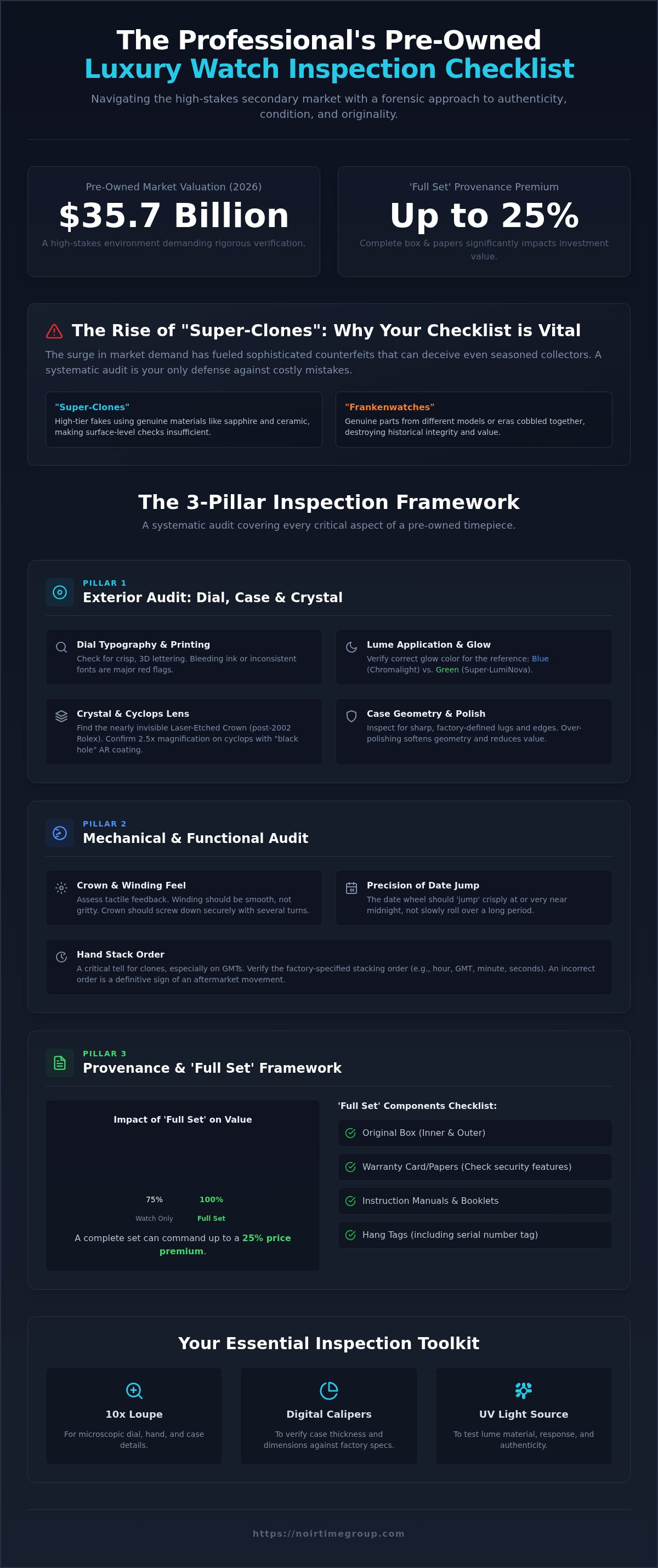
Establish your "dealbreaker" threshold early. If a watch is missing its original "full set" components, it might trigger a 25% value deduction you aren't willing to swallow. To execute a proper audit, you'll need a 10x loupe, digital calipers for case thickness verification, and a high-lumen UV light source to test lume response.
The Exterior Audit: Dial, Case, and Crystal Integrity
The exterior of a luxury timepiece is the first line of defense in your pre-owned watch inspection checklist. In 2026, counterfeiters have mastered the use of genuine sapphire and high-grade ceramics, making surface-level checks insufficient. You must look for microscopic flaws that reveal a watch's true history. Start with the dial typography. Genuine Rolex and Patek Philippe dials use a proprietary printing process that results in crisp, three-dimensional lettering. If you see "bleeding" ink or inconsistent font weights under a loupe, the dial is likely aftermarket or a high-end fake. It's a subtle detail, but essential when you evaluate pre-owned watch condition for high-ticket investments.
Testing the lume is equally critical. Modern Rolex models use Chromalight, which emits a distinct blue glow. Older references or other brands might use Super-LumiNova, which glows green. A mismatch in glow color or duration for the specific reference year is an immediate red flag. You should also verify the crystal integrity. On Rolex models produced after 2002, look for the laser-etched crown (LEC) at the 6 o'clock position. It's nearly invisible to the naked eye and should consist of tiny, distinct dots rather than a solid line. If the etching is too obvious, the crystal has likely been replaced with a generic part.
Microscopic Dial Details
The hand stack order is a technical detail clones often miss, especially on GMT movements. The hour, minute, and GMT hands must be stacked in the exact factory-specified order. Additionally, inspect the applied indices. On a Patek Philippe Nautilus or an Audemars Piguet Royal Oak, these should be perfectly aligned with no visible glue residue. Finally, check the "cyclops" lens. A genuine Rolex date magnifier provides exactly 2.5x magnification and features a distinct anti-reflective coating that creates a "black hole" effect when viewed at certain angles.
Case and Bezel Forensic Check
Case geometry tells the story of a watch's life. Over-polishing is a value-killer that softens the sharp, intentional lines of the lugs and fades the chamfers. Compare the lug width and thickness against factory specs using your calipers. Between the lugs, the serial and model number engravings should be deep and crisp. If they look "sandy" or shallow, they were likely applied with a cheap laser engraver. For models like the Rolex Submariner Date 126613LN, the Cerachrom bezel action is a tactile giveaway. It should have a precise, mechanical "click" with zero backplay. If the rotation feels mushy, the internal click-spring is likely non-genuine.
If these technical nuances feel overwhelming, leveraging a professional watch sourcing service ensures your investment has been vetted by eyes that see thousands of these pieces a year in the NYC Diamond District.
Mechanical Performance and Bracelet Mechanics
You've verified the dial and case; now you must test the engine. A pre-owned watch inspection checklist is incomplete without a tactile assessment of the movement's health. Luxury calibres from Rolex, Patek Philippe, and Audemars Piguet are engineered for silk-smooth operation. If you feel a "gritty" resistance when winding the crown or setting the time, it often indicates dried lubricants or internal gear wear. For models with a date complication, the jump should be instantaneous. At midnight, the date should click over with a crisp, audible snap. A slow, dragging transition over several minutes is a sign that the movement requires attention from a certified watch repair specialist.
The 5-Step Mechanical Stress Test
- Step 1: The Wind and Rotor Check. Fully wind the watch with approximately 40 turns. While doing so, listen for the "rotor wobble" or a grinding sound that suggests the oscillating weight is loose or touching the case back.
- Step 2: Hacking and Hand-Jump. Pull the crown to the time-setting position to engage the hacking seconds. The second hand should stop immediately. Watch the minute hand closely; it shouldn't "jump" or shift significantly when you push the crown back in.
- Step 3: The Beat Audit. Use a timegrapher or a high-sensitivity microphone app to listen to the beat. Modern Rolex calibres, like the 3235, vibrate at 28,800 beats per hour (4Hz). An irregular "gallop" or a lower frequency can indicate a counterfeit movement or a serious mechanical fault.
- Step 4: Power Reserve Consistency. Verify the power reserve over a 24-hour period. While some modern movements boast 70-hour reserves, a significant drop in timekeeping accuracy within the first day indicates a weak mainspring.
- Step 5: Crown Thread Integrity. Unscrew and rescrew the crown several times. It should catch the threads easily without binding. Cross-threaded crowns are common in pre-owned pieces and can compromise water resistance.
Bracelet and Clasp Security
The bracelet often tells the truest story of a watch's wear. To check for "stretch," hold the watch head and let the bracelet hang sideways. Significant lateral play in Oyster or Jubilee links suggests the internal pins are worn down. You must also verify the clasp codes. These alphanumeric engravings should match the production era of the case serial number. On precious metal models like the Rolex Submariner Date 126618LN, inspect the gold hallmarks on the underside of the lugs and the clasp. They should be deep and sharp, never soft or blurry. Check the screw links for "mushroomed" heads; damaged screws often mean an amateur attempted to size the watch with the wrong tools. Finally, test the extension systems like the Glidelock or Easylink. They should slide or click with mechanical precision, requiring firm but smooth pressure to operate.
Provenance, Paperwork, and the 'Full Set' Framework
A physical inspection only tells half the story. To truly master a pre-owned watch inspection checklist, you must verify the documentation that supports the timepiece's history. In the 2026 market, a "full set"—including the original box, warranty card, and booklets—can command a price premium of 10% to 25%. For high-ticket items like a Patek Philippe Nautilus, the absence of an "Extract from the Archives" or the original certificate of origin is a significant point of scrutiny. You should also pay attention to the hangtags. While the "Green Tag" signifies the superlative chronometer status, the serial-matching "White Tag" is often discarded by original owners; its presence is a hallmark of a meticulous collector.
Verification doesn't stop at the presence of a card. Modern Rolex warranty cards feature sophisticated security measures that require a forensic eye. Under a UV light source, these cards reveal distinct, glowing patterns that are nearly impossible for counterfeiters to replicate accurately. If you're looking at a piece without its original papers, a recent Rolex Service Center (RSC) card is a valuable substitute. It serves as a professional guarantee that the manufacturer has recently handled and authenticated the movement, case, and dial. It's essentially a secondary authentication that adds a layer of safety to your purchase.
Paperwork vs. Digital Provenance
The industry is shifting toward digital security. By 2026, blockchain-backed guarantees and digital passports have become common for new releases from major houses. These digital records combat the "ghost papers" often found with high-end counterfeits. When reviewing physical booklets, check the print quality. Forged booklets often have slightly blurry text or off-color logos. A "naked" watch—one without any collateral—isn't necessarily fake, but it should trigger a more intensive mechanical audit to justify the investment and risk.
The 'Story' Check
Every watch has a lineage. Verify the Authorized Dealer (AD) stamp on the warranty card and ensure the serial numbers align across the case, the card, and the outer box sticker. It's also vital to cross-reference the serial number with global stolen watch databases to ensure the piece has a clean title. Finally, look for "service parts." While a service dial or service hands maintain functionality, they can diminish the value of a vintage or neo-vintage piece compared to its all-original counterpart. If you want to skip the forensic headache and ensure your investment is secure, you can source a verified watch through a professional dealer who handles this due diligence for you in the NYC Diamond District.
Professional Sourcing: The Noir Time Group Standard
A technical pre-owned watch inspection checklist is a powerful tool for any collector, but it's only the first step. The final safeguard for a $40,000 investment is the trained eye of a professional who handles these pieces daily. At Noir Time Group, we've refined an authentication protocol specifically for the 2026 market. We don't just look for "super-clones"; we perform a forensic audit on every Rolex Submariner Date 126618LN and Patek Philippe Nautilus that enters our inventory. Our team evaluates movement beat error, the authenticity of internal components, and the historical accuracy of the dial. We act as your technical filter in a market where a single oversight can be a costly mistake.
Our watch sourcing service is built on deep-rooted relationships within the NYC Diamond District. We find pieces that never hit public listings. If you're hunting for a specific Audemars Piguet Royal Oak, we handle the vetting process for you. This includes verifying the provenance discussed in previous sections and ensuring the piece meets our strict mechanical standards before it's ever presented to you. It's a comprehensive approach that turns a high-stakes transaction into a secure investment.
Post-purchase security is just as vital as the initial sale. Our certified watch repair department provides a permanent safety net for your collection. Whether it's a routine service for a Rolex Submariner Date 126613LN or a complex mechanical adjustment, our NYC-based experts ensure your timepiece remains factory-spec. We believe that maintaining a watch's integrity is a lifelong commitment, not just a one-time check.
The NYC Diamond District Advantage
Buying a luxury watch shouldn't be a remote guessing game. Our physical presence in New York allows us to inspect every watch in person before it reaches your wrist. This hands-on approach gives us access to off-market inventory that isn't available to the general public. We also offer direct trade-in evaluations, which makes it easier for you to upgrade your collection to a higher-tier reference without the stress of private sales. You get the benefit of our professional network and our technical expertise in one place.
Your Next Steps in Collecting
Requesting a specific model like a Patek Philippe Nautilus is simple. We specialize in sourcing rare models and ensuring they pass our rigorous 2026 authentication protocol. Every watch we sell comes with the Noir Time guarantee of authenticity and dedicated after-sales care. You don't have to navigate the secondary market alone. Browse our curated collection of verified timepieces today to find your next investment-grade watch with total confidence.
Mastering Your Watch Collecting Future
Approaching the high-stakes secondary market in 2026 requires more than just a keen eye; it demands a forensic approach to every technical detail. By applying a rigorous pre-owned watch inspection checklist, you protect your capital against the rising tide of sophisticated counterfeits and "Frankenwatches" that can compromise an investment. Whether you're scrutinizing the microscopic dial typography of an Audemars Piguet Royal Oak or verifying the power reserve of a modern Rolex movement, your diligence ensures that your collection remains a source of pride and value for years to come.
You don't have to manage these technical complexities alone. Noir Time Group offers expert NYC-based sourcing and certified repair services to give you total peace of mind throughout your journey. As specialists in Rolex, Patek Philippe, and Audemars Piguet, we provide the professional-grade vetting that every high-ticket timepiece deserves. We invite you to leverage our Diamond District expertise to find your next heirloom-quality watch with absolute certainty.
Secure Your Next Investment: View Our Inspected Inventory
Frequently Asked Questions
Is a pre-owned watch without papers always a risk?
A pre-owned watch without papers isn't always a fake, but it does carry a higher level of risk. Many collectors sell "naked" watches after losing collateral during moves or estate transitions. You should offset this risk by using a rigorous pre-owned watch inspection checklist and requesting a service record from a brand center. A recent manufacturer service card acts as a secondary form of authentication for the timepiece.
How can I tell if a Rolex Submariner has been over-polished?
You can identify an over-polished Rolex Submariner by examining the lugs and crown guards. The lugs should be thick and have sharp, well-defined edges; thin, rounded lugs indicate excessive metal removal. On a solid gold model like the Rolex Submariner Date 126618LN, check the hallmarks on the underside of the lugs. If these engravings are faint or blurry, the case has likely been polished too many times.
What are the most common red flags on a fake Patek Philippe Nautilus?
The most common red flags on a fake Patek Philippe Nautilus include dial texture and case thickness. A genuine Nautilus dial has crisp, deep horizontal grooves, while clones often have shallow or "mushy" lines. Most high-end clones are also thicker than the genuine 8.3mm profile of a standard 5711. Always inspect the movement finishing; clones rarely replicate the high-level Geneva stripes and polished sinks found on a real Patek.
Does a 'Service Dial' decrease the value of a vintage Rolex?
A service dial typically decreases the market value of a vintage Rolex for serious collectors. While these dials are genuine factory replacements that improve legibility, they lack the period-correct tritium or unique patina that drives vintage prices. A replacement can reduce a watch's value by 20% or more compared to an all-original example. For many investors, original condition is far more important than modern functionality or glow.
What tools do I need for a basic home watch inspection?
You need three essential tools for a basic home inspection: a 10x loupe, digital calipers, and a UV light source. The loupe allows you to see microscopic dial flaws, while calipers verify the case thickness against factory specifications. A UV light is necessary to check the lume response and the security patterns on modern warranty cards. These tools are the foundation of any professional-grade pre-owned watch inspection checklist.
How do I verify the serial number on an Audemars Piguet Royal Oak?
Verify the serial number on an Audemars Piguet Royal Oak by checking the engraving on the exterior case back and the movement. These numbers must match the records on the original warranty certificate or the brand's digital registry. In 2026, many AP models utilize blockchain-based digital passports for easier verification. If the engravings appear shallow or use an incorrect font, it's a sign the watch might be non-genuine.
Why is the hand stack order important for GMT watches?
Hand stack order is a vital indicator of movement authenticity on GMT watches. On a genuine Rolex GMT-Master II, the hands are stacked from bottom to top: hour, GMT, minute, and seconds. Many counterfeiters use modified movements where the GMT hand is at the bottom of the stack to simplify the construction. This technical mismatch is a clear sign that the movement is not a genuine Rolex calibre.
Can a high-end clone pass a pressure test?
A high-end clone can often pass a standard pressure test, so this should never be your only method of authentication. Waterproofness is achieved through simple gaskets and screw-down crowns, which are easily replicated by counterfeiters. While passing a test proves the watch is water-resistant, it doesn't prove the internal movement is genuine. Always prioritize a forensic audit of the movement architecture over a basic pressure test.
