

Your Audemars Piguet isn't just a watch; it's a precision instrument that requires a proactive investment strategy to maintain its mechanical integrity and resale value. Neglecting the recommended Audemars Piguet service intervals can transform a minor lubrication issue into a costly overhaul that sidelines your timepiece for months. It's natural to feel anxious about the high costs of factory maintenance or the delicate process of polishing those iconic satin-finished surfaces without losing the watch's original lines.
We understand that the line between a simple water-resistance check and a complete movement restoration often feels blurred. This 2026 maintenance guide provides the clarity you need to protect your investment. You'll learn the difference between service tiers and how to recognize the subtle signs that your watch needs professional attention. As a New York City authority on luxury horology, Noir Time Group is here to ensure your Royal Oak or Offshore continues to perform at manufacturer-backed standards for decades to come.
Key Takeaways
- Establish the 1, 5, and 10-year benchmarks for Audemars Piguet service intervals to prevent long-term mechanical failure and costly component replacements.
- Identify the specific technical differences between a partial water-resistance check and a complete 10-step maintenance protocol.
- Learn how to mitigate environmental stressors and lifestyle habits, such as high-vibration sports, that can compromise your watch's precision.
- Understand why maintaining professional service documentation is essential for protecting the resale value and "full set" status of your timepiece.
- Gain expert guidance on navigating professional maintenance options in New York to ensure your watch receives certified care with optimized turnaround times.
The Audemars Piguet Service Timeline: 1, 5, and 10-Year Rules
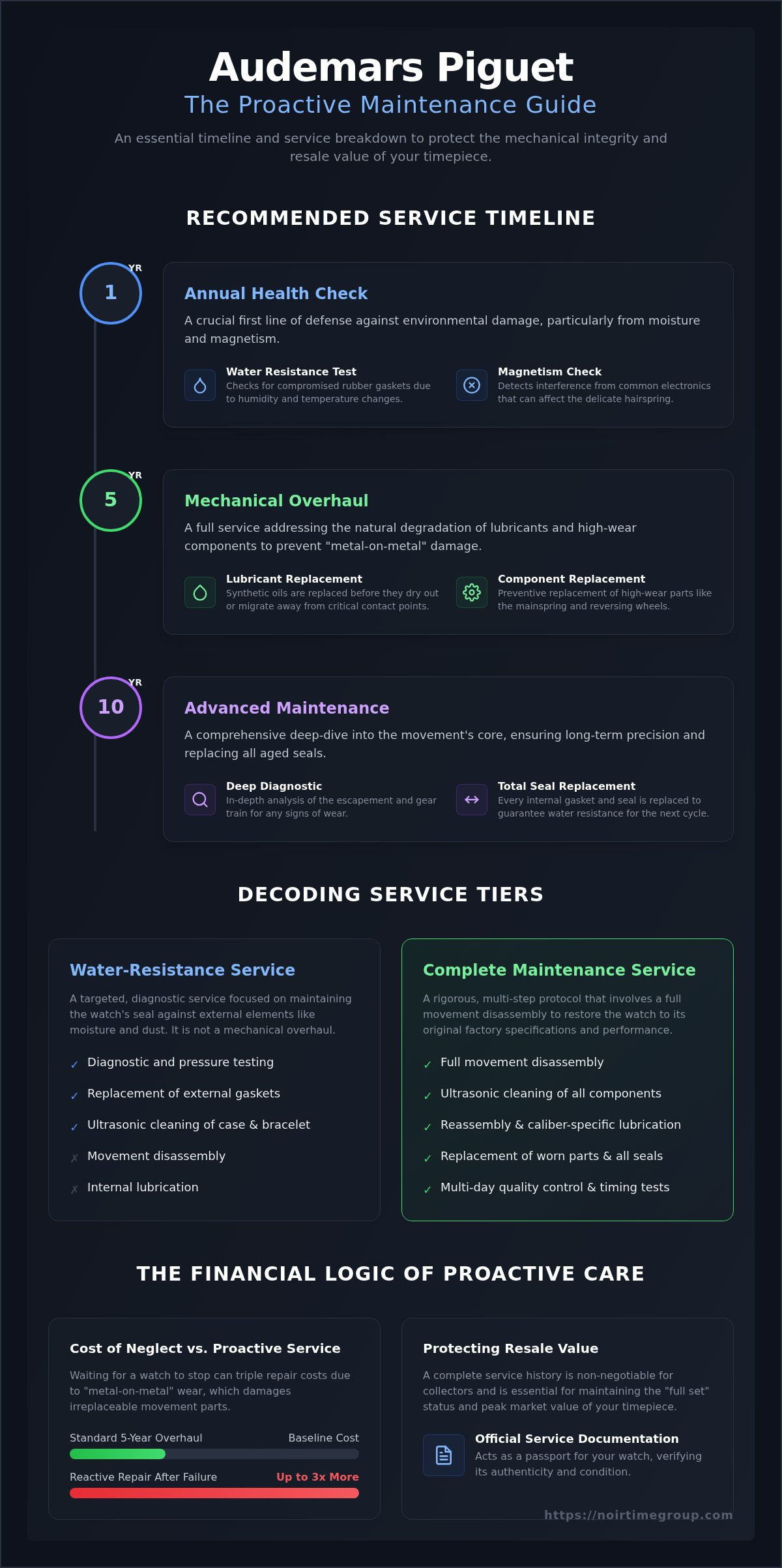
Understanding Audemars Piguet service intervals is the difference between preserving a legacy timepiece and facing a massive repair bill. The technical excellence of Audemars Piguet is built on centuries of horological heritage, but even the most robust calibers require disciplined maintenance. For the modern collector, maintenance isn't a single event but a tiered timeline designed to combat friction, moisture, and magnetism. Following a strict 1, 5, and 10-year schedule ensures your watch remains as precise as the day it left Le Brassus.
The Annual Health Check: Water Resistance and Magnetism
New York's environmental shifts create unique challenges for luxury watches. The city's varying humidity levels, from sweltering summers to dry, heated interiors in winter, cause rubber gaskets to expand and contract. This cycle eventually compromises the seals. Annual pressure tests are vital to ensure your Royal Oak remains water-resistant. Beyond moisture, the hairsprings in these delicate movements are highly susceptible to the magnets found in smartphones, tablets, and handbag clasps. A "Complimentary Check-up" serves as the first line of defense against costly repairs by identifying magnetization or seal failure before they cause internal damage. At Noir Time Group, we recommend these quick diagnostics to keep your timepiece running within factory specifications.
The 5-Year Mechanical Overhaul: Why Lubrication Matters
The industry standard for a complete mechanical movement overhaul falls between five and eight years. This window is dictated by the science of synthetic oils. These lubricants are engineered to reduce friction between jewels and steel pivots, but they eventually dry out or migrate away from critical contact points. Even if you don't wear your watch daily, these oils degrade over time. During a five-year service, watchmakers perform a preventive replacement of high-wear components like the mainspring and reversing wheels. Waiting for the watch to stop entirely is a mistake. By that point, you're likely dealing with "metal-on-metal" damage, where dry pivots grind into brass plates. This neglect can triple repair costs compared to a standard proactive overhaul.
By the 10-year milestone, your watch enters a phase of advanced maintenance. This involves replacing every internal seal and performing a deep diagnostic of the escapement and gear train. It's helpful to distinguish between a "Periodical Check-up" and a "Complete Maintenance Service." The former is a diagnostic and water-resistance test, while the latter is a total mechanical restoration that returns the movement to zero-hour condition. Sticking to these established Audemars Piguet service intervals protects the movement's longevity and secures the peak resale value of your investment.
Decoding AP Service Tiers: From Partial to Complete Maintenance
While the calendar dictates your Audemars Piguet service intervals, the actual physical condition of your timepiece determines the tier of care it requires. Audemars Piguet categorizes maintenance into distinct levels to address everything from routine moisture protection to the total mechanical restoration of a movement. For most collectors, the choice falls between a Water-Resistance Service and a Complete Maintenance Service; however, vintage pieces may require the specialized touch of the brand's Restoration Workshop. This artisanal intervention is reserved for historical calibres where parts may need to be hand-fabricated using traditional tools.
What Happens During a Complete Maintenance Service?
A complete service is a rigorous 10-step protocol that begins with a full diagnostic and movement stripping. Every single component is disassembled and placed into specialized Teflon washing containers. These containers are essential because they prevent microscopic scratches on the delicate bridges and plates during the ultrasonic cleaning cycle. The Horological Society of New York often highlights how such meticulous standards separate high-horology maintenance from standard watch repair. Once cleaned, the watchmaker reassembles the movement using calibre-specific lubrication charts to ensure every pivot and jewel receives the exact viscosity of oil required for peak performance. The process concludes with a series of quality control tests spanning several days to verify power reserve and chronometric precision.
Aesthetic Refinishing: To Polish or Not to Polish?
The iconic geometry of the Royal Oak relies on a sharp, high-contrast interplay between satin-brushed and mirror-polished surfaces. Over time, daily wear introduces scuffs that dull this effect. While a polishing service can restore that factory "newness," it's a permanent removal of metal. Over-polishing can round off the crisp edges of the octagonal bezel or thin the integrated bracelet links, which significantly impacts the watch's resale value and structural integrity. Many purists choose a "No Polish" directive during their service to keep the original factory lines intact. If you're debating whether to refinish your timepiece, the experts at Noir Time Group can help you weigh the aesthetic benefits against the long-term value of an unpolished case.
Factors That Accelerate AP Service Intervals
Standard factory recommendations provide a baseline, but your personal environment is the ultimate arbiter of your watch's health. While most collectors aim for the typical five-year mark, several external variables can shorten Audemars Piguet service intervals significantly. Recognizing these stressors early prevents a minor regulation issue from spiraling into a total movement replacement.
The "Safe Queen" paradox is a common trap for New York collectors. It's a mistake to assume a watch that sits in a safe for years remains in pristine mechanical condition. Synthetic oils are designed to stay in motion; when a movement remains static, these lubricants can coagulate or migrate away from critical friction points. Consequently, a watch that hasn't been wound in years might require a full overhaul sooner than a daily driver that keeps its components in constant, fluid motion.
Modern life is also a magnetism minefield. The magnets in smartphone cases, tablet covers, and laptop speakers are strong enough to bind the coils of an AP hairspring. This doesn't physically break the watch, but it causes it to run incredibly fast, often gaining several minutes per day. If you work in a tech-heavy environment, you may find your watch needs professional demagnetization and a health check more frequently than the standard timeline suggests.
The Impact of Water and Chemical Exposure
Chlorine in swimming pools is particularly aggressive, degrading rubber O-rings much faster than freshwater. Many owners rely on the "Screw-Down Crown" as a total safeguard, but this is a myth if the internal seals have dried out or cracked. Even with the crown tight, a dry gasket won't stop moisture from entering the case. For Royal Oak Offshore owners who take their pieces into the ocean, a thorough rinse in lukewarm freshwater is mandatory after every excursion. Failure to do so allows salt crystals to form around the gaskets and pushers. These crystals act as an abrasive that can eventually compromise the water resistance of the entire case.
Vibration and Shock: The Enemy of the Balance Wheel
The escapement of an AP movement is a marvel of micro-engineering, but it isn't invincible. High-frequency vibrations from activities like golf or tennis can knock the balance wheel out of beat or even damage the delicate pivots. Ultra-thin calibres, found in many Royal Oak models, are especially vulnerable to physical shock because their components have less mass to absorb sudden energy. If you notice a sudden drift in timekeeping, such as gaining or losing more than 10 seconds a day, it's an early warning sign that the movement's regulation has been compromised. In the high-vibration environment of an active lifestyle, keeping a closer eye on your Audemars Piguet service intervals is essential for long-term precision.
The Financial Logic: Protecting Your Audemars Piguet Investment
A luxury timepiece is a high-performance asset, and its valuation is inextricably linked to its mechanical health. Adhering to Audemars Piguet service intervals is not merely a technical requirement; it's a strategic financial move. In the secondary market, a "Full Set" that includes the original box, papers, and recent service documentation commands a significant premium. Collectors often pay between 10% and 15% more for a watch with a transparent maintenance history. This documentation proves the owner hasn't cut corners, which is vital for high-value models like the Royal Oak.
Documented Service History and Resale Value
Service records act as a secondary form of authentication for high-value pieces. When a watch passes through a certified service center, it receives a two-year warranty on labor and parts. This global warranty is a powerful selling point that increases resale velocity. It provides the next buyer with peace of mind that the movement has been verified to meet manufacturer standards. At Noir Time Group, we prioritize watches with a clear service lineage when evaluating trade-ins. A documented history ensures the integrity of the timepiece and justifies a higher valuation during the sourcing or trade-in process.
The Long-Term Cost of Ownership
Calculating the "cost per year" of ownership reveals the true value of proactive care. Spreading the price of a complete maintenance service over a five-year interval is a small price to pay for protecting a five-figure asset. Skipping service is a "false economy" that leads to catastrophic part failure. For instance, comparing a standard $1,500 service to a $5,000 movement replacement makes the financial logic clear. Proactive maintenance prevents "metal-on-metal" wear that can destroy rare calibres beyond repair. This is especially true for the Royal Oak Chronograph and Perpetual Calendar, which require more frequent, specialized care due to their mechanical complexity.
Vintage collectors must also navigate the "Service Dial" and "Service Hands" debate. While factory replacements ensure functionality, they can diminish the value of a vintage piece that relies on original tritium or unique patina. Maintaining original components while ensuring mechanical reliability is a delicate balance. If you're looking to maximize the value of your collection or explore a trade-in, consult with the experts at Noir Time Group to ensure your Audemars Piguet service intervals and maintenance strategy align with your long-term investment goals.
Professional Maintenance in New York: Navigating Your Options
Deciding where to entrust your timepiece once you reach the recommended Audemars Piguet service intervals is a high-stakes decision for any New York collector. Factory service centers offer the security of brand-direct repairs, but this path often comes with significant logistical hurdles. Turnaround times for factory overhauls in 2026 can stretch between four and six months, leaving your wrist empty for a substantial portion of the year. For many, the choice between factory boutiques and certified independent experts comes down to a balance of speed, personalization, and technical transparency.
Authenticity is the baseline for any repair. You must verify that your chosen watchmaker has the credentials to handle high-complication calibres and access to genuine parts. A luxury watchmaker should be able to demonstrate a track record with the Royal Oak and Offshore collections. When preparing your watch for service, always include the original warranty papers and a detailed list of any specific complaints, such as stiffness in the crown or a drop in power reserve. This documentation helps the technician pinpoint issues during the initial diagnostic phase.
The Boutique Experience vs. Independent Experts
While factory boutiques provide a standardized experience, Noir Time Group offers a concierge-level alternative for the NYC community. We bridge the gap between technical excellence and personalized service. Working with a local expert allows for a more transparent look at the movement's condition without the 4-6 month wait times typical of factory shipments. We ensure that only genuine manufacturer-backed components are used in every movement overhaul, preserving the integrity of your investment. Beyond maintenance, our "Watch Sourcing" insights provide a broader perspective on how current market trends might affect the long-term value of your specific model.
Next Steps for Your Audemars Piguet
If your timepiece is approaching its five-year milestone or showing signs of inaccuracy, scheduling a professional diagnostic check in New York is the most responsible next step. A quick pressure test and timing analysis can determine if you need a complete overhaul or just a minor regulation. This is also an ideal time to evaluate your watch for a potential trade-in or upgrade. At Noir Time Group, we help collectors transition between high-value pieces, whether you are looking to move into a Patek Philippe Nautilus or a different Royal Oak reference. Contact Noir Time Group for expert guidance on your AP maintenance or to explore our curated inventory.
Secure the Future of Your Audemars Piguet Collection
Maintaining an Audemars Piguet is an exercise in disciplined stewardship. By adhering to established Audemars Piguet service intervals, you ensure that your Royal Oak or Offshore remains a high-performance asset rather than a liability. Proactive care, ranging from annual pressure tests to the comprehensive five-year mechanical overhaul, prevents the friction-based damage that leads to catastrophic failures. It's also the most effective way to preserve the sharp geometry and "full set" status that collectors demand in the secondary market.
Navigating maintenance in New York doesn't have to mean months of uncertainty. Choosing a partner with a certified repair network and deep expertise in high-complication calibres provides the transparency and speed your collection deserves. Whether you're preparing for a trade-in or simply want to guarantee decades of precision, professional guidance is essential. Protect your investment with Noir Time Group’s expert watch services. Our NYC-based luxury watch specialists are ready to help you navigate the complexities of after-sales care with manufacturer-backed standards. Your timepiece represents a significant legacy; let's work together to keep it ticking perfectly.
Frequently Asked Questions
How much does a full Audemars Piguet service cost in 2026?
Official factory service for a Royal Oak Selfwinding in 2026 starts at 950 CHF at the Geneva boutique, while complicated models like Perpetual Calendars reach 2200 CHF. These figures exclude taxes and represent the baseline for complete maintenance. Prices vary based on the specific movement and the condition of internal components. For a precise estimate on your reference, consult a specialist who can perform a physical diagnostic of the caliber.
Can I take my Royal Oak in the shower or pool?
While many Royal Oak models are water-resistant, you should avoid taking them into hot showers or chlorinated pools without a recent pressure test. Heat causes gaskets to expand, while chlorine accelerates the degradation of rubber seals. If you frequently swim with your watch, annual water-resistance checks become essential Audemars Piguet service intervals. Always ensure the crown is fully screwed down before any contact with water to prevent moisture ingress.
What is the warranty on an Audemars Piguet service?
A complete maintenance service through an authorized network includes a two-year warranty on both labor and the parts replaced. This warranty is valid globally across the brand's service network. It covers any functional defects that arise under normal usage conditions during that period. Maintaining this documentation is critical for the watch's resale value, as it proves the movement has been restored to factory specifications by a certified technician.
How long does an Audemars Piguet service take?
Factory service typically takes between four and six months depending on the movement's complexity and parts availability. Specialized boutiques and high-end service centers in New York may offer more personalized timelines, but a thorough overhaul cannot be rushed. The process involves disassembly, ultrasonic cleaning, reassembly, and several days of quality control testing. Ensuring your watch receives this level of care is vital for its long-term mechanical health.
Is it okay to use an independent watchmaker for my AP?
You can use an independent watchmaker, provided they have access to genuine parts and specialized training for high-horology calibers. Noir Time Group specializes in certified watch repair and expert guidance for NYC collectors. While factory boutiques are an option, working with a local authority often provides more transparent communication and concierge-level care. The priority should always be maintaining manufacturer-backed standards that protect your timepiece's integrity and investment value.
How can I tell if my Audemars Piguet needs a service immediately?
Immediate signs that your watch needs service include gaining or losing more than 10 seconds per day, moisture under the crystal, or a stiff crown. You might also notice unusual clicking noises or a significantly reduced power reserve. If any of these occur, stop wearing the watch and seek a diagnostic check immediately. Continuing to run a damaged movement can lead to "metal-on-metal" wear that dramatically increases the final repair bill.
Do I need to service my watch if I never wear it?
Yes, you must service your watch even if it sits in a safe, as synthetic lubricants degrade and dry out over time. When oils coagulate, they create friction that can damage delicate pivots the moment you finally wind the watch. Following standard Audemars Piguet service intervals ensures the movement remains lubricated and ready for use. A "Safe Queen" requires proactive care just as much as a daily driver to prevent long-term mechanical failure.
Does polishing my Audemars Piguet reduce its value?
Polishing can reduce a watch's value if it rounds off the sharp, iconic edges of the Royal Oak bezel or thins the integrated bracelet. Collectors often prefer unpolished cases that show honest wear over those that have lost their original factory lines. While refinishing can restore aesthetic "newness," it involves removing a thin layer of metal. If you choose to polish, it must be done by a specialist who understands the complex interplay of brushed and polished surfaces.
