

Owning a Patek Philippe isn't just about telling time; it's a documented act of stewardship for a generational asset that directly correlates to its long-term market value. You likely understand that every tick of your Nautilus or Grand Complication represents centuries of horological mastery. However, the anxiety of shipping a high-value item or facing a twelve-week lead time for official servicing often leads collectors to delay essential care. This Patek Philippe maintenance guide will demystify the technical requirements of your timepiece and provide a clear roadmap for its preservation.
We'll explore the expert standards for maintenance, from the daily winding rituals that keep your movement healthy to the professional five-year service intervals recommended by the Henri Stern Watch Agency in NYC. You'll discover the specific differences between winding manual and automatic calibers, ensuring you never inadvertently stress the mechanism. By the end of this article, you'll have the confidence to choose the right service provider and understand exactly how professional upkeep protects your investment for the next generation.
Key Takeaways
- Learn how documented service history acts as a technical passport for your timepiece, directly impacting the resale and trade-in value of iconic models like the Nautilus.
- Identify the optimal servicing intervals for manual, automatic, and quartz movements to prevent internal wear and ensure long-term mechanical precision.
- Understand the technical complexity behind service costs by exploring the meticulous disassembly and diagnosis of over 150 individual movement components.
- Use this Patek Philippe maintenance guide to master daily winding rituals and environmental care that protect delicate leather straps and metal bracelets from premature wear.
- Navigate your service options in New York, from the official Henri Stern Watch Agency to utilizing a professional concierge for expert guidance on after-sales care.
The Patek Philippe Legacy: Why Maintenance is an Investment
The Patek Philippe legacy is built on the philosophy of stewardship rather than simple ownership. When you acquire one of these timepieces, you're accepting a responsibility to preserve a piece of horological history for future generations. This commitment requires more than just careful wear; it demands a disciplined approach to mechanical upkeep. Following a professional Patek Philippe maintenance guide isn't just about keeping time. It's about protecting the structural and functional integrity of an asset that often appreciates over decades. Preventative care is always more cost-effective than restorative horology, as catching a worn gasket early prevents the catastrophic moisture damage that ruins dials and movements alike.
The Impact of Service History on Market Value
In the secondary market, a Patek Philippe with a documented service history commands a significant premium. Collectors and auction houses prioritize "full set" examples that include original service receipts from authorized centers. For iconic models like the Patek Philippe Nautilus, the presence of these papers can swing the valuation by thousands of dollars. At Noir Time Group, we've seen how meticulous records provide buyers with the peace of mind needed to close high-value trades.
Condition is everything. Savvy collectors often prefer "unpolished" cases that retain their original factory lines, even if they show light scratches. If polishing is necessary, it must be a "factory polish" performed during a full service to ensure the metal isn't over-thinned. A watch that's been poorly maintained or aggressively polished by an uncertified technician loses its soul and its market edge. Documenting every visit to a specialist ensures your investment remains liquid and highly desirable.
Understanding the Patek Philippe Seal Standards
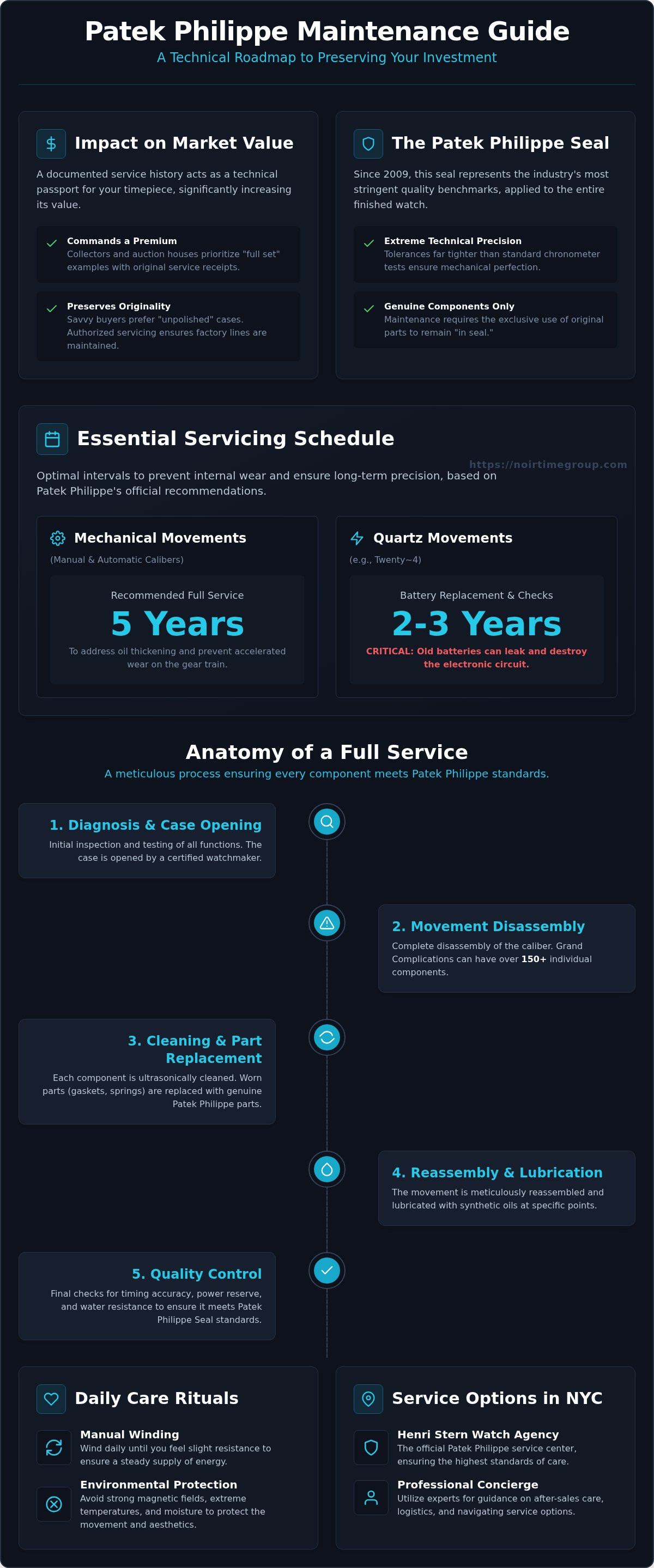
Since 2009, the Patek Philippe Seal has served as the industry's most stringent set of quality benchmarks. Unlike previous certifications that focused solely on the movement, this seal applies to the entire finished watch. It mandates extreme technical precision, with tolerances far tighter than standard chronometer tests. For owners, this means that any maintenance must adhere to these exact standards to remain "in seal."
Maintenance under these rules requires the exclusive use of original components. Every screw, spring, and wheel replaced during a service must be a genuine part produced in Geneva. This standard also dictates the training of the watchmakers who handle your piece. Only those who've completed years of brand-specific training are authorized to break the seal on a modern caliber. By sticking to these rigorous requirements, you ensure the movement continues to operate with the same mechanical perfection it possessed on its first day of life.
The Essential Servicing Schedule: Manual, Automatic, and Quartz
Patek Philippe officially recommends a full movement service every five years for mechanical watches. While some collectors suggest an 8-10 year interval, your specific "daily wear" factor often dictates a more frequent schedule. If you wear your Nautilus every day, the synthetic oils inside the movement work harder, eventually thickening and losing their lubricating properties. This increased friction accelerates wear on the delicate gear train. For owners of Grand Complications, the stakes are even higher. These intricate calibers possess hundreds of interacting parts where even a slight increase in mechanical resistance can lead to a complex and costly repair.
Quartz models, such as the Twenty~4, require a different maintenance cadence. While the movement itself is less mechanically demanding, battery replacements and basic checks are necessary every two to three years. Leaving a dead battery inside a luxury timepiece is a significant risk. Old cells can leak corrosive acid that permanently destroys the electronic circuit. This Patek Philippe Maintenance Guide provides a deeper look at how environmental factors like magnetism or temperature also influence these maintenance timelines.
Movement-Specific Care Requirements
Manual winding movements thrive on consistency. It's best to wind your watch every morning until you feel a slight resistance in the crown. This ensures the mainspring provides a steady flow of energy throughout the day. For self-winding (automatic) calibers, the oscillating rotor does the work, but if the watch has sat idle, you should manually wind it about 20 turns before wearing. Avoid using a winding crown aggressively; a smooth, steady motion prevents unnecessary stress on the winding pinion. If you're unsure about the specific needs of your movement, the experts at Noir Time Group can provide personalized guidance based on your specific collection.
Signs Your Watch Needs Immediate Attention
You shouldn't always wait for the calendar to tell you it's time for a service. Erratic timekeeping is the most obvious red flag. If your watch suddenly gains or loses several seconds a day, the movement may be magnetized or the lubricants might have dried out. Another physical cue is a "gritty" feel when turning the crown. This tactile resistance suggests that the internal seals or gears lack proper lubrication and are grinding against one another. Most critically, any sign of condensation under the crystal is a horological emergency. This indicates a breach in water resistance that requires immediate professional intervention to prevent rust from forming on the steel components.
The Anatomy of a Full Service: From Diagnosis to Quality Control
Understanding the technical rigor of a full service is essential for any collector following a Patek Philippe maintenance guide. This isn't a simple oil change; it's a complete mechanical restoration. The process begins with a comprehensive analysis where a master watchmaker examines the case and movement to identify specific wear patterns. Once diagnosed, the watch is completely stripped down. A standard caliber contains over 150 components, while grand complications can feature hundreds more. Every individual screw, wheel, and spring is removed and inspected under high magnification. This level of detail is why lead times for professional servicing can extend to 12 weeks at specialized facilities.
The technical journey follows a strict five-step protocol to ensure the timepiece returns to factory specifications:
- Analysis and Diagnosis: The watchmaker identifies mechanical issues and aesthetic requirements.
- Complete Disassembly: Every component of the movement and case is separated for individual inspection.
- Cleaning and Replacement: Parts are cleaned in ultrasonic baths and any worn components are replaced with genuine Swiss parts.
- Lubrication and Reassembly: The movement is put back together using specialized oils applied with microscopic precision.
- Quality Control: The watch undergoes several days of testing for timing accuracy, power reserve, and water resistance.
Internal vs. External Maintenance
A full service balances the needs of the "heart" and the "skin" of the watch. The movement overhaul is the priority, ensuring the mechanical heart beats with chronometric precision. However, external care is equally nuanced. While ultrasonic cleaning effectively removes grime from metal bracelets, the decision to polish a case is more complex. Many collectors prefer to leave scratches intact to preserve the original metal volume. If you decide on a refresh, it should only be handled by a professional providing Certified Watch Repair to avoid rounding off the sharp, iconic edges of a Nautilus case.
The Role of the Historical Archives
Patek Philippe maintains a legendary level of record-keeping, tracking every serial number produced since 1839. Before any service begins, the watch is verified against these historical archives. This step confirms the authenticity of the piece and ensures that every repair respects the original configuration of that specific serial number. Owners can even request an "Extract from the Archives," which serves as a birth certificate for the watch. At Noir Time Group, we emphasize that this archival connection is what makes maintenance a form of historical preservation. This verification process is the first line of defense in maintaining the integrity and value of your collection.
Preserving Aesthetics: Straps, Bracelets, and Environmental Care
Maintaining the external beauty of your timepiece is as critical as the movement overhaul discussed previously. A comprehensive Patek Philippe maintenance guide must address the organic and metallic components that interface with your skin and the environment. Leather straps are particularly susceptible to damage from humidity, sweat, and cosmetic oils. These elements degrade the hide over time, leading to cracking or discoloration. To extend the life of an alligator or calfskin strap, avoid direct contact with perfumes or lotions and allow the leather to breathe between wearings. Most collectors find that replacing a leather strap every six to twelve months keeps the watch looking its best.
Metal bracelets require a different approach. The phenomenon often called "stretch" isn't actually the metal expanding. It's the wear of the internal pins and screws caused by microscopic dirt particles acting as an abrasive. Regular cleaning prevents this mechanical erosion. For those wearing a Nautilus, a simple rinse with lukewarm water after exposure to saltwater or heavy perspiration is essential. This prevents salt crystals from drying inside the links and causing premature wear. Periodically, an ultrasonic cleaning for the bracelet alone can remove the deep-seated grime that a surface wipe cannot reach.
Modern environments present hidden dangers, specifically magnetic fields. Your watch doesn't need to touch a magnet to be affected. Proximity to tablets, speakers, or even magnetic handbag clasps can magnetize the balance spring. This causes the watch to run significantly fast. If you suspect your timepiece has been compromised by a magnetic field, the specialists at Noir Time Group can provide a quick diagnostic and degaussing service to restore accuracy.
Water Resistance and Gasket Health
Water resistance is a temporary state, not a permanent characteristic. The rubber gaskets that seal the crown, crystal, and case back naturally dry out and lose their elasticity over time. We recommend a professional pressure test every year, especially before the summer season. This simple check ensures the seals are still airtight. If you use your watch in the ocean, always rinse it with fresh water immediately afterward. Salt is highly corrosive to both the gaskets and the stainless steel or gold case material. Never operate the winding crown while the watch is submerged, as this is the most common cause of internal moisture damage.
Proper Storage for Luxury Timepieces
The debate between using watch winders or safe storage often comes down to the complexity of the movement. For a perpetual calendar, a winder maintains the correct date and moon phase, saving you the trouble of a complex reset. However, for simpler automatics, keeping the watch in a cool, dry safe is often preferred to reduce unnecessary mechanical wear. Avoid storing your collection in areas with high temperature fluctuations, like near a window or a heating vent. When shipping your watch for service, ensure you use a specialized courier that understands the requirements for high-value horological items to mitigate any anxiety during transit.
Professional Care in New York: Navigating Service Options
For collectors in the tri-state area, New York City serves as the global hub for high-end horological care. The Henri Stern Watch Agency, located at 45 Rockefeller Plaza, is the official heartbeat of Patek Philippe's after-sales service in the United States. While this agency provides the gold standard for factory repairs, the bureaucratic process of a twelve-week service window can be daunting for busy owners. Choosing a specialized Patek Philippe maintenance guide becomes an essential tool for managing your local options effectively. Local collectors often seek a more personalized experience that balances factory-grade technical skill with concierge-level service.
Noir Time Group fills this gap by acting as a dedicated partner for the entire maintenance lifecycle. We understand that a Patek Philippe Nautilus isn't just a watch; it's a significant portion of your investment portfolio. Our team provides expert guidance on whether a piece requires a full factory overhaul or if Certified Watch Repair is the more efficient route for maintaining its market value. While authorized retailers follow strict corporate protocols, independent luxury specialists offer the agility and market insights needed to prepare your timepiece for a future trade-in or sale.
Concierge Support for NYC Collectors
Local collectors choose Noir Time Group for our deep roots in the NYC watch community. We assist in sourcing rare parts for vintage models that the factory might otherwise require months to manufacture from scratch. Our local drop-off service and expert appraisal provide an immediate alternative to the long queues at Rockefeller Plaza. By integrating these local resources into your Patek Philippe maintenance guide, you ensure your collection remains in peak condition without the logistical headaches of international shipping or anonymous service counters.
Final Checklist Before Sending Your Watch for Service
Before you hand over your timepiece for a full overhaul, a few preparation steps are vital to protect your asset. Documentation is your best defense. We recommend taking high-resolution photos of the watch from every angle, including the serial numbers and any existing cosmetic marks. This creates a clear "before" record that ensures the watch returns to you in the expected condition. Additionally, you should always:
- Locate your original box and papers to keep the full set together for valuation purposes.
- Ensure the watch is securely packed in a non-branded box to avoid attracting unwanted attention during transit.
- Verify that your chosen service provider offers comprehensive insurance that covers the full current market value of the piece.
- Consult with Noir Time Group for expert advice on the most secure shipping methods and insurance requirements for New York collectors.
Secure the Future of Your Horological Investment
Preserving a Patek Philippe is a lifelong commitment to mechanical excellence and financial foresight. By following this Patek Philippe maintenance guide, you've learned how disciplined servicing and environmental awareness protect the integrity of your timepiece. Whether it's the daily winding of a manual movement or the rigorous 12-week overhaul of a Nautilus, every step ensures your legacy remains intact for the next generation. Documented care isn't just about functionality; it's the primary driver of long-term market value and trade-in potential.
As New York-based luxury specialists, we understand the unique needs of local collectors. Consult the Experts at Noir Time Group for Patek Philippe Sourcing and Care to receive personalized guidance on certified repairs and trade-in preparation. Our team brings deep expertise in the Patek Philippe Nautilus and high complications, ensuring your collection receives world-class attention right here in the city. Your watch was built to endure for centuries. Take the right steps today to guarantee its performance and value stay as sharp as the day it left Geneva.
Frequently Asked Questions
How often should a Patek Philippe be serviced?
Patek Philippe officially recommends a full service every five years for mechanical watches to ensure the lubricants remain effective. Quartz models typically require maintenance every two to three years, primarily for battery replacement and gasket checks. If you wear your watch daily or in extreme environments, you might need to schedule an inspection sooner. Following this Patek Philippe maintenance guide helps you track these intervals to prevent internal friction from damaging delicate movement components.
Can I wind my Patek Philippe every day?
You can and should wind your manual Patek Philippe every day, preferably at the same time each morning. This consistent routine provides the mainspring with steady tension, which improves the watch's chronometric accuracy throughout the day. For automatic models, daily winding is unnecessary if the watch is worn regularly. However, if the timepiece has stopped, giving the crown approximately 20 turns will safely restart the movement before the oscillating rotor takes over the task.
How much does a full Patek Philippe service cost?
Service costs depend heavily on the complexity of the movement and the specific model's requirements. A basic overhaul for a simple caliber is significantly less than the specialized labor required for a grand complication with multiple functions. Official service centers also charge varying fees if you decline a detailed estimate after the watch has been opened for inspection. For an accurate quote tailored to your specific timepiece, it is best to consult a specialist for a professional evaluation.
How long does a Patek Philippe service take?
A full service for a modern Patek Philippe typically takes between 6 and 12 weeks at an official service center. This duration allows for complete disassembly, cleaning, and a multi-day quality control phase to verify timing accuracy. Vintage pieces requiring hand-manufactured parts in Geneva can take significantly longer, sometimes several months. Understanding these timelines in our Patek Philippe maintenance guide helps collectors plan their schedule, especially if they intend to trade or sell the watch soon.
Is it okay to polish my Patek Philippe during service?
Whether to polish your watch is a personal choice, but many serious collectors prefer to keep the case in its original, unpolished condition. Aggressive or frequent polishing can round off the sharp, iconic edges of models like the Nautilus, potentially reducing their market value. If you choose to refresh the aesthetics, ensure the work is performed by factory-trained technicians who use specialized tools to remove only a microscopic layer of metal while preserving the original geometry.
What is the Patek Philippe Archive Extract?
The Extract from the Archives is a formal document that provides detailed information about your watch's production and original sale date. It acts as a birth certificate, confirming the caliber, case number, and date of manufacture based on records kept since 1839. While it does not serve as a certificate of authenticity, it is a vital piece of provenance for collectors. This document is particularly useful for vintage pieces where original papers may have been lost over many decades.
How do I know if my Patek Philippe is magnetic?
The most common sign of a magnetized watch is a sudden and significant gain in time, often several minutes per day. You can perform a simple test by placing a traditional compass near the watch; if the needle deflects, the internal balance spring has likely been magnetized. Modern electronics like tablets and speakers are common culprits. A professional can quickly resolve this issue using a degaussing machine to restore the movement to its correct operating frequency.
Can I wear my Patek Philippe Nautilus in the shower?
You should avoid wearing any luxury watch, including the Nautilus, in the shower despite its water resistance rating. The high temperature and steam can cause the metal components to expand at different rates, potentially compromising the integrity of the rubber gaskets. Additionally, soap and shampoo contain chemicals that can accelerate the drying and cracking of the seals over time. It is always safer to remove your timepiece before exposing it to pressurized water or high-heat environments.
