

Strict formalwear purists still argue that the only proper timepiece to wear with a tuxedo is no timepiece at all. Yet when you are choosing a watch for a black tie event today, deliberate horological restraint speaks far louder than complete absence. You shouldn't have to second-guess whether a luxury sports watch crosses the line into bad taste, struggle with an oversized case caught on your tailored French cuffs, or worry about clashing your watch metal against your cufflinks and studs.
Mastering black tie watch etiquette doesn't require sacrificing personal taste, and this guide shows you exactly how to select an immaculate luxury timepiece that elevates your tuxedo. We'll explore traditional dress standards alongside modern shifts, break down the critical dimensions that slide effortlessly under evening tailoring, and provide the clear criteria you need to step into any ballroom with absolute confidence.
Key Takeaways
- Understand the historical context of formal horology and discover why modern dress codes welcome understated mechanical elegance over complete timepiece absence.
- Master the critical dimensions, minimalist dial designs, and strap pairings required when choosing a watch for a black tie event to ensure seamless cuff clearance.
- Learn how to evaluate classic dress references against integrated luxury icons, determining which formal settings welcome subtle sporting heritage.
- Apply a structured styling framework to harmonize your watch's metal case and strap textures directly with your tuxedo fabric, cufflinks, and formal footwear.
- Discover the essential inspection standards and global sourcing avenues needed to secure verified, pristine luxury timepieces for evening occasions.
Black Tie Watch Etiquette: Traditional Rules vs. Modern Standards
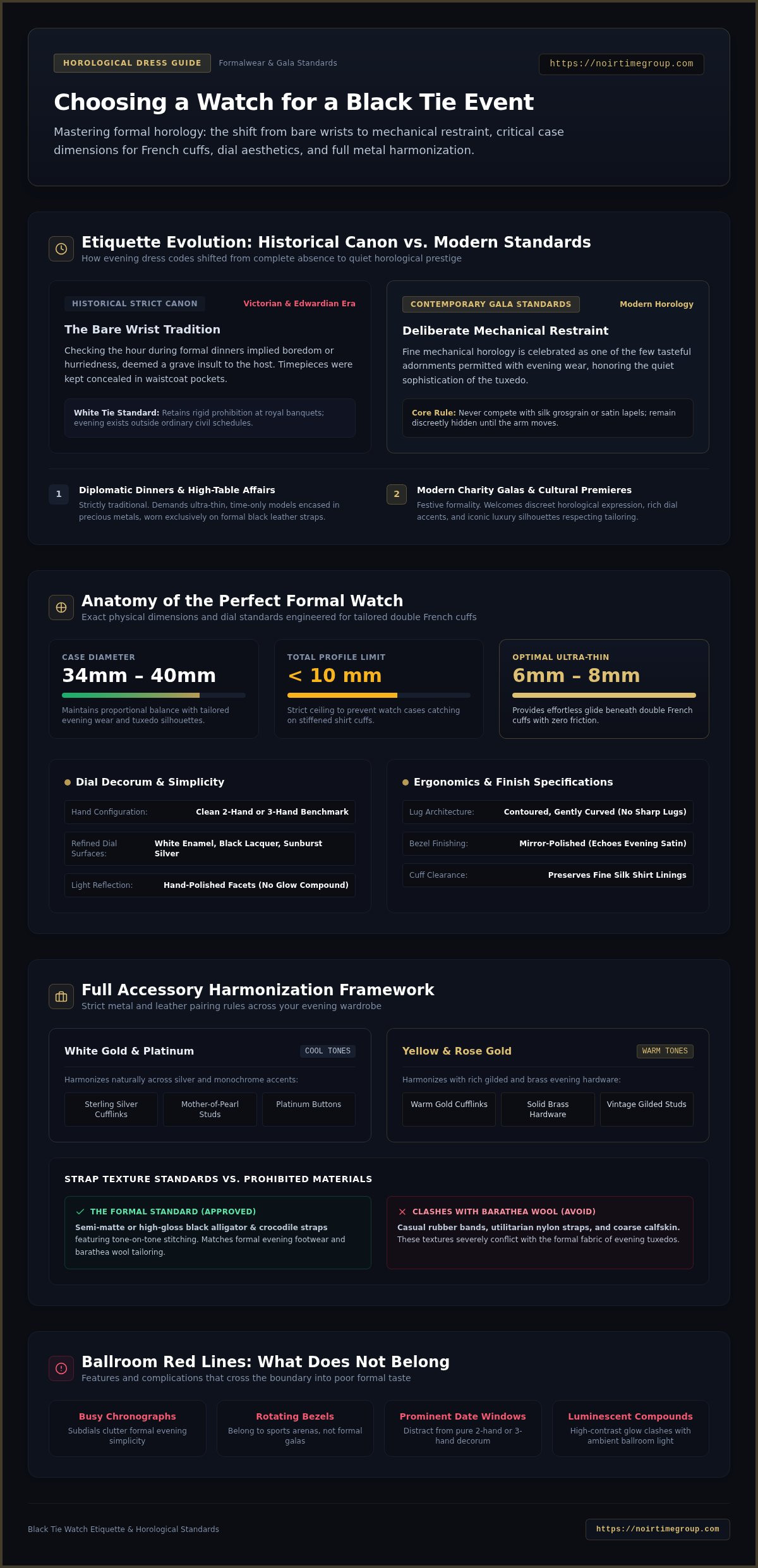
For generations, the sartorial canon dictated that gentlemen leave their wrists completely bare at formal evening affairs. A timepiece was considered an unnecessary distraction, subtly signaling that a guest had somewhere better to be. Today, that boundary has shifted. Modern etiquette views fine mechanical horology as one of the few tasteful adornments permitted with evening wear, provided it honors the quiet sophistication of the tuxedo.
The Historical Case for Wristless Formalwear
The traditional prohibition against watches dates back to late Victorian and Edwardian society. Checking the hour during an intimate dinner implied boredom or hurriedness, representing a grave insult to the host. Within the formal hierarchy established by the Black Tie dress code and its ultra-formal predecessor, white tie, the evening existed outside ordinary civil schedules. Gentlemen carried pocket watches concealed inside waistcoat pockets, keeping timekeeping hidden from view. While white tie retains this rigid restriction at royal banquets, contemporary black tie has evolved to embrace deliberate, elegant wristwear.
The 2026 Perspective on Luxury Horology at Galas
Today, high horology is widely celebrated as discreet personal adornment. When choosing a watch for a black tie event, your objective isn't ostentatious display, but harmonious integration with tailored evening attire. A pristine mechanical watch honors the occasion through exceptional hand-finishing and quiet prestige.
The setting naturally informs your latitude for expression. Understanding the exact nature of the gathering helps you strike the right balance:
- Diplomatic Dinners and High-Table Affairs: These strictly traditional settings demand ultra-thin, time-only models encased in precious metals, worn exclusively on formal black leather straps.
- Modern Charity Galas and Cultural Premieres: These festive gatherings welcome discreet horological expression, accommodating rich dial accents or iconic luxury silhouettes that respect formal tailoring.
Regardless of the venue, true formal horology requires restraint. A proper evening timepiece never competes visually with your silk grosgrain or satin lapels; it remains hidden beneath the cuff, revealing its craftsmanship only when your arm moves.
Anatomy of the Perfect Formal Watch: Case, Dial, and Strap Criteria
Formal tailoring exposes every flaw in an accessory's proportion. When choosing a watch for a black tie event, your timepiece must satisfy exacting physical standards. It needs to slide effortlessly beneath double French cuffs while complementing the balance of your evening silhouette.
Case Proportions and Cuff Ergonomics
Formal shirt cuffs leave mere millimeters of clearance. A tuxedo watch should feature a diameter between 34mm and 40mm, with an overall case profile staying strictly under 10mm. Ultra-thin profiles measuring between 6mm and 8mm provide the cleanest glide under stiffened cuffs. Sharp, angular lugs often snag on fine silk shirt linings, so contoured, gently curved lugs remain essential to preserve your shirt fabric during an evening of movement.
Dial Simplicity and Complication Etiquette
Restraint governs the dial face. Busy chronographs, rotating bezels, and prominent date windows look out of place alongside satin lapels. According to traditional dress watch etiquette, a clean two-hand or three-hand configuration represents the benchmark of formal decorum. Opt for refined dial surfaces such as crisp white enamel, deep black lacquer, or subtle sunburst silver. High-contrast luminescent markers belong in sports arenas, not ballrooms; your watch face should catch ambient light through hand-polished facets rather than glowing compound.
Strap Textures and Metal Harmonization
The strap anchors the watch to your overall look. Semi-matte or high-gloss black alligator and crocodile straps with tone-on-tone stitching set the formal standard. Casual rubber bands, utilitarian nylon, and coarse calfskin clash terribly against barathea wool. Metallic elements require strict coordination across your entire outfit:
- White Gold and Platinum: Pair naturally with sterling silver cufflinks, mother-of-pearl studs, and platinum jacket buttons.
- Yellow and Rose Gold: Align with warm gold accessories, solid brass hardware, and vintage gilded studs.
- Case Finishes: Prioritize mirror-polished bezels over utilitarian brushed textures to echo the sheen of evening satin.
If you want a reference that balances case thickness and metal finishing flawlessly, exploring a curated luxury timepiece collection ensures every proportion respects evening dress codes.
Evaluating Watch Styles: Dedicated Dress Models vs. Integrated Luxury Icons
Every formal event carries its own unwritten dress expectations. When choosing a watch for a black tie event, the debate usually centers on whether to stay strictly traditional or embrace an iconic modern design. Understanding how different horological silhouettes interact with tailored lapels lets you make a deliberate, tasteful choice.
The Classic Benchmark: Ultra-Thin Precious Metal Dress Watches
A pure dress watch remains the gold standard for formal evenings. Driven by ultra-thin manual-wind or micro-rotor movements, these pieces disappear gracefully beneath your cuff until needed. Cases crafted from platinum, yellow gold, or rose gold provide warmth without shouting. A dedicated dress model carries zero sartorial risk; it honors the historical sanctity of black tie and never invites unwanted scrutiny from traditional hosts.
The Haute Horlogerie Exception: Integrated Luxury Icons
The rise of high-end integrated bracelet watches has challenged traditional formal boundaries. Masterpieces like the Audemars Piguet Royal Oak and Patek Philippe Nautilus represent the pinnacle of Swiss hand-finishing. While purists might object to their sporting origins, these references have earned their place at creative black tie events, gallery openings, and modern charity galas. Their slender profiles slip under tailored cuffs far better than bulky chronographs. If you wear an integrated icon to a formal gathering, ensure the case remains slim and the brushed bevels are in immaculate condition.
The Diver Debate: Can a Rolex Submariner Suit Black Tie?
Pop culture frequently points to James Bond pairing a diving watch with a dinner jacket. In reality, a utilitarian steel tool watch often clashes with formal evening wear because rotating bezels and heavy clasps add unnecessary bulk. However, precious metal references tell a different story.
A solid yellow gold Rolex Submariner Date 126618LN brings rich, formal warmth that transforms an active tool silhouette into an opulent evening statement. Similarly, the two-tone Rolex Submariner Date 126613LN bridges the gap between functional design and evening sophistication. When choosing a watch for a black tie event that leans festive or contemporary, a pristine precious metal diver offers an assertive, rule-breaking alternative to classic leather straps.
Coordinating Your Watch with Formalwear: A Step-by-Step Styling Framework
A luxury timepiece should never look like an afterthought added right before walking out the door. When choosing a watch for a black tie event, success relies on seamless coordination across textures, metals, and shirt construction. Use this three-step framework to ensure every element aligns with your tuxedo.
Step 1: Match the Metals Across Your Evening Jewelry
Evening wear magnifies mismatched metals immediately. Platinum or white gold cases pair naturally with white gold studs, sterling silver cufflinks, or onyx studs set in cool metal. If your tuxedo furnishings feature yellow gold or brass, choose a matching yellow gold case. Rose gold demands identical warmth across your signet ring and cufflinks. Never mix warm and cool metals; doing so fractures the deliberate balance of your tailoring.
Step 2: Align Leather Finishes with Formal Footwear
Your strap finish must mirror the sheen of your evening shoes. The relationship is direct:
- Patent Leather Shoes: Wear a high-gloss, glazed black alligator strap to reflect the mirror-shine of your evening pumps or oxfords.
- Calfskin Oxfords: Choose a semi-matte or satin-finish black leather band to preserve understated harmony.
- Velvet Slippers: Select a supple, matte black crocodile strap that grounds the rich texture of evening velvet.
Keep the strap strictly black. Even with midnight blue tuxedos, black leather provides the essential formal anchor to match grosgrain or satin lapel facings.
Step 3: Conduct the Tailored Cuff Clearance Test
Before leaving for your event, fasten your formal shirt and jacket to test wrist mobility. Rest your arm at your side. The tailored French cuff should glide smoothly over the watch case without catching. If the fabric snags, bunches, or forces your jacket sleeve to ride up, the case is too thick. Adjust the strap tension so the watch remains centered over your wrist bone rather than sliding forward into your hand.
If your current collection lacks a reference that satisfies this precise checklist, contact Noir Time Group to explore verified luxury timepieces suited for formal occasions.
Curating and Sourcing Your Formal Watch with Noir Time Group
A bespoke tuxedo sets an exacting standard of crisp tailoring, meaning any timepiece worn alongside it must exhibit pristine physical condition and verified provenance. When choosing a watch for a black tie event, securing an authentic, immaculate reference matters just as much as matching case metals. Noir Time Group serves as a premier Manhattan destination, providing collectors direct access to elite Swiss manufactures.
The Advantage of Curated Pre-Owned and Rare Timepieces
Acquiring pre-owned timepieces allows collectors to secure elusive references that are unavailable through traditional retail channels. Every piece in our inventory undergoes rigorous inspection to ensure crisp case bevels, unblemished dials, and pristine crystal clarity that withstands bright ballroom lighting. Whether you prefer the warmth of a solid yellow gold Rolex Submariner Date 126618LN, the versatility of a two-tone Rolex Submariner Date 126613LN, or integrated icons like the Audemars Piguet Royal Oak and Patek Philippe Nautilus, our showcase delivers verified elegance. Explore our pre-owned collection at Noir Time Group for your upcoming formal engagements.
Bespoke Watch Sourcing Service for Elite Events
Tracking down a specific ultra-thin dress reference often requires global reach. Through our dedicated Watch Sourcing Service, our New York team taps an international network to locate rare timepieces across premier marques. We consider your wrist measurements, cuff tailoring, and event setting to source a reference that integrates naturally with your formal wardrobe. In addition, clients can utilize our authenticated trade-in process, seamlessly turning existing collection pieces into formal cornerstones.
Authenticity Guarantee and Certified After-Sales Care
Complete confidence in your timepiece is essential when stepping into prestigious gatherings. Every watch we handle undergoes thorough multivariable authentication, confirming movement integrity and component originality. To protect your investment over time, our New York-based Certified Watch Repair service handles precision regulation, timing calibration, and routine mechanical care so your watch functions reliably through long evening affairs. When you're ready to refine your formal wardrobe, connect with our team to secure your formal luxury timepiece with complete peace of mind.
Step into Your Next Gala with Absolute Poise
Selecting the right horological companion for a tuxedo doesn't have to be complicated. Successful formal pairing requires slim proportions that glide beneath French cuffs, matching case metals to your evening hardware, and choosing straps that complement your footwear. When choosing a watch for a black tie event, intentional restraint always speaks louder than flash.
As a premier New York luxury watch authority specializing in marques like Rolex, Patek Philippe, and Audemars Piguet, Noir Time Group helps you elevate your black tie presence. Whether you need our dedicated Watch Sourcing Service to secure an elusive reference or rely on our Certified Watch Repair specialists for precision maintenance, every timepiece comes with guaranteed authenticity. Explore curated formal timepieces at Noir Time Group and wear your evening attire with poise.
Frequently Asked Questions
Is it acceptable to wear a watch with a tuxedo to a black tie event?
Yes, modern dress codes fully accept wearing a wristwatch with a tuxedo, provided the timepiece remains understated and discreet. While Edwardian tradition frowned upon checking the hour, contemporary galas celebrate high horology as tasteful personal jewelry. When choosing a watch for a black tie event, stick to clean, slim profiles that respect formal tailoring rather than aggressive sports silhouettes that draw undue attention.
What is the ideal case thickness for a black tie dress watch?
The ideal case thickness for a black tie watch is under 10mm, with the most refined formal references measuring between 6mm and 8mm. Formal double French cuffs fit tightly against the wrist, leaving minimal excess space. A slender profile allows the watch to slide beneath your shirt cuff smoothly, ensuring the sleeve drape remains clean without bunching up against your forearm during the event.
Can I wear a stainless steel sports watch like a Submariner with black tie?
A standard brushed stainless steel tool watch generally clashes with formal black tie attire due to its thick rotating bezel and utilitarian aesthetic. However, precious metal variations create an elevated impression. Models like the solid yellow gold Rolex Submariner Date 126618LN or two-tone Rolex Submariner Date 126613LN bridge this gap effectively. Their polished gold elements match evening metals, making them a daring yet viable option for festive gatherings.
Should the strap of my formal watch always match my dress shoes?
Yes, harmonizing your watch strap with your footwear finish is essential for cohesive evening wear. If you wear high-shine patent leather shoes or evening pumps, select a glossy black alligator strap. For standard calfskin oxfords, choose semi-matte black leather with tone-on-tone stitching. Sticking strictly to black leather bands preserves the monochrome balance of a tuxedo, aligning smoothly with black satin or grosgrain jacket lapels.
Are integrated bracelet watches like the Royal Oak or Nautilus acceptable for black tie?
Integrated luxury bracelet icons are widely accepted at modern black tie gatherings, creative galas, and artistic premieres. Haute horlogerie masterpieces like the Audemars Piguet Royal Oak and Patek Philippe Nautilus offer exceptional hand-finishing and slim case profiles that sit comfortably beneath tailored cuffs. While ultra-traditional white tie banquets still call for pure leather-strap dress models, integrated icons deliver sophisticated wrist presence at contemporary formal affairs.
What dial colors are appropriate for a formal evening event?
Crisp white, clean silver, and deep black lacquer dials remain the most appropriate choices for formal evening wear. These timeless shades integrate naturally with the monochrome palette of evening attire. While choosing a watch for a black tie event, avoid bright neon accents or heavy luminescent indices. Subtle textured finishes like enamel or sunburst brushing catch ambient light elegantly without distracting from your tuxedo.
How does Noir Time Group authenticate pre-owned luxury timepieces for formal wear?
Noir Time Group performs exhaustive multivariable inspections on every timepiece to verify component originality, movement integrity, and aesthetic condition. Our New York specialists meticulously examine case finishing, serial engravings, and dial markers before verifying mechanical precision on timing machines. Backed by our in-house Certified Watch Repair capabilities, every reference from Rolex, Patek Philippe, and Audemars Piguet is guaranteed authentic and ready for prestigious evening settings.
