

The safest-looking luxury watch may not be the smartest first buy. Choosing the best first luxury watch under $10000 means weighing more than a famous name. You want a watch you’ll enjoy wearing, a model with a meaningful history, and a realistic idea of its resale prospects if your tastes change. Movement terms and power-reserve figures can make the decision feel more complicated than it needs to be, but a few practical checks can help you compare options.
It’s sensible to consider depreciation, especially when this is a significant purchase. But resale value isn’t guaranteed, and a watch’s reputation alone can’t tell you whether a particular example is authentic, well cared for, or right for your life. The pre-owned market can open the door to sought-after models, but provenance, condition, service history, and original parts deserve careful attention.
This 2026 collector’s guide offers a framework for choosing a watch that balances heritage, mechanical quality, everyday wearability, and potential liquidity. We’ll explain the specifications that matter, compare new and pre-owned options, and outline what to verify before buying. The goal is to help you choose a credible contender for a watch you’ll want to keep, with confidence rather than guesswork.
Key Takeaways
- Use the $10,000 threshold to compare more than brand prestige. Consider the movement, heritage, and how well the watch suits daily wear.
- Compare the Rolex Datejust or Oyster Perpetual, Omega Speedmaster, and Tudor Black Bay by their strengths as potential everyday watches.
- Assess new and pre-owned options side by side. Look beyond condition to provenance, service history, and original parts.
- Use a practical fit-and-condition checklist to narrow down the best first luxury watch under $10000 and avoid costly surprises.
- If a suitable Rolex is hard to find at retail, a specialist sourcing service may help you explore candidates, though availability and suitability depend on the specific watch.
Why $10,000 is the 'Golden Threshold' for Luxury Watches
A budget near $10,000 can take a first-time buyer beyond entry-level luxury and into a broader selection of established brands, refined finishing, and capable mechanical movements. It isn’t a universal dividing line: value depends on the exact model, its condition, and whether it’s new or pre-owned. At this level, buyers often choose between a recognizable everyday classic and a more distinctive enthusiast piece.
A five-figure watch purchase can feel like a serious commitment, so don’t treat it as a guaranteed investment. Weigh the pleasure of wearing the watch against its potential to retain value. The best first luxury watch under $10000 should make sense on your wrist, not just in a future resale listing.
The Anatomy of a $10,000 Timepiece
Materials and specifications can help explain a watch’s appeal, but no single feature proves that it’s worth the asking price. Rolex, for example, uses 904L steel in its Oystersteel watches; other brands may use different grades. Sapphire crystals are common in luxury watches, while precious-metal details can add visual distinction and affect the price.
Movement credentials also vary. COSC and METAS certifications indicate that a movement has met defined testing standards, but not every watch in this price range carries either certification. Some watches feature in-house calibres; others use movements made by specialist suppliers. Compare the movement, accuracy claims, service documentation, and condition instead of assuming that “in-house” automatically means better.
Heritage matters, too. A brand’s history can shape its designs and reputation, but it doesn’t guarantee comfort, reliability, or resale demand. Consider what the watch’s story means to you, not only what it signals to other collectors.
Investment vs. Wearability
Hype can draw attention to a model, but attention isn’t the same as lasting demand. Evergreen designs from recognizable brands may appeal to a wider pool of buyers, while a less conventional watch could be more personally rewarding. Neither is a sure route to appreciation. Pre-owned watches can offer access and value, but prices move, and depreciation is often steepest during a watch’s first one to three years.
For a more balanced decision, ask yourself:
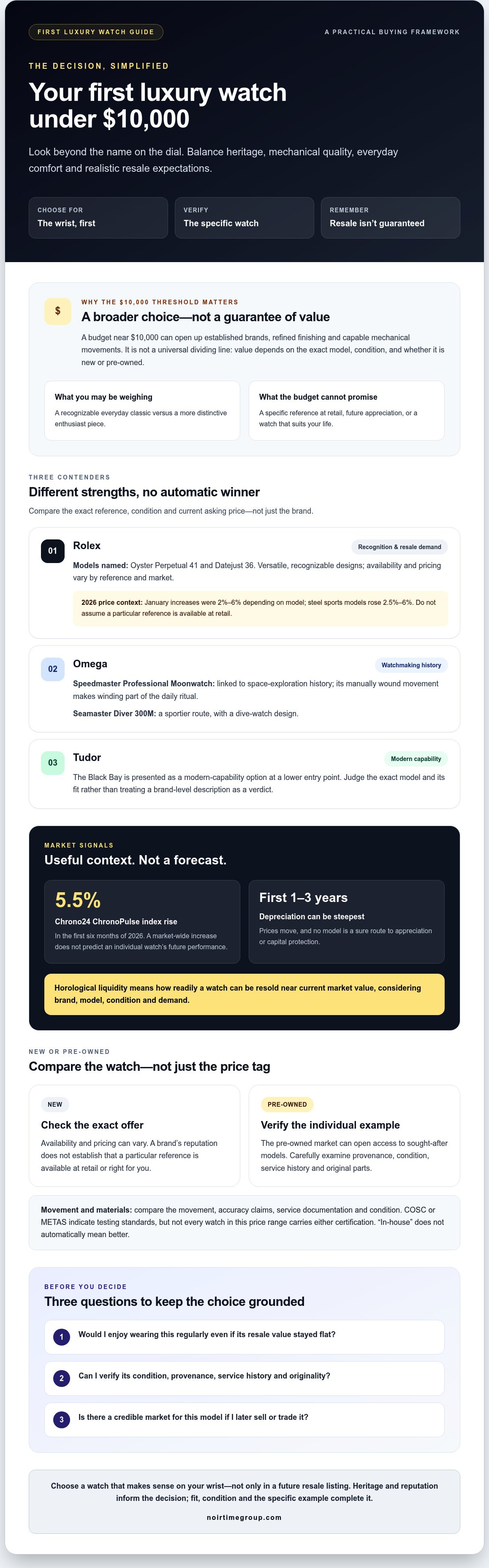
- Would I enjoy wearing this watch regularly, even if its resale value stayed flat?
- Can I verify its condition, provenance, service history, and originality?
- Is there a credible market for this model if I later decide to sell or trade it?
Horological liquidity describes how readily a watch can be resold at a price close to current market value, given its brand, model, condition, and demand.
In 2026, the Chrono24 ChronoPulse index rose 5.5% in the first six months of the year, but a market-wide increase doesn’t predict an individual watch’s future performance. Treat potential value retention as one part of the decision, not capital protection. Choose a watch you’ll be glad to own, then use its market reputation and careful authentication to make a more informed purchase.
The Top 3 Contenders for Your First $10,000 Watch
There isn’t one automatic winner. Rolex is known for broad recognition and resale demand, Omega appeals to enthusiasts with rich watchmaking history, and Tudor offers modern capability at a lower entry point. Compare the exact reference, condition, and current asking prices rather than assuming every model in a brand’s lineup fits the same budget. For a potential daily watch, also consider comfort, versatility, and whether you’ll enjoy wearing it in both professional and casual settings.
Rolex: The Standard of Prestige
The Oyster Perpetual 41 and Datejust 36 are versatile choices with recognizable designs, though availability and pricing vary by reference and market. Rolex increased prices in 2026, with January rises of 2% to 6% depending on model; steel sports models rose by 2.5% to 6%. Don’t assume a particular reference is available at retail. If you’re considering Rolex, a sourcing service such as Noir Time Group’s watch sourcing service may help locate a model that’s difficult to find. Rolex has strong resale recognition, but liquidity and value retention depend on the individual watch, its condition, and market demand.
Omega: The Enthusiast’s Choice
The Speedmaster Professional Moonwatch connects everyday ownership with the history of space exploration; its manually wound movement also makes winding part of the daily ritual. The Seamaster Diver 300M takes a sportier route, with a dive-watch design and its own technical strengths. Rather than declaring it categorically superior to the Rolex Submariner, compare the specific references, fit, features, and condition. As of September 2026, older standard Seamaster Diver 300M variants are available for under $6,000, while newer versions cost slightly more, according to Chrono24 Magazine. Omega can leave room in the budget for a considered pre-owned purchase or future servicing, but check the individual watch’s history and originality.
Tudor: The Modern Alternative
Tudor’s Black Bay series combines contemporary specifications with design cues that recall the brand’s history alongside Rolex. The Black Bay 58 received a five-link bracelet option and a Master Chronometer calibre in April 2026. Its listed prices range from $4,975 on rubber to $5,350 on the five-link bracelet, leaving more budget flexibility than a single high-demand Rolex. You could choose a Tudor and keep funds for other collecting priorities, but buy what you’ll wear, not simply more pieces. The choice between hype and enduring appeal starts with honest daily-use questions, not a logo alone.
Rolex, Omega, and Tudor each offer a distinct balance of recognition, watchmaking, and wearability. For a specialist perspective on what sets exceptional watchmaking apart, Chrono24 Magazine defines the very essence of distinction, though prestige alone doesn’t determine the right first watch.
New vs. Pre-Owned: Maximizing Your $10,000 Budget
A $10,000 budget can lead to two very different purchases: a new watch with a fresh warranty and first-owner experience, or a pre-owned model with more history, choice, and sometimes a more favorable price. The right route depends on how much you value pristine condition and manufacturer support versus access to sought-after or discontinued references.
In 2026, the pre-owned market is a major part of the luxury-watch landscape, not simply a fallback when boutiques come up short. Chrono24 reports that pre-owned examples can cost 10% to 40% less than new for many models, though high-demand Rolex and Patek Philippe watches can sell above retail. These are broad market patterns, not promises about a particular watch or its future value.
The Benefits of Buying New
A new purchase from an authorized dealer offers the cleanest ownership history: you’re the first owner, the watch arrives unworn, and the manufacturer’s warranty applies according to its terms. The presentation and unboxing can be part of the pleasure, too. For buyers who prefer certainty over searching for a particular reference, new is straightforward, provided the watch and price fit the budget.
The Strategic Advantage of Pre-Owned
Pre-owned can open access to discontinued designs and older references that aren’t available new. A well-chosen 1990s or 2000s watch may offer a distinctive period look, while pre-owned Zenith or IWC models can bring another brand into consideration. Availability, condition, and pricing vary, so treat these as options to explore rather than guaranteed bargains.
An older Rolex Submariner may appeal more than a new Omega if you value Rolex’s design, history, and market recognition; another buyer may prefer the Omega’s condition, warranty, or features. Compare specific references and verified asking prices. Don’t assume that one brand automatically offers better value or resale prospects.
Is a used watch as good as a new one? It can be a satisfying, dependable purchase, but its quality depends on the individual example. Before committing, check authenticity and provenance, case and crystal condition, movement performance, service records, and whether parts remain original. Box and papers are desirable and can support resale value, but they don’t replace a careful inspection.
For the best first luxury watch under $10000, prioritize the watch’s condition and your confidence in the seller over a tempting discount. A reputable specialist may help assess a difficult-to-find reference, but confirm what documentation and authenticity support come with the specific watch. That due diligence is what turns a pre-owned opportunity into a considered purchase.
Choosing the Best First Luxury Watch Under $10000: 5 Things to Verify
A polished listing and an attractive price don’t establish that a luxury watch is authentic, comfortable, or worth buying. Before deciding on the best first luxury watch under $10000, check the watch itself and the seller’s ability to support its claims. Use these five points to guide your inspection, especially when considering a pre-owned piece.
- Fit on your wrist. Case diameter is only a starting point. Watches around 39mm to 41mm suit some wrists, but lug-to-lug length, case thickness, and bracelet shape affect how a watch wears. Try it on if possible, and check that the lugs don’t overhang your wrist or make the case feel top-heavy.
- Movement and service condition. Ask whether the movement has been inspected and whether service records are available. A serial number that appears to match paperwork is useful, but it doesn’t prove authenticity on its own. For a high-value purchase, have the movement and identifying details assessed by a qualified professional.
- Power reserve and water resistance. Match the specifications to your routine. A longer power reserve may be convenient if you rotate watches; water resistance should suit your intended use. Confirm the rating for the exact reference and ask whether it has been tested recently. Don’t assume a pre-owned watch remains water-resistant just because it was designed for swimming.
- Authenticity and originality. Check the dial, hands, case, bracelet, and movement against the correct reference. Ask whether components have been replaced and whether those parts are original or approved replacements. Box and papers can strengthen a watch’s documentation and appeal to future buyers, but they can be separated from a watch or falsified, so they aren’t a substitute for authentication.
- Seller reputation and provenance. Compare the seller’s transparency, inspection process, return terms, and willingness to answer specific questions, not just the asking price. Provenance is a watch’s documented ownership and service history. It helps establish the watch’s background and can support confidence in a $10,000 purchase.
There’s no single authentication label that removes the need for careful checks in 2026. A reputable New York retailer with watch expertise can be a useful resource, but ask what was examined and what documentation accompanies the specific watch. Noir Time Group states that each timepiece is guaranteed for authenticity and that it provides certified watch repair, so buyers can ask about the specific watch and its after-sales support while evaluating a potential purchase.
Take your time with the details. If you’re looking for help sourcing a hard-to-find Rolex, explore Noir Time Group’s watch sourcing service.
Beyond the Boutique: Sourcing Your Grail with Noir Time Group
Popular Rolex models can be difficult to find through retail channels, and the right watch may not be sitting in a boutique window when you’re ready to buy. References such as an Explorer or Datejust can vary in availability, condition, and price, so a focused search may reveal options beyond what’s on display. A sourcing specialist can help you look for a watch that fits your preferences, but confirm availability and details rather than assuming a particular model or outcome.
Noir Time Group is a New York-based luxury retailer specializing in Rolex, Patek Philippe, and Audemars Piguet. Its watch sourcing service may be relevant if you’re looking for a Rolex that’s hard to locate at retail. Be clear about the reference, condition, budget, and features you’re seeking, then ask what the service can realistically identify. For a pre-owned watch, ask how authenticity, provenance, condition, and service history are established before you commit.
The Concierge Experience in New York
A precise brief helps narrow a search. Share the reference or preferred era, case size, dial preferences, and any condition requirements. If you’re flexible, say which details matter most. Noir Time Group’s New York presence offers an in-person point of contact for discussing a high-value purchase, while its stated authenticity guarantee and certified watch repair service speak to important ownership considerations. Confirm what documentation and after-sales care apply to the specific watch you’re considering.
Planning Your Watch Journey
Your first purchase doesn’t have to be your final collecting goal. A watch you enjoy wearing can be a meaningful starting point, and your preferences may change as you learn more about different brands and references. If you later set your sights on a Patek Philippe or Audemars Piguet, ask prospective dealers whether they accept trade-ins and how they assess the watch you own. Don’t assume a future trade-in will return what you paid; value depends on the model, condition, documentation, and market at that time.
The best first luxury watch under $10000 is one you can afford, authenticate, and wear with confidence, not simply the rarest name you can find. Sourcing can help you explore candidates, but compare the final watch and terms carefully before deciding. A retailer whose inventory focuses on higher-end models may not have an option within your budget, so confirm the price range and suitability of any sourced watch before proceeding.
Choose a Watch You’ll Be Glad to Wear
The best first luxury watch under $10000 isn’t simply the one with the biggest name or strongest resale reputation. It’s the watch that fits your wrist, routine, and collecting priorities, with its condition and history carefully checked before you buy. Whether you choose new or pre-owned, a confident decision comes from balancing personal enjoyment with realistic expectations about future value.
If the right Rolex is hard to find, expert sourcing can help you explore options beyond what’s immediately available. Noir Time Group is a New York-based retailer specializing in Rolex, Patek Philippe, and Audemars Piguet, with watch sourcing and trade-in services. Its certified watch repair service and authenticity guarantee can also inform the questions you ask as you assess a potential purchase. Confirm the authenticity, condition, and price of the specific watch you’re considering.
Contact Noir Time Group to discuss sourcing a luxury watch with a clear brief and a realistic budget. Confirm that any candidate fits your price range before moving forward.
Frequently Asked Questions
Is $10,000 enough for a 'real' luxury watch in 2026?
Yes, $10,000 can buy a genuinely luxurious timepiece, though the budget doesn’t guarantee a particular brand, specification, or level of finishing. New options from brands such as Tudor and Omega, along with pre-owned watches from a wider range of makers, give buyers meaningful choices. Focus on the individual watch’s movement, condition, materials, service history, and fit. “Luxury” is not a price cutoff, so choose a watch that earns its place on your wrist.
Will a $10,000 Rolex hold its value better than an Omega?
Not necessarily, though Rolex models with strong demand often have greater resale recognition and can be more liquid than comparable watches. That doesn’t guarantee a Rolex will retain its purchase price or outperform every Omega. The specific reference, condition, purchase price, originality, and market demand all matter. Compare recent asking and completed sale prices where available, and treat resale potential as one factor in your decision, not as a promised return.
Should I buy a vintage watch as my first luxury timepiece?
You can, if you’re comfortable researching the reference and evaluating an older watch’s condition. A vintage or neo-vintage model may offer a distinctive design or access to a discontinued reference, but age makes service records, originality, and parts condition especially important. Before buying, ask an experienced watch professional to assess the watch and clarify any likely maintenance needs. If you want simpler ownership, a newer pre-owned piece with clear documentation may be a better fit.
What is the best Rolex model I can get for under $10,000?
There’s no single answer because availability and market prices change by reference, condition, and seller. Pre-owned Datejust or Oyster Perpetual models may be worth researching, but don’t assume a particular size or configuration will fit your budget. Compare verified listings for the exact reference, then factor in service history, originality, and documentation. A trusted specialist can help you assess candidates, but confirm current availability and the full terms before committing.
Do I need to service my luxury watch immediately after buying it pre-owned?
Not automatically. First review available service records, the seller’s inspection details, and any warranty that applies to the watch. If its history is unclear, performance seems inconsistent, or the seller can’t explain its condition, arrange an assessment by a qualified watchmaker before relying on it for daily wear. Ask for a service estimate before authorizing work. A documented recent service can inform your decision, but the watch still needs to be evaluated on its own condition.
How do I know if a watch is too big for my wrist?
Try it on and check how the case sits, rather than relying on diameter alone. The lugs should generally stay within the edges of your wrist, and the watch shouldn’t feel top-heavy or slide around excessively. Lug-to-lug length, case thickness, and bracelet shape all affect comfort. Wear it for several minutes and move your wrist naturally. A 39mm watch may fit one person well and feel oversized on another.
Can Noir Time Group source a watch if it's not in their current inventory?
Yes. Noir Time Group offers a watch sourcing service for specific luxury models, including watches that may not appear in its public inventory. Share the brand, reference, preferred condition, and budget, then ask what can be sourced and what verification or documentation will be provided. Availability and outcomes can vary, so sourcing shouldn’t be treated as a guarantee. Noir Time Group is a New York-based retailer specializing in Rolex, Patek Philippe, and Audemars Piguet.
Why is 'Box and Papers' so important for a $10,000 watch?
The original box and paperwork can help document a watch’s sale history and make a future resale more appealing to some buyers. Papers may include details that support the watch’s identity, while the box completes the original set. Neither proves authenticity on its own: paperwork can be separated from a watch, and counterfeit documents exist. Check the watch itself, its serial details, condition, and provenance, and have authenticity assessed independently before purchase.
