

Did you know that counterfeit watches account for 48% of the total value of all seized Swiss goods globally? With the industry losing approximately CHF 2 billion in annual sales to fakes, learning the common signs of a fake luxury watch is no longer just a hobby; it's a financial necessity. Whether you're eyeing a Rolex Submariner 126618LN or an Audemars Piguet Royal Oak, the rise of "super-clones" means the stakes have never been higher.
It's natural to feel anxious about losing capital when modern replicas use tungsten cores to mimic the weight of solid gold. You shouldn't need a master's degree in horology just to avoid a scam. This guide provides a definitive 2026 checklist to help you identify high-end counterfeits before you invest. We'll break down the microscopic details of physical inspection, explain the red flags in "phishing" paperwork, and show you how to leverage professional sourcing services to ensure your collection remains 100% authentic.
Key Takeaways
- Learn to identify the common signs of a fake luxury watch by examining microscopic details like laser-etched crystals and font alignment that even super-clones struggle to perfect.
- Understand why the internal mechanics, including the balance wheel and movement finishing, are the ultimate indicators of a genuine Swiss caliber.
- Discover how to verify provenance through UV light tests and NFC chip validation to avoid the "phishing full set" trap used by modern counterfeiters.
- Master the use of digital scales and density checks to spot tungsten-core replicas that attempt to mimic the heft of solid 18k gold models.
- Recognize why a professional sourcing service and a physical presence in New York provide the most reliable protection against high-end horological fraud.
The Evolution of Counterfeits: Why 'Super-Clones' Change the Game
The landscape for counterfeit luxury watches has undergone a radical transformation. We've moved past the era of "flea market fakes" with plastic parts and blurry logos. Today, the market is flooded with "super-clones." These are high-end replicas produced using advanced CNC machining and reverse-engineered movements. Looking for the common signs of a fake luxury watch used to be simple. You'd check for a lightweight feel or a misspelled brand name. In 2026, those old-school red flags are dangerously outdated.
Super-clones represent a psychological trap for collectors. When you see a high-value piece at a price that feels "too good," your brain wants to justify the purchase. Counterfeiters exploit this greed and the current scarcity in the secondary market. They create a sense of urgency that causes even seasoned buyers to skip the due diligence. Without a physical presence or a trusted expert to verify the piece, you're essentially gambling with your capital. It's easy to ignore a red flag when you think you've found a bargain.
The Rise of the $1,000 Counterfeit
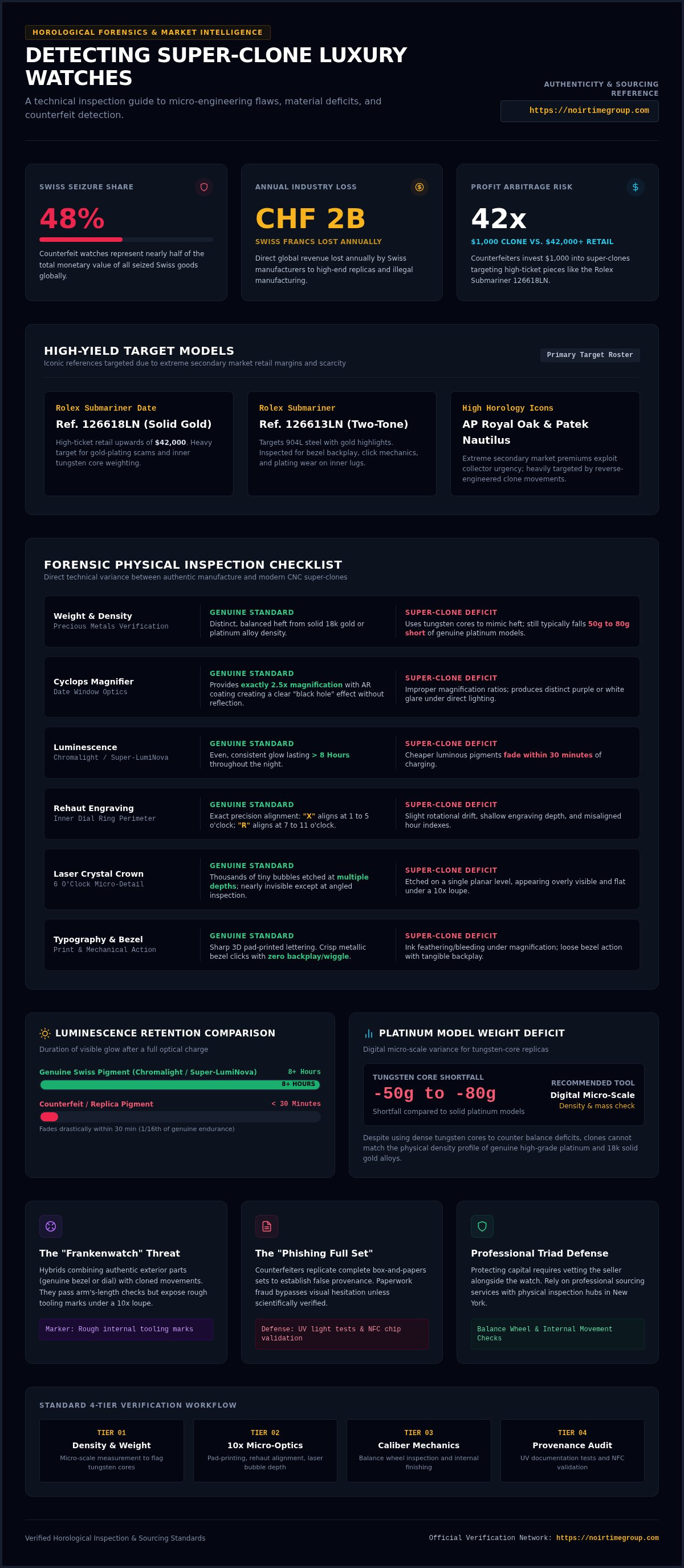
Modern counterfeiters aren't cutting corners on materials. They now utilize 904L stainless steel, the same corrosion-resistant alloy used by Rolex, and genuine sapphire crystals with anti-reflective coatings. The most insidious threat is the "frankenwatch." These hybrids mix genuine exterior components, like a real bezel or dial, with a cloned movement. These pieces easily pass a casual "arm's length" inspection. While the common signs of a fake luxury watch are harder to see here, a 10x loupe often reveals rough tooling marks that don't exist on authentic pieces.
Why High-Ticket Models are Primary Targets
Counterfeit factories focus their resources where the margins are highest. They follow the money. Iconic models like the Rolex Submariner 126613LN and the Patek Philippe Nautilus are constant targets. When a genuine Rolex Submariner 126618LN sells for upwards of $42,000, a counterfeiter can spend $1,000 on a super-clone and still see a massive return. Scarcity makes the problem worse. Because these watches are so difficult to find at retail, buyers often turn to unverified online sellers. This is why our Watch Sourcing Service is so vital. It acts as a professional barrier between you and the high-quality fakes circulating in the 2026 market.
The 10-Point Physical Inspection Checklist for Luxury Watches
The naked eye can be easily deceived by modern super-clones. To truly identify the common signs of a fake luxury watch, you need a structured approach and specific tools like a 10x loupe and a digital micro-scale. According to the U.S. Customs and Border Protection, vetting the seller is as important as vetting the watch itself; however, physical markers remain your first line of defense.
- Weight and Density: Luxury watches made of 18k gold or platinum have a distinct heft. Clones often use tungsten cores to mimic this, but they still typically fall 50 to 80 grams short of authentic platinum models.
- The Cyclops Lens: A genuine Rolex date window provides exactly 2.5x magnification. It also features an anti-reflective coating that creates a "black hole" effect. This means the date is clear without purple or white glare.
- Dial Precision: Inspect the typography. Authentic dials use pad-printing that creates sharp, three-dimensional edges. Fakes often show ink bleeding or "feathering" under magnification.
- Luminescence: Genuine Chromalight or Super-LumiNova should glow consistently for over eight hours. Most fakes use cheaper pigments that fade within thirty minutes.
- Bezel Action: For a diver like the 126613LN, the bezel should have a crisp, metallic click with no "backplay" or wiggle.
Material Integrity and Finishing
Precious metal models, such as the Rolex Submariner Date 126618LN, are prime targets for plating scams. Check the inner lugs and between the links for any sign of base metal showing through. The "rehaut," or the inner ring between the dial and crystal, must feature perfectly aligned engravings. On a genuine Rolex, the "X" should align with the 1 o'clock to 5 o'clock markers, while the "R" aligns from 7 to 11. If you're unsure about a piece you've found, our experts at Noir Time Group can provide professional verification.
The Micro-Details: Macro Photography and Loupes
Use a loupe to examine the crown at 6 o'clock. It's laser-etched with thousands of tiny bubbles at different depths, making it nearly invisible unless viewed from an angle. Replicas often etch this on a single plane; this makes it too easy to see. Also, look for the "floating m" in the depth rating on older Submariner clones, where the "m" sits slightly higher than the numbers. Authentic engineering is about microscopic consistency that machines can't easily replicate.
Movement and Internal Mechanics: The Heartbeat of Authenticity
While the exterior of a super-clone might fool a loupe, the mechanical soul of the watch is much harder to replicate. Identifying the common signs of a fake luxury watch requires moving beyond the aesthetics and scrutinizing how the caliber actually performs. Modern horology is a game of microscopic tolerances; even the most advanced counterfeit factories struggle to match the friction-free efficiency of a genuine Rolex or Patek Philippe movement.
The "sweep" of the second hand is your first clue. High-end Swiss calibers typically vibrate at 28,800 vibrations per hour (vph), which results in eight micro-ticks per second. While many clones have moved away from cheap quartz, they often use lower-frequency movements that stutter under high-speed video. Another critical test is the power reserve. A genuine Rolex Submariner Date 126613LN features the 3235 caliber with a 70-hour power reserve. Most fakes, even those with "decorated" plates, rely on older architecture that barely reaches 40 hours. If the watch dies after sitting on a nightstand for two days, it's likely a counterfeit.
The Sound of Luxury
The beat rate of a standard luxury caliber is 28,800 vibrations per hour, creating a smooth visual sweep that masks the rapid-fire mechanical pulses. Beyond the visuals, listen to the watch. Authentic luxury movements are remarkably quiet. If you hear a clunky, spinning sound when you move your wrist, you're likely hearing a cheap ball-bearing rotor found in mass-produced Asian movements. Professional collectors use a timegrapher to verify the movement's health. A genuine piece will show a stable amplitude, usually above 270 degrees, and a low beat error under 0.3ms. Clones often display erratic "snowing" on the timegrapher screen, indicating poor lubrication and unstable gears.
Internal Engravings and Caliber Markings
Opening the caseback remains the only way to be 100% certain of authenticity. Under the balance wheel, genuine movements feature tiny, crisp engravings of the caliber number and manufacturer hallmarks. Counterfeiters often use "decorated" base movements from Miyota or ETA, adding thin aesthetic plates to mimic the look of a Patek Philippe Nautilus or an Audemars Piguet Royal Oak. These plates are often held on by adhesive rather than screws. If you're considering a high-stakes purchase, our Certified Watch Repair experts can safely open the case to verify the internal architecture before you commit. This mechanical audit is the ultimate safety net against even the most convincing super-clone.
Provenance, Paperwork, and the 'Full Set' Trap
A "full set" used to be the gold standard for security. In 2026, it's often a Trojan horse. Counterfeiters now produce forged warranty cards with operational NFC chips. When scanned, these chips redirect you to spoofed websites that look identical to official manufacturer portals. One of the common signs of a fake luxury watch is actually found in the paperwork. Authentic Rolex cards feature specific patterns visible only under UV light. If the card glows like a standard piece of paper or lacks the hidden text, the watch it accompanies is likely a clone. This "phishing full set" is designed to lower your guard before you even look at the timepiece.
Don't ignore the box. Luxury packaging for an Audemars Piguet Royal Oak or a Patek Philippe Nautilus is an engineering feat itself. Check the hinges; they should be smooth and silent without any lateral movement. Fake boxes often have a chemical smell from cheap adhesives, whereas genuine ones smell of high-grade leather and wood. Cross-referencing serial numbers against global databases is also mandatory. A "service history" from a certified center is often more valuable than a blank warranty card because it creates a verifiable paper trail in the manufacturer’s system that counterfeiters can't easily spoof.
The Red Flags of Secondary Market Paperwork
Watch out for "perfect" vintage papers. If a card from 2010 looks brand new without any yellowing or edge wear, be suspicious. Counterfeiters often use the wrong font weights or spacing for serial numbers. A "full set" from an unverified private seller is actually a higher risk than a "naked" watch from a professional. Scammers use the box and papers to distract you from the flaws of the watch. For total peace of mind, use our Watch Sourcing Service to ensure every document is as authentic as the timepiece itself.
Leveraging Digital Authentication in 2026
Digital Product Passports (DPPs) are changing the game for modern collectors. Brands like Audemars Piguet now use blockchain technology to secure ownership records. You can use official manufacturer apps to verify registration instantly, providing an unforgeable link between the watch and its history. However, this tech has limits. Vintage models won't have these digital footprints. For older pieces, you must rely on physical hallmarks and professional expertise. Verification isn't just about a card; it's about the entire history of the watch.
The Ultimate Safety Net: Buying the Seller, Not Just the Watch
Identifying the common signs of a fake luxury watch is a skill that takes years of dedicated study to master. Even with the checklists provided in previous sections, the sophisticated nature of 2026 super-clones means a single oversight can cost you tens of thousands of dollars. This is why the "Buy the Seller" rule remains the most effective form of authentication. For most collectors, the safest path isn't becoming a part-time watchmaker; it's finding a dealer with an unshakeable reputation and a physical presence you can trust.
At Noir Time Group, our authentication process begins the moment a timepiece enters our inventory. Every watch, whether it's a Patek Philippe Nautilus or a Rolex Submariner Date 126613LN, undergoes a rigorous multi-stage inspection. We don't just look at the dial; we utilize our Certified Watch Repair department to verify the movement's integrity and performance. This internal audit ensures that every watch we sell meets our strict standards. A service record from a certified center doesn't just guarantee authenticity; it builds long-term value for your investment.
Why a New York Presence Matters
A physical presence in New York offers a level of security that digital-only marketplaces simply can't match. High-stakes trades involving pieces like the Rolex Submariner 126618LN require a professional environment where the watch can be inspected and verified in person. Our New York-based team maintains a deep network of trusted contacts across the globe. This allows us to offer a Noir Time Group Sourcing Service that bypasses the risks of the open market, ensuring you never have to gamble with your capital.
Making the Final Decision
The most important lesson in luxury watch collecting is knowing when to walk away from a deal. If a price point feels too good to be true, it almost certainly is. Counterfeiters rely on the buyer's desire for a "steal" to mask the common signs of a fake luxury watch that would otherwise be obvious under professional scrutiny. Choosing a partner that provides a 100% authenticity guarantee removes the anxiety from the acquisition process. You shouldn't have to worry about whether your Audemars Piguet Royal Oak is genuine when you're making a significant investment. Contact Noir Time Group for professional sourcing and authentication.
Protecting Your Horological Legacy
Mastering the common signs of a fake luxury watch is your first line of defense in a market increasingly crowded by "super-clones." We've explored how microscopic finishing, internal movement architecture, and the "full set" trap reveal the truth behind a timepiece. While the 2026 market presents new challenges, your passion for collecting shouldn't be overshadowed by the fear of counterfeiters. By focusing on mechanical precision and verifying provenance through digital and physical checks, you can navigate high-ticket acquisitions with confidence.
The most reliable way to safeguard your capital is to partner with NYC-based luxury experts who live and breathe horology. Whether you're seeking a Rolex Submariner or a Patek Philippe Nautilus, professional verification is the only way to ensure your investment is sound. At Noir Time Group, we provide an authenticity guarantee on every sale and offer professional sourcing for rare, high-ticket models. Secure Your Investment: Shop Certified Authentic Luxury Watches at Noir Time Group. Your collection deserves nothing less than total certainty and world-class expertise.
Frequently Asked Questions
Can a fake watch have a real serial number?
Yes, counterfeiters often engrave real serial numbers onto fake watches. They find these numbers from photos of genuine watches posted online or from stolen inventory lists. This is why a serial number check alone isn't enough to verify authenticity. You must look for the depth and precision of the engraving, as fake engravings often look shallow or "sandy" under a loupe compared to the surgical laser sharpness of a genuine Rolex.
How much does it cost to have a luxury watch professionally authenticated?
The cost of professional authentication varies based on the watch model and the level of inspection required. Instead of focusing on a flat fee, you should consider the value of the expertise provided. A comprehensive check often includes opening the caseback, testing metal density, and verifying the movement on a timegrapher. For high-ticket items like a Rolex Submariner Date 126618LN, professional verification is an essential investment that prevents a total loss of capital.
Do all fake watches tick loudly?
No, the idea that all fakes "tick" loudly is a myth from the era of cheap quartz replicas. Modern super-clones use mechanical movements that vibrate at 28,800 beats per hour, creating a smooth visual sweep. While some low-end fakes might have noisy rotors that clatter when you move your wrist, high-end counterfeits are often as silent as the real thing. This is why checking for common signs of a fake luxury watch requires looking at finishing rather than just listening.
Is it possible for a fake Rolex to have a real sapphire crystal?
Yes, it's very common for high-end fake Rolex models to feature genuine sapphire crystals. These crystals are scratch-resistant and provide the same clarity as the original. However, the difference usually lies in the anti-reflective coating on the cyclops lens and the laser-etched crown at the 6 o'clock position. On a fake, the etched crown is often too visible to the naked eye, whereas the genuine version is nearly impossible to see without a specific light angle.
What happens if I accidentally buy a fake watch from a private seller?
Buying a counterfeit from a private seller often leaves you with very few legal options, especially if the transaction was cash-based or through an unverified platform. Most private sales are "as-is," making it difficult to prove fraud after the fact. To avoid this risk, you should always insist on a meeting at a professional facility or use a trusted intermediary. This is where a New York-based expert team provides the security that a marketplace listing cannot.
Are 'super-clones' actually made of real gold?
Super-clones are almost never made of solid 18k gold. Instead, they use heavy plating over stainless steel or high-density tungsten cores to match the weight of a genuine Rolex Submariner Date 126618LN. While they might feel heavy, an XRF metal analysis or a simple density test will reveal the truth. Counterfeiters prioritize the look of gold over the actual material value because using solid gold would destroy their profit margins on the replica.
Does 'Box and Papers' always mean the watch is genuine?
No, "Box and Papers" are no longer a guarantee of authenticity. Counterfeiters produce high-quality forged warranty cards that include working NFC chips and UV-reactive text. These "phishing full sets" are designed to convince you the watch is genuine before you even inspect the piece itself. Always verify the watch first; the paperwork should be the last thing you check, not the primary reason you trust a deal.
How can I check if a watch is stolen before buying?
You can check if a watch is stolen by searching its serial number in global databases like The Watch Register or Enquirus. These registries are used by police and insurers to track stolen luxury goods. Before finalizing a purchase, it's wise to cross-reference the serial number found on the rehaut or between the lugs. This step is a vital part of identifying the common signs of a fake luxury watch or a high-risk transaction.
