

Over 40 million counterfeit watches flood the global market every year, a staggering figure that now exceeds the total annual production of the entire Swiss watch industry. If you feel anxious about spotting a superclone watch before your next high-ticket purchase, you aren't alone. The rise of sophisticated replicas has turned what used to be a simple visual check into a high-stakes forensic challenge. It's no longer enough to look for a laser-etched crown or a specific dial font; today's superclones use tungsten-weighted cases and reverse-engineered movements that can easily fool an untrained eye.
We understand the fear of financial loss and the frustration caused by these high-quality online replicas. This guide provides a clear mental checklist for authentication by revealing the forensic techniques professional watchmakers use to protect their clients. You'll learn why traditional visual tells are failing in 2026, how to identify true clone caliber architecture, and why a professional internal caseback inspection is now non-negotiable. By the end of this expert guide, you'll have the confidence to navigate the luxury market and ensure your next timepiece is a genuine masterpiece.
Key Takeaways
- Discover why the movement architecture, specifically the balance wheel assembly, remains the most definitive proof of authenticity in 2026.
- Master the forensic mental checklist for spotting a superclone watch by looking for microscopic finishing flaws on the plates and bridges.
- Learn how macro-photography and UV screening reveal subtle inconsistencies in rehaut alignment and hand stack order that basic inspections miss.
- Understand the necessity of a professional authentication protocol that includes internal caliber verification and serial tracing against global databases.
- Gain the confidence to secure high-ticket timepieces like the Patek Philippe Nautilus or Rolex Submariner through expert-vetted sourcing.
The Rise of the Superclone: Why Traditional Checks Fail in 2026
In 2026, the term "fake" feels insufficient. We're now dealing with "superclones," which are 1:1 replicas created using high-precision CNC machining and 3D laser scanning. These aren't just cheap knockoffs found on street corners. They're engineered to deceive even experienced collectors. If you're spotting a superclone watch today, you're looking at a piece that mimics the weight, feel, and even the movement of a genuine timepiece with terrifying accuracy.
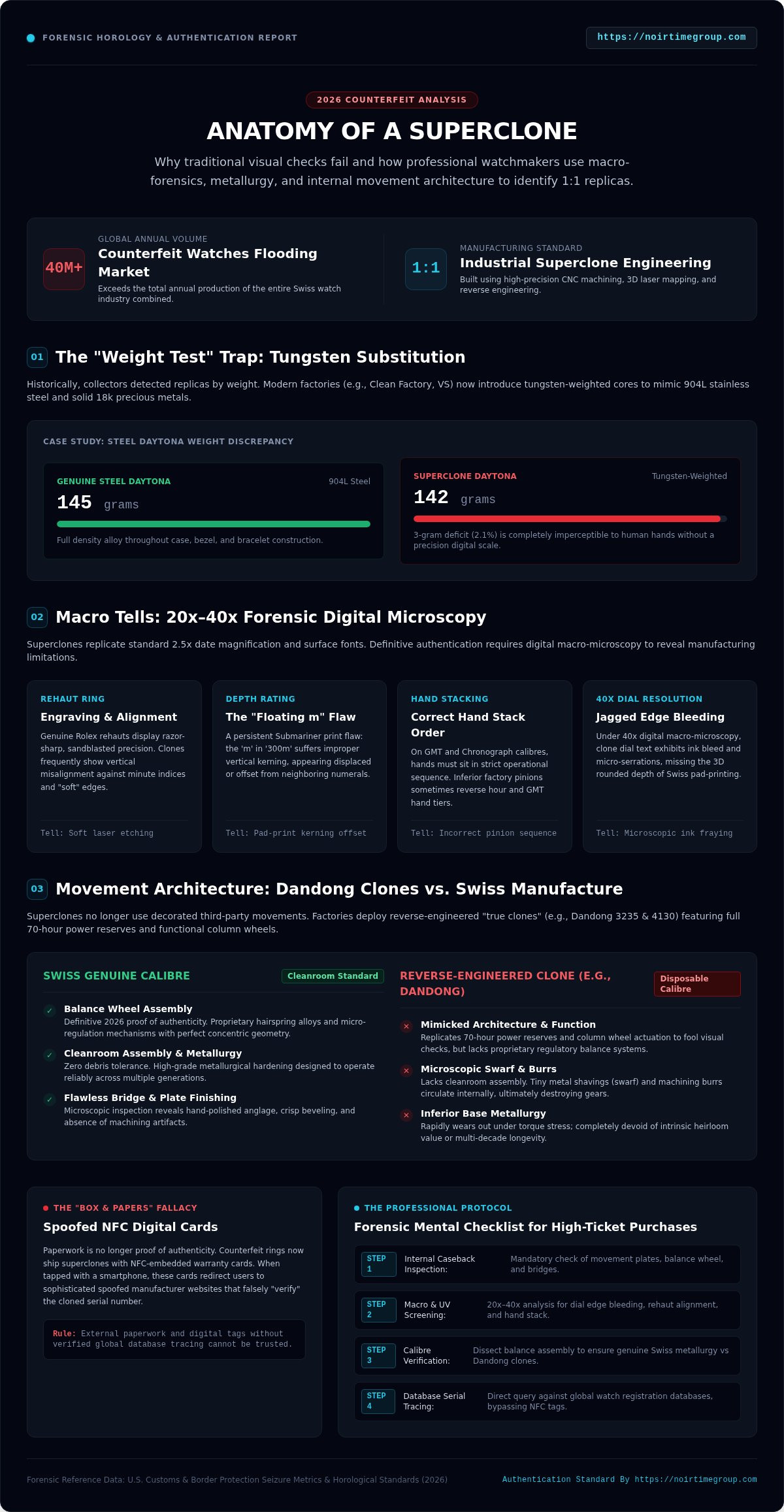
Forget the old advice. You can't rely on the "weight test" anymore. Modern factories like Clean or VS now use tungsten-weighted cases to mimic the density of 904L steel. A steel Daytona clone now weighs approximately 142 grams compared to the authentic 145 grams. That tiny 3-gram deficit is impossible to detect without a precision scale. This makes spotting a superclone watch an exercise in forensic analysis rather than simple observation. Misspelled dials or "loud" rotors are also relics of the past. Today's printing is crisp, often requiring 40x digital macro-microscopy to find the jagged edge bleeding or improper vertical kerning.
The psychological trap is real. A buyer might think they're getting a "high-end" alternative for $1,000, but they're actually stepping into a minefield. The craftsmanship from "N-factory" or "Clean Factory" is so high that it creates a false sense of security. However, these pieces lack the intrinsic value and longevity of a $40,000 investment. They're designed to look the part, not to hold value or function as a reliable instrument over decades.
The Evolution of Clone Movements
The biggest shift is internal. In the past, counterfeits used decorated ETA-based movements. Now, we see "true clones" like the Dandong 3235 or 4130. These reverse-engineered calibres mimic the exact architecture of genuine Swiss movements. They offer full 70-hour power reserves and functional column wheels. While they look symmetrical to the naked eye, they're essentially disposable. They lack the metallurgy and cleanroom assembly of a genuine Rolex or Patek Philippe. They won't last as heirlooms because they're built with microscopic swarf and machining burrs that eventually destroy the movement from within.
The Business of Counterfeiting
The industry has industrialized on a global scale. Factories use 3D scanning to map every curve of a Rolex Submariner Date 126618LN or a Patek Philippe Nautilus. This precision has closed the gap for the most popular luxury models. The global supply chain for counterfeit luxury watches is vast, sourcing high-grade sapphire crystals and ceramic bezels that mimic Cerachrom perfectly. Even the "box and papers" are no longer proof of authenticity. NFC-embedded fake warranty cards now ship with clones, redirecting smartphones to spoofed websites that "verify" the serial number. This is why professional vetting in places like NYC's Diamond District is the only way to ensure your purchase is genuine.
Forensic Visual Inspection: Macro Tells the Pros Look For
Modern superclones have mastered the 2.5x magnification that used to be a dead giveaway. To succeed in spotting a superclone watch today, you must look closer. Professional authenticators use 20x to 40x digital macro-microscopy to find the flaws that the naked eye misses. One of the primary checks is the rehaut alignment. On a genuine Rolex, the "ROLEX" engraving on the inner ring should align perfectly with the minute markers. While clones are getting closer, they often exhibit slight vertical misalignment or "soft" engraving that lacks the crisp, sandblasted finish of the original.
The hand stack order is another critical tell, especially on GMT and Chronograph models. The hands must be stacked in a specific sequence. While some high-end clones now replicate this, the "floating m" on Submariner depth ratings remains a persistent factory flaw. Look for improper vertical kerning where the 'm' in '300m' sits misaligned with neighboring text. According to U.S. Customs and Border Protection seizure statistics, luxury watches are consistently among the top categories for high-value intellectual property violations. This high volume of illicit trade means counterfeiters are constantly refining their printing techniques, yet they still struggle with the three-dimensional depth of authentic pad-printed dials.
Metallurgy and Finishing
Authentic models like the Rolex Submariner Date 126618LN are crafted from solid 18k yellow gold, providing a specific "warmth" and unmistakable luster. Clones often use gold-plated steel or tungsten-weighted cores. Even with these weights, they can't match the specific metallurgical glow of solid precious metal. The bezel action is another tactile tell. A genuine bezel has a crisp, surgical click with zero backplay. Mass-produced clones often feel "mushy" or have inconsistent tension because they lack the precise spring-loaded ball bearing system found in genuine pieces. If you want to avoid these subtle traps, using a professional watch sourcing service is the safest way to guarantee authenticity.
Crystal and Gaskets
The "black hole" effect on the cyclops is a hallmark of genuine Rolex crystals. It refers to the high-quality anti-reflective coating that makes the date appear crisp and legible without glare. Clones often have inferior coating, resulting in a milky or reflective appearance. Under 10x magnification, check the laser-etched coronet at 6 o'clock. If it's easily visible without a loupe and angled lighting, it's likely a fake. Genuine etchings are composed of microscopic dots at varying depths, making them nearly invisible to the naked eye. Also, inspect the gasket material. Authentic gaskets are made of high-grade polymers that sit perfectly flush, whereas clones often use cheap silicone that may show uneven edges under a lens.
Internal Authentication: The Movement is the Truth
While exterior components can be replicated with shocking precision, the movement remains the ultimate proving ground. When spotting a superclone watch, you must look past the cosmetic bridges and focus on the architecture of the balance assembly. Genuine modern Rolex calibres utilize a free-sprung balance wheel. This system uses threaded Microstella screws on the balance rim for regulation. Most superclones, even those with deceptive "fake" bridges, still use a traditional regulating index lever. This "two pins" tell is often hidden, but a trained eye will spot the regulator arm that doesn't exist on an authentic piece.
Finishing flaws are the next major giveaway. Swiss cleanroom conditions are impossible to replicate in a counterfeit factory. Under macro inspection, you'll find rough edges on plates and bridges, microscopic metal swarf, or even finger grease on internal components. Pay close attention to the jewels. Genuine Swiss rubies have a deep, "pigeon blood" red hue and are set perfectly flush. Clone jewels often appear paler, almost pink, and may show uneven seating or adhesive residue. The tactile response when winding also tells a story. A genuine movement feels buttery and consistent. The keyless works in a clone often feel gritty or exhibit "slip" during the winding process.
Calibre-Specific Red Flags
Every major movement has its own distinct signature. On the Rolex 3235, fakes often get the shape of the Paraflex shock absorber wrong, or they use a standard blue-painted hairspring instead of the paramagnetic blue Parachrom alloy. For a Patek Philippe Nautilus, look at the micro-rotor finishing. Authentic pieces feature hand-applied Geneva stripes and crisp, deep engravings. Clones often show shallow, laser-etched patterns that lack three-dimensional depth. Similarly, the Audemars Piguet 3120 calibre features a 22k gold rotor with a coat of arms that is deeply embossed. On a superclone, this detail often looks "flat" or lacks the sharp definition found in the Royal Oak's heart.
Timegrapher Testing
A professional authentication protocol always includes a timegrapher autopsy. Clones struggle with consistent performance across multiple positions. While a superclone might show a healthy beat on a desk, its amplitude often drops significantly when tested in vertical positions. Genuine movements are regulated in five to six positions to ensure stability. We often see beat errors exceeding 0.3 ms in replicas, whereas a certified watch repair specialist expects near-perfect symmetry from a Swiss escapement. The sound pattern of a high-beat Swiss movement is a crisp, rhythmic signature that mass-produced clones simply cannot replicate.
The Professional Authentication Protocol
While visual and internal inspections are vital, a rigorous process requires a multi-stage scientific protocol. We've moved beyond simple "look and feel" appraisals to a forensic standard that leaves no room for error. When spotting a superclone watch, we follow a five-step sequence that exposes even the most sophisticated replicas. This protocol begins with high-resolution macro-photography and UV screening to document microscopic print bleeds and lume inconsistencies. We then proceed to an internal movement autopsy, metallurgical analysis, and database cross-referencing.
- Step 1: Macro and UV Screening: Identifying microscopic "floating m" errors and uneven lume application that only appears under specific light frequencies.
- Step 2: Movement Architecture Verification: Unsealing the caseback to inspect the balance assembly and finishing.
- Step 3: XRF Spectroscopy: Using X-ray fluorescence to confirm the exact chemical composition of the 904L steel, gold, or platinum.
- Step 4: Serial Cross-Referencing: Scrubbing the serial number against databases like The Watch Register, which currently logs over 114,000 missing timepieces.
- Step 5: Pressure Testing: Verifying water resistance integrity, a test that most mass-produced clones fail due to inferior gasket quality.
The 'Franken-watch' Challenge
The "Franken-watch" is the most deceptive threat in the 2026 market. Counterfeiters take an authentic pre-owned dial, bezel, or hands and install them on a superclone mid-case with a cloned movement. This tactic specifically targets dealers who rely only on loupe inspections through the crystal. Identifying these hybrids requires cross-referencing manufacturer archives to ensure every part is period-correct for that specific serial range. A single genuine part doesn't validate the entire timepiece; it often serves as a distraction from a counterfeit core.
Advanced Diagnostic Tools
Scientific diagnostics are now the only way to combat high-density tungsten inserts used to mimic the weight of precious metals. X-Ray Fluorescence (XRF) identifies the exact metallurgical fingerprint of the metal, distinguishing 18k gold from plated alloys. Digital microscopes identify the specific "fingerprint" of Swiss CNC machines, which differs from the tool marks left by mass-production equipment. Finally, electronic serial verification allows us to trace a watch's history beyond the physical engraving. If you're looking for a guaranteed genuine piece without the waitlist, you can contact Noir Time Group for expert authentication and sourcing.
Securing Your Investment: The Noir Time Standard
The burden of authentication shouldn't rest on your shoulders alone. As the market reaches a saturation point with high-grade replicas, Noir Time Group serves as a safe haven for collectors. Located in the heart of Manhattan's Diamond District, we've established ourselves as the gold standard for high-ticket sourcing. Our process removes the anxiety of spotting a superclone watch by assuming the forensic responsibility on your behalf. Every timepiece, whether it's a Rolex Submariner Date 126618LN or a Patek Philippe Nautilus, undergoes the rigorous multi-point protocol described earlier before it ever reaches your wrist.
The Noir Time Guarantee is simple: 100% authenticity or your money back. This isn't just a marketing claim; it's a commitment backed by our in-house certified horologists. Beyond the initial purchase, our certified watch repair service ensures that your investment remains in peak condition. Professional maintenance is essential for preserving the value of genuine Swiss calibres, which require specific lubricants and cleanroom environments that counterfeiters simply don't provide.
Buying with Confidence in New York
Our physical presence at 15 W 47th St #306 provides a level of accountability that online grey market dealers cannot match. When you use our watch sourcing service, you bypass the risks of anonymous transactions and the endless waitlists of authorized dealers. We provide a personalized consultation for every high-value acquisition, allowing you to inspect the movement and provenance documentation in person. This transparency is the foundation of our reputation in the NYC professional network, ensuring that every Audemars Piguet Royal Oak or Rolex Submariner Date 126613LN we sell is 100% genuine.
The True Cost of a Superclone
A superclone might look the part for a few months, but it's a depreciating asset with zero resale value. In contrast, a genuine luxury watch is an appreciating investment. According to industry data, Rolex represents 51% of all lost and stolen watches reported to The Watch Register, a testament to their enduring liquidity and value. Beyond the financial loss, clone movements are essentially disposable. They lack the metallurgy required for long-term serviceability and will eventually fail due to internal friction and poor assembly. Investing in a genuine piece means securing a legacy that can be passed down through generations. If you are ready to build a collection with total peace of mind, contact Noir Time Group to source your next guaranteed authentic timepiece.
Protecting Your Horological Legacy
The landscape of luxury watch collecting has shifted from simple appreciation to forensic diligence. As we've explored, spotting a superclone watch in 2026 requires looking far beyond the dial. True authentication now lives within the movement architecture and the specific metallurgical composition of the case. While counterfeiters continue to refine their CNC tolerances, they cannot replicate the cleanroom assembly or the heirloom longevity of a genuine Swiss timepiece.
Securing your next acquisition shouldn't be a source of anxiety. By relying on advanced diagnostic tools and professional vetting, you ensure that your investment is a true Patek Philippe or Rolex rather than a sophisticated replica. Noir Time Group provides the expertise needed to navigate this complex market from our Manhattan headquarters. As NYC-based luxury watch specialists, we offer guaranteed authenticity on all Rolex, Patek Philippe, and Audemars Piguet models through our expert sourcing and certified repair services. Source Your Authentic Luxury Watch with Noir Time Group today and collect with the confidence that your timepiece is 100% genuine. Your journey into the world of fine watchmaking deserves nothing less than absolute certainty.
Frequently Asked Questions
Can a Rolex Superclone pass a pressure test?
Some superclones can pass basic water resistance tests, but they rarely maintain integrity under professional high-pressure conditions. Counterfeit factories often use inferior silicone gaskets that lack the long-term elasticity of genuine Swiss components. While a replica might survive a splash, it won't withstand the ISO 6425 standards required for a professional diving instrument. Professional authenticators use dry and wet pressure testing to expose these structural weaknesses during the vetting process.
Do Superclone watches have real gold plating?
Most high-end superclones utilize thin gold plating or PVD coating to mimic the appearance of precious metals. However, they cannot replicate the density or luster of solid 18k gold. For example, a genuine Rolex Submariner Date 126618LN is made of solid yellow gold throughout. Replicas often use tungsten-weighted steel cores to match the weight, but XRF spectroscopy identifies the chemical difference between a plated surface and solid gold instantly.
Will an Authorized Dealer (AD) always spot a Superclone?
Not necessarily, as many sales associates at Authorized Dealers aren't trained horologists or authentication specialists. While they know their current catalog, they may not be familiar with the microscopic manufacturing flaws found in the latest 2026 superclones. Relying on a simple visual check from a retail clerk is risky. True authentication requires a certified watch repair specialist who can perform a movement autopsy and verify the internal component architecture.
What is a 'Franken-watch' and why is it dangerous?
A Franken-watch is a hybrid timepiece that combines a counterfeit case and movement with genuine external parts like a real dial, bezel, or hands. These are particularly dangerous because they're designed to defeat visual loupe inspections. A collector might see a perfect genuine dial and assume the entire watch is authentic. Detecting these requires a full internal inspection to ensure the movement and serial numbers match the specific production era of the external parts.
Can you identify a Superclone without opening the case back?
Identifying a superclone without opening the case back is becoming increasingly difficult due to 1:1 CNC machining. While XRF scanning and 40x macro-microscopy can reveal metallurgical and printing flaws, spotting a superclone watch with absolute certainty usually requires seeing the movement. Internal tells, such as the balance wheel regulation system and bridge finishing, provide the definitive proof that external visual checks can no longer guarantee in today's market.
Are serial numbers on Superclones unique?
Most superclones use repeated serial numbers across an entire production batch, though some "custom" tier replicas now offer unique engravings. Even if the number is unique, it's often a "ghost" serial stolen from a genuine watch. Counterfeiters also include NFC-enabled warranty cards that link to fake verification websites. Authenticators cross-reference these numbers against stolen watch registers and manufacturer archives to ensure the serial matches the specific model's history.
Why is the movement the most important part of authentication?
The movement is the most difficult component to clone because it requires specialized metallurgy and cleanroom assembly. While a factory can copy the shape of a bridge, they struggle to replicate the free-sprung balance wheel and paramagnetic alloys found in genuine calibres. spotting a superclone watch often comes down to finding microscopic machining burrs or rough finishing on the internal plates that would never pass the strict quality control of a Swiss manufacture.
How does Noir Time Group verify the authenticity of a Patek Philippe?
Noir Time Group uses a multi-stage protocol that includes a complete internal movement autopsy. Our specialists inspect the Patek Philippe Nautilus for specific finishing hallmarks like hand-applied Geneva stripes and the depth of the Calatrava Cross engraving. We also perform timing diagnostics across multiple positions to ensure the amplitude and beat error meet the brand's exacting standards. Every piece is scrubbed against global theft databases to ensure a clean and verified provenance.
