

Could a single deep scratch on your Rolex Submariner's lug really cost you thousands of dollars in future resale value? For many collectors in Manhattan, the answer is a definitive yes. You've likely felt the frustration of seeing a once-pristine Patek Philippe Nautilus lose its luster to daily wear or watched the high-polish center links of your favorite timepiece grow dull over time. It's a common dilemma; you want that "like-new" factory finish, but you're terrified of an inexperienced technician "meatballing" the lugs or rounding off the sharp, crisp bevels that define a luxury watch's geometry.
We understand that your timepiece is both a personal treasure and a high-stakes investment. This guide demonstrates how a premier watch polishing service NYC restores the original brilliance of your watch while strictly adhering to brand-specific standards. You'll discover the meticulous techniques used to preserve the distinct chamfers of an Audemars Piguet Royal Oak and learn why certified expertise is the only way to ensure your watch remains retail-ready. By the end of this article, you'll have the peace of mind needed to trust a professional with your most valuable horological assets.
Key Takeaways
- Learn how the unique NYC environment affects your watch's finish and why proactive care is vital for maintaining its long-term aesthetic appeal.
- Understand the technical necessity of full disassembly and ultrasonic cleaning during a professional watch polishing service NYC to ensure every component is properly restored.
- Discover the critical difference between cosmetic polishing and professional refurbishment to avoid "meatballing" and preserve the resale value of your investment.
- Identify the specific criteria for selecting a watchmaker, including their mastery of brand-specific geometry for Rolex, Patek Philippe, and Audemars Piguet.
- See how a retailer’s eye for detail ensures your timepiece meets "retail-ready" standards, matching the quality of high-end luxury inventory.
Why Professional Watch Polishing in NYC is Essential for Luxury Assets
Owning a luxury timepiece in New York City is a unique experience that comes with a specific set of challenges. The city’s fast pace and dense environment create a gauntlet for high-end metals like 18k gold or 904L stainless steel. While these watches are engineered for durability, the transition from a pristine investment to a scratched "daily wearer" happens faster in Manhattan than almost anywhere else. Seeking a professional watch polishing service NYC is more than a cosmetic choice; it's a strategic move to maintain the "retail-ready" condition that preserves the asset's long-term market value.
Generic jewelry cleaning is fundamentally insufficient for high-end horology. A luxury watch is a complex assembly of varying textures. For instance, the visual appeal of a Rolex Submariner Date 126613LN relies entirely on the sharp contrast between its brushed "satin" steel and its high-polish gold center links. A standard jeweler's buffing wheel can blur these lines in seconds, destroying the factory-spec finish. Professional restoration requires a skilled artisan who uses specialized laps and compounds to respect the original design intent of the manufacturer.
Urban Wear and Tear: The NYC Factor
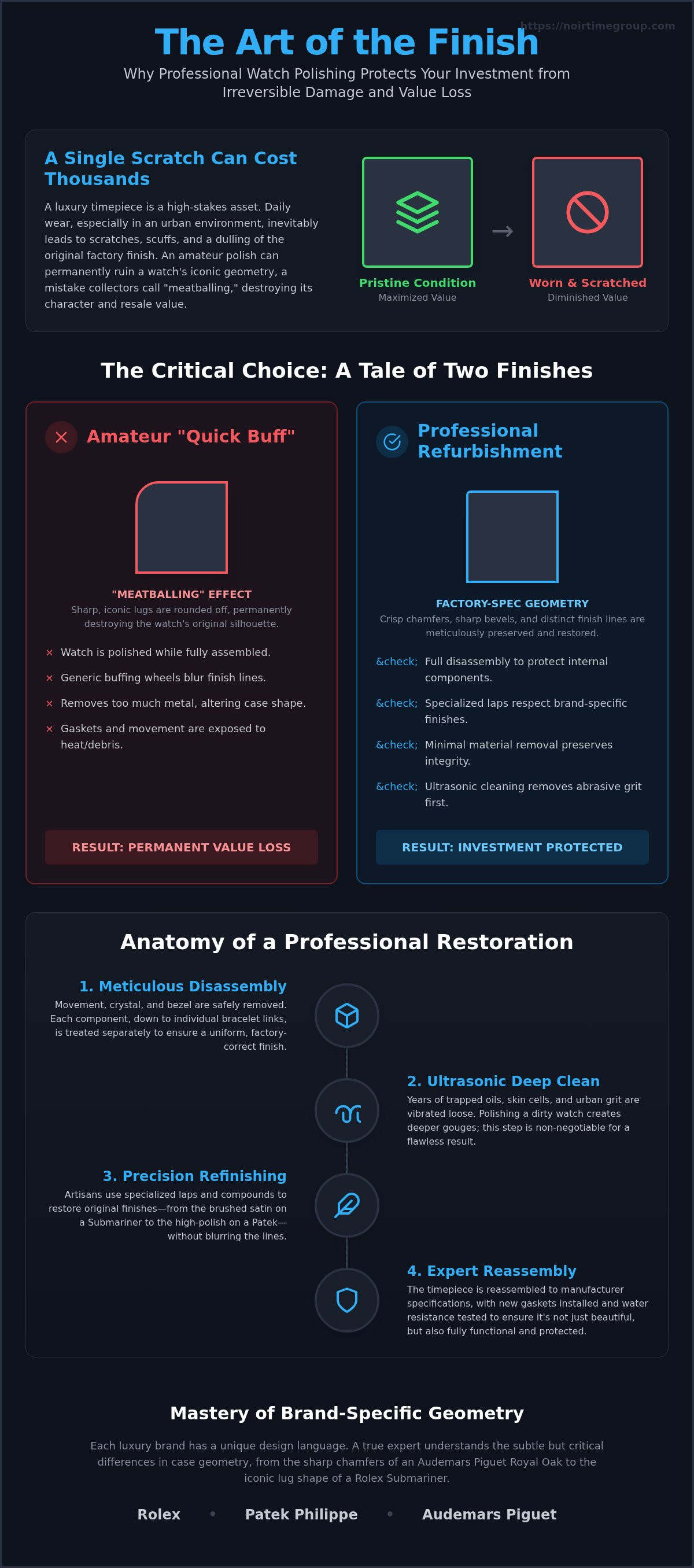
Manhattan’s environment is surprisingly abrasive. Daily life involves constant contact with granite countertops, metal subway turnstiles, and office furniture. These interactions lead to "desk diving" scratches that dull the bracelet and case over time. New York’s humidity levels can also impact the appearance of certain vintage alloys, leading to subtle oxidation that steals the metal's natural luster. Many owners make the mistake of visiting local kiosks for a "quick buff." These shortcuts often result in "meatballing," a term collectors use when an amateur rounds off the sharp, iconic lugs of a Patek Philippe Nautilus or an Audemars Piguet Royal Oak. Once that metal is gone, the watch's original silhouette is permanently compromised.
Restoring the 'New Watch' Experience
There is a powerful psychological shift that occurs when you strap on a watch with a factory-correct finish. Professional polishing revives the intricate light-play that defines luxury watches, making the piece feel like a new acquisition rather than a tired heirloom. This restoration process includes:
- Reviving the "pop" of high-polish surfaces that have become cloudy from oils and micro-abrasions.
- Restoring the crisp chamfers and bevels that define the geometric complexity of an Audemars Piguet case.
- Removing deep scuffs from the clasp and bracelet, which are often the first areas to show significant wear.
By moving your timepiece from a "worn" state back to a "curated" condition, you ensure it remains a point of pride. For those with a collection of $18k to $42k+ timepieces, this level of care is the difference between a watch that looks like an old tool and one that looks like a masterpiece.
The Anatomy of a Professional Watch Polishing Service
A professional watch polishing service NYC is far more than a cosmetic touch-up; it's a technical restoration that requires surgical precision. Unlike amateur buffing that can be done in minutes, a true horological refinishing involves a multi-stage process designed to respect the original engineering of the timepiece. This level of care is essential for retaining their value and ensuring that the case geometry remains exactly as the manufacturer intended.
The process begins with a comprehensive ultrasonic cleaning. Over years of wear, oils, skin cells, and urban grit accumulate in the tight tolerances of a bracelet and case. We use specialized ultrasonic tanks to vibrate this debris loose before any abrasive work begins. Polishing a "dirty" watch is a recipe for disaster, as trapped particles can create deep, unintended gouges during the refinishing stage.
The Disassembly Process
We never polish a "closed" watch. To do so would risk heat damage to the movement's delicate lubricants and potential compromise of the gaskets. A professional technician fully disassembles the timepiece, removing the movement, crystal, and bezel. Each component is treated as an individual piece of art. Bracelet links are often separated to ensure that the finish is uniform even in the areas that aren't visible when the watch is on the wrist. This meticulous separation protects sensitive components like the ceramic bezel on a Rolex Submariner Date 126613LN from accidental contact with polishing wheels.
Precision Graining and Mirror Polishing
The real distinction between a standard jeweler and a specialist lies in the equipment used. While many shops use handheld buffing wheels, high-end restoration relies on lapping machines. These precision devices use flat, rotating plates to ensure that the flat surfaces of an Audemars Piguet Royal Oak stay perfectly flat and the edges remain razor-sharp. This addresses the common fear of "meatballing" where lugs become rounded and thin.
Refining the finish involves multiple stages:
- Coarse Scratch Removal: Targeted removal of deeper "desk diving" marks without thinning the metal.
- Grain Matching: Recreating the specific "satin" or "brushed" texture unique to Rolex 904L steel or Patek Philippe gold.
- Mirror Polishing: Using brand-specific compounds to achieve a distortion-free, high-mirror finish on chamfers and center links.
Once the aesthetic work is complete, the watch is reassembled with fresh gaskets and undergoes rigorous pressure testing. This ensures that your investment isn't just beautiful, but also retains its factory-rated water resistance. If your timepiece has lost its luster, you can explore our certified watch repair options to bring it back to a retail-ready state.
Polishing vs. Refurbishing: Protecting Your Resale Value
The debate between "unpolished" and "restored" often dominates collector circles. While many believe that any metal removal devalues a watch, the reality is more nuanced. A poorly executed job certainly hurts value, but a professional watch polishing service NYC can actually enhance an asset's marketability by returning it to "retail-ready" condition. The key lies in distinguishing between a destructive "buff" and a restorative "refurbishment" that adheres to professional watchmaking standards.
Over-polishing is the primary concern for owners of high-value pieces like the Patek Philippe Nautilus. You can spot a bad polish by looking at the lugs and edges. If the sharp, defined lines of the case have become soft or rounded, the watch has lost its original silhouette. In extreme cases, the lugs may even appear asymmetrical or thin. This "meatballing" is a direct result of using high-speed buffing wheels without the necessary geometric guides or technical expertise.
Restoring Geometry with Lapping
A lapping machine is the gold standard for restoring the complex geometry of watches like the Audemars Piguet Royal Oak. Unlike a handheld buffing wheel, a lapping machine uses a flat, abrasive plate to ensure that flat surfaces remain perfectly planar. This is mandatory for maintaining the crisp chamfers and sharp bevels that define luxury watch design. Hand-buffing alone cannot replicate the factory-sharp edges found on an AP or Patek; it requires the mechanical precision of a lap.
By using machine-lapping, a technician can remove scratches while precisely maintaining the watch's original lines. This process requires a steady hand and a deep understanding of the specific angles used by different manufacturers. At Noir Time Group, we evaluate a watch's "polish history" before beginning any work. This ensures we only remove the absolute minimum amount of metal necessary to achieve a factory-spec finish without compromising the case's structural integrity.
The Collector's Dilemma: When to Polish
Deciding when to refresh your timepiece involves balancing aesthetic desire with long-term value. For modern Rolex references, such as the Rolex Submariner Date 126613LN, a service polish is often considered standard maintenance. These modern alloys are resilient, and a professional touch-up every 5 to 7 years helps maintain the watch's "new" feel. However, deep dings require a different approach than light surface swirls.
Before committing to a restoration, consult with a luxury retailer to understand how the work might impact your specific model's resale price. For many, the joy of wearing a pristine timepiece outweighs the negligible metal loss of a single, expert-led restoration. If you are unsure about the state of your collection, our team can provide a professional assessment to ensure your watch remains a viable investment. You can learn more about our certified watch repair services to see how we handle high-value inventory.
How to Choose the Right NYC Watchmaker for Your Timepiece
Choosing a watchmaker in New York City is a decision that impacts both the beauty and the resale value of your luxury asset. With hundreds of shops in the Diamond District alone, the options can be dizzying. However, for owners of high-complication pieces like an Audemars Piguet Royal Oak or a Patek Philippe Nautilus, the criteria must be exceptionally strict. When searching for a watch polishing service NYC, you aren't just looking for a technician; you're looking for a specialist who understands the specific metallurgy and geometry of your reference.
A reputable watch polishing service NYC should offer a transparent intake process. This starts with a detailed condition report that identifies existing dings, scratches, and any previous "meatballing" from past services. If a shop doesn't document the watch's state before they touch it, they can't be held accountable for the final result. You should also ask about the warranty provided on reassembly and water resistance. A professional restoration isn't complete until the watch has been pressure tested to ensure its seals are intact.
Equipment and Environment Standards
The physical workshop says everything about the quality of the work. High-end horology requires a dust-free environment for reassembly to prevent micro-particles from entering the movement. This is why you should avoid "while-you-wait" polishing services. A proper restoration requires full disassembly; it's a time-consuming process that cannot be rushed in a retail storefront. Verify that the shop uses professional-grade pressure testing equipment and specialized lapping machines rather than just standard jewelry buffing wheels.
The Portfolio of Work
Don't be afraid to ask for "before and after" examples of their previous restorations, specifically for your brand. A shop that handles a Rolex Submariner Date 126618LN differently than a stainless steel model shows they respect the varied properties of precious metals. The best NYC watchmakers often have a background in high-ticket retail sales. They understand what a "retail-ready" watch looks like because they sell them every day. This retailer's eye ensures that your watch won't just look clean, but will meet the standards of a $40,000+ inventory piece.
If you want to ensure your timepiece receives concierge-level care from experts who specialize in Rolex, Patek, and AP, you can schedule a certified watch repair with our team today.
Certified Watch Restoration at Noir Time Group
Noir Time Group offers a specialized watch polishing service NYC that bridges the gap between technical repair and high-end retail presentation. Because we manage an inventory of timepieces valued between $18,000 and $42,000+, we understand the specific standard required for a watch to be considered "mint." Our clients gain access to a dedicated network of certified watch repair experts who share our commitment to preserving the original geometry of Rolex, Patek Philippe, and Audemars Piguet watches. We don't just clean watches; we restore them to meet the rigorous expectations of the global luxury market.
Our NYC-based concierge care ensures that your timepiece is handled with the highest level of security and professionalism. By integrating our restoration services with our trade-in and watch sourcing service, we provide a holistic approach to collection management. We understand that a well-maintained watch is a more liquid asset. Whether you're preparing a piece for sale or simply want to enjoy the brilliance of a fresh factory finish, our retailer’s perspective ensures that every polish adds value rather than detracting from it.
The Noir Time Advantage
Every restoration starts with a personalized consultation. We don't believe in a one-size-fits-all approach. For a vintage Patek Philippe Nautilus, we might recommend a light conservation over a full polish to protect its historical value. For a modern Rolex Submariner Date 126618LN, a full restoration might be the best path to achieving a "like-new" finish. Our white-glove intake process ensures that your high-value asset is documented and secured from the moment it enters our NYC office. We treat your watch with the same care as our own retail inventory, focusing on the specific nuances of brand-specific finishes like Rolex Oystersteel or AP's intricate brushing.
Next Steps for Your Timepiece
Scheduling a condition assessment is the first step toward restoring your luxury investment. During this meeting at our NYC location, we'll evaluate the depth of scratches, the state of the case geometry, and the integrity of the bracelet. This transparency allows you to make an informed decision. While turnaround times for a professional watch polishing service NYC can range from 1 to 9 weeks depending on complexity, the result is a timepiece that looks exactly as it did the day it left the boutique.
In the New York market, a documented service history and a professional finish can significantly impact your watch's liquidity. Don't leave your investment to chance with an unverified shop. Book your watch polishing consultation with Noir Time Group to receive a professional evaluation of your timepiece from experts who understand the true value of your collection.
Secure the Future Value of Your Timepiece
Your luxury watch is more than a tool for telling time; it's a significant financial asset that deserves specialized care. We've explored how professional restoration goes beyond surface-level cleaning to preserve the sharp edges and specific finishes that define brands like Rolex and Patek Philippe. By utilizing a professional watch polishing service NYC, you ensure your timepiece remains in retail-ready condition, protecting its marketability for years to come.
Noir Time Group brings a retailer's eye to every restoration project. With our expertise in timepieces valued at $42,000 or more and our access to a certified horological repair network, we provide the precision your collection requires. Our location in the heart of NYC's luxury market makes it easy for you to access concierge-level care for your most prized assets. Don't let daily wear diminish the brilliance of your investment.
Take the first step toward a factory-fresh finish today. Request a Professional Watch Polishing Quote and let our experts restore the light-play and geometry of your favorite timepiece. You'll enjoy the confidence of wearing a watch that looks as pristine as the day you first strapped it on.
Frequently Asked Questions
Does polishing a watch in NYC devalue it?
Professional polishing only devalues a watch if the process is handled by an uncertified technician who rounds off the original case lines. When a watch polishing service NYC is performed to factory standards, it actually enhances the marketability of the asset by returning it to "retail-ready" condition. Collectors often prefer a clean, sharp watch over one with significant damage, provided the original silhouette and bevels remain intact.
How often should I get my Rolex or Patek polished?
Most industry experts recommend polishing your timepiece every 5 to 7 years, typically coinciding with a mechanical movement service. Constant polishing can eventually thin the metal, so it's best to wait until surface scratches or dullness affect your enjoyment of the piece. For high-value models like the Patek Philippe Nautilus, a conservative approach is always better to ensure the metal retains its original weight and structural integrity over decades.
What is the difference between a 'buff' and a 'full restoration'?
A "buff" is a superficial procedure that simply shines the metal without correcting geometry or removing deep scratches. A full restoration involves complete disassembly, ultrasonic cleaning, and the use of specialized lapping machines to recreate factory-sharp edges. This technical process ensures that the transition between brushed and polished surfaces remains crisp. Restoration is the preferred method for maintaining the value of an $18,000 to $42,000+ investment.
Can deep scratches and dings be completely removed?
Most surface scratches and moderate dings can be completely removed through professional refinishing. However, very deep gouges may require laser welding to add metal back before polishing, as grinding them out would compromise the case's symmetry. Our experts assess each mark to determine if removal is possible without "thinning" the lugs. We prioritize the structural health of the watch over purely cosmetic perfection to protect your long-term investment.
How long does a professional watch polishing service take in NYC?
The timeline for a professional watch polishing service NYC typically ranges from 1 to 9 weeks. This duration depends on the complexity of the watch, the current state of the metal, and the availability of specific parts like gaskets or crystals. Because we fully disassemble the movement and case to prevent heat damage, this process cannot be rushed. A "while-you-wait" service often indicates a lack of technical depth and should be avoided.
Is water resistance affected by the polishing process?
Polishing itself doesn't damage water resistance, but the required disassembly does. Every time a case is opened, the seals and gaskets are disturbed. This is why professional shops always perform a rigorous pressure test after the watch is reassembled. At Noir Time Group, we ensure your timepiece meets its original factory depth ratings before it's returned. This provides peace of mind that your restored watch is as functional as it is beautiful.
What brands does Noir Time Group specialize in for polishing?
Noir Time Group specializes in the restoration and care of the world's most prestigious horological brands. Our primary expertise lies with the Rolex Submariner, the Patek Philippe Nautilus, and the Audemars Piguet Royal Oak. We handle everything from yellow gold references to complex stainless steel geometries. Our retailer's perspective allows us to apply the same high standards to your personal timepiece that we use for our own $40,000+ retail inventory.
Can you polish gold and platinum watches as well as steel?
Yes, professional technicians can polish gold, platinum, and stainless steel, though each material requires distinct abrasive compounds and techniques. Precious metals like those found on a Rolex Submariner Date 126618LN are softer than steel and require a gentler touch to prevent excessive metal loss. Our certified repair network understands the nuances of 18k gold and platinum, ensuring that the finish is uniform and the hallmarks remain deep and legible after the restoration.
