

That dull film on your 18k gold isn't just an eyesore; it's often an abrasive paste of skin oils and grit that's actively wearing down your investment. Most collectors realize that the "stretch" found in vintage bracelets is actually the result of microscopic debris acting like sandpaper between the pins and links. You likely worry that a DIY deep clean might scratch those mirror-polished surfaces or, even worse, allow moisture to penetrate the watch case. It's a stressful trade-off when you're handling a high-value piece like a Rolex Submariner 126618LN or a Patek Philippe Nautilus.
In this guide, you'll learn exactly how to clean a gold watch bracelet using professional-grade techniques that preserve both the structural integrity and the market value of your timepiece. We will walk you through the precise steps to safely dissolve grime at home while maintaining the factory finish. You'll gain the confidence to keep your watch pristine and learn how to identify when a bracelet requires the specialized ultrasonic equipment and inspection services found at a certified repair center like Noir Time Group in NYC.
Key Takeaways
- Learn how removing skin oils and grit prevents "bracelet stretch," which is the permanent elongation of links caused by internal friction.
- Master the professional process of how to clean a gold watch bracelet using mild soap and soft-bristle tools to protect the metal's mirror finish.
- Gain the skills to safely inspect your timepiece for loose pins and ensure the crown is fully sealed before any exposure to moisture.
- Discover the material-specific nuances of caring for yellow, white, and rose gold alloys to maintain their original luster and market value.
- Understand why professional ultrasonic cleaning and pressure testing are necessary complements to your routine home maintenance.
Why Cleaning Your Gold Watch Bracelet is Essential for Value
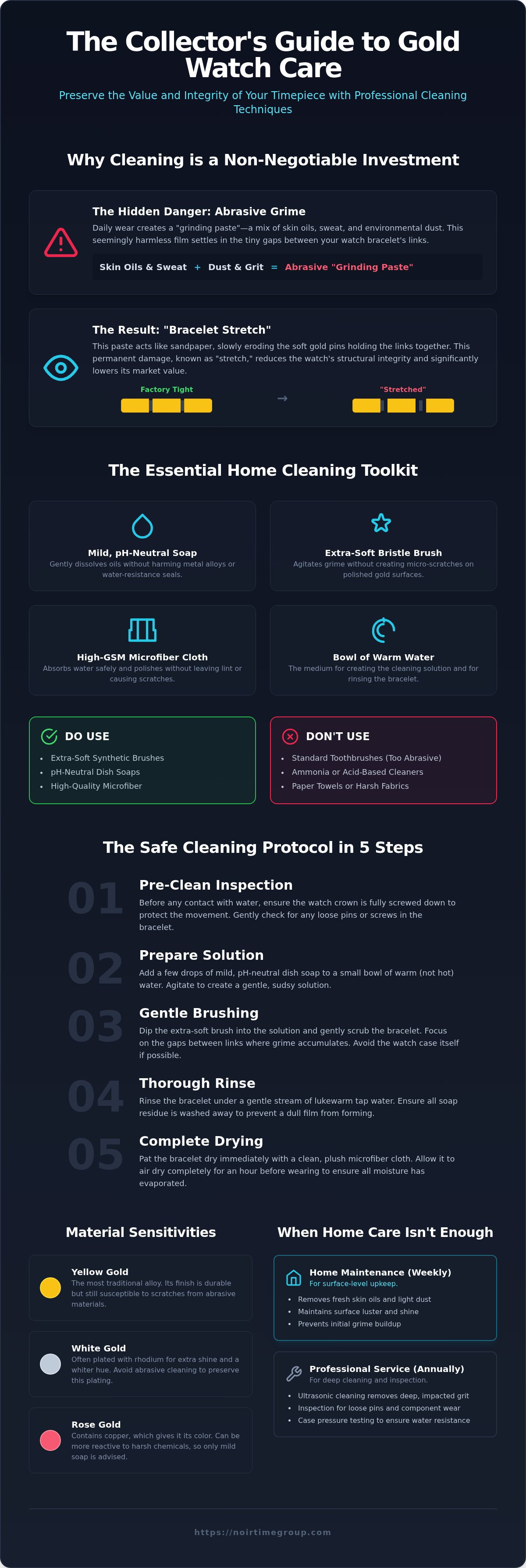
Owning a solid gold timepiece like a Rolex Submariner Date 126618LN is a significant investment. However, the longevity of that investment depends on more than just the movement's accuracy. Most owners prioritize the dial and crystal, yet the bracelet often bears the brunt of daily wear. Understanding how to clean a gold watch bracelet is a fundamental skill for any serious collector because cleanliness directly correlates with mechanical health. When skin oils, salt from sweat, and environmental dust mix, they form a "grinding paste" that settles inside the tiny gaps between links.
This mixture is highly abrasive. As you move your wrist, the paste slowly eats away at the gold pins that hold the bracelet together. In the world of horological conservation, maintaining the structural integrity of these components is vital for long-term preservation. If left uncleaned, this internal friction causes what collectors call "stretch," which can eventually lead to a total bracelet failure or an expensive rebuilding process. For luxury brands like Rolex and Patek Philippe, the condition of the bracelet is a primary factor in determining market value during a resale or trade.
The Science of Bracelet Stretch in Gold Alloys
Gold is naturally softer and more ductile than the 904L stainless steel found in many professional-grade watches. This makes high-karatage alloys more susceptible to internal friction. Bracelet stretch is the mechanical wear of link pins due to trapped particulates, leading to gaps between links. Regular cleaning prevents this grit from accumulating, ensuring the bracelet remains tight and secure for decades. For owners of a Patek Philippe Nautilus or Audemars Piguet Royal Oak, maintaining a factory-tight bracelet is often the difference between a top-tier resale price and a heavily discounted one.
Aesthetic Benefits: Restoring the Luster of 18k Gold
Beyond the mechanics, the visual impact of a clean watch is undeniable. Dirt and grime act as a matte coating, dulling the vibrant reflection of polished center links and intricate bevels. Learning how to clean a gold watch bracelet allows you to restore that factory shine at home. A pristine bracelet also makes it easier to spot hidden issues that might otherwise be masked by buildup:
- Fine hairline scratches that might need professional attention.
- Loose screws or pins that could lead to the watch falling off the wrist.
- Signs of oxidation or discoloration in specific rose gold alloys.
By the standards of 2026, home care is viewed as a necessary maintenance routine rather than a luxury. While you can handle surface debris, deep-seated grit often requires a professional touch. Noir Time Group in NYC recommends a hybrid approach. Perform gentle home cleanings weekly, but bring your timepiece in for a certified inspection and ultrasonic cleaning once a year to ensure the bracelet remains structurally sound and the case remains water-resistant.
Essential Tools for Safe Home Cleaning
Success starts with the right equipment. When you're learning how to clean a gold watch bracelet, the biggest risk isn't the water; it's the friction. Gold is a relatively soft metal. Using the wrong tools can quickly turn a maintenance task into a restoration nightmare. Professional collectors avoid the "all-purpose" kits found in big-box stores, opting instead for a curated set of gentle supplies that protect the metal's finish.
The "Soft-Only" Rule is your first line of defense. Many online guides suggest using a medium-bristle toothbrush, but these are far too aggressive for 18k alloys. They create micro-scratches that dull the luster of polished center links over time. Instead, use an extra-soft synthetic brush. Look for brushes with tapered filaments designed for sensitive dental care. These provide enough agitation to break up the "grinding paste" discussed in the previous section without marring the surface.
Your choice of cleaning agent is equally vital. Avoid "jewelry dips" or specialized solutions containing ammonia or acids. These can be too harsh for luxury watches, especially those with complex gaskets or specific alloys like rose gold. A mild, pH-neutral dish soap is the safest surfactant. It's designed to break down skin oils and grease effectively while remaining gentle on the metal and the watch's water-resistance seals.
The Luxury Cleaning Kit Checklist
A professional-grade home kit should be specific and high-quality. To achieve the best results when mastering how to clean a gold watch bracelet, gather these items:
- High-GSM Microfiber Cloths: Choose cloths with at least 300 Grams per Square Meter (GSM). These are plush enough to trap moisture and lint without scratching high-polish surfaces.
- Distilled Water: Tap water often contains minerals like calcium and magnesium. Using distilled water for the final rinse prevents unsightly water spots and mineral buildup inside the link pins.
- Synthetic Soft Brush: Ensure the bristles are synthetic rather than natural, as natural hair can sometimes be too coarse.
Setting Up Your Cleaning Station
Environment matters as much as the tools. Always work in a well-lit area; a focused LED desk lamp is perfect for spotting hidden grime inside the clasp or between the lugs. Most importantly, never clean your watch over an open sink drain. It's a common mistake that leads to lost spring bars or, in the worst-case scenario, a dropped timepiece. Work over a rubber mat or a thick, folded towel. This creates a "soft landing" zone that protects the case and movement from impact if the watch slips from your hands. If you're ever unsure about the condition of your gaskets before cleaning, the experts at Noir Time Group provide certified watch repair and pressure testing to ensure your timepiece stays dry and secure.
Step-by-Step Guide to Cleaning Your Gold Bracelet
Executing a safe clean requires a methodical approach. Before water ever touches the metal, you must perform a thorough physical inspection. Check for any loose pins or screws that might have backed out during wear. If you find a compromised link, stop immediately and contact a specialist for certified watch repair. For a secure timepiece like the Rolex Submariner Date 126618LN, ensure the Triplock crown is fully screwed down to the case to maintain its hermetic seal.
Once you've verified the watch's integrity, follow these steps to master how to clean a gold watch bracelet safely at home:
- The Lukewarm Soak: Submerge the bracelet in a bowl of lukewarm water mixed with a few drops of mild dish soap. Let it sit for ten to fifteen minutes. This softens the "grinding paste" of oils and skin cells without the risk of thermal shock to the movement's lubricants.
- Precision Brushing: Use your extra-soft synthetic brush to gently agitate the gaps between each link. Pay close attention to the areas where the bracelet meets the lugs, as this is where the most grit accumulates.
- The Rinse: Rinse the bracelet under a gentle stream of distilled water. Avoid high-pressure faucets, as the force can drive moisture past gaskets that haven't been recently pressure-tested.
- Low-Pressure Drying: Pat the gold dry with a clean microfiber cloth. You can use a handheld air blower, like those used for camera lenses, to clear moisture from the internal link pins.
Protecting the Watch Head and Movement
While many luxury watches are water-resistant, it's best practice to minimize the watch head's exposure to soapy water during a bracelet clean. If you aren't removing the bracelet entirely, wrap the watch case in plastic wrap or use a dedicated watch holder to keep the head elevated above the soaking bowl. This prevents unnecessary stress on the crown and pusher gaskets. Remember that water resistance isn't a permanent state; it relies on rubber seals that degrade over time. Unless you've had a recent pressure test at a facility like Noir Time Group in NYC, treat the watch head with extreme caution.
Deep Cleaning the Clasp and Hidden Links
Modern bracelets feature complex adjustment systems like the Rolex Glidelock or EasyLink. These mechanisms have multiple sliding parts and recesses that act as magnets for debris. Open the clasp fully and brush the internal tracks where the adjustment slides. For the integrated bracelet joints of a Patek Philippe Nautilus, ensure you brush from multiple angles to reach the recessed pin areas. You can use a sharpened wooden toothpick to gently lift stubborn grime from the corners of the clasp hinge, as wood is softer than 18k gold and won't leave permanent marks.
Understanding Material Sensitivities: Yellow vs. White vs. Rose Gold
Not all gold alloys react to cleaning in the same way. While 18k gold is the standard for luxury houses like Rolex and Patek Philippe, the specific metals mixed with the gold change how you should approach maintenance. Purity plays a major role in scratch resistance. 18k gold is 75% pure, making it significantly softer and more prone to surface marring than 14k gold. When you're learning how to clean a gold watch bracelet, you must tailor your pressure to the specific alloy and finish of your timepiece to avoid accidental damage.
Rose gold, such as the Rolex Everose alloy, contains a high copper content to achieve its warm hue. This copper can sometimes react with harsh chemicals or even certain types of tap water, leading to subtle surface oxidation over several years. To keep these alloys vibrant, stick strictly to the pH-neutral soap method. Avoid any "homemade" solutions involving vinegar or baking soda, as these acids and abrasives can permanently alter the color of the metal.
The White Gold Challenge
White gold requires the most delicate touch. Most luxury white gold watches are finished with a thin layer of rhodium plating to provide a brilliant, silvery-white sheen. Aggressive scrubbing, even with a soft brush, can prematurely wear down this plating, eventually revealing the naturally yellowish tint of the gold underneath. When cleaning a white gold Patek Philippe Nautilus, use the lightest possible pressure and always pat the metal dry with a plush microfiber cloth. If you notice your bracelet losing its "cool" tone, it likely requires a professional certified watch repair service to strip and re-apply the rhodium finish.
Maintaining Brushed and Matte Finishes
The visual appeal of an Audemars Piguet Royal Oak often lies in the contrast between its mirror-polished bevels and its deep, vertical satin-brushed surfaces. Maintaining these textures is a specific challenge when figuring out how to clean a gold watch bracelet at home. You should never use a polishing cloth on brushed surfaces. These cloths contain fine abrasives designed to remove scratches, which will effectively "sand down" the brushed grain and leave a patchy, semi-shiny mess.
To clean a brushed integrated bracelet, follow these rules:
- Directional Cleaning: If you must use a brush for stubborn grime, move it only in the direction of the grain.
- Avoid Flattening: Do not apply heavy pressure to the sharp edges of the links. The crisp geometry of a Royal Oak is its most valuable aesthetic trait; rounding those edges through over-cleaning will decrease the watch's market value.
- Rinse Thoroughly: Soap residue can dry in the "peaks and valleys" of a matte finish, making the gold look cloudy. A double rinse with distilled water is essential for these textures.
Professional Maintenance: When Home Cleaning Isn’t Enough
While mastering the routine of how to clean a gold watch bracelet at home is essential for daily upkeep, it isn't a substitute for professional maintenance. Home cleaning focuses on surface debris and accessible gaps. However, microscopic particles often migrate deep into the link pins where a soft brush cannot reach. Over time, this residual grit continues to act as an abrasive, even if the watch looks pristine on the outside. For high-value assets like a Rolex Submariner Date 126618LN or an Audemars Piguet Royal Oak, a professional deep clean is a necessary safeguard for your investment.
Professional care also addresses the inevitable wear and tear that occurs beyond simple dirt buildup. Over several years, even the most careful owner will accumulate "desk diving" scratches on the clasp or fine marks on the polished center links. A certified technician can perform precision refinishing, a process that restores the factory look without the uneven metal loss often seen in amateur polishing attempts. This level of care ensures the watch remains in "collector grade" condition, which is vital for long-term value retention.
The Ultrasonic Cleaning Advantage
Professional watchmakers use industrial-grade ultrasonic tanks to achieve a level of cleanliness impossible at home. These machines use high-frequency sound waves to create millions of microscopic "cavitation bubbles" in a specialized solution. When these bubbles implode, they create a vacuum effect that pulls 100% of the internal grit out from the tightest tolerances of the bracelet links. This process is the only way to completely halt the mechanical wear that leads to bracelet stretch.
You should never use a consumer-grade home ultrasonic machine on a complete watch. The high-frequency vibrations can disrupt the delicate hairspring and movement lubricants, potentially causing timing issues or mechanical failure. Professionals always remove the bracelet from the case before submerging it. For a daily-wear gold watch, we recommend a professional ultrasonic cleaning once every twelve to eighteen months. This frequency ensures that the internal components of the bracelet remain as clean as the polished exterior.
Noir Time Group’s Expert After-Sales Care
In addition to deep cleaning, a professional service includes a critical water-resistance check. Every time a watch is subjected to deep cleaning or heavy wear, the integrity of its gaskets should be verified. At Noir Time Group in NYC, our Certified Watch Repair services include dry and wet pressure testing to ensure your timepiece meets factory specifications. This is especially important for gold models that are frequently exposed to moisture.
Accessing certified maintenance in New York City provides the peace of mind that your high-karatage luxury alloys are being handled by experts who understand their specific properties. Documenting these professional services creates a verified service history, which is a significant asset if you ever decide to use a watch sourcing service or sell your timepiece. Keeping your Patek Philippe Nautilus or Rolex in peak condition requires a partnership between diligent home care and expert technical support.
Protecting Your Investment for Generations
Maintaining the luster and structural integrity of an 18k gold timepiece is a commitment to its history and future value. You've learned how to clean a gold watch bracelet using gentle surfactants and soft-bristle tools to eliminate the abrasive grit that leads to link stretch. It's a simple routine that protects the delicate rhodium plating of white gold and the warm tones of rose gold from premature wear. By identifying the limits of home care, you ensure your watch never faces the risks of water ingress or mechanical friction.
Professional maintenance remains the essential partner to your home efforts. Our NYC-based luxury watch experts at Noir Time Group provide certified repair and maintenance services to keep your collection in factory condition. We prioritize guaranteed authenticity for every Rolex, Patek Philippe, and Audemars Piguet we handle, ensuring your high-value assets are always protected. Explore Our Collection of Pristine Gold Timepieces at Noir Time Group today to find your next investment or schedule a professional inspection. Your dedication to proper care ensures your timepiece remains a masterpiece for years to come.
Frequently Asked Questions
Can I use toothpaste to clean my gold watch bracelet?
No, you shouldn't ever use toothpaste on a high-value timepiece. Toothpaste contains abrasive particles like silica or calcium carbonate designed to scrub enamel, but these leave permanent micro-scratches on polished 18k gold surfaces. These scratches dull the luster of your Rolex or Patek Philippe over time. Stick to pH-neutral dish soap and an extra-soft synthetic brush to ensure the metal's finish remains intact and factory-fresh.
How often should I clean my luxury gold watch?
For a watch worn daily, perform a light surface clean once a week to remove oils and salts. This frequency prevents the "grinding paste" from forming between the links. However, a deep professional service is recommended every twelve to eighteen months. Noir Time Group in NYC provides certified maintenance that includes deep-seated grit removal and water-resistance testing, which are essential for long-term value preservation.
Is it safe to use an ultrasonic cleaner at home?
Using a home ultrasonic machine on a complete watch is dangerous and not recommended. The high-frequency vibrations can disrupt the movement's lubricants or even damage the hairspring, leading to poor timekeeping. Professionals always detach the bracelet from the case before submerging it in an ultrasonic tank. This is the only safe way to achieve a deep clean without risking the mechanical health of your luxury timepiece.
What is the best way to dry a gold watch after cleaning?
The best way to dry your watch is by patting it with a high-GSM microfiber cloth to absorb surface moisture. Avoid rubbing, as trapped dust can still cause scratches. Use a handheld air blower to clear water from the internal pins and the clasp's adjustment tracks. Never use a hairdryer or direct heat; this can cause the rubber gaskets to expand and contract, potentially compromising the watch's hermetic seal.
Can I clean my gold watch with alcohol?
Avoid using isopropyl alcohol or harsh chemical solvents on your watch. While alcohol is a degreaser, it's too aggressive for the rubber gaskets and seals that protect the movement from water. Over time, alcohol exposure causes these seals to become brittle and crack, leading to eventual water ingress. When learning how to clean a gold watch bracelet, remember that distilled water and mild dish soap are far safer alternatives.
Should I remove the bracelet from the watch case before cleaning?
Removing the bracelet is the gold standard for a thorough clean. It allows you to reach the grime trapped in the end links and lugs without exposing the watch head to moisture. If you aren't comfortable removing spring bars, you must ensure the crown is fully screwed down and the watch head is shielded. Many collectors prefer bringing their pieces to Noir Time Group for a professional breakdown to ensure no damage occurs.
How do I remove scratches from my gold watch bracelet at home?
Attempting to remove scratches at home with polishing cloths or compounds is risky. Gold is a soft metal, and amateur polishing often results in uneven surfaces or the loss of sharp, factory edges. For high-value models like the Rolex Submariner Date 126618LN, any metal loss can negatively impact resale value. It's better to leave refinishing to certified repair experts who use precision tools to restore the factory look while preserving original geometry.
What should I do if my gold watch bracelet feels "stiff"?
A stiff-feeling bracelet is usually a sign of significant grit buildup inside the link pins. This debris creates friction that prevents the links from moving fluidly. If a standard soak doesn't resolve the issue, don't force the links to move; this accelerates the wear that causes bracelet stretch. If you are unsure how to clean a gold watch bracelet with deep-seated issues, bring it to a specialist for a professional ultrasonic cleaning.
