
The Gondolo’s identity is about more than its name: choosing one means weighing how its case sits on your wrist, which movement suits your preferences, and whether the dial feels right for everyday wear. Patek Philippe’s Chronometro Gondolo history includes rectangular yellow-gold watches dating from 1913 to 1922. That heritage gives the design choices a story as well as a distinctive look.
If you’re drawn to Art Deco, geometric lines and balanced proportions may be part of the appeal, but comfort and legibility matter too. It’s easy to focus on the dial or case at first glance, but the movement also shapes the ownership experience. This guide explores the Gondolo’s history and Art Deco influence, then explains how to weigh case shape, movement, and dial together. You’ll come away with a clearer sense of which details suit your taste and how you want to wear the watch.
Key Takeaways
- Compare case proportions, movement preferences, and dial legibility to narrow your choice around how you plan to wear the watch.
- Understanding the name’s origins can add context to the design details you’re drawn to.
- Look for the geometric balance and clean lines associated with Art Deco when assessing a watch’s visual character.
- When considering long-term value, weigh the specific watch’s condition and characteristics rather than relying on style alone.
Choosing a Gondolo by case shape, movement, and dial
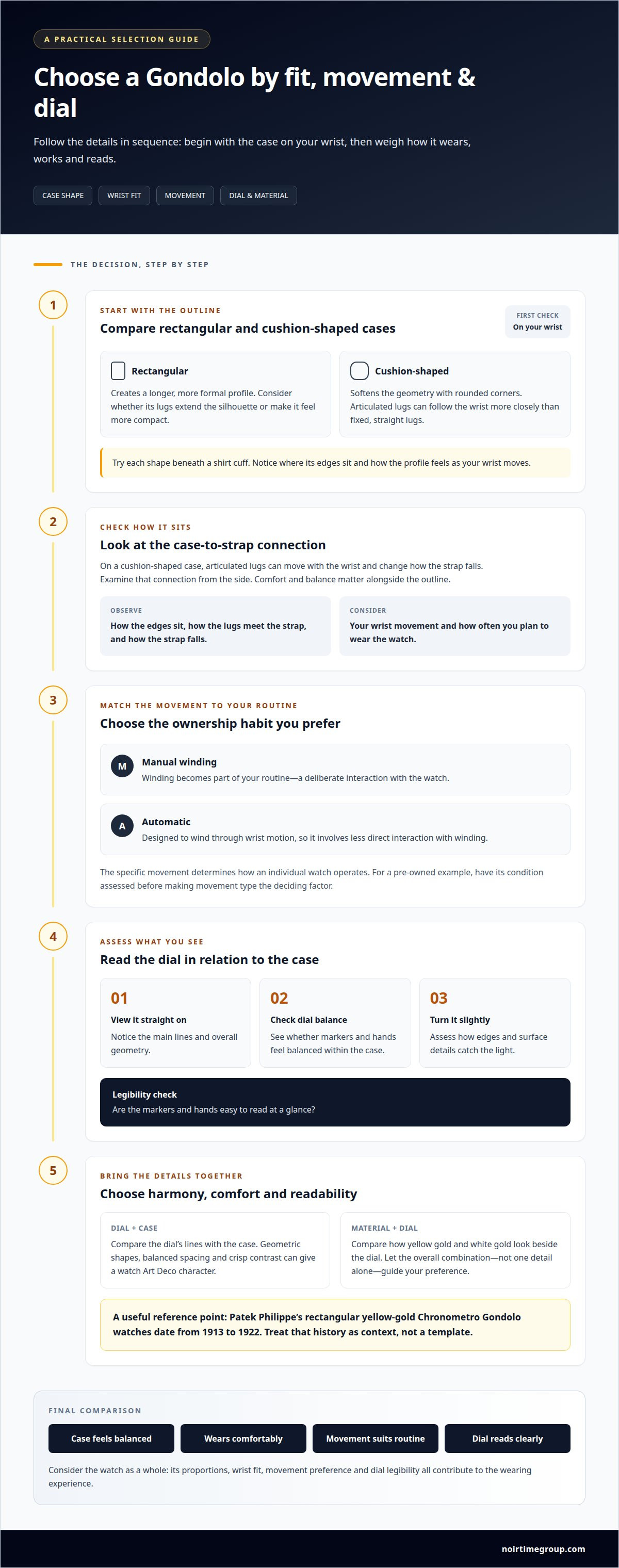
Start with the outline you want on your wrist. Rectangular cases create a longer, formal profile, while cushion-shaped cases soften the geometry with rounded corners. Try each shape beneath a shirt cuff and notice where its edges sit. A Gondolo should feel comfortable as well as balanced, so consider wrist movement and how often you’ll wear it.
On a cushion-shaped case, articulated lugs can follow the wrist more closely than fixed, straight lugs. Their movement affects how the watch sits and how the strap falls. Examine the connection between case and strap from the side. With a rectangular case, consider whether the lugs extend the silhouette or make it feel more compact.
- Case: Compare rectangular and cushion-shaped profiles against your wrist and clothing.
- Movement: Decide whether winding a mechanical movement suits your routine or you prefer less interaction.
- Dial: Consider whether clear markers and hands are easy to read at a glance.
- Material: Compare how yellow gold and white gold look beside the dial.
Movement choice is about ownership habits, not just mechanics. A manually wound watch makes winding part of your routine; an automatic movement is designed to wind through wrist motion. The specific movement determines how a particular watch operates. For a pre-owned example, have its condition assessed before making movement type the deciding factor.
Art Deco case shapes favor strong geometry, so compare the dial’s lines with the case rather than viewing either alone. Patek Philippe’s rectangular yellow-gold Chronometro Gondolo watches date from 1913 to 1922. Treat that historical example as a reference, not a template. Choose proportions and a dial layout that feel harmonious, then let comfort, readability, and movement preference guide your decision.
Gondolo name and historical origins
The documented watchmaking context for the name is Patek Philippe’s Chronometro Gondolo designation. That association gives the term a specific place in the brand’s history, but it doesn’t establish the word’s etymology. Keep those questions separate: the name connects a watch to a designation, while explaining the word itself would require evidence beyond the watch’s label. This distinction helps prevent assumptions based only on a model name.
For a particular watch, start with the exact wording shown on its dial and case. “Chronometro Gondolo” is a more specific inscription than “Gondolo” alone. Then compare the wording with the watch’s reference information and accompanying records. Consistency among those details can help clarify how the individual example is described. A diamond-set dial, for instance, identifies a visible feature, but doesn’t explain the name’s origin or establish the model’s history.
Names can also shape interpretation. A description may use the family designation, a reference, or both, and those terms serve different purposes. The designation links the watch to a named group; the reference helps distinguish a particular configuration. Keep each detail in its proper role. This is especially useful when comparing models with different cases or dials, since a shared name doesn’t mean every example has identical features.
When assessing an example, record its stated designation, reference, and visible details separately. Then consider whether the documentation supports that description. This method lets the historical association inform your understanding without treating the name as proof of every detail. To explore examples and compare how watches are presented, browse Gondolo watch listings with the distinction between family name and individual configuration in mind.
Art Deco influence
Art Deco style is easiest to recognize through geometry, symmetry, and crisp contrast. On a watch, look for repeated lines, balanced spacing, and stepped details rather than decoration alone. A rectangular case paired with a carefully aligned dial can create a unified design. The case, hands, markers, and crown each contribute to that visual order. Consider how those elements relate before deciding whether a watch feels distinctly Deco.
Patek Philippe’s Gondolo designs offer a useful example of how a watch can have geometric character without relying on elaborate ornament. Compare the dial’s layout with the case outline: straight markers may echo a rectangular profile, while rounded details can soften it. A diamond detail, if present, changes the emphasis, so consider whether it complements the overall pattern or draws attention away from it. This is a matter of visual interpretation, not a standalone measure of quality.
Use a simple three-step review. First, view the watch straight on and note its main lines. Next, check whether the dial’s markers and hands feel balanced within the case. Finally, turn the watch slightly and assess how its edges and surface details catch the light. These steps help distinguish a coherent design from one where separate features compete. A manual-winding movement may suit someone who enjoys a deliberate routine, though movement choice and Art Deco styling are separate decisions.
A collection doesn’t need identical watches to feel consistent. A rectangular example can anchor the group, while a cushion-shaped design adds a softer profile. Compare each piece by its geometry, dial balance, and level of ornament. That approach helps you choose a watch with a clear Deco influence without assuming every vintage-looking detail belongs to the same period or design tradition. Focus on the details you’ll notice during everyday wear, not just the style label.
Gondolo value retention
Resale value depends on the individual watch, not its name alone. Start with condition, originality, and consistency across its identifying details. A clean dial, an undamaged case, and components that match the watch’s description support a clearer assessment. Replacement parts or visible wear can affect desirability. A rectangular yellow-gold example and a later model shouldn’t be treated as interchangeable simply because both share a designation.
Documentation adds context. Records that connect a watch to its model and service history help establish what is being evaluated. Missing papers don’t automatically determine value, but they leave fewer details to support the watch’s history. Ask for an assessment that separates observable condition from claims about provenance. For instance, a polished case should be described as polished, rather than presented as untouched.
Market offers provide a reference, not a promise of future resale. Gondolo wristwatches typically appear on the market between $16,000 and $23,000, with a median of about $21,000. The range reflects observed offers, not a guaranteed selling price or an estimate for every example. Condition, configuration, documentation, and buyer interest all influence how a particular watch compares.
Use a consistent review before deciding: identify the model, examine the case and dial, assess the movement’s condition, then review supporting records. Consider whether the design and materials suit your priorities, rather than choosing only for a predicted return. A watch that needs repair can carry different ownership costs from one ready to wear, so account for its condition when judging value. The movement’s service needs also matter to long-term ownership.
To compare examples against these factors, explore current watch listings and focus on each watch’s documented details, condition, and configuration.
Noir Time Group
Noir Time Group is a natural next step if you’re ready to move from research toward a watch purchase. Its Watch Sourcing Service can help with sourcing when your priorities include a particular case profile, movement preference, or dial style. Share the details that matter most to you, such as wrist comfort or a preference for understated design, to make your search criteria clear. If a watch you own needs attention, Certified Watch Repair addresses that separate ownership need. These services support different stages: sourcing helps with the search, while repair applies when maintenance is needed. For other watch interests, Noir Time Group also offers the Rolex Submariner Date 126613LN and 126618LN. Contact Noir Time Group to discuss your watch needs.
Choose a Watch for the Life You Lead
A thoughtful purchase should make sense beyond the first impression. Picture the settings where you’ll wear the watch: a workday, a formal occasion, or a relaxed weekend. Consider whether you want it to blend into your routine or become a defining detail of your style. Just as personal presentation and grooming choices—from tailored wardrobe pieces to aesthetic care from providers like Rooted Scalp Clinic—elevate everyday confidence, the right watch subtly reinforces that presence. That real-world picture can help turn preferences into a useful shortlist.
Before deciding, identify the qualities you’re unwilling to compromise on and the details you can be flexible about. You might prioritize wrist comfort over a particular finish, or favor a distinctive design even if it feels less versatile. Keeping those priorities clear can make a Gondolo search more personal and focused. It also gives you a practical way to assess individual examples without relying on appearance alone.
When you’re ready to take the next step, explore Gondolo options and continue shaping a choice around your own tastes. Your ideal watch is the one you’ll be glad to wear.
Frequently Asked Questions
What does “gondolo” mean?
In watchmaking, Gondolo is a name associated with Patek Philippe watches, not a general term for a case shape. The name alone doesn’t describe a watch’s material, movement, or exact design. For example, two watches carrying the Gondolo name can differ in their visible details. Treat it as a model designation, then identify a specific watch through its reference and features.
What is the history of the gondolo?
The name’s watchmaking history is tied to Patek Philippe’s Chronometro Gondolo watches. The designation appears on historical rectangular yellow-gold examples, placing it within the brand’s early watch designs. For an individual watch, distinguish that broader historical association from its own production details. Its reference, construction, and documentation help establish how that particular example relates to the name.
