
A rare watch can take more than a search of one shop to find. Global luxury watch sourcing network access connects your request with dealers, collectors, and watchmakers who may help locate a specific model. A sourcing service can also arrange inspection and authentication. Photos, serial-number details, and a condition report help you assess the watch before deciding.
When you’re considering a hard-to-find luxury watch, a promising listing is only a starting point. The sourcing process begins with the brand, model, or features you want, then helps you evaluate available options and their condition. This article explains what a watch sourcing service does, how concierge sourcing works, how a global dealer network can help, and what to review before deciding whether a watch meets your needs.
Key Takeaways
- Share the brand, model, and features you want so a sourcing expert can focus the search.
- Use authentication and inspection to assess whether a watch is genuine and understand its condition.
- Review clear photos, serial-number details, and a condition report to evaluate a specific candidate.
- A wider dealer network can help locate watches that are difficult to find through a single seller.
- For help sourcing a specific timepiece, Noir Time Group offers a Watch Sourcing Service.
What Is a Watch Sourcing Service?
A watch sourcing service helps buyers locate a specific timepiece and assess it before purchase. For pre-owned and vintage watches, authentication and inspection are essential to evaluating whether the piece is genuine, original, and accurately described.
Authentication examines the watch as a whole, not just its brand name or paperwork. A specialist compares its reference and serial-number details with visible features, including the case, dial, hands, bracelet, and movement. The inspection also looks for replacement parts, refinishing, damage, or repairs that could affect originality or condition. No single detail proves authenticity on its own; the assessment depends on how the watch’s components and records align.
For a pre-owned watch, condition matters as much as authenticity. Ask for clear images of the front, back, sides, clasp, and any visible wear. A condition report should describe scratches, dents, polishing, service history, and missing or replaced components. These details help distinguish ordinary wear from issues that materially affect the watch. With vintage pieces, pay particular attention to original components and documented changes, since age alone does not establish originality.
Originality checks compare a watch’s details with the expected standards for its model and production period. Review the reference number, dial layout, hands, bezel, and bracelet together rather than treating a box or certificate as proof. Papers and accessories can support the purchase record, but the watch itself still needs inspection. Ask for any limitations in the report to be stated clearly, so you can weigh the evidence before committing.
Cross-Border Costs and Customs
To compare international luxury watch prices, convert them to one currency and consider the exchange rate, asking price, taxes, shipping, and import charges together. For a watch entering the United States, duties, taxes, and customs processing depend on the item and shipment details. Include these costs when comparing the total landed cost. Sourcing fees and commissions also vary, so review the service’s pricing upfront. Compare the full transaction, not just the listing price.
Buyer Protections and Purchase Risks
Warranties, return policies, and other buyer protections depend on the seller and transaction, so read the written terms before purchasing. Risks with international dealers or marketplaces include inaccurate descriptions, limited recourse, payment disputes, shipping problems, and a watch whose condition or originality differs from its listing. Prioritize secure payment, reliable shipping, clear documentation, and a return policy you understand. Treat authentication records and condition reports as evidence to assess, not as a substitute for reviewing the sale terms.
For first-time luxury watch buyers, a sourcing service can help navigate the options and identify models that may suit their preferences. Share your priorities and questions, then consider the guidance alongside the watch’s authentication, condition, and originality details. This makes it easier to assess whether a particular piece fits your needs.
How concierge watch sourcing works
Concierge sourcing turns a buyer’s preferences into a focused search across dealers, collectors, and watchmakers. Start with a clear brief: brand, model, desired features, condition, and whether the watch is for personal wear or a gift. Specific details narrow the search and distinguish a suitable piece from a near match. Global luxury watch sourcing network access can connect your request with leads beyond your local market.
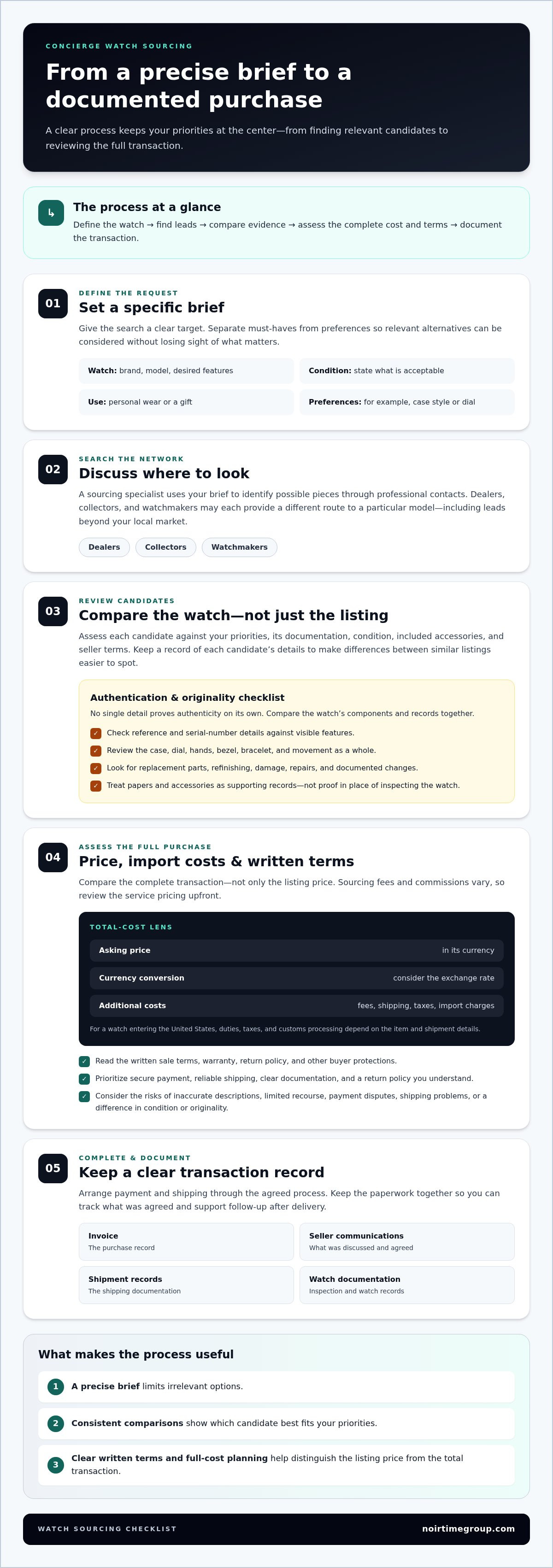
To source and import safely, define the watch and acceptable condition, review each candidate’s documentation and inspection details, then assess the written sale, payment, shipping, and return terms. Before purchasing, account for currency conversion and the import requirements and charges that apply to the shipment entering the United States.
- Set the brief. Name the watch brand, model, and features that matter. For example, a Patek Philippe request can clarify preferred case style, dial, or intended use. Separate must-haves from preferences, so the search can consider relevant alternatives without losing sight of your goal.
- Discuss the search. A sourcing specialist uses the brief to identify potential pieces through professional contacts. Dealers, collectors, and watchmakers may each offer different routes to a particular model. If you’re choosing a gift, recipient preferences and everyday style can help guide the shortlist.
- Compare candidates. Review each watch against your stated priorities, including model details, condition, included accessories, and seller terms. A record of the candidate’s details makes comparisons easier and reduces the chance of overlooking a meaningful difference between similar listings.
- Evaluate the purchase. Consider the asking price in its currency, conversion, service fees, shipping, and import charges together. A sourcing expert’s knowledge of market values may help inform price discussions. Keep the negotiation grounded in the specific watch and its documented condition.
- Complete the transaction. Read the sale terms and arrange payment and shipping through the agreed process. Keep the invoice, seller communications, shipment records, and watch documentation together. These records help you track what was agreed and support follow-up after delivery.
Each stage serves a purpose. A precise brief limits irrelevant options, consistent comparisons show which candidate best fits, and clear written terms establish what the seller has agreed to provide. The practical value of global luxury watch sourcing network access is connecting a specific request with potential market leads while keeping your criteria at the center. Planning the full transaction also helps prevent the listing price from being mistaken for the total cost.
Concierge sourcing is especially useful when a desired watch is difficult to locate through one seller, or when the buyer wants help weighing models. The specialist’s role is to connect the search with suitable market options and help the buyer make an informed choice. For a specific model, watch sourcing support can be a natural next step.
Photography, serial numbers, and condition reports
Photos and records help buyers assess a watch before arranging an in-person inspection. They show visible details, support comparisons between references, and help identify questions to raise about the listing. For pre-owned watches, images should show the actual piece being offered, not simply illustrate the model.
Review photos systematically. Check that the color looks consistent and the details are sharp, then compare the images with the stated reference and description. Useful views include:
- The dial, hands, markers, and date display, shown clearly from the front.
- The case sides, bezel, lugs, and crown, where wear or refinishing may be visible.
- The bracelet, clasp, and links, including close-ups of scratches or damage.
- The case back and movement, when visible and safely photographed.
- Accessories and documents included in the sale, shown separately from the watch.
Serial-number information can help connect the physical watch with its paperwork and seller records. Compare the number and reference details across available documents, photos, and the watch itself. A matching number is useful evidence, but it does not prove that every component is original or that the watch is authentic. Treat it as one part of a broader assessment, alongside the movement, case, dial, and other details.
Serial numbers can also be sensitive identifying information. Share the full details privately with the specialist handling the evaluation rather than publishing them alongside listing photos. A public image can show the relevant area while obscuring identifying characters. Keep copies of documents and seller communications with the purchase record so the description and transaction details stay together.
A condition report translates images and inspection findings into specific observations. It should describe visible marks, dents, scratches, bracelet stretch, replaced parts, and known service work. Ask the report to distinguish observed facts from information supplied by the seller. This matters when comparing similar watches, since a polished case or replacement dial may affect a collector’s view of originality.
Demand, retail availability, and collector preferences can shape which details deserve closer attention. One buyer may prioritize an original dial, while another values documented servicing and daily wearability. Don’t treat a watch as an investment based on photographs or a condition label alone. Consider the images, serial details, and report together to decide whether the specific piece fits your priorities.
Access to a global dealer network
A sourcing network extends your search beyond one local dealer or storefront. It can connect you with dealers, collectors, and watchmakers who may know where a specific model is available. Their expertise can also help clarify model details, service records, and the seller’s description before you compare candidates.
Geography matters because luxury watch brands distribute products through different channels. Rolex, for example, sells through authorized dealers and Rolex-owned stores, which it carefully selects to maintain its brand’s exclusivity and value. A professional sourcing service may also work with independent dealers and collectors, broadening the search for watches that are difficult to find through a single channel.
Switzerland has a central role in luxury watchmaking, but a Swiss connection alone does not establish whether a particular watch is right for you. Assess the exact reference, condition, seller, and terms. A network can help identify candidates across markets and organize the details needed to compare them. Judge each lead on the watch itself, not just its point of origin.
Use a structured brief to make network access productive:
- Name the brand and model, then separate required features from preferences.
- State whether pre-owned, vintage, or unworn condition is acceptable.
- Describe preferred dial, case, bracelet, and included accessories.
- Set priorities for documentation, condition, and seller terms.
A clear brief gives each dealer a consistent request. If you’re seeking a particular Rolex model, for example, the reference and preferred condition help distinguish relevant leads from similar watches. Keeping a record of each candidate also makes comparisons easier when sellers provide different details or photographs.
Network access does not mean every dealer holds every watch or that every lead will match your request. A useful process filters candidates against your priorities, then compares the seller’s information and transaction terms. Dealers may describe the same model differently, so consistent criteria matter. Request a written description of the specific piece and review its supporting records before deciding.
Luxury watch brands have distinct distribution and servicing practices. Rolex’s authorized-dealer structure differs from the way buyers encounter pre-owned pieces through collectors or independent sellers. A network can help locate these different routes while you weigh provenance, condition, and purchase terms. This can be especially useful when a desired model is scarce locally, but the final decision should rest on evidence about the individual watch.
The practical value for buyers lies in coordinated searching and clearer comparisons, not simply a longer list of sellers. Define the model, review relevant leads, and keep each candidate’s details in one record. Then you can see whether a global search has produced a genuine fit for your request.
Rolex distributes watches to authorized dealers around the world after they pass quality control. That process is separate from evaluating an individual watch’s condition and the seller’s terms.
Access to rare and limited-edition watches
A rare watch may require a broader search than a standard model that is readily available. Professional sourcing services can work with dealers worldwide to locate exclusive pieces, while contacts among collectors and watchmakers can reveal leads beyond ordinary retail listings. Your preferences should guide the search: rarity matters only if the specific watch fits your collection or intended use.
Set your request around the exact model, reference, and features that matter. For an Audemars Piguet Royal Oak, for example, clarify the dial, materials, and condition you want. Separate essential details from flexible preferences. This gives a sourcing specialist room to identify relevant alternatives without treating every similar-looking watch as an acceptable match.
Scarcity can have several causes. A model may be hard to find because production is limited, demand is strong, or few owners are selling. A discontinued reference may also be uncommon in a particular condition or configuration. Ask what makes the requested piece difficult to locate, then use the answer to guide the search and assess each candidate on its own details.
The scale of the market helps explain why searches can cross borders. The global luxury watch market was valued at USD 58 billion in 2025. According to The Watches of Switzerland Group, US retail sales of luxury watches reached $10.1 billion in calendar year 2025. Revenue in the luxury watch market varies across countries. These market facts describe scale, not the availability or value of any individual watch.
As leads come in, compare them with your original request rather than reacting only to rarity. Consider the exact reference, condition, originality, documentation, included accessories, and seller terms. A rare watch with a mismatched configuration may suit a different collector better. Keep a record of each candidate’s details so the differences stay clear as you decide.
- Define the target: identify the model and features that are non-negotiable.
- Allow alternatives: decide which details can vary while preserving the main preference.
- Assess the reason for scarcity: distinguish limited production from low resale availability or strong demand.
- Compare individual candidates: weigh condition and documentation alongside rarity.
In America and other major markets, a wide search can surface more leads, but it doesn’t remove the need to assess each watch carefully. Ask for details tied to the exact piece, not general claims about a model or brand. If you’re looking for a hard-to-find reference, request help sourcing a rare watch.
Noir Time Group: Rolex Submariner Date 126613LN
Noir Time Group offers a Watch Sourcing Service for buyers seeking a particular luxury timepiece, including watches that may take a wider search to locate. If the Rolex Submariner Date 126613LN is your target, share the model you want and the details that matter to your choice. Noir Time Group also offers the Rolex Submariner Date 126618LN for buyers considering another Submariner Date option.
If the watch you own needs attention, Noir Time Group provides Certified Watch Repair for high-end timepieces. If you’re searching for a specific model, its Watch Sourcing Service can help pursue it.
To discuss watch sourcing or repair, contact Noir Time Group or visit noirtimegroup.com.
Turn Your Watch Search Into a Clear Next Step
Turn your interest into a specific brief. Decide which model you want, which details are essential, and where you can be flexible. This gives your search direction and helps you assess opportunities against your priorities rather than deciding based only on scarcity or excitement.
For buyers seeking global luxury watch sourcing network access, Noir Time Group’s Watch Sourcing Service offers a way to pursue a particular timepiece. You can also explore the Rolex Submariner Date 126613LN and Rolex Submariner Date 126618LN as defined options while considering what best suits your preferences.
A thoughtful purchase starts with a clear goal and a considered decision. When you’re ready to discuss your search, contact Noir Time Group and take the next step toward finding the watch that feels right for you.
Frequently Asked Questions
What is a global luxury watch sourcing network?
A global luxury watch sourcing network connects buyers with dealers, wholesalers, collectors, and watchmakers who may help locate a specific timepiece. Instead of searching one retailer’s inventory, you can share a model or set of preferences with a specialist who looks for suitable leads. The network’s value lies in connecting your request with potential sellers and helping you assess the specific watch and transaction.
Which platforms and dealers provide access to global luxury watch sourcing networks?
Concierge sourcing can draw on authorized dealers, wholesalers, trade shows, and private sellers. Noir Time Group offers a Watch Sourcing Service for buyers seeking specific timepieces. Start by providing the exact model or reference and explaining which details matter most, such as configuration or condition. A defined request gives the sourcing specialist a clear direction for the search.
How can buyers verify the authenticity and provenance of a luxury watch sourced internationally?
Compare the watch’s serial number and provenance records with its paperwork, seller documentation, and inspection findings. For Noir Time Group, every watch is 100% authentic, verified through rigorous expert authentication, including serial number verification and provenance checks. Keep the invoice and seller communications with the watch records, too. This creates a transaction history tied to the specific piece, which is especially useful if you later service or resell it.
How can buyers find rare or discontinued luxury watches through a sourcing network?
Give the sourcing specialist the exact brand, model, and reference, then identify which features are essential and which can vary. For a discontinued Audemars Piguet Royal Oak, for example, specify your preferred configuration and acceptable condition. Noir Time Group’s Watch Sourcing Service helps pursue specific timepieces. Keep a shortlist of candidates and compare each with your original preferences before choosing.
