

What if your first luxury watch isn’t the start of a spending race, but the beginning of a collection you’ll actually wear? Learning how to build a luxury watch collection doesn’t require buying several pieces at once. Start by deciding what you can comfortably spend, then choose each watch for a clear reason.
Luxury watches can feel out of reach, and it’s easy to wonder whether to start with a dress watch, a daily wearer, or a sports model. You may also have questions about authenticity, pre-owned condition, resale claims, and the cost of maintenance. A little planning can help you avoid rushed purchases and watches that serve the same purpose.
This guide explains how to set a realistic budget that accounts for ownership over time, choose complementary watches for different occasions, and assess pre-owned pieces. You’ll also learn what to check before buying and how to plan for upkeep. The goal isn’t to build a large collection overnight. It’s to build a considered one at your own pace and within your means.
Key Takeaways
- Learn how to build a luxury watch collection by making deliberate choices instead of buying to keep up with trends.
- Use your wear habits, fit, and occasions to decide whether a watch fills a genuine gap.
- Check seller transparency, condition, paperwork, and provenance before committing to a pre-owned watch.
- Keep service records and follow manufacturer guidance to plan for ownership and future purchases.
How to Build a Luxury Watch Collection on a Budget: Start With a Plan
Luxury collecting can feel financially intimidating, especially when polished watches and online wish lists make it seem as if you need several pieces at once. You don’t. A staged plan helps you decide what you can comfortably spend, what you want a watch to do, and when another purchase makes sense. That’s a more sustainable approach to how to build a luxury watch collection.
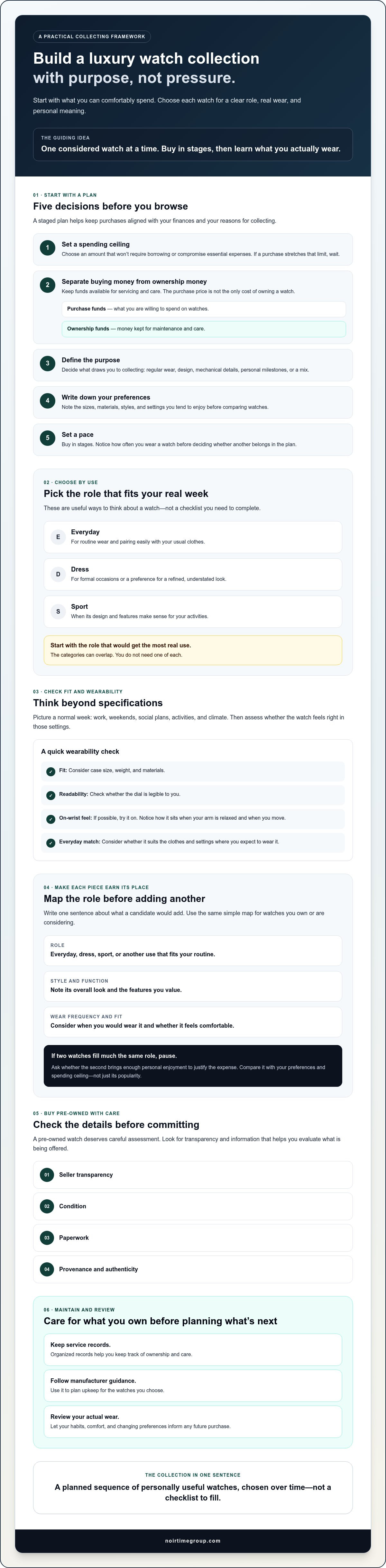
Before browsing models, work through this framework:
- Set your spending ceiling. Choose an amount you can put toward collecting without borrowing or compromising essential expenses.
- Separate purchase funds from ownership funds. Reserve money for servicing and other care needs rather than treating your entire budget as available for buying watches.
- Define the collection’s purpose. Decide whether you’re drawn to daily wear, design, mechanical details, milestone purchases, or a mix.
- Write down your preferences. Note the sizes, materials, styles, and settings you tend to enjoy before comparing listings.
- Set a pace. Buy in stages. Review what you actually wear before deciding whether another piece belongs in the plan.
Set a collecting budget that includes ownership
Think of your budget as two separate amounts: what you’re willing to spend on watches and what you’ll keep available to maintain them. The appropriate reserve depends on the watches you choose and their condition, so don’t assume the purchase price is the only cost. Leave room for upkeep and set a firm personal ceiling. If buying a watch means borrowing or stretching beyond that limit, wait. Budget boundaries help set a sensible pace and keep the collection aligned with your finances.
Choose a collection purpose before a first watch
Ask yourself what you want from collecting: a dependable watch for regular wear, an appreciation of design, an interest in movements, or pieces connected to personal milestones. If you’re still exploring, the history of watches can provide context on movement types and how watches have been used and valued. Then note what feels right on your wrist and suits your routine. Those preferences will help you compare options by personal relevance, not just reputation or online attention.
A budget-led collection is a planned sequence of personally useful watches, chosen over time rather than bought to fill a checklist. Keep that principle in view as your tastes develop. You might begin with one watch and take time to learn how often you wear it before deciding what, if anything, should come next.
Choose the First Luxury Watch by Role, Fit, and Wearability
Your first watch should suit the life you lead, not an image of collecting shaped by status or online hype. Before comparing specifications, picture a normal week: what you wear to work, how you spend weekends, and when you need a more formal look. This turns how to build a luxury watch collection into a practical decision about what you’ll genuinely enjoy wearing.
Think in terms of roles, not a mandatory checklist. An everyday watch should feel comfortable during routine activities and pair easily with your usual clothes. A dress watch may suit formal events or a preference for a refined, understated look. A sport watch can make sense if its design and features fit your activities. These categories can overlap, and you don’t need one of each. Start with the role that would get the most real use.
Match a watch to everyday use
Consider your work environment, social plans, activities, and climate. A watch that feels right at a desk may not be your first choice for active weekends. A bold design may rarely leave the drawer if it doesn’t suit your daily style. Comfort matters as much as specifications: case size, weight, materials, and dial legibility all affect wearability.
If possible, try a candidate on before deciding. Check how it sits when your arm is relaxed and when you move. Look at it from several angles rather than judging only in a mirror. It should feel balanced on your wrist and make sense with the clothes and settings where you expect to wear it.
Avoid buying the same collection role twice
Before committing, write one sentence describing what the candidate would add. Then make a simple collection map for each watch you own or are considering:
- Role: everyday, dress, sport, or another use that fits your routine.
- Style and function: note its overall look and the features you value.
- Wear frequency and fit: estimate when you’d wear it and whether it feels comfortable.
If two candidates would fill the same role in much the same way, pause and consider whether the second brings enough personal enjoyment to justify the expense. Compare each option with your preferences and spending ceiling, not just its popularity. A watch earns its place through a distinct role, not rarity alone.
If you’ve clarified what you want but would value expert input, explore watch guidance from Noir Time Group as one possible next step.
How to Balance a Luxury Watch Collection Without Overspending
A balanced collection isn’t measured by the number of watches or the prestige of the names on their dials. It’s built by choosing pieces that suit different needs without stretching your budget for small variations. Use a written shortlist to compare candidates, then give yourself time to consider each one. Scarcity or a burst of online attention isn’t a reason to rush.
This comparison table can help you see whether a watch fills a genuine gap or overlaps with one you already own:
| Candidate | Role | Style | Wear frequency | Condition | Fit with collection |
|---|---|---|---|---|---|
| Watch A | Everyday | Note the look | Often, sometimes, or rarely? | New or pre-owned; record concerns | What does it add? |
| Watch B | Dress, sport, or other | Note the look | Often, sometimes, or rarely? | New or pre-owned; record concerns | Does it fill a gap? |
Be honest about how often you’d wear each piece. One versatile watch that works across work and social settings may offer more practical use than several reserved for rare occasions. A narrowly focused watch can still earn a place if that role matters to you and fits your spending plan. Your shortlist should clarify the trade-offs, not pressure you to own a particular number of watches.
Compare new and pre-owned watches carefully
Assess condition, documentation, provenance, and seller transparency as separate checks. Ask what is included, what is known about the watch’s history, and how its authenticity is established. A pre-owned watch isn’t automatically better value. Wear, missing information, or unresolved questions can affect whether it’s right for you. Compare what you can verify, and don’t treat asking prices or resale predictions as proof of future value.
Decide what makes a second watch meaningfully different
Give your first watch enough wrist time to learn what you actually reach for and what feels missing. Then compare a possible second piece by use, design, material, and comfort, not brand recognition alone. Rolex, Patek Philippe, and Audemars Piguet are examples of luxury watch brands, not a checklist for building a collection. No combination or structure guarantees appreciation or resale value. The aim of how to build a luxury watch collection is to make considered choices you can afford and enjoy, without assuming what the market will do.
How to Buy a Luxury Watch Safely on a Budget
A low asking price doesn’t tell you whether a watch is a sound purchase. Assess the specific piece and seller, not just the brand name. Before paying, get clear answers about the watch’s condition, history, included documents, and how its authenticity is established. If key details are vague or the seller discourages reasonable questions, pause rather than letting urgency make the decision for you.
Check authenticity, condition, and provenance
Use this checklist to organize your questions and compare listings on the same basis:
- Seller transparency: Can you confirm who you’re buying from, review the stated return terms, and get answers in writing?
- Watch details: Do the reference and identifying details match the listing? Ask for clear images and a specific description of wear, damage, replaced parts, or other known issues.
- Documentation: Find out what paperwork, packaging, or service records are included. Paperwork can support an assessment, but it isn’t proof on its own and shouldn’t replace professional verification.
- Provenance: Ask what is known about the watch’s history and what records support that account. Provenance describes a watch’s documented ownership and history.
- Authentication: Ask who assesses the watch, what the process involves, and what recourse is available if a concern arises.
Don’t rely on appearance alone. Ask how the specific watch was assessed, and consider having it examined by a qualified professional before finalizing a purchase. Compare the seller’s answers with the condition and documentation you can review. If important points remain unresolved, walk away.
Know when expert sourcing may help
A particular reference or configuration may not appear in the public listings you’ve checked. Once you’ve set your budget and written down the criteria that matter, a sourcing service can be another way to explore a request. Be specific about acceptable condition and required documentation, and ask about the sourcing process and terms before proceeding. This keeps the search tied to your priorities instead of letting availability pressure you to compromise.
Noir Time Group offers a watch sourcing service for requested watches that may not be in its public inventory. If you’d like to explore that option, ask Noir Time Group about watch sourcing and confirm the details directly. Review any sourced candidate’s condition, provenance, and authentication information before deciding. A careful process is central to how to build a luxury watch collection with confidence and within your means.
Maintain Your Watch Collection and Plan the Next Purchase
Responsible ownership continues after the purchase. Store watches securely when you’re not wearing them, handle them with care, and keep purchase details and service records together. A simple digital or paper log can note each watch’s identifying details, purchase date, included documents, and maintenance or repair history. Organized records make it easier to track each piece and share useful information with a watch professional when questions arise.
Care needs vary by watch, so don’t assume one service schedule applies to every piece. Check the manufacturer’s guidance or ask a qualified watch professional about appropriate care intervals. Add potential repair and service needs to your collection budget before shopping for another watch. You don’t need to predict every future expense, but treating upkeep as part of ownership can help prevent a new purchase from crowding out care for the watches you already have.
Plan for care before adding another watch
Keep receipts, warranty documents, service reports, and relevant correspondence organized by watch. If a piece needs attention, describe the issue clearly and ask what the proposed work covers before authorizing it. Noir Time Group offers certified watch repair. Confirm the current service scope and terms directly to decide whether it suits your needs.
Let the collection grow at a deliberate pace
After you’ve worn your watches regularly, revisit your collection map. Which pieces do you reach for, and which roles remain unfilled? A watch that looked like a gap on paper may turn out to duplicate something you already enjoy wearing. There’s no requirement to keep adding. A smaller collection of well-used watches may serve your goals better than a larger group of pieces that rarely leave storage.
Patience is central to how to build a luxury watch collection that feels personal and remains manageable. Review your budget, care records, and actual wear habits before considering your next purchase. If you’d like professional input, first clarify what you’re looking for, then explore Noir Time Group’s watch inventory and sourcing support as possible next steps.
Build Your Collection One Considered Choice at a Time
Knowing how to build a luxury watch collection starts with a plan that respects your budget and everyday life. Set aside funds for ownership as well as purchases, choose a watch for how you’ll wear it, and let real experience reveal what your collection needs next. Before buying pre-owned, ask clear questions about condition, documentation, provenance, and how authenticity is assessed.
You don’t need to rush or meet anyone else’s idea of a complete collection. A few well-chosen watches that suit your taste can be more rewarding than a longer list of overlapping pieces. Careful research and patience help keep each decision grounded in what matters to you.
Noir Time Group states that its watches are guaranteed authentic and offers curated pre-owned inventory with verified provenance. Confirm current authentication and provenance procedures directly. The retailer also offers watch sourcing and certified repair, so check the current service scope and terms. Ready to explore your options? Explore Noir Time Group’s luxury watches and sourcing support, and take the next step at a pace that feels right.
Frequently Asked Questions
How do you start a luxury watch collection on a budget?
Start by setting a spending limit that protects essential expenses and leaves room for future care. Separate your purchase budget from money reserved for servicing or repairs, and don’t borrow to chase a particular watch. Then decide what you want a watch to do, such as daily wear or formal occasions, and write down your preferences. This gives you a practical foundation for how to build a luxury watch collection at your own pace.
Can you build a luxury watch collection with one watch at a time?
Yes. Buying one watch at a time lets you learn what you enjoy wearing before committing to another purchase. Wear your first watch in your usual settings and note its comfort, versatility, and limitations. Then consider whether you have a genuine gap, such as wanting a more formal option, or whether another candidate would largely duplicate its role. A measured pace can help keep spending and ownership responsibilities manageable.
What should be the first watch in a luxury collection?
Choose a watch that fits your routine, wrist, taste, and budget rather than a model that is simply popular. Consider where you’ll wear it, how often, and whether its size, weight, materials, and legibility feel comfortable. Someone who wants one watch for work and weekends may prioritize versatility, while a person who attends formal events often may prefer a dressier style. Try it on if possible before deciding.
Is buying a pre-owned luxury watch a good way to build a collection?
It can be, but pre-owned doesn’t automatically mean better value or lower risk. Evaluate the specific watch’s condition, included documentation, known service history, and provenance, which describes its documented ownership and history. Ask the seller how authenticity is established and what recourse is available if concerns arise. Compare what you can verify, not just the brand or asking price. If important details are unclear, pause or seek a qualified professional’s assessment.
How many watches should a luxury watch collection have?
There’s no required number. The right collection size depends on your budget, lifestyle, and how often you wear each piece. One versatile watch may be enough, while another collector may enjoy several watches with distinct roles, such as everyday, dress, or sport. Review your collection map before adding another. If a new watch overlaps in style and use with one you already own, consider whether it adds enough personal value to justify the purchase.
How do I verify a luxury watch before buying it?
Ask for clear details and images, a description of the watch’s condition, any known service history, and a list of included documents. Check that the identifying details are consistent across the watch and paperwork, but don’t treat paperwork or visual inspection as definitive proof. Ask who assessed authenticity and how. Vet the seller, understand the stated return terms, and consider an independent assessment by a qualified watch professional before completing the purchase.
What ongoing costs should I consider when collecting luxury watches?
Plan for servicing, repairs, and other care needs, since requirements depend on the watch and its condition. Keep a reserve separate from your purchase budget, and check the manufacturer’s care guidance or consult a qualified watch professional about service intervals. Ask about repair scope and terms before authorizing work. Maintain organized purchase and service records, too. This makes it easier to track ownership needs and decide whether another watch fits your budget.
