

The best-prepared watch isn’t necessarily the one polished the most. To understand how to prepare a watch for sale, focus on careful cleaning, an honest condition assessment, and gathering its original accessories and paperwork. With vintage watches, preserving original details can matter more than removing every mark.
It’s natural to want your watch looking its best and to choose a selling route that reaches serious buyers. A professional can assess whether cleaning or repair makes sense. The watch’s condition, service history, and included accessories help present it clearly. Preparation is about showing what the watch is, not hiding its history.
This guide explains how dealer, marketplace, and private-sale options compare, and what a professional may review before your watch is offered for sale. You’ll also learn what to gather, from boxes, bands, and service records to any chargers or adapters supplied with the watch, so buyers can see exactly what’s included.
Key Takeaways
- Have a professional clean the watch with its materials and condition in mind, especially if it’s vintage.
- Choose a selling route that suits your priorities, and present the watch’s condition and history clearly to potential buyers.
- Gather the original box, papers, service records, and any bands or accessories supplied with the watch.
- Weigh the value of a professional service against the watch’s condition and the effect of selling it without service.
How a professional prepares a watch for sale, including cleaning
- Knowing how to prepare a watch for sale starts with inspecting it before cleaning. A professional records visible wear, checks the case, bracelet, clasp, and crystal, and identifies dirt that can be safely removed. Cleaning methods should suit the watch’s materials and construction, removing surface grime without disguising wear or changing original details.
- Preserve vintage character rather than polishing away every mark. Original case lines, dials, and hands can matter to collectors, and refinishing a vintage dial may reduce its value. Refinishing a modern watch may be worth considering. A damaged sapphire crystal should be repaired or replaced before sale; weigh other cosmetic work against the importance of originality.
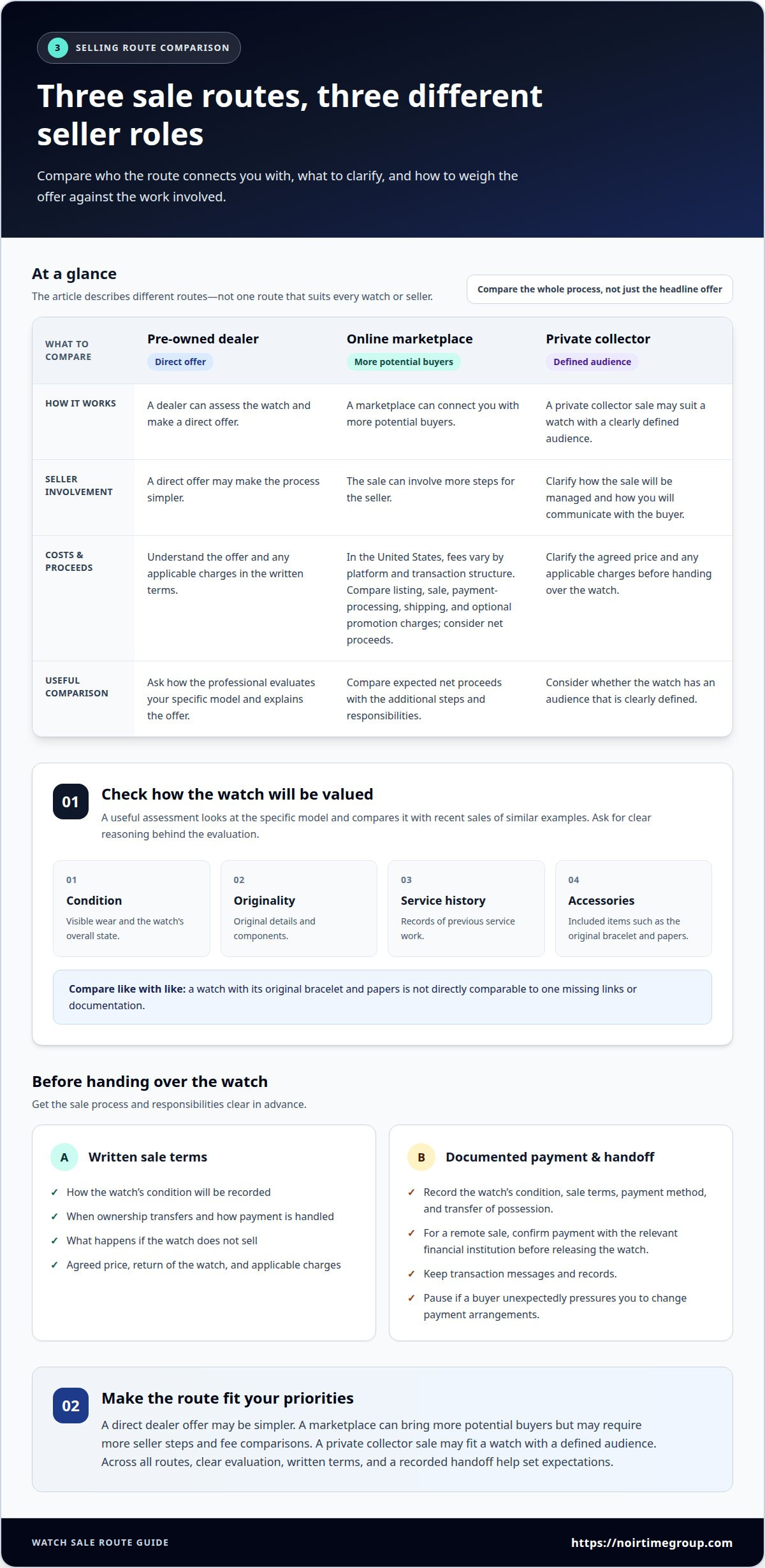
- Assess value using evidence tied to the exact model. A professional can research recent comparable sales, consider condition and accessories, consult dealers, or provide an appraisal. When deciding how to prepare a watch for sale, compare like with like: a watch with its original bracelet and papers isn’t directly comparable to one missing links or documentation.
- For a U.S. personal-watch sale at a profit, keep purchase and sale records. Tax treatment depends on the transaction and your circumstances, so a tax professional can explain how it applies. For shipping, use protective packaging, tracking, and insurance appropriate to the watch’s value. Keep shipment records and document the watch’s condition before it leaves.
- Reduce payment risks with a documented handoff. A professional can record the watch’s condition, agreed sale terms, payment method, and transfer of possession. For a remote sale, confirm payment with the relevant financial institution before releasing the watch. Keep transaction messages and records, and pause if a buyer unexpectedly pressures you to change payment arrangements.
Choosing a professional to sell the watch
- Choose a selling route that matches your priorities. A pre-owned dealer can assess the watch and make a direct offer. An online marketplace can connect you with more potential buyers, while a private collector sale may suit a watch with a clearly defined audience. Each route differs in who manages the sale and how you communicate with buyers.
- Ask how the professional evaluates your specific model. A useful assessment considers condition, originality, service history, and accessories, then compares the watch with recent sales of similar examples. A Rolex Submariner with its original bracelet and papers, for instance, isn’t directly comparable to one missing links or documentation. Clear reasoning makes an offer easier to understand.
- Clarify the sale process before handing over the watch. Understand how its condition will be recorded, when ownership transfers, how payment is handled, and what happens if the watch doesn’t sell. Written terms can prevent misunderstandings about the agreed price, return of the watch, and any applicable charges.
- Marketplace fees in the United States vary by platform and transaction structure. Compare listing, sale, payment-processing, shipping, and optional promotion charges, then consider your net proceeds rather than the headline offer. A dealer’s direct offer may be simpler, while a marketplace can involve more steps for the seller.
- Consider communication and security as part of the choice. A professional should explain the watch’s condition accurately, keep a record of the transaction, and use a clear process for payment and delivery. Avoid arrangements that rely on vague promises or sudden changes to payment terms. For help exploring a particular timepiece, review specialist watch guidance.
How a professional accounts for boxes, bands, chargers, and adapters
- Inventory the complete set before preparing your sale listing. Record the watch, original box, warranty card, manuals, service records, extra bands, chargers, and adapters, when supplied. Separate included items from unrelated accessories to describe exactly what the buyer receives. A clear inventory also helps keep small items with the correct watch.
- Inspect the bracelet and count its links. Present the watch with its original bracelet and all links intact when possible. If any links are missing, note that rather than implying the bracelet is complete. If the watch has a non-original strap, a new original-equipment-manufacturer strap is the recommended replacement.
- Identify the clasp or buckle as part of the set. Original deployant clasps and buckles can increase resale value, so record whether the original component accompanies the watch. A listing, for example, should distinguish an original clasp from a replacement instead of describing both simply as included hardware.
- Match each document and accessory to the correct watch. Original boxes, warranty cards, manuals, and service records can enhance value, but don’t present a mismatched box as the watch’s original packaging. A professional can label each item and accurately describe how it relates to the watch.
- Document chargers and adapters only when they belong to the watch’s supplied set. Record their presence and condition, and include clear photographs in the sale materials. Keep small accessories together during packing so the buyer receives the complete set described. This is especially helpful when a watch has several bands or detachable charging components.
Should a professional service a watch before selling it, and how much does service cost?
- Start with a condition assessment, not an automatic full service. A qualified watchmaker can test water resistance and mechanical performance before sale. The findings help determine whether the watch needs attention or can be presented in its current condition. If performance is uncertain, an assessment gives buyers clearer information than appearance alone.
- Ask for checks suited to the watch’s functions. Mechanical testing can cover precision, balance amplitude, power reserve, and complication functionality. For example, a chronograph should be assessed for its timing function, while a time-only watch needs checks relevant to its movement. Clear results help describe what works and identify repairs that could affect a sale.
- Compare the proposed service with its likely benefit. Factory servicing can provide correct parts, refinishing, and a warranty, supporting buyer confidence and potentially the sale price. However, service work costs money, and its value depends on condition, movement complexity, required parts, and the work involved. Request an itemized scope to weigh the service against the expected selling outcome.
- Consider selling without service if the watch runs and its condition is accurately documented. You can sell a watch as-is, but should expect lower offers and a longer selling process. A documented assessment can still explain its performance and help distinguish routine attention from significant repair.
- Use a professional repair assessment when mechanical concerns could hold up the sale. The cost depends on the watch’s condition, parts, complications, and service scope, so a general figure would not describe every job. For a watch that needs attention before sale, arrange professional watch repair as part of the preparation process.
Noir Time Group
Noir Time Group can be a next step when preparation reveals that a luxury watch needs repair or you’re considering what to wear next. Its Certified Watch Repair addresses repair needs, while the Watch Sourcing Service supports collectors seeking a particular timepiece. If your watch needs attention before you decide whether to keep or sell it, repair is directly relevant. If you plan to replace it, sourcing may suit that next decision. A repair decision is most useful when it follows the watch’s condition, not a desire to remove every sign of age. Noir Time Group also offers the Rolex Submariner Date 126613LN and Rolex Submariner Date 126618LN. To discuss your watch plans, contact Noir Time Group.
Make Your Next Move With Confidence
If you’re deciding how to prepare a watch for sale, start with a clear conversation about your goal: a straightforward sale, a repair decision, or finding another timepiece. This keeps each choice relevant to what you want from the watch, rather than treating preparation as a checklist with the same answer for every owner.
Bring your priorities to the discussion, including what matters most about the watch and what you hope to do next. Noir Time Group can help you explore buying, selling, trading, sourcing, and repair options for luxury watches. You don’t need to settle every detail before reaching out. Start with the question you’re weighing and take the next step with a clearer sense of direction.
Contact Noir Time Group to discuss your next step. A thoughtful plan can make moving forward feel simpler and more intentional.
Frequently Asked Questions
What steps does a professional take to prepare a watch for sale?
A professional typically identifies the watch and records its visible condition, then assesses whether cleaning, repair, or further evaluation is appropriate. They organize relevant documentation and accessories, create a clear description, and prepare the watch for the chosen selling route. For example, a watch with uncertain provenance may need further examination before its listing accurately describes its history.
How does a professional clean a watch safely before selling it?
A professional chooses a cleaning method suited to the watch’s materials and construction, rather than treating every case and bracelet alike. They focus on areas where residue collects while avoiding methods that could affect delicate finishes or let moisture into the watch. If cleaning alone won’t address the condition, they can distinguish that issue from a repair need before sale.
How can a professional verify a watch’s authenticity and document its condition?
A professional can examine identifying details, compare the watch’s reference and serial information with its features, and assess whether its documents support its history. They can also create a condition record noting visible wear or discrepancies, helping prevent unclear claims in a listing. Noir Time Group verifies serial numbers and guarantees the authenticity of the watches it sells.
What watch photos and details should a professional include in a sales listing?
A useful listing shows the dial, case, caseback, bracelet or strap, clasp, and any visible damage in clear, well-lit images. Identify the model, disclose its condition accurately, and distinguish included accessories from items shown for reference only. If a photograph shows an extra strap that isn’t included, for example, say so plainly.
How can a professional help you choose between a private sale, a dealer, or an online marketplace?
A professional can explain the trade-offs: a private sale may give you more control over negotiation, a dealer can provide a direct route to a sale, and a marketplace can connect you with prospective buyers. Consider how much time you can spend communicating, managing payment, and coordinating delivery. The best fit depends on your priorities, not just the asking price.
What paperwork, box, and accessories can a professional help gather to support a watch’s resale value?
A professional can help organize the warranty card, manuals, purchase records, service documents, original box, bracelet links, and any supplied straps or charging accessories. A service record can help explain maintenance history, while a complete bracelet clarifies what accompanies the watch. Keeping items together with the correct timepiece avoids confusion during appraisal and listing preparation.
