

What if the very safe meant to protect your Rolex Submariner or Patek Philippe Nautilus is actually quietly degrading its movement? It is a common anxiety for collectors; the fear that oils are drying out or settling while a prized timepiece sits idle. You have invested significant capital into your collection, and the last thing you want is an avoidable mechanical failure because of a simple storage oversight. Storing automatic watches correctly is not just about finding a shelf. It is about managing a delicate mechanical ecosystem to ensure every gear and spring remains in peak condition.
We understand the pressure to maintain a "full set" for future resale while keeping your daily rotation secure from physical damage or theft. This guide provides the professional standards you need to preserve both the mechanical integrity and the market value of your luxury watches. We will explore the ideal 30 to 50 percent humidity levels for storage, settle the debate on whether watch winders are truly necessary, and establish a secure routine that keeps your Audemars Piguet as accurate as the day it left the boutique.
Key Takeaways
- Control your storage environment by maintaining humidity levels between 30 and 50 percent to protect delicate gaskets and synthetic lubricants.
- Understand the mechanical trade-offs of using a watch winder to balance daily convenience with the long-term health of your timepiece's movement.
- Learn the professional standards for storing automatic watches correctly to preserve the 'full set' status and financial value of your luxury assets.
- Assess the pros and cons of home safes versus bank deposit boxes to create a secure physical protection plan for your collection.
- Implement a 'wake up' routine for pieces in long-term storage to keep internal components lubricated and ready for professional maintenance.
Environmental Protection: Managing Temperature, Humidity, and Magnetism
High-end calibers are miniature mechanical ecosystems. Storing automatic watches correctly requires a commitment to environmental stability that goes beyond simple aesthetics. For a Patek Philippe Nautilus or an Audemars Piguet Royal Oak, the internal components rely on micro-thin layers of synthetic lubricants. These oils are engineered to perform within specific parameters. When a watch is exposed to extreme temperature fluctuations, these lubricants can thin out or coagulate. This leads to increased friction, which eventually wears down the delicate pivots and jewels inside the movement.
A stable environment is non-negotiable for preserving the accuracy of your timepiece. Sudden shifts in heat or cold can also cause the metal components to expand and contract at different rates. Over time, this stress compromises the tension of the hairspring and the integrity of the seals. If you are keeping your collection in an NYC apartment, avoid placing your storage case near radiators, air conditioning vents, or windows where direct sunlight can create a localized greenhouse effect.
Ideal Temperature and Humidity Ranges
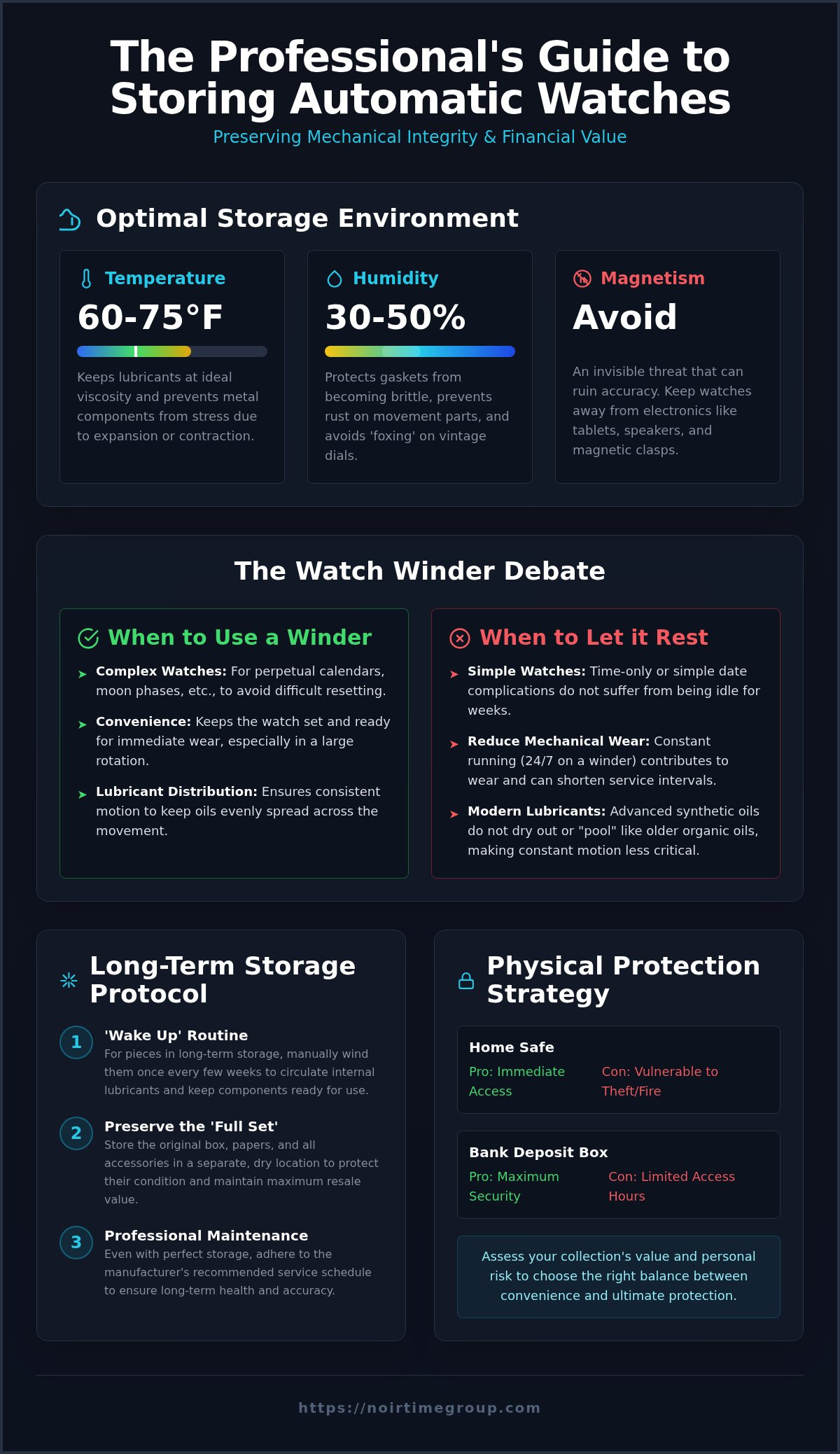
The "Goldilocks zone" for mechanical watch storage sits comfortably between 60 and 75 degrees Fahrenheit. This range keeps the internal lubricants at their ideal viscosity. Humidity is equally critical. Excessive moisture leads to "foxing" on vintage dials, which appears as unsightly brown spots, and can even cause rust to form on steel movement parts if the gaskets are aged. Conversely, air that is too dry can cause the rubber gaskets to become brittle and crack, destroying the watch's water resistance. For luxury watch storage, maintain a consistent humidity level between 30 and 50 percent.
Identifying and Avoiding Magnetic Fields
Magnetism is an invisible threat that can instantly ruin a watch's accuracy. Modern life is full of magnetic sources, including tablets, high-end speakers, and even the magnetic clasps on handbags. If your watch begins running erratically fast, it's often a sign that the hairspring coils have become magnetized and are sticking together. While many Rolex models utilize Parachrom hairsprings or soft-iron inner cases to resist these forces, it's still best practice to keep your watches away from electronics. Collectors often ask What is a Watch Winder? when looking for storage solutions, but even these devices must be placed far from other magnetic interference to ensure the motor doesn't impact the movement. If you suspect magnetization, professional servicing is required to safely neutralize the field and restore timing.
The Watch Winder Debate: To Wind or Not to Wind?
The decision to use a watch winder remains one of the most debated topics among luxury enthusiasts. While many believe constant motion is required for mechanical health, the reality is more nuanced. Modern automatic movements, like those found in a Rolex Submariner Date 126613LN, use advanced synthetic lubricants that don't dry out or "pool" as easily as older organic oils. Storing automatic watches correctly often involves deciding if the convenience of a winder outweighs the incremental mechanical wear on the movement's components.
For time-only pieces or simple date complications, a winder is rarely a mechanical necessity. A watch that sits idle for a few weeks won't suffer internal damage. However, for complex pieces such as a Patek Philippe Nautilus with a perpetual calendar, the story changes. Resetting moon phases and leap year indicators is time-consuming and risks unnecessary stress on the crown and stem. In these cases, a winder serves as a vital utility rather than just a luxury accessory.
Advantages of Using a Quality Watch Winder
A high-end winder ensures your timepiece is ready for immediate wear without the need for manual winding or time-setting. Beyond convenience, consistent motion helps maintain a uniform distribution of lubricants across the escapement and gear train. For collectors who value presentation, a luxury winder also doubles as a secure display. If your collection has grown beyond your daily rotation, consulting with experts at Noir Time Group can help you determine the best maintenance schedule for your specific calibers.
Potential Drawbacks and Myths
The primary argument against winders is "unnecessary wear." Every rotation of the rotor and engagement of the winding gears contributes to the eventual need for service. While modern movements are robust, a watch on a winder for 365 days a year effectively "runs" 24/7. This constant activity can lead to a slightly shorter interval between professional overhauls compared to a watch that rests between uses.
Budget winders present a more tangible danger: magnetism. Low-quality motors often lack magnetic shielding, which can lead to the erratic timekeeping issues caused by magnetized hairsprings. Additionally, using a winder with incorrect settings can be counterproductive. A Rolex Datejust typically requires about 650 turns per day (TPD), while an Omega Seamaster might need 800 TPD. Using a generic winder that over-winds can stress the slipping spring mechanism in the mainspring barrel. Always verify the manufacturer's recommended TPD to keep your movement in peak condition.
Preserving Financial Value: Cleaning and Document Storage
For collectors of high-stakes timepieces like the Patek Philippe Nautilus or Audemars Piguet Royal Oak, the watch is more than a mechanical marvel; it is a significant financial asset. The difference between a "mint" and "excellent" condition rating can impact resale value by thousands of dollars. Storing automatic watches correctly begins with a total removal of environmental contaminants that have accumulated during wear. Skin oils, salt from perspiration, and microscopic dust can act as abrasives or corrosive agents if left on the metal surfaces for extended periods.
Pre-Storage Cleaning Ritual
Before placing your timepiece into a safe or storage case, perform a thorough but gentle cleaning. Use a high-quality microfiber cloth to remove surface smudges. For the intricate spaces between bracelet links and behind the lugs, a soft-bristled brush is essential. If the watch has a high water-resistance rating, like a Rolex Submariner Date 126618LN, you can use a small amount of distilled water to neutralize salt deposits. Avoid tap water, as the minerals can leave deposits in tight tolerances. Ensure the crown is fully screwed down before any moisture touches the case. A completely dry watch is a safe watch before it enters long-term storage.
The 'Full Set' Management Strategy
The "Full Set" includes the original box, warranty papers, hangtags, and extra bracelet links. This collection of ephemera is the "birth certificate" of your watch and is vital for maximizing resale value. However, you should never store the watch inside its original presentation box for long periods. These boxes are often made of materials like wood, leather, or velvet that can trap moisture or off-gas chemicals that might tarnish the watch. Instead, store the watch in a dedicated travel roll or safe, and keep the box in a separate, climate-controlled environment.
Protect your documentation from the elements as well. High humidity can cause warranty cards to peel and paper certificates to yellow or develop "foxing." Use acid-free plastic sleeves to house all paper documents. This prevents them from sticking to the box lining or absorbing moisture from the air. By treating the packaging with the same respect as the movement, you ensure that your investment remains as liquid and valuable as possible for future trades or sales.
Security and Physical Protection in an Urban Environment
Living in a high-density urban center like New York City introduces unique risks for luxury watch collectors. When you're managing assets like an Audemars Piguet Royal Oak or a Patek Philippe Nautilus, the stakes are high. Storing automatic watches correctly in an apartment setting requires a blend of discretion and heavy-duty hardware. One common mistake is leaving original branded boxes on display in closets or offices. These are immediate signals to anyone entering your home; it's much safer to store empty boxes in a separate, less obvious location than the timepieces themselves.
Standard homeowner's or renter's insurance policies often provide a false sense of security. Most of these plans have a jewelry sublimit between $1,500 and $2,500 total, which doesn't even cover a fraction of a Rolex Submariner Date 126613LN. Given that the median sale price for Rolex watches was $12,495 between July 2025 and June 2026, specialized coverage is a necessity. Most high-value carriers will mandate that your collection be kept in a certified safe when not being worn to maintain coverage eligibility. While bank safety deposit boxes offer the highest level of security, they lack the convenience required for an active collector who changes their watch daily.
Selecting a Home Safe for Luxury Watches
Don't settle for a basic fire safe from a big-box retailer. These are designed to protect paper from heat, not to stop a determined thief with power tools. For a collection valued at $18,000 to $42,000 or more, look for a safe with a Underwriters Laboratories (UL) rating of TL-15 or TL-30. These ratings signify that the safe can withstand a professional tool attack for 15 or 30 minutes, respectively. Fireproofing is a secondary benefit; your primary goal is theft protection. Every safe must be professionally bolted to the floor or a structural beam. A safe that can be carried out of the building is merely a convenient, handles-included gift box for a burglar.
Travel Storage and Portability
When you're on the move, high-quality watch rolls or leather pouches provide essential physical protection against scratches and impacts. Be cautious with hotel safes; they are often the weakest link in a security chain and are easily bypassed by staff or intruders. If you are transporting pieces for a trade or professional inspection, keep the items on your person or in a discreet, non-branded bag. For those looking to expand or rotate their collection securely, you can utilize the Watch Sourcing Service at Noir Time Group to find your next investment through a trusted, professional network.
Long-Term Storage and Professional Maintenance
When your collection transitions from a daily rotation to a period of extended rest, the requirements for preservation change. Storing automatic watches correctly over six months or more involves more than just environmental control. It requires a strategy for mechanical "hibernation." While modern lubricants are resilient, they aren't immortal. A watch that sits completely stationary for years may still face issues with oil stagnation or gasket failure, even if it looks pristine on the surface.
The most effective way to maintain a long-term asset is to "wake up" the movement periodically. If you don't use a watch winder, aim to manually wind the watch and let it run through its full power reserve at least once every two months. This simple act ensures that the synthetic oils remain distributed across the pivots and escapement. It also allows you to verify that the complications, such as the date function on a Rolex Submariner Date 126618LN, are still engaging correctly without resistance.
The Long-Term Storage Checklist
A common debate among collectors is whether to pull the crown to the "time-setting" position to stop the movement during storage. While this saves the power reserve, it's generally discouraged for long-term use. Leaving the crown unscrewed creates a gap in the watch's primary defense against moisture and dust. It's better to let the watch run down naturally with the crown fully secured. Before re-introducing a timepiece to your wrist after a year of storage, always have the gaskets and water-resistance seals checked. Rubber components can degrade over time regardless of use, and a failed seal can lead to catastrophic internal damage during a simple hand wash.
Partnering with Noir Time Group for Expert Care
Professional servicing is the ultimate form of "storage insurance" for high-value assets. At Noir Time Group, our NYC-based team specializes in the intricate calibers found in the Patek Philippe Nautilus and Audemars Piguet Royal Oak. These movements require precise calibration that only a certified technician can provide. When we source watches through our professional network, the storage and service history of the piece are the first things we verify. A watch that has been neglected in a safe for a decade without professional oversight will often require a full movement overhaul to ensure it meets our standards for accuracy and longevity. Whether you are preparing a piece for a long rest or bringing a vintage treasure back to life, our experts ensure your collection remains a viable financial and mechanical investment. Protect your investment with Noir Time Group’s certified repair services
Secure the Future of Your Collection
Mastering the art of storing automatic watches correctly is the final step in becoming a truly sophisticated collector. By maintaining a stable environment with humidity between 30 and 50 percent, you protect the mechanical heart of your Audemars Piguet or Patek Philippe from unnecessary degradation. Physical security and documentation preservation are just as vital as movement health for maintaining your timepiece's financial legacy. Whether you choose a high-end winder for your perpetual calendars or a secure safe for your daily drivers, consistency is your greatest ally.
As your collection grows, professional oversight becomes the foundation of long-term value. Noir Time Group specializes in the expert sourcing and certified repair of elite brands like Rolex, Patek Philippe, and Audemars Piguet. Our NYC-based network ensures that every piece we handle meets the highest standards of mechanical integrity and guaranteed authenticity. Explore our curated collection of masterfully maintained timepieces at Noir Time Group to find your next investment with confidence. With the right care and a trusted partner, your watches will continue to tell their story for generations to come.
Frequently Asked Questions
Is it bad to let an automatic watch stop running?
It isn't bad for modern movements to stop. Synthetic lubricants used today don't dry out or pool like older organic oils did. Letting a watch rest actually reduces friction and wear on the gear train. While it's fine for a Rolex Submariner to sit idle, pieces with complex perpetual calendars are often kept on winders purely for convenience. Periodic winding every few months is enough to keep everything functional.
Should I keep my luxury watch in its original box?
You shouldn't use the original box for long-term storage. These presentation cases often use woods, glues, or leathers that can trap moisture or release gases that tarnish the watch's finish. To preserve the "full set" value, store the box in a cool, dry place. The watch itself belongs in a dedicated travel roll or a felt-lined safe drawer where airflow and humidity are easier to control.
How often should I wind a watch that is in storage?
You should wind a stored watch about once every two months. Let the movement run through its entire power reserve to ensure lubricants stay distributed across the escapement. When you're storing automatic watches correctly, this occasional activity prevents the internal components from becoming static. It also gives you a chance to check that the crown and date functions are still operating smoothly without any resistance.
Can magnets really damage my automatic watch?
Magnets are a serious threat to mechanical accuracy. While they won't break the watch, they can cause the hairspring to stick, making the watch run incredibly fast. Common household items like tablets, speakers, and magnetic handbag clasps are frequent culprits. If your watch suddenly gains minutes per day, it likely needs professional demagnetization. Keep your collection several feet away from any electronic devices with powerful internal magnets.
What is the best humidity level for storing mechanical watches?
The recommended humidity level for mechanical watch storage is between 30 and 50 percent. This specific range prevents dial oxidation and rust while ensuring that rubber gaskets don't become brittle. If the air is too dry, seals can crack and fail. If it's too damp, moisture can penetrate the case. Using silica gel packs inside your safe helps maintain this balance, especially in humid coastal cities like New York.
Does a watch winder cause extra wear on the movement?
A watch winder does cause incremental wear because the movement is constantly active. Every rotation of the rotor and engagement of the gears contributes to the eventual need for professional maintenance. However, for a Patek Philippe Nautilus with multiple complications, the mechanical wear is often considered a fair trade for the convenience of immediate wear. High-quality winders with adjustable turns per day settings help minimize this unnecessary stress.
Is it safe to store my watch in a fireproof safe?
It is safe only if you manage the internal environment. Many fireproof safes use a moisture-releasing lining to protect paper documents from heat, which can create a humid environment that damages steel components. If you use a fireproof safe for your collection, always include a hygrometer and desiccant packs. Ensure the safe is a UL-rated model, such as a TL-15, to provide adequate theft protection for high-value assets.
Should I pull the crown out when not wearing my watch?
You should never pull the crown out to stop the movement during storage. Keeping the crown unscrewed or pulled out leaves an open path for dust and moisture to enter the movement. This bypasses the watch's primary defense system and can lead to internal corrosion or debris buildup. It's much safer to let the power reserve run down naturally with the crown fully secured and screwed down to the case.
