
What if the best trade-in decision starts with the watch you want, not the one you’re giving up? If you’re searching “trade in luxury watch New York,” start by clarifying your upgrade goal and gathering useful details about your current watch. Its condition, box and papers, and current demand may all inform an evaluation, but none alone determines an offer.
This guide explains what goes into a luxury-watch evaluation, how to prepare, and how a trade-in compares with a direct sale. You’ll also learn how to weigh a proposed trade against the watch you hope to acquire. At Noir Time Group, specialists evaluate and authenticate watches, and trade-in value can be applied toward a watch in the retailer’s inventory. If you have a particular upgrade in mind, you can also explore the curated inventory or use the sourcing service to pursue a specific timepiece.
Key Takeaways
- Learn how a trade-in differs from an outright sale and which path better fits your next-watch plans.
- Understand how a watch’s model, condition, authenticity, history, and included accessories can inform its evaluation.
- Prepare identifying details and notes on condition and history before you trade in luxury watch New York.
- Use an evaluation to decide whether to apply trade-in value toward a watch in inventory or choose a direct sale.
- See how Noir Time Group’s watch evaluation and authentication can inform your next step.
Benefits of Trading Luxury Watches in New York
A watch trade-in turns a timepiece you own into value toward another watch. A trade-in applies an agreed value for your watch toward another purchase, while a direct sale transfers the watch for payment without tying the transaction to a replacement. A trade may suit someone who already has a new model in mind. A direct sale may fit better if you want to sell first and decide what comes next later.
Luxury watches can carry value tied to craftsmanship, brand, and desirability, characteristics associated with luxury goods. But the category alone doesn’t determine an individual watch’s value. An expert evaluation considers the particular timepiece rather than relying on its original purchase price or assumptions about its future value. For New York collectors, discussing the watch being offered and a potential next purchase through one retailer can help make the upgrade decision more straightforward.
What happens during a luxury-watch trade-in?
The process starts with useful details about the watch, such as its brand, model or reference, condition, and any available documentation or accessories. The retailer then evaluates and authenticates the timepiece before determining a trade-in value. At Noir Time Group, that value can be applied toward a watch in the inventory. You can weigh the proposed trade against your intended purchase. An evaluation informs the discussion, but it doesn’t mean every watch will receive the same value or lead to the same outcome.
Prepare a few clear facts to keep the conversation focused. Describe visible wear honestly, and distinguish what you know about the watch’s history from what you’re unsure about. This gives the evaluation a useful starting point without asking you to predict market demand or future performance.
Who may benefit from trading a watch in New York?
A trade-in may appeal to a collector moving from a current watch toward a different model, complication, or brand. For example, someone considering a Rolex might be exploring a Patek Philippe or Audemars Piguet, or the reverse. The right choice depends on personal priorities and the watches being considered, not on a promise that one brand or transaction will produce a particular return.
A trade-in can also suit collectors who prefer to connect the evaluation and purchase decision instead of arranging an independent sale first. Trade-in value toward inventory offers a practical point of comparison: how does the watch you’re offering relate to the one you want? If your goal is simply to sell and decide what comes next later, a direct sale may align better. Anyone looking to trade in luxury watch New York can make the discussion more focused by identifying the desired outcome before evaluating the watch.
How New York luxury-watch trade-in value is evaluated
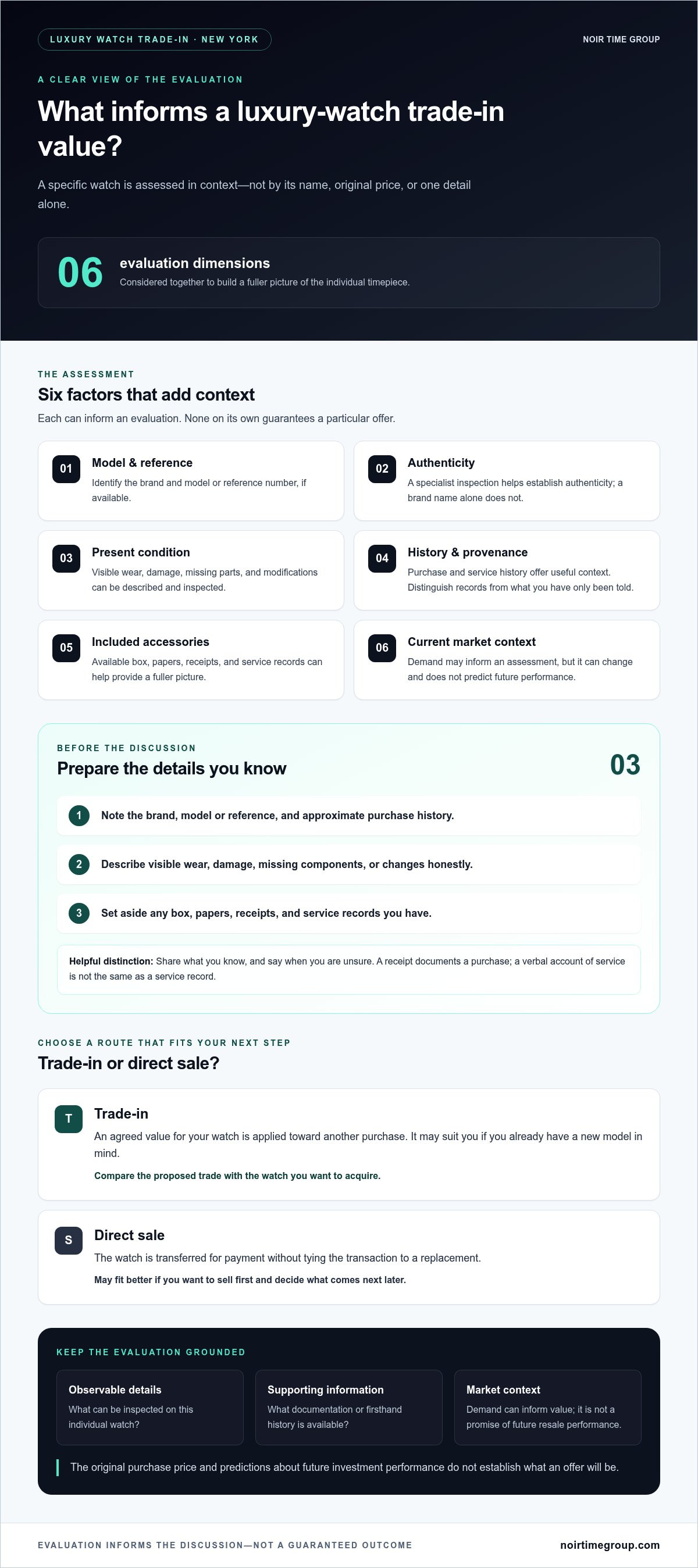
A trade-in evaluation considers the specific watch, not just its name or original retail price. Its reference, authenticity, present condition, known history, included accessories, and current market demand can all inform the assessment. Each factor adds context; none alone guarantees a particular value.
A luxury-watch evaluation considers the model, authenticity, condition, provenance, included accessories, and current market context together. Observable details, such as visible scratches or missing components, can be described and inspected. Resale demand is a separate consideration. Neither a watch’s past price nor predictions about its future investment performance establish what an offer will be.
Which watch details help an evaluation?
Before seeking an assessment, note the brand and model or reference number, approximate purchase history, and any service history you know. Be straightforward about visible wear, damage, missing parts, or modifications. Gather available paperwork and accessories, but don’t assume every item is mandatory. Sharing what you have helps provide a fuller picture.
- Record identifying details, including the reference if available.
- Describe the watch’s visible condition and any known changes.
- Set aside any box, papers, receipts, and service records you have.
Keep firsthand knowledge distinct from assumptions. A receipt may document a purchase, for example, while a verbal account of a previous service is useful context but not the same as a service record. Clear details help specialists understand what is known and what remains uncertain.
Why authentication and condition matter
Authentication is an essential part of evaluating a high-value timepiece. Noir Time Group evaluates and authenticates watches, considering the timepiece alongside the information and materials provided. Inspection helps establish authenticity and assess the watch’s current state; a prestigious brand name alone establishes neither.
Original components and documented service history can give an evaluator more context than unsupported claims about a watch’s past. If you don’t know whether a component is original, say so rather than guessing. Describe wear accurately, too. These details help create a grounded discussion, but no single condition description or brand guarantees a specific trade-in value.
Separate two questions: what can be observed about this individual watch, and how might its model be regarded in the current market? Demand may inform a valuation, but it can change. An evaluation isn’t a promise of future resale performance. A considered offer reflects the watch’s particulars and the transaction being discussed, rather than a prediction that it will appreciate.
If you’re preparing to trade in a luxury watch in New York, bring your notes and available documentation to the discussion. Noir Time Group’s watch evaluation and authentication can help establish a clear basis for considering the watch and your next step.
Trade in or sell your luxury watch in New York?
The right route depends on what you want after the transaction. A trade-in connects the evaluation of your current watch with a potential purchase from a retailer’s inventory. A direct sale is a separate option if you want to sell without selecting another watch as part of the same transaction. Neither option automatically produces a higher value. Compare the terms in light of your goal.
Use this comparison to clarify what matters most before deciding:
| Decision factor | Trade-in | Direct sale |
|---|---|---|
| Primary goal | Apply the evaluated watch’s value toward another timepiece. | Sell the watch without linking the sale to another purchase. |
| Next purchase | You’re considering a watch in inventory or exploring a desired watch through a sourcing service. | You don’t plan to acquire another watch as part of the transaction. |
| What to weigh | How the proposed trade relates to the watch you want and the overall purchase terms. | Whether the proposed sale terms and transaction convenience suit your plans. |
When a trade-in may fit an upgrade
If you already have a particular upgrade in mind, a trade can connect two decisions: the evaluation of the watch you own and the potential purchase of another. Noir Time Group applies trade-in values toward watches in its inventory, and its sourcing service offers another way to pursue a desired timepiece. Compare the proposed trade with your actual target, not with a general idea of an upgrade. Consider whether the watch being discussed suits your priorities and whether the transaction terms make sense to you.
For example, you might be moving from a familiar daily watch toward a different brand or style. Start with the kind of watch you want, then assess the trade terms alongside that specific purchase. An evaluation can inform the decision, but it doesn’t predetermine the outcome or make every trade equivalent.
When a direct sale may fit better
A direct sale may be a better match if you want to part with your watch and aren’t planning to replace it. Without a next watch to select, you can focus on the sale terms and whether handling the transaction through a luxury-watch retailer fits your preferences. Weigh convenience alongside the proposed terms rather than assuming one factor tells the whole story.
Think through what you’ll do with the proceeds and whether you want to keep your options open for a future purchase. If you’re unsure about upgrading, a direct sale keeps that decision separate. If a specific watch is already part of your plan, a trade-in may make it easier to assess your current watch in relation to that goal.
If you’re deciding whether to trade in luxury watch New York or sell directly, write down your intended outcome first. Then compare the route, proposed terms, and next step against that goal. The clearest choice is the one that fits your plans, not a blanket promise about which transaction will be worth more.
Preparing for a Luxury Watch Trade-In in New York
A little preparation can make an evaluation conversation more focused. You don’t need to determine your watch’s authenticity or estimate its value yourself. Gather accurate details, describe what you know, and decide what you want from the transaction. This gives the specialist useful context while keeping the assessment grounded in the watch and its available records.
Gather watch details and supporting records
Collect what you can and note any gaps before seeking an evaluation. Specific, factual information is more useful than guesses about originality, condition, or price. Use this checklist to organize the details you’ll share:
- Identify the watch. Record its brand and model, along with the reference number if you know it. If you’re unsure of a detail, mark it as unknown rather than trying to infer it.
- Summarize purchase history. Note approximately when and where you acquired the watch, if known. Keep any receipt or purchase documentation you still have with your records.
- Describe visible condition. Write down scratches, dents, damage, missing parts, or other changes you can see. Be specific, avoid minimizing wear, and don’t try to diagnose a problem.
- Gather service information. Include known service dates and available records. Separate documented work from details you remember but can’t verify with paperwork.
- Collect accessories and papers. Set aside the box, papers, warranty card, receipts, and other original accessories you have. They can provide helpful context, but don’t assume every item is required.
- Note questions or uncertainties. List anything you’d like the specialist to examine, such as an unfamiliar component or a detail in the watch’s history. Leave conclusions about authenticity and value to the evaluation.
Clear information helps the specialist understand what is being presented and what is documented. It also reduces the chance that an assumption is mistaken for a known fact. Noir Time Group evaluates and authenticates watches, using the timepiece and available details as a basis for the discussion.
Set a clear goal for the transaction
Decide whether you’re hoping to upgrade or sell without buying another watch. If you have a next watch in mind, note the model or the qualities that matter to you, such as brand or style. If you’re still exploring, say so. Noir Time Group’s inventory and watch sourcing service can help frame options around your preferences. An evaluated trade-in value can be considered toward a watch in its inventory.
Before you trade in luxury watch New York, keep your goal with your watch notes. That way, the conversation can address both the timepiece you’re offering and the transaction you’re considering, without assuming a particular value or outcome.
Once your details and goal are organized, explore Noir Time Group’s luxury-watch services and bring your prepared notes to a considered discussion about your watch.
Complete your New York luxury-watch trade with Noir Time Group
A considered trade starts with three clear steps: identify the watch you own, understand what an evaluation considers, and choose the transaction goal that suits you. You may want to put its value toward another timepiece or sell without making a new purchase. Knowing which outcome you prefer helps keep the conversation focused on your plans.
For collectors hoping to trade in a luxury watch in New York, an evaluation is about more than a number. It connects the watch being assessed with the decision ahead. Accurate details about the timepiece and a clear idea of what you want next give both sides a useful basis for discussing the possibilities, without assuming a particular offer or result.
What to expect from Noir Time Group’s evaluation
Noir Time Group’s team evaluates and authenticates watches for trade or direct purchase. The assessment considers the individual watch and establishes a grounded basis for discussing a potential transaction. Authentication is part of that process, while available records and identifying details can offer additional context. The evaluation informs the discussion; it doesn’t guarantee a particular value or outcome.
If you’re considering a trade, the trade-in value can be applied toward a watch in Noir Time Group’s inventory. This connects the timepiece you’re offering with a potential next purchase. Consider whether the watch you have in mind fits your goal and weigh the proposed terms accordingly. If you’re not planning to buy another watch, a direct purchase is a separate path.
Take the next step toward your next watch
Before starting, bring together the practical details you’ve gathered: the brand and reference if known, a factual description of the watch’s condition, its known purchase or service history, and any paperwork or accessories you have. Then state your preferred outcome plainly. Explain whether you want to trade toward a particular kind of timepiece or sell without choosing a replacement. You don’t need to estimate authenticity or predict value; the team’s evaluation and authentication provide a basis for the discussion.
If you have a specific watch in mind, Noir Time Group’s specialists can offer expert guidance, and the watch sourcing service provides a route for collectors pursuing a particular timepiece. Sharing your preferences can help shape a conversation around the upgrade you want, whether you’re considering inventory or seeking a sourced option. Compare the evaluation and transaction terms with your priorities before moving forward.
When you’re ready to discuss a trade or direct sale, start your luxury-watch trade or sale with Noir Time Group. Bring your watch details and preferred goal, then take the next step with a clearer understanding of the transaction you’re considering.
Make Your Next Watch Decision With Confidence
A trade can be more than a way to move on from a watch. It can help you shape a collection around how you want to wear, enjoy, or explore timepieces next. Before deciding to trade in luxury watch New York, consider what you want the next watch to add to your life, and let that priority guide the conversation.
Noir Time Group brings luxury-watch expertise to the process, with sourcing for collectors pursuing a particular timepiece and certified repair services for watch care. These services support different stages of collecting, whether you’re focused on an upgrade now or considering the longer-term direction of your collection.
Take the next step at your own pace. Explore watch trades and sales with Noir Time Group and start a conversation about your watch and what you hope to find next. A clear goal is a strong place to start.
Frequently Asked Questions
How does trading in a luxury watch work?
A trade-in starts with sharing information about your watch so a specialist can assess its authenticity and condition. For readers searching “trade in luxury watch New York,” the key distinction is that the evaluated value is considered toward another watch, rather than treated as a standalone sale. You can then decide whether the proposed transaction fits your plans. The offer and outcome depend on the individual watch and transaction.
What affects the trade-in value of a luxury watch?
A watch’s reference, condition, authenticity, provenance, accessories, and market context may all inform its evaluation. Specific details matter: a documented service record offers different evidence from a seller’s recollection, while visible wear can be inspected directly. Demand may also affect how a model is viewed, but it isn’t a promise of future appreciation. An evaluation considers the particular watch, so brand reputation or original retail price alone won’t determine its trade-in value.
Is it better to trade in a luxury watch or sell it?
Choose based on whether you want another watch as part of the transaction. A trade-in may suit you if you’re ready to apply the evaluated value toward a watch in inventory. A direct sale may fit if you want to sell without selecting a replacement. Compare the proposed terms with your goal, including whether you value a connected upgrade or prefer to keep the sale and any later purchase separate.
Can I trade in a Rolex, Patek Philippe, or Audemars Piguet?
Yes, Noir Time Group evaluates and authenticates luxury watches, including pieces from Rolex, Patek Philippe, and Audemars Piguet, for trade or direct purchase. The brand alone doesn’t establish an offer: the specific model, condition, authenticity, and available history inform the evaluation. Share the reference if you know it and be clear about any uncertainty. The assessment provides a basis for discussing the watch, not a guaranteed transaction result.
Do I need the original box and papers to trade in a watch?
Original box and papers can provide useful context, but you can share the watch details even if you don’t have every accessory or document. Bring whatever you do have, such as a warranty card, purchase receipt, or service record, and describe what’s missing accurately. Don’t try to recreate or replace paperwork with guesses. The watch is evaluated on its own details as well as any supporting materials available.
How should I prepare a luxury watch before an evaluation?
Make a short record of the brand, reference, purchase background, known service history, and visible condition. Gather available paperwork and accessories, and note any damage, missing parts, or changes you’re aware of. Keep the description factual rather than estimating authenticity or value yourself. Avoid polishing or altering the watch just to prepare it, since that can change its current state before the specialist assesses it.
Can I trade my watch toward a specific luxury watch?
You can discuss a specific target and compare it with watches in Noir Time Group’s inventory. Trade-in values can be applied toward an inventory watch. If you’re pursuing a particular timepiece, Noir Time Group’s sourcing service can help locate specific watches. Discuss that goal alongside your trade plans without assuming the trade value will automatically apply to a sourced watch. Sharing a reference, preferred features, or other priorities helps make your request clear.
