
What if the strongest offer for your watch depends as much on its story as its name? If you want to sell luxury watch Upper East Side, it’s natural to wonder how condition, reference, service history, and original paperwork will shape its value. A clear account of the watch’s provenance can help ground its evaluation and make the process feel less uncertain.
This guide explains what to gather before a sale, how authentication and an individual evaluation fit into the process, and how to choose between a direct sale and a trade-in. You’ll also learn how the box, papers, and service records can help establish a watch’s history, and why polishing it before an evaluation may not be the best move.
Noir Time Group, a New York luxury-watch retailer specializing in Rolex, Patek Philippe, and Audemars Piguet, authenticates and evaluates watches for direct purchase or trade-in. Read on for a practical path from preparing your watch and records to choosing the transaction that best suits your plans.
Key Takeaways
- Prepare the details that help tell your watch’s story, from its reference and condition to any ownership or service records.
- Understand how authenticity, condition, and provenance can shape an evaluation of your individual watch.
- Compare a direct purchase with a trade-in by considering what you want to do next with the value of your watch.
- If you plan to sell luxury watch Upper East Side, learn how a New York-based retailer can guide the process from evaluation to transaction.
- See how Noir Time Group’s authentication and evaluation support both direct purchases and trade-ins.
Selling a Luxury Watch on the Upper East Side: What to Expect
Finding a knowledgeable buyer is only part of the decision. Before you sell luxury watch Upper East Side, understand what an evaluation considers, how the watch’s identity and history are established, and whether a direct sale or trade-in better fits your plans. A considered transaction looks at the individual watch rather than relying on its name alone.
The Upper East Side is your starting point, but the selling market extends across New York City. Noir Time Group is a New York-based luxury-watch retailer specializing in Rolex, Patek Philippe, and Audemars Piguet. It authenticates and evaluates watches for both direct purchases and trade-ins. During an evaluation, you can discuss the watch’s condition, authenticity, and provenance with a retailer focused on luxury timepieces.
Luxury watches carry stories as well as technical and design characteristics. For background on the category, including the history and characteristics of luxury watches, it helps to distinguish a watch’s broader appeal from the details that matter in an individual evaluation. Collectors may value a model for its heritage or design, but an offer for a specific watch depends on its own attributes and verified background.
What makes selling a luxury watch different?
Brand and reference identify the watch; condition and originality help explain what’s being evaluated. The reference can distinguish one configuration from another, while the case, dial, bracelet, and other components describe the watch as it is today. A desirable brand can attract collector interest, but it doesn’t make every watch identical in value. Each piece needs an individual review.
Sentimental value is personal and may be a meaningful part of your decision to sell. A commercial evaluation, however, focuses on the watch and the information that supports its identity and history. Provenance means the ownership and documentation history that helps establish a watch’s background. Records can provide useful context, while authentication helps assess whether the watch is genuine.
Which transaction path fits your plans?
A direct purchase suits an owner who wants to sell without selecting another watch as part of the transaction. A trade-in may fit better if you’re planning to move into a different timepiece. Noir Time Group authenticates and evaluates watches for both routes, so the practical choice starts with your next step: are you ready to part with the watch, or do you want its value to contribute toward another one?
Before proceeding, be ready to describe your goal and share what you know about the watch. You don’t need to decide based on brand reputation alone. Understanding how the watch will be evaluated, then choosing a transaction path that matches your plans, makes the process clearer from the outset.
How a Luxury Watch Valuation Works: Authenticity, Condition, and Provenance
A useful evaluation brings together three questions: Is the watch genuine? What condition is it in? And what can be established about its history? These factors explain the individual piece beyond its brand or general reputation. Noir Time Group authenticates and evaluates watches before facilitating a direct purchase or trade-in, grounding the process in the watch presented rather than assumptions about a model.
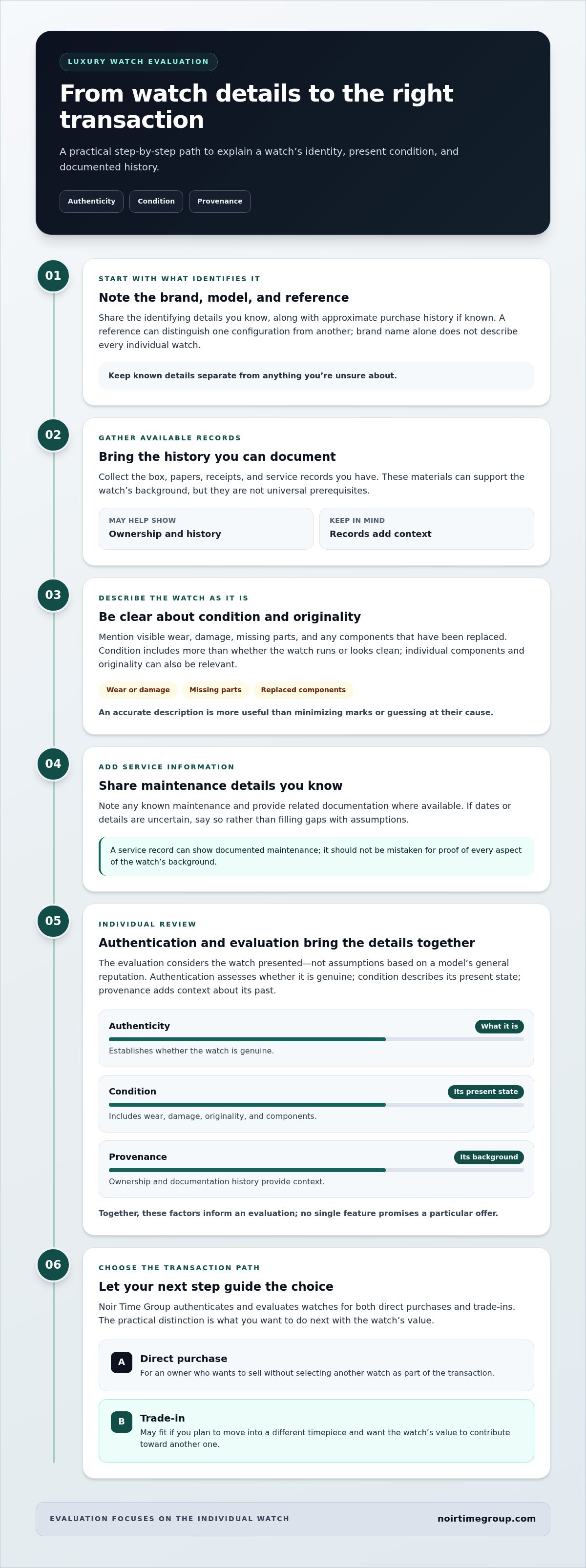
Authenticity establishes what the watch is; condition describes its present state; provenance provides context about its past. Together, these details inform an evaluation, but they don’t promise a particular offer or determine value through a single feature.
What watch details support an informed evaluation?
Start with the identifying information you know, then gather records that help fill in the picture. You don’t need every document to describe your watch accurately. Share what you have, and be clear about what you don’t know.
- Identify the watch: Note the brand, model or reference, and approximate purchase history if known. The reference helps distinguish the specific watch from other versions of a model.
- Collect available records: Bring the box, papers, receipts, and service records you have. These materials can support the watch’s history, but they aren’t universal prerequisites.
- Describe its condition: Mention visible wear, damage, missing parts, or components that have been replaced. An accurate description is more useful than minimizing marks or guessing at their cause.
- Share service information: Note any known maintenance and provide related documentation where available. If dates or details are uncertain, say so rather than filling gaps with assumptions.
This preparation gives an evaluator useful context while keeping documented facts distinct from recollection. For example, a receipt may support an approximate purchase date, while a service record can show documented maintenance. Each item helps describe the watch, but none should be mistaken for proof of every aspect of its background.
Why authentication and condition matter
Authentication is the process of establishing whether a watch is genuine. It matters because brand and reference alone don’t settle what a particular watch is; the individual piece needs to be reviewed. Noir Time Group authenticates watches as part of its evaluation for direct purchases and trade-ins, informing the transaction with a closer assessment.
Condition is more than whether a watch runs or looks clean. Visible wear, damage, originality, and the state of individual components can all be relevant to how collectors view a piece. A replacement part or alteration isn’t something to conceal; describing it helps make the evaluation more precise. Documented maintenance adds context, while an undocumented service history should simply be identified as unknown.
Provenance means the ownership and documentation history that helps establish a watch’s background. It can connect the watch to its records and support a clearer account of what is being evaluated. If you're preparing to sell luxury watch Upper East Side, gather the information you do have and let an individual review address the rest. You can explore Noir Time Group’s luxury-watch expertise as you consider the next step.
Direct Sale or Trade-In? Compare Luxury Watch Selling Options
Decide what you want the transaction to accomplish before choosing a route. If you’re ready to part with your watch and don’t plan to select another, a direct purchase may align with your goal. If you’re considering a different timepiece, a trade-in may be more relevant. Noir Time Group authenticates and evaluates watches for both options, with each watch assessed individually.
For someone planning to sell luxury watch Upper East Side, the choice isn’t simply about whether a watch is valuable. It’s about what you want to do next, and whether you want the transaction to end with a sale or connect to another collecting decision.
| Option | Purpose | Next step | Decision factor |
|---|---|---|---|
| Direct purchase | Sell a watch without choosing another one as part of the transaction. | Have the specific watch authenticated and evaluated. | You’re focused on parting with the watch or reshaping your collection. |
| Trade-in | Use the watch as part of a planned move to another timepiece. | Consider the watch being evaluated alongside your collecting plans. | You’re interested in moving into a different watch. |
When does a direct sale make sense?
A direct sale can suit an owner whose priority is to sell, not shop for a replacement. You might be simplifying a collection, moving away from a style you no longer wear, or making room for a different collecting focus. The watch still needs an individual evaluation before a transaction proceeds; brand recognition alone can’t describe its specific condition, authenticity, and background.
Think about what you want after the sale. If your goal is to reduce the number of watches you own or let one piece go without adding another, a direct purchase keeps the decision centered on the watch you’re selling. Noir Time Group evaluates and authenticates watches for direct purchase, grounding the process in the individual piece rather than a broad assumption about its category.
When might a trade-in suit a collector?
A trade-in may fit if you already have a direction for your next timepiece. Perhaps your interests have shifted, or you want to focus your collection differently. Consider both sides of the decision: what you’re ready to part with and what kind of watch you want to pursue. Your collecting goal can help clarify whether a trade-in is worth considering.
Noir Time Group evaluates and authenticates watches for trade-ins as well as direct purchases. That evaluation informs the transaction, but it doesn’t establish a guaranteed value in advance. Before choosing, be clear about your priorities and share the available information about the watch. The best route is the one that fits your plans, whether that means selling outright or putting the watch toward another timepiece.
How to Prepare Your Luxury Watch for Sale in New York
A little preparation can make a watch’s identity, history, and condition easier to discuss during an evaluation. If you plan to sell luxury watch Upper East Side, organize what you know before considering a direct sale or trade-in. You don’t need a perfect file or a polished watch; accurate details and available records are more useful than filling gaps with guesses.
Use this four-step checklist to get ready:
- Identify the watch. Write down the brand, model, and reference if you know them. Add the approximate purchase date, where it came from, and any ownership details you can recall. If you’re unsure of a reference or date, mark it as unknown rather than guessing.
- Gather available records. Set aside purchase receipts, ownership or provenance documents, and service records. Include the original box and accessories if you still have them. These materials can provide context, but no single item is a universal requirement for an evaluation.
- Describe its condition. Note visible wear, damage, missing components, or parts you know have been replaced. Include any known repairs or maintenance, even if you don’t have paperwork. Avoid polishing or modifying the watch solely to prepare it for sale; a clear account of its current state is more useful than trying to make it appear newer.
- Choose your transaction goal. Decide whether you’re primarily looking to sell outright or considering a trade-in toward another timepiece. This helps focus the conversation on the outcome that suits your plans.
Upper East Side sellers can use this preparation to make a discussion about an evaluation more focused. Keep records together, and separate documents from your own recollections. For example, distinguish a service shown on an invoice from maintenance you remember but can’t document. Both may be relevant context, but labeling them accurately avoids suggesting they carry the same evidence.
Clear documentation helps an evaluator connect the watch’s identity and history to the specific piece being reviewed. It can also make it easier to explain what’s known, what’s documented, and what remains uncertain. If a component was replaced or a repair affected the watch’s condition, disclose that plainly rather than trying to assess its effect on value yourself. Noir Time Group authenticates and evaluates watches for both direct purchases and trade-ins, considering the individual watch as part of the process.
Before the evaluation, jot down concise questions about what the review involves, how the available records will be considered, and what steps follow if you decide to proceed. Clear questions help you understand the process without assuming an outcome. Once your notes and materials are organized, share your watch details with Noir Time Group as you consider the next step.
Sell or Trade Your Watch with Noir Time Group
For collectors in New York City, Noir Time Group offers a way to explore selling or trading a luxury watch. The business specializes in Rolex, Patek Philippe, and Audemars Piguet, and evaluates and authenticates watches for both direct purchases and trade-ins. If you’re looking to sell luxury watch Upper East Side, start with the details you have, then move toward an individual evaluation and a decision about whether to proceed.
What to expect from Noir Time Group’s evaluation
The review focuses on the specific watch, not just its brand or model. Authentication helps establish whether the watch is genuine; its condition and available provenance provide further context. Share any known history and relevant records, and describe wear, repairs, or replaced components accurately. This gives the evaluation a clearer foundation, while leaving the transaction decision with you.
Noir Time Group evaluates and authenticates watches before facilitating a direct purchase or trade-in. The evaluation informs either route, but it doesn’t guarantee a particular offer or outcome. Use the discussion to understand how your watch is being considered, then decide whether a direct sale or trade-in fits your plans.
Take the next step from the Upper East Side
Getting started can be straightforward. First, share the details you know, such as the brand, model or reference, condition, and available documentation. Next, arrange an evaluation with Noir Time Group. Once you understand the assessment and transaction path, decide whether you’d like to proceed with a direct purchase or trade-in. If a detail is uncertain, say so; a clear account is more useful than a guess.
Before moving ahead, consider what you want to accomplish. If your priority is to part with the watch, a direct sale may suit your plans. If you’re looking toward another timepiece, a trade-in may be worth discussing. Expert guidance can help you understand the individual watch and available route without treating a brand name as a substitute for review.
Upper East Side collectors can explore these options through Noir Time Group, a New York-based retailer. Bring your questions and the information you’ve gathered into the conversation, then make your decision with a clearer picture of the process. Explore selling or trading your watch.
Take the Next Step with Confidence
Selling a watch doesn’t have to mean deciding everything at once. Start by choosing what you want the next chapter of your collection to look like: letting a piece go, or making room for another timepiece. That intention can guide your conversation and help you decide whether a sale or trade is the better fit.
If you’re ready to sell luxury watch Upper East Side, an expert perspective can help turn what you know about your watch into a clearer next step. Noir Time Group is a New York retailer specializing in Rolex, Patek Philippe, and Audemars Piguet, and authenticates and evaluates watches for direct purchase or trade-in. The choice to proceed remains yours.
Bring your questions and the information you’ve gathered, then explore the path that fits your plans. Explore selling or trading your luxury watch with Noir Time Group. Move forward with a better-informed decision about what comes next.
Frequently Asked Questions
Can I sell a luxury watch if I no longer have its box or papers?
Yes, you can still present the watch for evaluation without its box or papers. Share what you know about its model, purchase history, and ownership, and mention which items are missing. Don’t try to replace absent documents or infer details from memory. Noir Time Group authenticates and evaluates watches for direct purchase or trade-in, considering the individual watch and the information available.
Should I service my luxury watch before selling it?
Not automatically. A service can involve cost and changes to the watch, so consider its known condition and history before arranging work solely for a sale. Gather any service invoices you already have, and describe issues such as inaccurate timekeeping or a watch that has stopped. For a Rolex, Patek Philippe, or Audemars Piguet, an individual evaluation can help clarify what the watch needs before you decide on maintenance.
Can I sell a luxury watch that is damaged or not running?
A damaged or non-running watch can still be presented for evaluation, but its condition may affect whether a direct purchase or trade-in proceeds. Describe the problem plainly, including whether it stopped suddenly, has visible damage, or has known repair history. Avoid trying to force the watch to run or making repairs before documenting its current state. Noir Time Group’s evaluation considers the individual watch; an offer or outcome isn’t guaranteed.
Can I sell an inherited luxury watch if I do not know its full history?
Yes, you can share an inherited watch for evaluation even if its history is incomplete. Be clear about what you know, such as who it belonged to, when it came into your possession, or whether any papers were kept with it. Separate family recollections from written records. Noir Time Group authenticates and evaluates watches for direct purchase or trade-in, with available provenance contributing context rather than requiring a complete ownership story.
How long does it take to sell a luxury watch?
The timing can depend on the watch, the evaluation, and the transaction path, so there isn’t one timeframe that applies to every sale. An auction or consignment route can involve different stages from a direct purchase or trade-in. Before proceeding, clarify the steps involved and when you’ll need to make a decision.
Is a trade-in different from selling my watch outright?
Yes. An outright sale means you’re selling the watch without selecting another timepiece as part of that transaction. A trade-in is for a collector considering a move to another watch. Before choosing, think about whether your priority is to let the current piece go or redirect your collection. Noir Time Group authenticates and evaluates watches for both direct purchases and trade-ins, with the specific watch reviewed individually.
What information should I provide when selling a Rolex, Patek Philippe, or Audemars Piguet?
Provide the model or reference if known, the watch’s current condition, and any details about purchase or ownership history. Mention whether it runs, note visible damage or replaced parts, and share service records or other documents you have. If you’re unsure about a detail, say so rather than guessing. This information helps Noir Time Group evaluate and authenticate the individual watch for a potential direct purchase or trade-in.
