

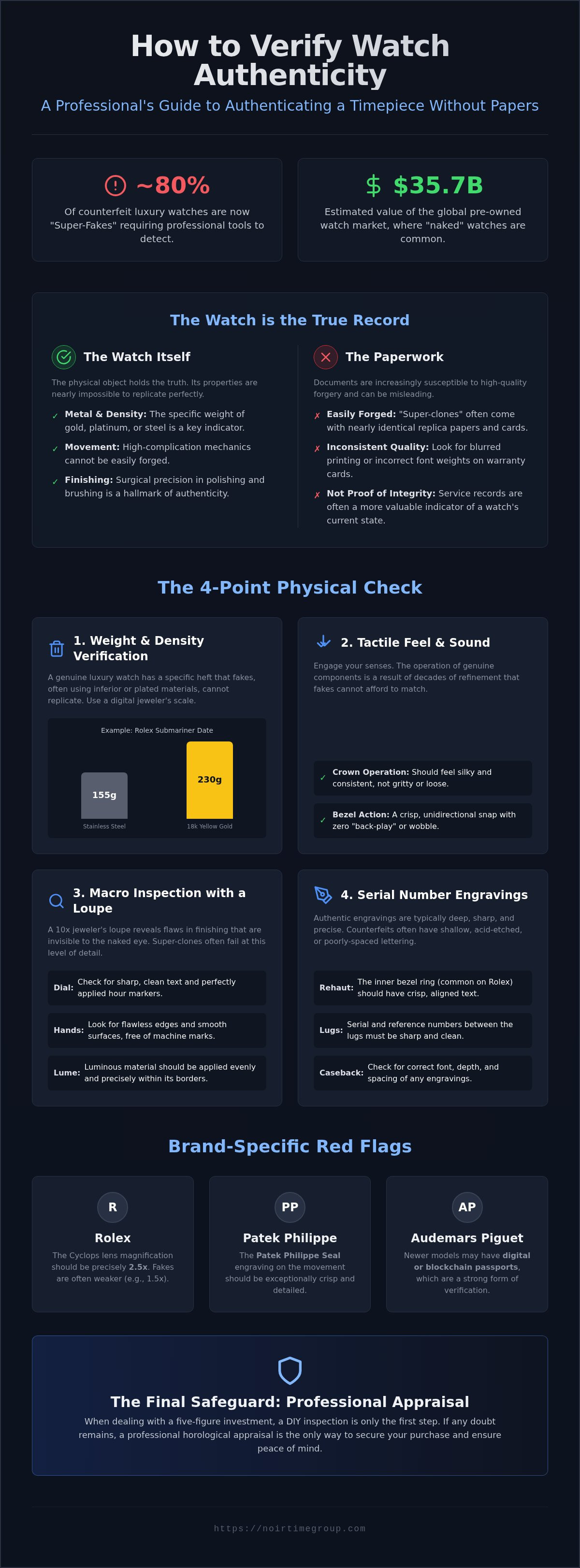
Did you know that nearly 80% of counterfeit luxury watches are now classified as "super-fakes," requiring professional tools to detect? If you're looking at a Rolex Submariner or a Patek Philippe Nautilus without its original warranty card, you're likely wondering how to verify watch authenticity without papers before risking a five-figure sum. It's a valid concern. While the global pre-owned market grew to $35.7 billion in 2026, the prevalence of high-end replicas has made the "naked" watch market a minefield for the uninitiated.
We understand the anxiety of staring at a beautiful timepiece and not knowing if the movement inside matches the dial. Paperwork can be forged more easily than a high-complication movement; the watch itself is the only immutable record of its own authenticity. This guide will help you master the expert techniques used by New York’s top horologists to authenticate luxury timepieces through physical evidence and technical inspection. You'll walk away with a reliable mental checklist for physical verification, an understanding of which brand-specific details are hardest to fake, and the confidence to know when to walk away from a deal.
Key Takeaways
- Understand why the watch itself is a more reliable record of authenticity than paperwork, which is increasingly susceptible to high-quality forgery.
- Learn the professional techniques for how to verify watch authenticity without papers, starting with a tactile 4-point check of weight, density, and movement sound.
- Identify brand-specific "tells" that super-clones often miss, such as the specific magnification of a Rolex cyclops or the precision of a Patek Philippe seal.
- Master technical forensics by inspecting the depth and method of serial number engravings found on the lugs, rehauts, and casebacks.
- Recognize the critical moment to transition from a DIY inspection to a professional horological appraisal to secure your five-figure investment.
The Reality of 'Naked' Watches: Why Papers Aren't the Final Word
In the secondary luxury market, a "naked" watch refers to a timepiece sold without its original manufacturer box or warranty paperwork. While some buyers view these items with suspicion, they represent a massive portion of the $35.7 billion pre-owned market in 2026. Watches often outlive their packaging; papers get lost during house moves, boxes deteriorate in humid attics, and estate executors frequently find the timepiece separate from its documentation. Understanding how to verify watch authenticity without papers is a fundamental skill for any serious collector looking to navigate this space safely.
Relying solely on a plastic warranty card can be a dangerous mistake. As manufacturing technology advances, the production of a Counterfeit watch has expanded to include high-quality forged documentation. Modern "super-clones" often arrive with serialized cards that look and feel identical to the real thing. This is why we advocate for a "watch-first" philosophy. The metal, the movement, and the finishing are the only immutable records of a watch's origin. In 2026, missing papers typically result in a 10% to 20% discount on models like the Rolex Submariner Date 126613LN, making them attractive for those who prioritize the engineering over the ephemera.
The Psychology of the Full Set
Collectors pay a premium for a "full set" because it implies the previous owner was meticulous. However, for those focused on the investment value, a naked watch often provides a better entry point into high-demand pieces. When you're assessing a "full set," look for inconsistencies in font weight and hologram quality on the warranty card. If the documentation feels flimsy or the printing is slightly blurred, the "full set" might actually be a red flag rather than a reassurance. For many, a naked Patek Philippe Nautilus is a more attainable way to own a masterpiece without paying the "paper premium."
Provenance vs. Authenticity
It's vital to distinguish between provenance (the history of ownership) and authenticity (the physical reality of the watch). A watch can be 100% genuine but have a murky history. Conversely, a stolen or franken-watch can have perfectly real papers. Today, certified service records from a reputable facility are often more valuable than original papers because they prove the watch's current mechanical integrity. Digital registries and blockchain-based passports, like those used for the Audemars Piguet Royal Oak, are also becoming the new gold standard for verifying history without needing physical paper. If you're unsure, our watch sourcing service can help find pieces with verifiable backgrounds.
Tactile and Visual Inspection: The 4-Point Physical Check
Once you look past the missing documentation, the physical watch becomes your primary source of truth. Authentic luxury timepieces are masterpieces of micro-engineering that fakes, even super-clones, struggle to replicate perfectly. Learning how to verify watch authenticity without papers requires you to engage your senses of touch and hearing. High-end horology isn't just about the look; it's about the weight, the sound of the escapement, and the surgical precision of the moving parts.
The "feel" of a watch often gives away a forgery before you even pick up a loupe. Genuine crowns on a Patek Philippe Nautilus or an Audemars Piguet Royal Oak should engage with a silky, consistent resistance. If the crown feels "gritty" or loose when setting the time, it's a major red flag. Similarly, a Rolex bezel should click with a crisp, unidirectional snap that has zero "backplay" or wobble. These tactile details are the result of decades of Swiss refinement that mass-produced replicas simply cannot afford to match.
Weight Verification for Precious Metals
Density is a counterfeit watch's greatest enemy. A Rolex Submariner Date 126618LN crafted in solid 18k yellow gold possesses a distinct heft that stainless steel or gold-plated lead cannot simulate. While a steel Submariner weighs approximately 155 grams, the solid gold 126618LN should tip the scales at roughly 230 grams. To perform a preliminary density check, place the watch on a digital jeweler’s scale and compare the result against the manufacturer’s official weight specifications for that exact reference. If you want to skip the guesswork, our watch sourcing service ensures every piece meets these rigorous physical benchmarks before it reaches your wrist.
Macro Inspection of the Dial and Hands
A 10x jeweler's loupe is your most important tool for visual forensics. Under magnification, the dial of a genuine luxury watch should be flawless. Check for "bleeding" where the ink meets the dial surface; authentic Rolex and Patek dials use precision printing that remains sharp even under 10x zoom. Pay close attention to the "hand stack" at the center pinion. On a genuine GMT-Master II, for example, the hands must be stacked in a specific order: hour, GMT, minute, then seconds. Many fakes use generic movements that force a different, incorrect order. Finally, inspect the sapphire crystal for its anti-reflective (AR) properties. Genuine crystals should remain clear and legible at sharp angles, whereas cheaper fakes often produce a milky, blueish glare that obscures the dial details.
The sound of the movement also provides a vital clue. Most modern luxury calibers beat at 28,800 vibrations per hour (vph), resulting in eight tiny ticks per second. This produces a smooth, sweeping motion of the seconds hand and a rapid, high-pitched "heartbeat" when held to the ear. If you hear a slow, clunky "thump-thump" typical of a 21,600 vph movement, you are likely holding a low-grade replica or a watch with a swapped movement.
Technical Forensics: Investigating Serials and Movements
If you're wondering how to verify watch authenticity without papers, you have to look where the counterfeiters hope you won't: the technical engravings and the movement architecture. While "super-clones" can mimic the external weight and dial of a Patek Philippe Nautilus, the microscopic precision of the internal components remains the ultimate safeguard. Technical forensics involves moving beyond what the eye sees to analyze how the watch was manufactured at a molecular level.
Authentic luxury brands use diamond-cut or high-pressure stamping for their serial numbers and hallmarks. These markings are deep, crisp, and feature perfectly vertical walls when viewed under a loupe. Many fakes use laser etching, which creates a shallow, "burnt" appearance with rounded edges. If the serial number looks like it was printed on the surface rather than carved into the metal, the watch is likely a forgery. This level of scrutiny is why our Certified Watch Repair team performs deep technical inspections on every "naked" piece we source.
Serial Number Placement and Consistency
Modern Rolex models produced after 2005 feature the serial number engraved on the rehaut (the inner ring between the dial and the crystal) at the 6 o'clock position. On older models, you'll find these numbers between the lugs, requiring the removal of the bracelet. A key part of how to verify watch authenticity without papers is checking for consistency across these locations. In a genuine Patek Philippe, the movement serial and the case serial are distinct but must correspond to the manufacturer’s records for that specific production year. Counterfeiters often reuse the same serial number for thousands of units; if a quick search reveals the same number on multiple forum "legit check" threads, walk away immediately.
The Movement: The Ultimate Proof
Opening the caseback is the only 100% reliable way to verify high-complication pieces like the Audemars Piguet Royal Oak. Even the best replicas often use "decoration-only" plates. These are thin pieces of metal screwed onto a cheap base movement to make it look like a proprietary caliber. You can spot these by looking for non-functional "jewels" or gears that don't move when the watch is running.
The balance wheel and hairspring are also dead giveaways. A genuine Rolex 3235 movement features a blue Parachrom hairspring, which is paramagnetic and has a very specific hue that fakes struggle to match. Furthermore, the regulation of a genuine movement is handled by "Microstella" weights on the balance wheel. If you see a standard regulator lever (a small metal arm used to adjust the speed), it's a sign of a generic ETA or Miyota movement inside a fake case. The movement doesn't lie; it's the physical signature of the watchmaker's art.
Brand-Specific Red Flags: Rolex, Patek, and AP
Once you've mastered the basics of weight and movement forensics, you must look for the microscopic "fingerprints" unique to the world's most prestigious houses. Counterfeiters often focus on the broad strokes, but they rarely perfect the proprietary manufacturing processes used by Rolex, Patek Philippe, and Audemars Piguet. Knowing how to verify watch authenticity without papers requires a deep understanding of these brand-specific nuances, from the chemical composition of lume to the mechanical "snap" of a date change.
One of the most common traps in 2026 is the "Frankenwatch." These pieces use genuine external parts, like a real Rolex dial or bezel, paired with a high-end clone movement. This makes visual-only inspections dangerous. You must evaluate the watch as a holistic system where every component, from the screws to the clasp, matches the specific reference's era and material standards.
The Rolex Submariner Checklist
When inspecting a Rolex Submariner Date 126613LN or 126618LN, start with the "instantaneous" date flip. At exactly midnight, the date should jump to the next day with a sharp, audible click. If the date begins to crawl or sits halfway between numbers at 12:05 AM, it's a fake. Pay close attention to these additional markers:
- Cyclops Magnification: The date window should magnify the numbers by exactly 2.5x. The edges of the cyclops should be sharp, and the crystal must have a clear anti-reflective coating only over the date.
- Ceramic Bezel Fill: On genuine Cerachrom bezels, the recessed numbers are PVD-coated with actual platinum or gold. This gives them a matte, metallic luster that fakes, which often use silver or gold paint, cannot replicate.
- Chromalight Lume: Modern Rolex models emit a specific, vibrant blue glow. If the lume appears green or fades within minutes, it's likely a lower-grade replica.
- Glide-lock Clasp: The adjustment should be smooth and tool-less. Any friction, sharp edges, or "tinny" sounds when sliding the clasp indicate a lack of Swiss precision.
High-Complication Authentication (AP and Patek)
The Audemars Piguet Royal Oak and Patek Philippe Nautilus are defined by their finishing. The "Tapisserie" dial on a Royal Oak is a complex 3D pattern of squares created by an engine-turning machine that leaves microscopic concentric circles within each block. This 3D depth and the way it catches the light is nearly impossible to replicate with the stamping methods used by counterfeiters. Furthermore, the eight hexagonal screws on the Royal Oak bezel must be perfectly flush with the surface and aligned so their slots follow the curve of the case.
For the Nautilus, the bracelet is the ultimate tell. Each link is hand-finished with a specific taper and a mix of brushed and polished surfaces. The clasp should close with a distinct, high-quality "snap" that requires intentional force to open. High-complication fakes often fail on functional moonphase or perpetual calendar displays; if a sub-dial is merely a "day-of-the-week" pointer disguised as a moonphase, the watch is a forgery. If you're considering a high-value acquisition, our watch sourcing service provides guaranteed peace of mind by handling these forensic checks for you.
Professional Authentication in New York: The Final Safeguard
DIY inspection is an essential first step, but it shouldn't be the last when your capital is on the line. When you're dealing with high-value pieces like the Patek Philippe Nautilus or the Audemars Piguet Royal Oak, the stakes are too high for guesswork. In the heart of the New York luxury market, professional verification has evolved into a multi-layered process that combines traditional horological skill with modern technology. Learning how to verify watch authenticity without papers usually ends at the workbench of a specialist who can perform a movement analysis that no amateur eye can replicate.
By 2026, the industry has shifted toward digital safeguards to protect the $35.7 billion pre-owned market. Many brands now utilize blockchain-based digital passports and NFC tagging to provide an immutable record of authenticity. While these tools are becoming standard for newer models, the secondary market still relies heavily on physical expertise for "naked" vintage and pre-owned pieces. Independent authenticators in New York typically charge between $150 and $300 for a formal written opinion in 2026, a small price to pay for securing a five-figure investment.
The Role of Certified Repair Centers
A certified repair center acts as the ultimate authority for undocumented timepieces. One of the most effective strategies for owners of "naked" watches is the "service paperwork loophole." When a watch is sent to a brand-authorized facility for maintenance, the resulting service receipt serves as a contemporary proxy for original papers. It confirms that the manufacturer or a certified specialist accepted the piece as genuine. This document is often more trusted by modern collectors than 20-year-old original warranty cards, which are easily forged.
At Noir Time Group, our Certified Watch Repair team in New York specializes in these deep-dive inspections. We don't just look for surface-level tells; we verify the caliber’s beat rate, amplitude, and part-by-part consistency. For our Watch Sourcing Service, this forensic approach is mandatory. We ensure that every piece, whether it’s a stainless steel Submariner or a solid gold Rolex Submariner Date 126618LN, meets the exact technical specifications of its reference before it ever reaches a client's wrist.
Securing Your Investment
Once authenticity is confirmed, documenting your asset is vital for future liquidity. You should maintain a digital file containing high-resolution macro photography of the movement, serial numbers, and any professional appraisal documents. For high-ticket items like the Audemars Piguet Royal Oak, a formal valuation from a New York specialist is often required by auction houses to prove market value. This documentation replaces the "missing" history and provides a clear provenance for the next buyer.
If you're looking to sell or trade a watch without its original documentation, we offer trade-in evaluations that provide fair market value based on physical condition rather than missing paper. This allows owners of "naked" watches to unlock the equity in their collection without the stress of private-market skepticism. Trust the experts at Noir Time Group for your next acquisition or trade to ensure your investment is protected by professional-grade verification and deep market expertise.
Secure Your Next Horological Investment
Mastering the physical and technical markers of a timepiece is the only way to navigate the secondary market safely. While papers can be forged, the surgical precision of a Rolex movement or the hand-finished links of a Patek Philippe Nautilus cannot. Understanding how to verify watch authenticity without papers empowers you to identify value where others see risk. By focusing on weight, sound, and brand-specific forensics, you turn a potential liability into a calculated acquisition.
You don't have to manage this process alone. At Noir Time Group, every timepiece in our NYC showroom is guaranteed for authenticity. We offer expert sourcing services for Rolex, Patek Philippe, and Audemars Piguet, backed by certified in-house repair and maintenance for your peace of mind. Whether you're hunting for a vintage classic or a modern icon, professional verification ensures your collection is built on a foundation of genuine engineering. Browse our curated collection of fully authenticated luxury timepieces and invest with total certainty. Your next masterpiece is waiting, and it's 100% real.
Frequently Asked Questions
Can a watch be real if it doesn’t have the original papers?
Yes, it is very common for genuine luxury timepieces to be sold without papers on the secondary market. Documentation is often lost during moves or estate transfers, but the absence of a warranty card doesn't change the watch's physical engineering. Learning how to verify watch authenticity without papers involves focusing on the movement and case finishing rather than the paperwork. A "naked" watch can be a 100% authentic piece and often represents a better value for collectors.
How much value does a Rolex lose if it doesn’t have its box and papers?
A Rolex typically loses between 10% and 20% of its market value when the original box and papers are missing. For modern models like the Rolex Submariner Date 126613LN, this discount can be substantial for buyers who don't mind a "naked" set. While collectors pay a premium for "full sets," the watch's mechanical condition and physical authenticity are the most important factors for long-term value and daily wearability.
What is a "super-clone" and can a professional tell the difference?
A "super-clone" is a high-grade counterfeit designed to mimic every visual detail of a luxury watch, including the weight and dial texture. While these replicas can fool an untrained eye, a professional watchmaker can still identify them. By opening the caseback, experts check for "decoration-only" plates and generic movement parts that lack the proprietary finishing found in a genuine Patek Philippe Nautilus or Audemars Piguet Royal Oak.
How do I check a Rolex serial number for authenticity?
To check a Rolex serial number, look at the rehaut (the inner ring) at the 6 o'clock position on modern models. For older references, you must remove the bracelet to find the number engraved between the lugs. Check that the engraving is deep and crisp rather than shallow or laser-etched. A key step in how to verify watch authenticity without papers is ensuring the serial number isn't a known duplicate used by counterfeiters.
Do Patek Philippe watches always come with a Certificate of Authenticity?
Modern Patek Philippe watches are sold with an "Origin Certificate" that includes the serial and movement numbers. If this is missing, you cannot get a replacement certificate from the manufacturer. However, for older models, you can sometimes request an "Extract from the Archives" which confirms the watch's production details. This document provides a verified history even if the original sales papers were lost decades ago.
Is it safe to buy a luxury watch from a private seller without papers?
Buying from a private seller without papers carries significant risk due to the prevalence of "super-fakes" in the $35.7 billion pre-owned market. If you choose this route, always arrange to meet at a specialist like Noir Time Group for a professional inspection. Without a certified watchmaker to verify the movement and serial consistency, you risk losing a five-figure investment on a timepiece that may have been altered or stolen.
Can I get new papers for my watch from the manufacturer?
No, luxury manufacturers like Rolex and Patek Philippe don't reissue original warranty cards or papers once they are lost. The best alternative is to send the watch for a full service at a certified center. The resulting service receipt acts as a formal record of authenticity, as these brands won't work on counterfeit pieces. This paperwork is highly respected by collectors and provides proof of mechanical integrity.
What should I look for in a professional watch appraisal service?
Look for a service that employs in-house certified watchmakers who specialize in high-complication brands like Patek Philippe and Audemars Piguet. A reputable appraisal should include a physical inspection of the movement, not just a visual check of the dial. In the New York market, choose a firm with a physical showroom and a transparent process for evaluating "naked" watches, ensuring you receive a detailed report for your records or future resale.
