

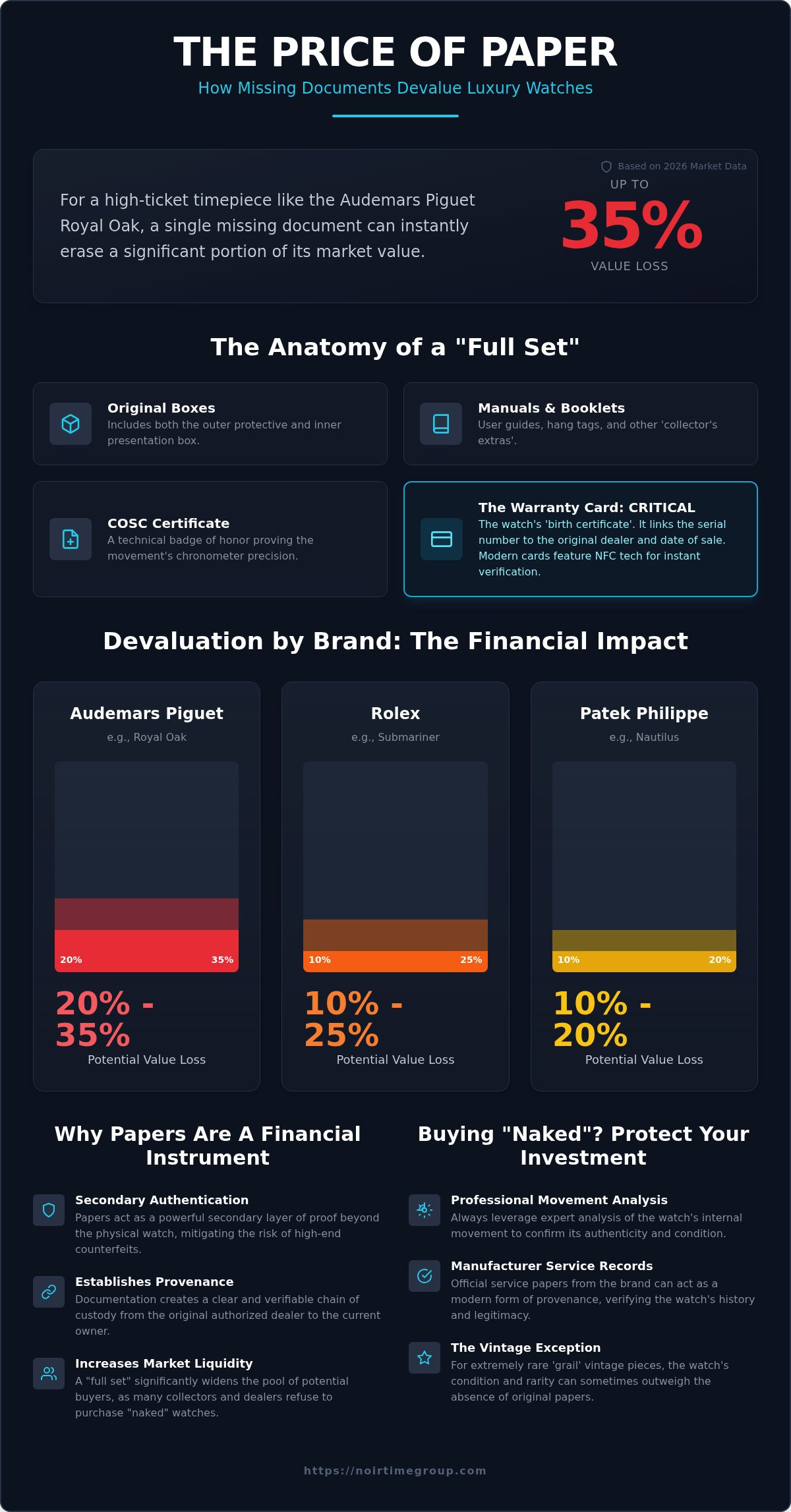
For a high-ticket Audemars Piguet Royal Oak, a missing piece of paper can effectively wipe out up to 35% of its market value in an instant. It's a staggering figure that leaves many collectors asking: does not having papers devalue a watch to the point of being a bad investment? You've likely felt that pang of anxiety while browsing the secondary market. You see a beautiful Rolex Submariner at a tempting price, but then you notice the "naked" label. It feels like a gamble; you're right to worry about whether you're buying a genuine piece or a high-end counterfeit that'll be impossible to sell later.
We understand that the logic behind a thousand-dollar piece of paper can be confusing. This guide provides a clear, percentage-based understanding of how much value a luxury watch loses without its original paperwork. You'll discover current 2026 market trends for brands like Patek Philippe and Rolex, plus the specific criteria for when it's safe to buy without a full set. We'll also look at how professional authentication and service records act as a modern form of provenance to help you navigate the market with total confidence.
Key Takeaways
- See exactly how much does not having papers devalue a watch across different luxury brands like Rolex and Patek Philippe.
- Understand the specific components of a full set and why modern NFC warranty cards are the new standard for provenance.
- Explore the rare exceptions where missing documentation matters less than you'd expect, such as with certain vintage grails.
- Identify how to safely acquire naked watches by leveraging professional movement analysis and manufacturer service records.
- Gain insights into using expert sourcing services to find complete sets for high-ticket models like the Rolex Submariner Date 126618LN.
What Does 'Box and Papers' Actually Mean in Horology?
In high-end horology, the term "full set" refers to the complete package a watch comes with from the manufacturer. This includes the outer cardboard box, the inner presentation box, the instruction manuals, and the warranty card. When collectors ask "does not having papers devalue a watch", they're often focusing on that final piece: the warranty card. It serves as the Certificate of Authenticity for the piece. Over decades, these documents evolved from large paper certificates to the modern, credit-card-sized plastic versions equipped with NFC technology. These modern cards allow retailers to scan the watch to verify its origin instantly, making them harder to forge than old-school paper slips.
Think of the warranty card as the watch's birth certificate. It records the specific serial number, the authorized dealer (AD) who sold it, and the date of sale. This information is vital. The AD stamp proves the watch was originally sold through legitimate channels, while the date dictates the remaining factory warranty. In the 2026 market, where a Rolex Submariner Date 126618LN can trade for over $42,000, these details provide the peace of mind necessary to close a deal. Collectors aren't just buying a watch; they're buying the history and legitimacy that these documents represent.
The Anatomy of Watch Documentation
- Original Warranty Card: This is the most critical document for modern Rolex and Patek Philippe models. It links the serial number on the watch case to a specific sale.
- COSC Certificates: Many brands include these to prove the movement's chronometer precision. It's a technical badge of honor for the caliber inside.
- Hang tags and booklets: Often called "collector's extras", these include green or red wax seal tags and model-specific user guides. While small, their presence signals that the previous owner was meticulous.
Why Papers Matter to the Secondary Market
Provenance is everything. In the 2026 secondary market, papers establish a clear chain of custody from the original buyer to the current seller. This documentation eases the psychological burden on a buyer during high-ticket transactions involving tens of thousands of dollars. Papers act as a secondary layer of authentication beyond the physical watch. Without them, a buyer must rely solely on the physical condition and the reputation of the seller. This is why many wonder if does not having papers devalue a watch; the answer is tied directly to the perceived risk and the difficulty of future resale. A "naked" watch requires more scrutiny, which naturally drives the price down compared to a complete set.
Quantifying the Devaluation: How Much Value is Lost?
The financial impact of missing provenance is rarely a fixed number, but the 2026 secondary market has established a clear hierarchy of devaluation. Generally, a "naked" luxury watch trades at a discount of 10% to 30% compared to its "full set" counterpart. This gap represents more than just a missing box; it is a "liquidity tax." When you decide to sell or trade your timepiece, missing papers significantly shrink your pool of potential buyers. Many collectors and professional dealers simply won't touch a high-ticket item without its original warranty card, which forces the seller to lower the price to attract those willing to take the risk. If you're looking to upgrade, this devaluation directly impacts your trade-in equity, often making the jump to a newer model more expensive than anticipated.
Devaluation by Brand: Rolex, AP, and Patek
Brand sensitivity plays a massive role in answering exactly how much does not having papers devalue a watch. For a modern Rolex Submariner Date 126613LN, the discount typically ranges from 10% to 25%. While Rolex produces a high volume of pieces, the demand for modern references with 2026-era NFC warranty cards remains intense. Patek Philippe collectors are even more discerning. A Patek Philippe Nautilus without its original certificate can see a 10% to 20% reduction in value, especially since the brand has become increasingly strict regarding "Extracts from the Archives."
Audemars Piguet sees the most dramatic impact. In the 2026 market, missing factory certificates for an Audemars Piguet Royal Oak can reduce its resale value by 20% to 35%. This is particularly notable given that steel AP models are currently trading at an average premium of 22% over retail, following a 7.5% MSRP increase in January 2026. For these high-ticket assets, the paperwork is effectively a financial instrument worth thousands of dollars.
The 'Naked' Watch Discount: A Buyer's Opportunity?
While missing papers hurt a seller, they can create a strategic entry point for a buyer who intends to keep the watch for life. If you aren't concerned with future resale liquidity, buying a vetted, naked watch allows you to allocate your budget toward a higher-tier model or a precious metal reference you might otherwise be priced out of. The ROI of buying naked makes sense when the discount exceeds the cost of a manufacturer service, which provides a modern service card that acts as a secondary form of authentication. You can explore our current inventory to compare the value propositions of both full sets and professionally vetted naked pieces. If you are hunting for a specific reference with all its original documentation, our watch sourcing service can help you locate a "grail" that meets your strict provenance requirements.
The Authentication Dilemma: Can You Trust a Watch Without Papers?
While many collectors ask does not having papers devalue a watch, a more dangerous question is whether the presence of papers proves a watch is real. In the 2026 market, the "super-clone" threat has reached a level where high-end replicas are visually indistinguishable from the real thing to the untrained eye. Paradoxically, it's often easier for a sophisticated forger to print a high-quality warranty card or forge an authorized dealer stamp than it is to replicate the intricate finishing of a Patek Philippe movement. A set of papers is just plastic and ink; the true value lies in the mechanical integrity of the timepiece itself.
Authentication requires a holistic approach that goes beyond a simple matching of serial numbers. It isn't enough to see a serial number on a card that matches the one engraved on the watch rehaut. A master watchmaker must verify that the serial number on the case matches the specific movement caliber and production era; this physical inspection is the only 100% proof of authenticity. The market's obsession with paperwork often obscures the fact that does not having papers devalue a watch less than discovering the movement is a high-end fake. For a high-ticket asset like an Audemars Piguet Royal Oak, relying solely on documentation without a movement analysis is a massive risk.
Common Forgery Tactics in Watch Documentation
Forgeries often involve blank warranty cards sourced from bankrupt dealers or high-quality replicas of modern NFC cards. Under a loupe, fake documentation often reveals inconsistent font weights, poorly aligned authorized dealer stamps, or incorrect holographic features. For older watches where original papers are lost, an "Extract from the Archives" serves as a modern alternative. This brand-issued document verifies the watch's production details based on factory records, providing a secondary form of provenance for pieces from the 1980s or 1990s without needing the original physical paperwork.
The Importance of Buying the Seller, Not the Paper
In the luxury watch world, provenance is the documented history of a timepiece's ownership and origin that establishes its legitimacy. Because papers can be faked, a reputable NYC dealer's guarantee carries more weight than a suspicious plastic card from an unverified source. At Noir Time Group, our vetting process for incoming trades involves a multi-point inspection and movement verification by our experts. We specialize in high-ticket models like the Rolex Submariner Date 126618LN, ensuring that every piece, whether "naked" or a "full set", meets the highest standards of horological integrity. Our certified watch repair and authentication services provide a safety net that papers alone cannot offer, giving you the confidence to invest in pieces like a Patek Philippe Nautilus even when the original box is missing.
When Papers Don't Matter: Exceptions to the Rule
While provenance is a primary driver of value, does not having papers devalue a watch in every single scenario? There are specific contexts where the physical condition of the timepiece or its historical rarity outweighs the presence of a plastic card. For collectors focusing on the "Daily Wearer" philosophy, purchasing a naked watch can be a brilliant financial move. If you intend to wear the piece every day and never plan to sell it, saving 10% to 25% on a modern Rolex or up to 30% on a neo-vintage model allows you to enter the market at a much lower cost basis. In these cases, the utility of the watch provides a better return than the premium paid for a box sitting in a safe.
Condition always trumps content. A mint-condition, unpolished "naked" watch is far more desirable to an experienced collector than a "full set" that has been over-polished, poorly maintained, or damaged. Collectors of high-ticket pieces like the Patek Philippe Nautilus or the Audemars Piguet Royal Oak prioritize the sharp edges of the case and the integrity of the movement over a faded warranty slip. If a watch is mechanically perfect and aesthetically superior, the market will still value it highly, even if the original owner lost the paperwork decades ago.
Vintage vs. Modern Expectations
- Modern (Post-2010): For current references like the Rolex Submariner Date 126613LN, papers are essentially mandatory for achieving top-dollar resale. The market expects these to have survived.
- Neo-Vintage: For 5-digit Rolex references from the 1990s and early 2000s, a discount of 15% to 30% is common for naked pieces. At this age, service papers often provide sufficient peace of mind for buyers.
- True Vintage: For watches from the 1970s and 1980s, original papers were rarely preserved. Rarity, the patina of the dial, and the condition of the bezel drive the price much more than a box that was likely discarded long ago.
Manufacturer Service Records as 'New Papers'
One of the most effective ways to mitigate the risk of a naked watch is through official manufacturer service records. When you send a watch to an authorized service center for a full overhaul, they issue a service receipt and, in many cases, a service card. This card validates the watch's serial number and movement caliber against the brand's internal database. It acts as a modern proxy for authenticity, effectively building a "new" provenance for a watch that lost its original birth certificate. If you own a naked timepiece and want to establish its legitimacy for future buyers, our certified watch repair service can help you facilitate the professional vetting needed to secure your investment's value.
Securing Your Investment with Noir Time Group
While the market reality is that does not having papers devalue a watch, it doesn't mean a naked timepiece is a poor investment. The key is working with a partner who understands the nuances of provenance and technical authentication. At Noir Time Group, we bridge the gap between market anxiety and collector confidence. Whether you're eyeing a Rolex Submariner Date 126613LN or a high-ticket Patek Philippe Nautilus, our role is to ensure that the physical asset matches its purported history. We provide the expert guidance you need to decide if a naked watch fits your long-term collection goals or if you should hold out for a complete set.
Our trade-in process is designed with the same level of transparency. We evaluate every timepiece based on its mechanical condition, aesthetic integrity, and the presence of documentation. If you're looking to move a piece from your collection, we provide a fair market valuation that accounts for the current 2026 premiums. We don't just look at the missing paper; we look at the caliber, the case lines, and the rarity of the reference to ensure you receive the maximum possible equity toward your next acquisition.
Our Multi-Point Authentication Process
Every watch that enters our NYC showroom undergoes a rigorous vetting process that papers alone cannot replicate. Our experts perform deep movement inspections, serial number verification, and historical database checks to confirm the watch is exactly what it claims to be. This is especially vital for Audemars Piguet Royal Oak models, where the movement's finishing is the ultimate signature of authenticity. By providing certified watch repair and professional authentication, we offer a level of after-sales care and manufacturer-backed support that far outweighs the security of a standalone warranty card. We ensure every piece meets the high standards expected in the New York luxury market before it ever reaches a client's wrist.
Sourcing and Trading High-Value Timepieces
For collectors who insist on impeccable provenance, our watch sourcing service is the ultimate tool. We leverage an extensive NYC network to track down "full set" grails that are often hidden from public listings. Whether you're hunting for a specific Rolex Submariner Date 126618LN with its original 2026 NFC card or a vintage Nautilus with archive extracts, we handle the heavy lifting of verification. We specialize in finding pieces that satisfy both the heart of a collector and the mind of an investor. You can explore our curated luxury watch inventory or start a sourcing request today to find the perfect addition to your portfolio.
Master Your Luxury Watch Investment Strategy
Navigating the secondary market requires a balance between seeking value and ensuring authenticity. While the data shows that missing documentation can significantly impact resale prices, it's clear that papers are only one part of the provenance puzzle. For collectors of high-ticket assets like the Patek Philippe Nautilus or Audemars Piguet Royal Oak, the physical integrity of the movement often speaks louder than a plastic card. Does not having papers devalue a watch? It certainly creates a pricing gap; however, a professionally vetted "naked" watch can be a strategic acquisition for those who prioritize the timepiece over the packaging.
At Noir Time Group, we specialize in bridging this gap through expert NYC-based authentication and concierge sourcing. Whether you're hunting for a "full set" Rolex Submariner Date 126618LN or trading in a beloved piece without its original box, we provide the transparency you deserve. We guarantee the authenticity of every timepiece we sell, ensuring your collection is built on a foundation of genuine horological excellence. Secure your next investment at Noir Time Group and buy with the confidence that only a master watchmaker's inspection can provide. Your next grail is waiting; make sure it's protected by the right expertise.
Frequently Asked Questions
Can I get replacement papers for my Rolex from the manufacturer?
Rolex doesn't issue replacement warranty cards. Once the original is lost, it's gone forever. However, an official service at a Rolex Service Center provides a service card that acts as a secondary form of authentication. This helps address the concern that does not having papers devalue a watch, as it proves the movement's legitimacy through official factory channels.
Is it worth buying a watch without papers if the price is low enough?
It's worth it if the discount compensates for the risk. For a daily wearer, saving 10% to 25% on a naked Rolex Submariner is a smart move. You should only proceed if you're buying from a reputable dealer who guarantees authenticity. We often hear the question, does not having papers devalue a watch? The answer is yes, but the lower entry price often outweighs that loss.
What is an 'Extract from the Archives' and does it replace original papers?
An Extract from the Archives is a document issued by brands like Patek Philippe that confirms production details based on factory records. While it verifies the serial number and sale date, it's not a legal warranty document. It serves as a valuable form of provenance for vintage pieces. It doesn't carry the same market weight as the original birth certificate, but it helps mitigate devaluation.
Do missing papers affect the cost of servicing or repairing a watch?
Missing papers don't affect the physical cost of maintenance or repair. Brands like Rolex or Patek Philippe will service a genuine watch regardless of its documentation status. However, if the watch is still within its original factory warranty period, you'll need the card to receive repairs at no cost. Without it, you'll pay standard service fees even for manufacturing defects that would've been covered.
How much does a missing box devalue a watch compared to missing papers?
A missing box has a much lower impact on value than missing papers. While a box might only represent a few hundred dollars, missing papers can trigger a 10% to 30% devaluation. Boxes are easily replaced on the secondary market. Original warranty cards are unique to the watch's serial number and impossible to replicate legally, making them the primary driver of investment security for collectors.
Why do some luxury watches come with 'open' warranty cards?
An open warranty card is one where the authorized dealer didn't fill in the buyer's name or the date of sale. While some collectors prefer this for anonymity, it can complicate the factory warranty status. Most modern manufacturers now require digital activation at the point of sale. This makes open cards less common for current references like the Rolex Submariner Date 126613LN.
Can I sell a watch to a professional dealer like Noir Time without any paperwork?
Yes, you can sell a naked watch to Noir Time Group. Our experts perform a multi-point authentication process, including movement inspection and serial verification, to establish legitimacy. We provide competitive trade-in values for high-ticket models like the Patek Philippe Nautilus even without documentation. Our physical vetting process ensures the asset's integrity, allowing us to acquire pieces that other dealers might reject due to missing provenance.
How can I verify a watch's serial number if I don't have the papers?
You can find the serial number physically engraved on the watch. For modern Rolex models, it's on the inner rehaut at the 6 o'clock position. On other pieces, it's between the lugs or on the case back. A professional watchmaker can also open the case to verify the movement serial. This ensures it matches the case production era and the brand's internal databases.
