

What if a watch that looks like a market-beating asset is actually the riskier bet? The question “is a luxury watch a better investment than stocks” has no universal answer. A handful of sought-after models have gained value, but those results don’t represent the entire market or account for the costs and friction of buying, maintaining, authenticating, and reselling a watch.
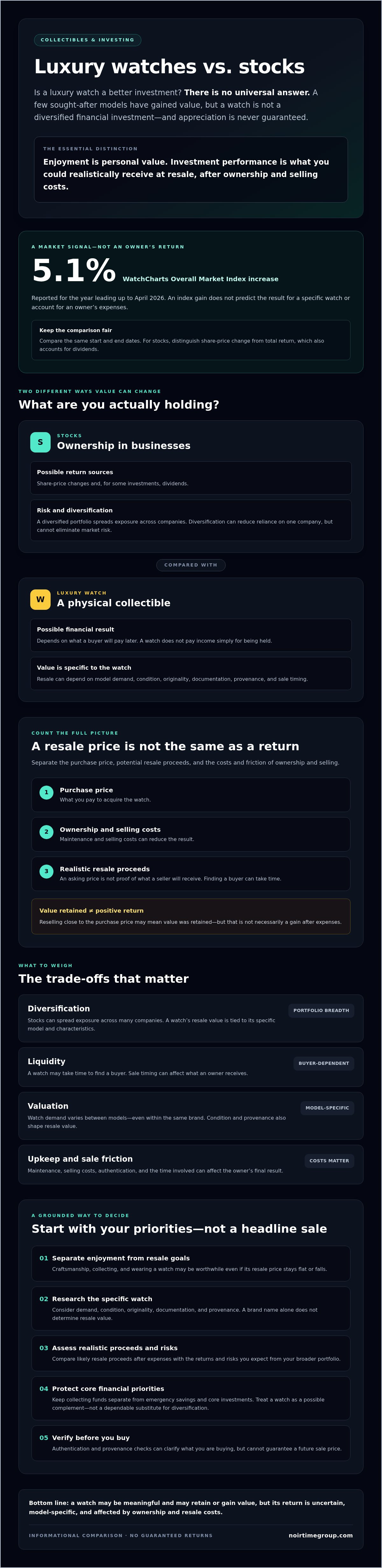
It’s easy to see the appeal. A luxury watch is tangible, enjoyable to own, and may attract lasting demand. But a diversified stock portfolio spreads exposure across many companies, while a watch’s resale value depends heavily on its specific model, condition, provenance, and sale timing. WatchCharts reported that its Overall Market Index rose 5.1% in the year leading up to April 2026. An index gain, however, is not the same as an owner’s return after expenses.
This comparison looks at potential returns, volatility, liquidity, and ownership costs to show where watches may fit alongside stocks. You’ll also learn why resale pricing and authenticity matter, and how to assess a watch as a possible complement to a financial plan, not a dependable substitute for diversification.
Key Takeaways
- Decide whether you’re buying for enjoyment or potential resale, and keep those goals distinct when judging a watch’s value.
- To assess whether is a luxury watch a better investment than stocks for your situation, compare realistic resale proceeds with the returns and risks you expect from your broader portfolio.
- Compare liquidity, diversification, valuation, and upkeep to identify the trade-offs that matter for your goals and time horizon.
- Before considering a purchase, review your financial priorities and keep collecting funds separate from emergency savings and core investments.
- When evaluating a specific watch, consider how condition and provenance affect resale, and learn what expert sourcing and authentication can help clarify.
Is a Luxury Watch an Investment, or First and Foremost a Collectible?
A watch can be personally meaningful and financially valuable, but those are different measures of worth. Enjoyment, craftsmanship, status, and the pleasure of collecting may make a purchase worthwhile even if its resale price stays flat or falls. For a financial assessment, focus on what you could realistically receive when selling, minus the purchase price and the costs of owning and selling it.
A luxury watch is a collectible that may retain or gain value, but it isn’t a diversified financial investment, and appreciation isn’t guaranteed. That distinction matters when asking, “is a luxury watch a better investment than stocks?” A watch may hold its value without generating income, and a rise in market prices doesn’t automatically translate into a profit for every owner.
What does it mean for a luxury watch to be an investment?
Separate three figures: the purchase price, potential resale proceeds, and total return after ownership expenses. Maintenance, selling costs, and the time it takes to find a buyer can all affect the result. A watch that resells for close to its purchase price may have retained value, but that isn’t the same as earning a positive return after expenses.
Stocks represent ownership in businesses and may produce returns through changes in share prices and, for some investments, dividends. A watch is a physical object that doesn’t pay its owner income simply for being held. Its market value can shift with demand, condition, and buyer interest. If you enjoy wearing it, that personal benefit is real, but it shouldn’t be mistaken for financial performance.
Why do some luxury watches attract investor attention?
Collectors may pay close attention to scarcity, condition, provenance, brand demand, and interest in a particular model. Rolex, Patek Philippe, and Audemars Piguet are prominent names in the luxury-watch market, but a brand alone doesn’t determine resale value. Demand can vary substantially between individual watches, even within the same brand.
That’s why a headline-making auction result isn’t a reliable forecast for an ordinary purchase. A highly sought-after example may have unusual provenance, rarity, or collector appeal that another watch doesn’t share. The broader category of collectable items includes objects whose appeal and possible investment value depend on demand, but that potential also comes with uncertainty. Treat striking sales as individual outcomes, not proof that every watch will appreciate.
If you’re considering a watch with resale in mind, verify its authenticity and provenance, examine its condition, and research interest in that specific model. These checks can clarify what you’re buying, but they can’t guarantee a future sale price.
How Do Luxury Watches and Stocks Generate, or Lose, Value?
Stocks and watches have different routes to a possible return. A stock represents partial ownership in a business, so its price may rise or fall as expectations about that company and the wider market change. Some stocks also pay dividends. A luxury watch is a physical collectible with no built-in income stream; its financial result depends on what a buyer will pay for it later.
How stock-market returns are measured
A share-price change shows only one part of a stock investment’s performance. Total return also accounts for dividends, including dividends reinvested where applicable. To compare results fairly, use the same start and end dates and check whether the figures represent price return or total return. Diversification spreads money across different investments, which can reduce reliance on one company, but it can’t eliminate market risk. The SEC’s guide to traditional investment principles explains how risk and diversification factor into investing. Past performance isn’t a promise of future results.
How a watch’s resale value is determined
Watch resale depends on factors that can vary from one example to another: demand for its model, condition, originality, documentation, provenance, and sale timing. A popular model may attract buyers, but demand can shift, and an asking price isn’t proof of what a seller will receive. WatchCharts’ Overall Market Index rose 5.1% in the year leading up to April 2026, according to the market data cited here. That index-level movement doesn’t predict the result for a specific watch or include an owner’s expenses.
Realized watch returns depend on resale proceeds minus the acquisition price and ownership costs, including servicing and authentication where needed, as well as transaction friction. The difference between a quoted market value and cash received can matter: finding a buyer, documenting condition, and completing a sale may take time and involve costs. Stocks also have investment-related costs and risks, but they’re generally easier to trade through financial markets than a physical collectible.
So, is a luxury watch a better investment than stocks? The answer depends on the specific asset, the period measured, and the return after costs. A watch’s appeal may combine financial potential with the pleasure of ownership, while stocks are valued through business performance and market pricing. If you’re evaluating an individual piece, Noir Time Group’s watch sourcing service and verified-provenance inventory may help you review the watch and its documentation before deciding.
Luxury Watches vs. Stocks: Which Trade-Offs Matter Most?
Neither asset is automatically the right choice for everyone. Stocks can offer easier access to markets and exposure to multiple businesses, while a watch combines potential resale value with ownership of a tangible object. To decide whether is a luxury watch a better investment than stocks for your circumstances, compare the practical trade-offs, not just a headline return.
| Factor | Luxury watch | Stocks |
|---|---|---|
| Liquidity | Selling may involve finding a buyer, authenticating the piece, and negotiating. Timing and proceeds can vary. | Exchange-traded shares can generally be bought or sold through a brokerage during market hours, subject to market conditions. |
| Diversification | One watch concentrates value in a single physical item and its specific market demand. | A portfolio can hold shares across companies or funds, but diversification depends on holdings and investor choices. |
| Valuation | Model, condition, originality, provenance, and current buyer interest influence resale value. | Share prices change with company prospects, investor expectations, and broader market forces. |
| Upkeep | Servicing, storage, and possible insurance are ownership considerations. | Investment costs may include brokerage or fund fees, depending on the account and investments. |
| Access | Requires acquiring a specific watch and later arranging a sale if you want to convert it to cash. | Access depends on the investment account, trading rules, and market availability. |
| Personal enjoyment | Can be worn and appreciated as craftsmanship or a collectible. | Typically offers financial exposure rather than the experience of owning a physical object. |
Liquidity, diversification, and access to your money
A listed stock’s market price is visible, and trades can generally be placed through a brokerage, though the price may move before an order is completed. Selling a watch is less standardized. You may need to establish its authenticity and condition, locate an interested buyer, and negotiate terms. If you need cash by a specific date, that difference matters.
A single watch also ties your outcome to one item. Stocks can spread exposure across businesses, but owning several shares doesn’t necessarily create a diversified portfolio. Your holdings, fees, and investment choices all count.
Costs, condition, and comparing returns
Don’t compare a watch’s purchase-to-resale price change with a stock’s total return and call the results like-for-like. Use matching dates and account for dividends where applicable, along with watch servicing, sale friction, and any relevant storage or insurance costs. There’s no universal ownership-cost estimate that fits every watch or investor.
A famous brand isn’t a guarantee of strong resale demand. Interest can differ sharply between models, and condition or documentation can affect a specific watch’s appeal. The better choice depends on your goals, time horizon, liquidity needs, and how much you value personal enjoyment alongside possible financial returns.
How to Decide Whether a Luxury Watch Fits Your Financial Priorities
Before comparing a watch with stocks, check whether buying it fits your financial plan even if its resale value doesn’t rise. This checklist can help you separate a collectible purchase from a decision you’re relying on to meet financial goals.
- Start with your goals, liquidity needs, and time horizon. Identify what the money is meant to do, when you might need it, and whether you could wait to sell. A watch may take time to resell, and the eventual price is uncertain.
- Protect your financial foundation. Keep emergency savings and core investments separate from discretionary collecting funds. Don’t rely on a future watch sale to cover expenses or a near-term financial goal.
- Ask whether you’d still want the watch if its value fell or stayed flat. If the purchase only makes sense with appreciation, consider whether that risk suits your circumstances and tolerance for loss.
- Research the exact model, not just the brand. Look for evidence of buyer interest in that specific reference and consider how demand, condition, and sale timing could affect resale. A well-known name alone doesn’t establish that every model is sought after.
- Check the individual watch carefully. Review authenticity, condition, originality, documentation, and provenance. Understand what records are included and whether any service history can be verified.
- Compare like with like. Choose the same measurement period for the watch and stock comparison. Account for purchase and resale friction, ownership expenses, and relevant taxes. Tax treatment depends on individual circumstances, so confirm it with a qualified tax professional rather than assuming a particular outcome.
- Consider your broader portfolio and risk comfort. A single watch concentrates exposure in one item, while stock diversification depends on what you own and how it’s allocated. Decide whether uncertain resale timing and a less diversified holding fit your needs.
For personalized investment or tax advice, consult a qualified financial or tax professional. A watch retailer can help with product-specific due diligence, such as reviewing a piece’s provenance, condition, or sourcing options, but can’t determine whether it belongs in your financial plan.
If you’re assessing a specific watch, explore Noir Time Group’s watch sourcing service as one way to seek product guidance and evaluate the details of a potential purchase. That can inform your research, but it can’t guarantee resale demand or a future return.
Where Noir Time Group Fits: Expert Watch Guidance Without Return Promises
Choosing a watch with possible resale in mind calls for product due diligence, not a promise about future value. Noir Time Group is a New York luxury-watch retailer specializing in Rolex, Patek Philippe, and Audemars Piguet. Its curated pre-owned inventory includes watches with verified provenance, and its sourcing service can help customers seek a requested model beyond what’s publicly listed. These services can support an informed purchase, but they can’t predict resale demand or investment performance.
How expert sourcing and authentication support informed ownership
For a specific watch, ask what is known about its origin and what documentation accompanies it. Review its condition and any available service history, and clarify what authenticity verification covers. Noir Time Group guarantees the authenticity of its timepieces, but buyers should confirm the current terms and scope for the particular watch they’re considering.
It’s also sensible to ask whether a manufacturer-backed warranty applies, what its terms are, and whether the watch’s records support its history. Certified repair services may help with ownership needs, but maintenance doesn’t assure a higher resale price. Provenance and authentication can help establish what a watch is; they don’t guarantee what a future buyer will pay.
Choosing a watch for enjoyment as well as financial awareness
Start with fit, design, craftsmanship, and genuine collecting interest. Rolex, Patek Philippe, and Audemars Piguet offer distinct options, but a brand name alone doesn’t make every model a suitable purchase or a strong resale prospect. Consider whether you’d still be happy owning the watch if its value remained unchanged or declined.
The question “is a luxury watch a better investment than stocks” is best answered in light of your wider financial goals, not by a retailer. Noir Time Group can offer watch-specific guidance on sourcing and product details, but it isn’t a financial adviser and can’t promise returns. Before deciding, compare the specific watch’s documentation, condition, and purchase terms with your own priorities.
If you have a particular watch in mind, contact the Noir Time Group team to discuss the model, its condition, available documentation, and sourcing options. Treat that conversation as part of your product research, then make the financial decision based on your needs and risk tolerance.
Make Your Next Watch Decision With Clear Priorities
So, is a luxury watch a better investment than stocks? There’s no universal winner. Stocks offer exposure to businesses and can be diversified, while a watch is a tangible collectible whose resale depends on the specific piece, its condition, and buyer demand. Compare realistic net outcomes over the same period, and don’t rely on appreciation to meet essential financial goals.
A watch may still be a rewarding purchase if you value wearing and collecting it, and can afford to hold it without needing quick access to the money. Treat potential resale value as uncertain, and review the watch’s provenance, documentation, condition, and ownership needs before buying.
Noir Time Group offers curated new and pre-owned watches with verified provenance, a watch sourcing service, expert guidance, and certified repair services. These can support product research and ownership, but they don’t promise investment performance. Explore the curated watch selection or ask the team about sourcing a specific timepiece, and take your time choosing a watch that fits both your interests and financial priorities.
Frequently Asked Questions
Is a luxury watch a better investment than stocks?
No, a luxury watch isn’t universally a better investment than stocks. The outcome depends on the specific watch, purchase terms, resale demand, ownership costs, and your goals. Stocks can provide diversified exposure to businesses and may generate dividends, but they carry market risk. Consider a watch primarily as a collectible unless you’ve assessed its potential net resale value and can accept uncertainty and limited liquidity.
Can a luxury watch outperform the stock market?
Yes, an individual luxury watch can outperform a stock-market benchmark over a chosen period, but that result isn’t assured or repeatable. Performance depends on the particular model, buying price, condition, sale timing, and costs. Compare the watch’s net resale proceeds with a stock investment’s total return over matching dates, including dividends where applicable. A standout resale or auction result alone doesn’t predict what another watch will earn.
Do luxury watches hold their value over time?
Some luxury watches may retain value, but none should be assumed to hold its purchase price indefinitely. Resale depends on buyer demand for the exact model, condition, originality, documentation, provenance, and market timing. Ownership expenses and selling friction can also reduce what you receive. Even if a watch sells for close to its original purchase price, that doesn’t necessarily mean you made a profit after costs.
Which factors affect a luxury watch's resale value?
Resale value can be influenced by the model’s demand, condition, originality, authenticity, documentation, provenance, and timing. Service history may help buyers understand the watch’s maintenance, while missing records or condition issues can affect interest. Brand recognition alone isn’t enough: demand can vary between models from the same manufacturer. The eventual sale price also depends on the buyer, transaction terms, and costs associated with selling.
How do you compare watch investment returns with stock returns?
Use the same start and end dates, then compare net outcomes rather than isolated price changes. For a watch, subtract the purchase price and relevant ownership and selling costs from resale proceeds. For stocks, distinguish share-price change from total return, which may include dividends and their reinvestment. Account for relevant taxes based on your circumstances, and remember that past performance doesn’t predict future results.
Are luxury watches easy to sell when you need cash?
Not always. A watch sale may require confirming authenticity and condition, finding an interested buyer, and agreeing on a price. The process and timing can vary by model and demand, so the amount you receive may differ from an advertised asking price. If you may need the money soon, don’t rely on a quick sale or a particular resale value to meet essential expenses.
Should I buy a luxury watch as an investment or for enjoyment?
Buy primarily for enjoyment if you value the watch’s design, craftsmanship, or place in your collection, and can afford it without relying on appreciation. Before purchasing, consider whether you’d still be comfortable owning it if its resale value fell or stayed flat. Keep discretionary collecting funds separate from emergency savings and core investments, and seek qualified financial advice for decisions about your portfolio.
