

A famous name alone won’t tell you whether a watch will hold its value. The specific model, configuration, condition, and documentation matter too, so the watches that hold their value the best 2026 buyers consider aren’t guaranteed to deliver the same resale outcome.
Luxury-watch value can be difficult to judge, and even sought-after names such as Rolex, Patek Philippe, and Audemars Piguet aren’t automatic investments. Missing papers, heavy polishing, or incomplete service records may affect future buyer interest. A sensible comparison starts with the exact watch, not a brand-wide reputation.
This guide explains how to assess value retention without treating appreciation as a promise. You’ll learn what to compare across models, including the Rolex Submariner Date, Patek Philippe Nautilus, and Audemars Piguet Royal Oak, and which ownership details can support a more informed resale decision. Use the checks below to compare condition, provenance, and current market evidence, then choose with realistic expectations about ownership.
Key Takeaways
- Judge potential resale interest using evidence for the exact reference and configuration, not brand reputation alone.
- Compare market demand, condition, provenance, and how well the watch suits your needs.
- Value retention can change with market conditions, so treat 2026 comparisons as a snapshot rather than a forecast.
- Set your style, intended use, and ownership horizon before browsing to keep the decision grounded in your priorities.
- A sourcing service can help locate a requested configuration, but it can’t guarantee availability or future resale value.
What Makes a Watch Hold Its Value in 2026?
Value retention describes how a watch’s resale value compares with its original purchase price. It doesn’t necessarily mean a profit: the purchase context and costs associated with selling can affect what an owner ultimately recovers. Nor is value retention guaranteed. Buyer interest can rise or fall even when a watch’s craftsmanship and condition remain unchanged.
Resale appeal is only one part of ownership. A finely made watch can be rewarding to wear and admire without being in high demand on the secondary market. For example, a mechanical watch contains intricate components that reflect skilled engineering, but complexity alone can’t tell you what future buyers will want.
Brand reputation can attract attention, but the specific reference, configuration, condition, and market timing help determine whether that interest supports resale value.
Does a luxury watch always retain its value?
No. Demand changes, and established luxury brands are no exception. Value retention compares resale demand and potential proceeds with the original purchase context. Appreciation means a watch’s value rises beyond that starting point. Neither outcome is assured. Before buying, identify the exact reference and configuration, then consider when and under what circumstances you’re purchasing. A broad brand reputation can’t replace evidence about the specific watch.
Which factors shape a watch’s resale appeal?
Start with demand for the model, then assess the details that distinguish one example from another. Configuration affects which buyers may be interested, while condition and documented provenance help them evaluate the watch. Wear, previous repairs, and available ownership or service records may all be relevant.
Supply and buyer preferences can shift over time. A design that draws attention now may not remain equally sought after, and scarcity alone doesn’t establish lasting demand. When researching the watches that hold their value the best 2026 buyers are considering, look for recent evidence tied to the exact reference and configuration rather than relying on general rankings or old resale anecdotes. Compare like with like, and remember that personal enjoyment is a valid reason to buy even when resale is uncertain.
How to Evaluate a Watch’s Value-Retention Potential
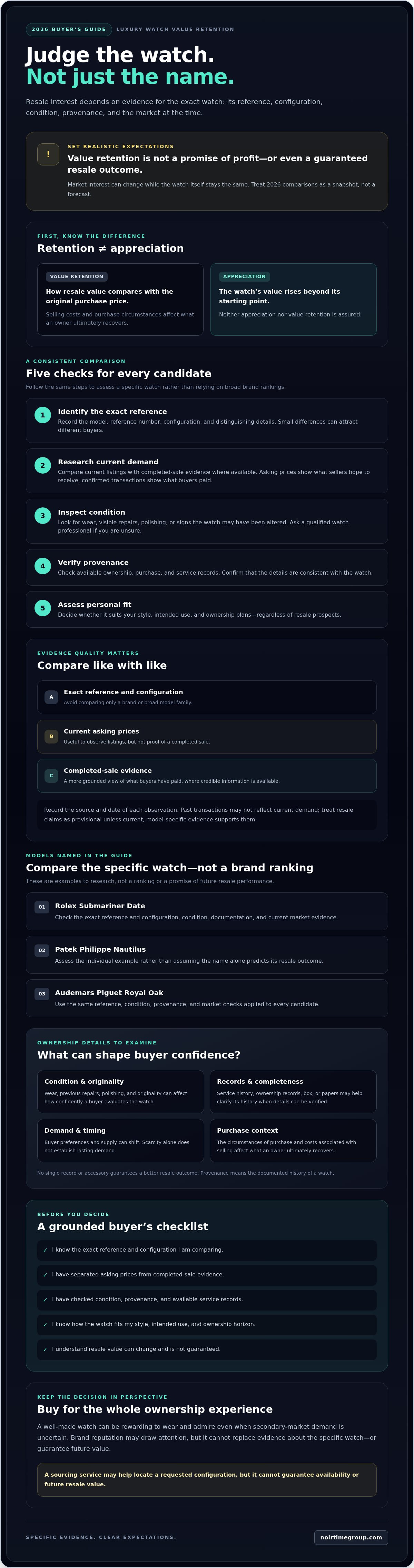
Use the same checks for every candidate so the comparison is consistent. This five-step framework helps you move beyond broad brand rankings and assess the evidence for a particular watch.
- 1. Identify the exact reference. Record the model, reference number, configuration, and any distinguishing details. Small differences can mean you’re comparing watches that appeal to different buyers.
- 2. Research demand. Review current listings alongside completed-sale evidence where available. Asking prices show what sellers hope to receive; confirmed transactions provide a more grounded view of what buyers have paid.
- 3. Inspect condition. Look for wear, visible repairs, and signs that the watch may have been altered. If you’re unsure, ask a qualified watch professional to assess it before purchase.
- 4. Verify provenance. Check which ownership, service, and purchase records are available, and whether their details are consistent with the watch.
- 5. Assess fit. Consider whether the watch suits your style, intended use, and ownership plans, regardless of its resale prospects.
How should buyers research a specific reference?
Search for the exact reference and configuration, not just the brand or model family. Compare several current listings, then look for completed-sale information from credible sources where available. Record the date and source of each observation. An asking price isn’t proof of a sale, and a past transaction may not reflect current demand. Treat 2026 resale claims as provisional unless current, model-specific evidence supports them.
Why do condition and documentation matter?
Visible wear, previous servicing, and originality can affect how confidently a buyer evaluates a watch. Records may help clarify its history, while a box or papers can support the overall documentation. No single item guarantees a better resale outcome. Provenance is the documented history of a watch, and checking it helps buyers assess what they’re purchasing with greater confidence.
Completeness matters most when the details can be verified and match the watch. Ask what records are included, whether service history is documented, and what an inspection can establish. If you’re comparing candidates or looking for a particular configuration, explore watch sourcing options as one way to seek a suitable example, without treating sourcing as a promise of availability or future value.
Rolex, Patek Philippe, or Audemars Piguet: How to Compare Models
The Rolex Submariner, Patek Philippe Nautilus, and Audemars Piguet Royal Oak are useful research candidates, not a definitive ranking or investment recommendation. Each family includes variations, and a reputation attached to the name doesn’t establish how a particular reference is performing. Compare the exact watch you’re considering, then weigh the evidence against your own preferences.
| Brand | Confirmed model family | Configuration to compare | Demand evidence to check | Potential buyer fit |
|---|---|---|---|---|
| Rolex | Submariner | Compare the exact reference and its configuration, including the Submariner Date references 126613LN and 126618LN. | Current listings and completed sales for the same reference and configuration, with dates and sources. | Consider whether the watch suits your intended use, style, and ownership plans. |
| Patek Philippe | Nautilus | Identify the reference and specific configuration rather than treating the family as one uniform offering. | Seek recent, comparable evidence for that reference and note whether figures are asking prices or confirmed sales. | Assess whether its design and ownership characteristics appeal to you beyond resale interest. |
| Audemars Piguet | Royal Oak | Compare like-for-like references and configurations; don’t assume the whole family performs alike. | Check current evidence for the specific model and configuration, and record when it was observed. | Choose based on personal taste, intended wear, and the time you expect to own it. |
What should buyers compare between these watch families?
Compare design, materials, configuration, and intended use alongside market evidence. A watch that fits your daily life may be a better choice for you than one that gets more attention but doesn’t suit your preferences. Availability and demand can change, so verify both while researching. For the watches that hold their value the best 2026 buyers are comparing, current evidence for the specific model matters more than generalized brand rankings.
Is a popular model automatically the better choice?
No. Popularity can indicate buyer interest, but it can’t predict future resale performance. A current listing may reflect the seller’s expectations rather than a completed transaction, and even comparable sale evidence can’t guarantee what a future buyer will pay. Consider demand alongside condition, documentation, purchase context, and how well the watch fits your ownership plans. Use comparisons to make a more informed choice, not as a promise of appreciation.
A Practical Checklist Before Buying a Value-Retention Watch
Decide what you want from ownership before browsing. Write down your preferred style, how you expect to wear the watch, and how long you may keep it. These priorities help you compare candidates on more than resale interest. Even among the watches that hold their value the best 2026 buyers are considering, the right choice depends on the individual watch and your plans for it.
What should you verify before completing a purchase?
Ask for the exact reference and configuration, then check that the watch matches its documentation. Review its condition, service information, and available ownership records, and consult an appropriate watch professional if needed. Ask the seller what authenticity assurance and after-sales support they provide, then clarify what those statements cover before buying.
- Set your priorities: note preferred design, intended use, and likely ownership horizon.
- Confirm identity: match the reference and configuration against reliable documentation.
- Assess condition: examine wear and ask a qualified professional to inspect the watch if needed.
- Review records: check available provenance and service information, and ask questions about gaps.
- Check market evidence: compare current, like-for-like listings and completed-sale data where available. Record the date and source, and remember that asking prices aren’t confirmed transactions.
For a useful market snapshot, note the date, source, exact reference, and condition of each comparable. A broad ranking without those details may tell you little about the watch in front of you.
How can buyers avoid value-retention misconceptions?
Resale value is uncertain, not a guaranteed financial outcome. Demand may shift, and a watch’s condition or purchase context can change how it compares with similar examples. Treat predictions cautiously, especially when they don’t identify the reference, configuration, evidence, or date behind the claim. Buy a watch you’ll be comfortable owning even if the market changes.
Essential checks include the watch’s identity, authenticity, condition, and available records. Optional accessories may complete the set, but they can’t replace sound checks or guarantee resale. Noir Time Group states that its timepieces are guaranteed authentic. To discuss a specific model or configuration, contact Noir Time Group and ask about its watch-sourcing service.
Finding and Caring for the Right Watch with Noir Time Group
Choosing among sought-after watches involves more than comparing brand names. Noir Time Group is a New York luxury-watch retailer offering Rolex, Patek Philippe, and Audemars Piguet watches, including Rolex Submariner Date, Patek Philippe Nautilus, and Audemars Piguet Royal Oak models. Its range gives buyers examples to consider, but check availability and resale demand for the specific watch rather than assuming either from its name.
When can a watch-sourcing service help?
If you have a particular reference in mind or are looking for a hard-to-find timepiece, a sourcing service may help you seek a suitable option. Be specific about what you want before starting the conversation. Sharing the preferred model and configuration, along with your condition priorities, can help focus the search.
Sourcing doesn’t promise that a watch will be available or meet every preference. It also doesn’t guarantee a particular price or resale performance. When researching the watches that hold their value the best 2026 buyers are considering, treat sourcing as a way to look for a fitting candidate, not a forecast of what it may be worth later.
How does after-sales care support ownership?
Good ownership decisions don’t end at purchase. Noir Time Group states that its timepieces are guaranteed authentic and offers trade or sale assistance, as well as certified watch repair. These services may be relevant as you consider a watch’s documented history and ongoing care. Ask what a repair service includes and confirm any service or warranty details directly before relying on them.
Whether you’re considering a specific Rolex Submariner Date, a Nautilus, or a Royal Oak, explain what matters most to you: the reference, configuration, condition, and intended use. That helps keep the discussion focused without treating resale appeal as a certainty.
Explore watches and sourcing with Noir Time Group or get in touch to discuss a specific watch or sourcing request.
Choose with Confidence, Not a Promise of Returns
The watches that hold their value the best 2026 buyers consider aren’t defined by brand name alone. Focus on evidence for the exact reference and configuration, then weigh condition, provenance, and current demand. Just as important, choose a watch that suits your style and ownership plans, since resale outcomes can change.
Noir Time Group states that its watches are guaranteed authentic and offers sourcing, trade or sale assistance, and certified watch repairs. These services can help you explore a specific timepiece and consider its ownership history, but they can’t guarantee availability or future value.
Explore watches or request help sourcing a specific timepiece. With careful research and realistic expectations, you can make a considered choice and enjoy the watch for what it is, not only what it might be worth later.
Frequently Asked Questions
Which watches hold their value best in 2026?
No single watch is a guaranteed value-retention leader for every buyer. Rolex Submariner, Patek Philippe Nautilus, and Audemars Piguet Royal Oak models are often considered by people researching the watches that hold their value the best 2026, but each family includes different references and configurations. Compare recent evidence for the exact watch, including completed sales where available, and consider its condition, documentation, and purchase context.
Do Rolex watches hold their value?
Some Rolex models attract strong resale interest, but the brand name alone can’t predict what a particular watch will be worth later. Demand can differ by reference, configuration, condition, and market timing. For a specific Rolex, compare current listings with completed-sale evidence where possible, and note when you gathered the information. Treat any resale estimate as an informed snapshot, not a promise of what you’ll recover.
Can a luxury watch increase in value?
Yes, a luxury watch can increase in value, but appreciation isn’t assured. The resale market may shift with buyer preferences, supply, and broader conditions. An increase in a quoted asking price doesn’t prove that a watch sold for that amount. If you’re weighing potential resale against enjoyment, consider how long you expect to own it and whether you’d still be happy with the purchase if its market value changed.
What matters most when buying a watch for resale value?
Start with the exact reference and configuration, then research demand using current listings and confirmed sales where available. Assess condition, originality, service history, and available provenance records, since these details help buyers evaluate an individual watch. Compare like with like and date your market notes. A broad brand ranking or an old price observation may not represent today’s market for the model you’re considering.
Does a watch’s condition affect its resale value?
Yes, condition can influence buyer interest and how a watch compares with similar examples. Wear, repairs, and changes from the original state may affect an evaluation, while clear service information can help explain its history. Have a qualified watch professional inspect a pre-owned piece if you’re uncertain about its condition. Documentation and accessories can support an assessment, but no single item guarantees a higher resale value.
Are Patek Philippe Nautilus and Audemars Piguet Royal Oak watches good value-retention candidates?
They can be worth researching, but neither model family guarantees value retention or appreciation. Demand and resale outcomes depend on the specific reference, configuration, condition, documentation, and timing. Look for current evidence tied to the exact watch rather than assuming every Nautilus or Royal Oak performs similarly. Also consider whether its design, intended use, and ownership horizon suit you, even if resale conditions change.
How can I check whether a pre-owned luxury watch is authentic?
Ask for the exact reference and available documentation, then have the watch assessed by a qualified professional. Check that the watch and its records are consistent, and ask the seller what authenticity assurance they provide. Noir Time Group states that its timepieces are guaranteed authentic. Confirm the scope of any assurance directly, and don’t rely on photographs, papers, or accessories alone as proof of authenticity.
