

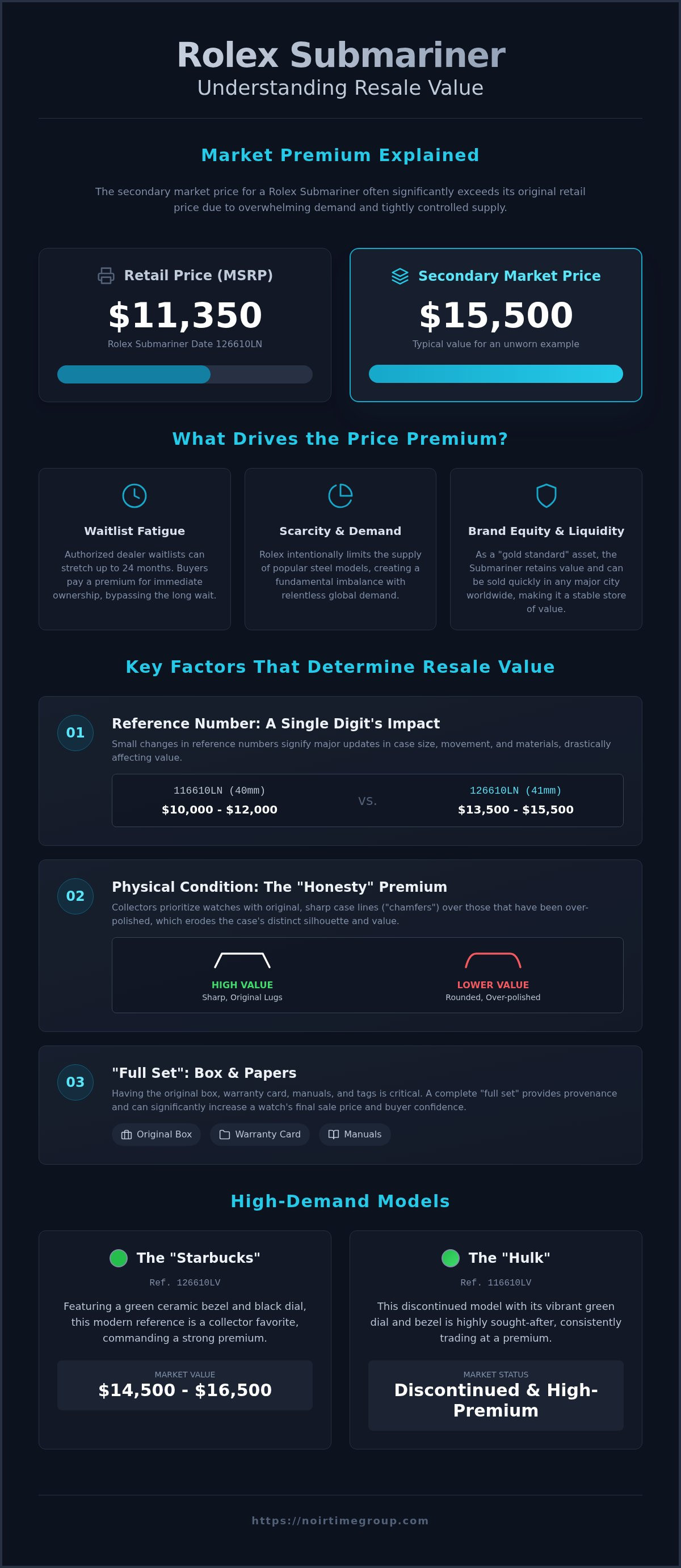
Why would a pre-owned watch cost $4,000 more than a brand-new one sitting in a boutique window? As of July 2026, a standard steel Rolex Submariner 126610LN often commands a secondary market price of $15,500, even though its retail MSRP is just $11,350. This staggering premium is the reality of the Rolex Submariner resale value in a market where waitlists at authorized dealers still stretch up to 24 months.
It's understandable if you feel overwhelmed by conflicting price data or worry about being low-balled when it's time to sell. You know that a "full set" adds value, but exactly how much it moves the needle remains a mystery to many collectors. At Noir Time Group, we believe transparency is the only way to protect your investment and ensure you're treated fairly by the market.
This guide will unlock the specific factors, reference numbers, and market trends that determine exactly what your timepiece is worth in today's secondary market. We'll provide a clear framework for valuing your specific reference, from the "Hulk" to neo-vintage classics, so you can execute your exit or entry strategy with professional confidence.
Key Takeaways
- Learn why current market demand keeps secondary prices for steel models significantly above their original retail MSRP in 2026.
- Master the specific variables, such as original documentation and case sharpness, that dictate the Rolex Submariner resale value for your specific reference.
- Discover which discontinued and current production models, like the "Hulk" and "Starbucks," are currently commanding the highest market premiums.
- Get a step-by-step framework for identifying your watch's exact reference number to accurately compare "sold" prices across major platforms.
- Understand why professional authentication and provenance are more critical than ever for securing a high-value exit strategy.
Understanding the Rolex Submariner Secondary Market Dynamics
The concept of Rolex Submariner resale value is often misunderstood as a static number. In reality, it's a living calculation reflecting the delta between a manufacturer's suggested retail price (MSRP) and the actual cash value on the secondary market. While MSRP is the price Rolex dictates for its authorized dealers, the secondary market price is what the world is actually willing to pay. In 2026, these two numbers rarely align. This gap, often called the "market premium," exists because demand for this specific diver remains relentlessly high while supply stays tightly controlled.
Rolex produces roughly one million watches annually, yet the allocation for steel Submariners remains intentionally low. This creates a "Scarcity vs. Demand" cycle that fuels the grey market. For most collectors, the secondary market isn't just an alternative; it's the only viable point of entry. By mid-2026, we've seen the market enter a phase of healthy stability. We've moved past the frenetic price spikes of previous years into a period where values are underpinned by genuine collector interest rather than pure speculation. This makes the Submariner the "Gold Standard" of watch investments because of its incredible liquidity. You can sell a Submariner in almost any major city in the world within hours because its value is universally recognized.
The Role of Brand Equity in Value Retention
The Submariner's status as a premier asset isn't an accident. With over seven decades of Rolex Submariner History backing the collection, it has built a level of brand equity that other luxury divers simply can't match. While a competitor's watch might lose 30% of its value the moment you leave the store, a Submariner often gains value. This "Entry-Level Icon" effect ensures that as new enthusiasts enter the hobby, they gravitate toward the Submariner first, keeping the floor price high and consistent across the globe.
Retail Price vs. Market Price in 2026
The current MSRP for a standard Submariner Date (126610LN) sits at $11,350. However, waitlists at authorized dealers still range from 12 to 24 months for most buyers. This "Waitlist Fatigue" is the primary engine behind the Rolex Submariner resale value premiums we see today. Collectors are frequently willing to pay between $13,500 and $15,500 for an unworn example because they value immediate ownership over a multi-year wait. Certain models, like the green-bezel "Starbucks," command even higher premiums, often trading for $14,500 to $16,500 depending on the specific year and condition.
At Noir Time Group, we've observed that several factors contribute to this price gap:
- Instant Gratification: Buyers pay a premium to bypass the 2-year dealer waitlist.
- Production Consistency: Rolex rarely makes radical changes, ensuring older models don't look "dated."
- Currency Hedge: High-end horology often acts as a stable store of value during inflationary periods.
Key Factors That Determine Your Submariners Resale Premium
Two watches might look identical to the untrained eye, yet their market prices can vary by thousands of dollars. The Rolex Submariner resale value isn't just a reflection of the model name; it's a calculation of specific technical and historical details. For instance, the transition from the 116610LN to the 126610LN involved a move from a 40mm to a 41mm case and an upgraded movement. This single digit change in the reference number shifts the price floor significantly. While a last-generation 116610LN might trade between $10,000 and $12,000, the current 126610LN commands $13,500 to $15,500 in the 2026 market.
Physical condition remains the most subjective yet critical factor. Collectors today prioritize "honesty" over a sterile, like-new appearance. A watch with original factory chamfers and sharp lug edges is far more valuable than one that has been over-polished to remove scratches. Over-polishing rounds off the distinct lines of the Oyster case, which savvy buyers view as a permanent loss of the watch's original silhouette. This obsession with preservation is why many experts use the Rolex Submariner Test of value when benchmarking other luxury assets. If you're unsure where your watch falls on the condition scale, our team at Noir Time Group can provide a professional assessment to ensure you don't leave money on the table.
The "Box and Papers" Premium
In 2026, a "naked" watch—one sold without its original packaging—typically faces a 10% to 20% price reduction. The original green box, booklets, and specifically the warranty card are vital for maximum value. The warranty card date is especially important; a watch with a 2026 date carries the balance of the 5-year Rolex guarantee, which is a major selling point. Be wary of "Franken-sets," where sellers pair a watch with a box from a different era. Authenticators look for the matching serial number on the card to verify a true "full set" status.
Condition: Honest Wear vs. Value-Reducing Damage
While surface scratches on the steel bracelet are expected, damage to the "Cerachrom" ceramic bezel is a different story. Unlike older aluminum inserts that could fade into a desirable "ghost" grey, a cracked ceramic bezel is simply broken and expensive to replace. On the other hand, certain vintage defects actually increase the Rolex Submariner resale value. "Spider dials," where the lacquer has cracked into a web-like pattern, or "Tropical" dials that have faded to chocolate brown, are highly sought after by specialists who value unique patinas over modern perfection.
When evaluating your Submariner's condition, consider these high-impact areas:
- Bracelet Stretch: Hold the watch sideways; a sagging bracelet indicates heavy wear and lowers the price.
- Service Records: Documentation from a Rolex Service Center (RSC) proves the watch contains genuine parts.
- Lume Quality: Ensure the Chromalight or Super-LumiNova is consistent and hasn't been sloppily reapplied.
Most Profitable Rolex Submariner References to Own
Identifying the right reference is the difference between buying a watch and making a strategic investment. While every Submariner holds its own, certain models act as high-performance assets due to their production history or unique aesthetics. The Rolex Submariner resale value often hinges on these specific technical variations. For modern collectors, the current 41mm lineup represents the pinnacle of daily-wear liquidity. For those looking for historical appreciation, the vintage market offers a higher ceiling but requires a more sophisticated eye for detail.
Modern References (Ceramic Bezel Era)
The 126610LN is the modern titan of the catalog. With a retail MSRP of $11,350 and secondary market prices reaching up to $15,500, it remains a "safe haven" for capital. However, the real excitement in 2026 surrounds the green-bezel variants. The discontinued "Hulk" (116610LV) with its green sunburst dial is currently trading between $20,000 and $25,000, with specific listings hitting $22,010 as of July 29, 2026. In comparison, the current "Starbucks" (126610LV) maintains a steady premium, typically selling for $14,500 to $16,500. Precious metal models like the white gold "Smurf" (126619LB) cater to a different tier, holding value between $32,000 and $37,000. These heavy-hitters retain value differently than steel; they trade on rarity and material weight rather than mass-market hype.
Vintage and Neo-Vintage Gems
The neo-vintage era, spanning the 1990s to the early 2010s, is where savvy investors find the most "honest" value. The 16610 is a prime example. While standard examples trade between $6,500 and $9,500, the specific era of production matters immensely. Collectors are currently paying a premium for pre-1999 "Tritium" dials, which develop a creamy patina that later Luminova versions lack. If you prefer the clean look of a "No-Date" model, the 14060M is frequently cited as the "last best Submariner" because it retains the classic proportions before the move to the "Maxi" case.
For those with a higher risk appetite, vintage icons like the 1680 "Red Submariner" or the 5513 remain blue-chip holdings. A 5513 can range from $12,000 to over $80,000 depending on the provenance and dial configuration. These watches aren't just timepieces; they're historical artifacts. We've noticed that "holes cases"—models with visible lug holes for easier strap changes—are gaining significant traction in 2026. They offer a rugged, tool-watch aesthetic that modern ceramic models have traded for luxury polish.
When choosing a reference for value retention, keep these tiers in mind:
- High Liquidity: 126610LN and 124060 (Current production steel).
- Maximum Growth Potential: 116610LV (Hulk) and 16610LV (Kermit).
- Entry-Level Stability: 16610 and 14060 (Neo-vintage).
- Museum Grade: 1680 and early 5513 (Vintage).
How to Accurately Estimate Your Rolex Submariners Market Value
Estimating the Rolex Submariner resale value of your specific timepiece requires more than a casual glance at online listings. It's a technical process that begins with identifying your reference and serial numbers. Since 2011, Rolex has used random serial numbers, so you'll need to check your warranty card or look between the lugs if it's an older model. Knowing the exact year is vital because a 2026 model carries a different premium than a 2024 version, even if the reference number is the same. This granularity ensures you aren't comparing your watch to a model that lacks modern movement upgrades or the latest bracelet refinements.
Don't fall into the trap of using "asking" prices as your baseline. These figures represent a seller's hope, not market reality. Instead, filter for "sold" listings on major platforms to see what cash actually changed hands. You'll also need to account for the dealer margin. Most professional buyers will offer 10% to 20% less than the current retail asking price. This gap covers their overhead, the cost of professional authentication, and the risk they take by holding the inventory. If you see a Submariner listed for $15,000, don't expect a dealer to write you a check for that same amount.
Where to Find Reliable Price Data
For high-end vintage pieces, auction house results from Phillips or Sotheby's provide the most accurate benchmarks for museum-grade assets. For modern steel models, enthusiast forums and private sale groups offer a glimpse into values that sit between dealer buy-back and retail prices. Avoid relying solely on automated price bots. These tools often fail to distinguish between a "naked" watch and a true "full set" with original paperwork, which we've already established can shift the price by thousands of dollars.
The "Noir Time" Valuation Checklist
A Grade A investment watch must possess 100% original components, verifiable provenance, and a case that retains its factory-delivered geometry.
- Case Integrity: Check for original chamfers and sharp lug edges that haven't been rounded by over-polishing.
- Bezel Clarity: Inspect ceramic inserts for micro-cracks or aluminum for even, natural fading.
- Bracelet Health: Measure the "stretch" or play in the links to determine the intensity of previous wear.
- Dial and Hands: Ensure the lume color is consistent and the dial surface is free of oil spotting or moisture damage.
- Documentation: Verify that the serial on the warranty card matches the watch and any recent service records.
Professional authentication is the final, non-negotiable step in this process. In a market where high-quality clones are increasingly common, a certificate of authenticity from a trusted expert is the only way to secure your Rolex Submariner resale value. If you want a definitive analysis of your watch's current worth, contact Noir Time Group for a professional market appraisal that goes beyond automated estimates.
Strategic Buying and Selling for Long-Term Value Retention
The most successful collectors don't just buy watches; they manage a luxury portfolio. Maximizing your Rolex Submariner resale value requires a clear entry and exit strategy that begins long before you list a piece for sale. It starts with the "Buy the Seller" rule. Purchasing from a reputable dealer ensures the watch hasn't been tampered with or fitted with aftermarket parts. This verified provenance is the only way to guarantee a smooth, high-value transaction five or ten years down the road. If the initial purchase lacks professional authentication, your future exit strategy is already compromised.
Timing also plays a subtle but measurable role in secondary market performance. While the Submariner is a year-round icon, demand for luxury divers typically peaks in the late spring and early summer months. If you're looking to sell, listing your watch when "wrist season" begins can often lead to a faster transaction and a tighter spread on your asking price. Conversely, the winter months can be an opportunistic time to buy as the market slightly cools, allowing you to secure a better entry point for long-term appreciation.
Exit Strategies: Selling vs. Trading
When you're ready to move on from your timepiece, you have three primary paths. A direct sale to a dealer offers immediate liquidity, but it usually results in the lowest net price. Consignment is the patient collector's choice. While consignment fees generally range from 10% to 30%, you'll often net a higher return because the watch is sold at retail market rates rather than wholesale. Finally, consider the trade-in. If you're looking to move from a steel 126610LN to a vintage 5513 or a precious metal model, many dealers offer a higher valuation for your watch when it's used as credit. This effectively reduces your out-of-pocket cost and simplifies the upgrade process.
Future-Proofing Your Collection
Looking ahead, the 2026 market shows signs of a shift toward two-tone "Bluesy" models. Historically, these were overshadowed by stainless steel, but as steel premiums stabilize, the value proposition of gold-and-steel references is becoming harder for investors to ignore. We also anticipate that any 2026 Rolex anniversary releases or unexpected discontinuations will cause a ripple effect across the secondary market. If a specific reference is retired, its value can jump significantly as collectors scramble to secure the final production years. Proper storage in a climate-controlled environment and maintaining up-to-date insurance appraisals are the final, essential steps in protecting your investment.
Managing these variables requires more than an automated price bot; it requires human expertise and market intuition. Discover how Noir Time Group can help you navigate the complex world of luxury watch investment and ensure your collection remains a high-performing asset for years to come.
Securing Your Future in the Submariner Market
Navigating the secondary market requires a balance of technical knowledge and strategic timing. We've explored how specific reference numbers like the 126610LN dictate price floors and why "unpolished" condition often carries a premium over showroom perfection. In 2026, the most successful collectors are those who prioritize provenance and "full set" documentation to ensure their assets remain liquid and high-performing.
Ultimately, your Rolex Submariner resale value isn't just a number on a screen; it's a reflection of your watch's unique history and current market demand. While automated price bots offer a general starting point, they can't replace the nuanced insight of a specialist who understands the value of a sharp case or a rare dial variation. Precision in valuation is just as important as the precision of the movement itself.
If you're ready to move from estimation to execution, our expert market analysts are here to help. At Noir Time Group, we specialize in high-grade Rolex references and offer a transparent buy-back process that respects the true worth of your timepiece. Get a Professional Valuation for Your Rolex Submariner at Noir Time Group today. Your collection represents a legacy of horological excellence; make sure your exit strategy does too.
Frequently Asked Questions
Does a Rolex Submariner always increase in value?
Not always, though it's one of the most stable assets in luxury horology. While long-term trends show consistent appreciation, the market can experience short-term corrections. In 2026, the market has entered a phase of healthy stability. Most modern steel models continue to trade above their original retail MSRP because demand from collectors consistently outpaces the limited annual production numbers from the factory.
How much does the original box and papers add to the resale value?
A "full set" typically adds between 10% and 20% to the Rolex Submariner resale value compared to a "naked" watch. Collectors pay this premium for the peace of mind and provenance that original documentation provides. Without the warranty card and box, a watch is harder to authenticate and often sells at a significant discount to professional buyers and enthusiasts alike.
Is it better to sell a Rolex Submariner to a dealer or a private buyer?
It depends on whether you prioritize speed or total profit. Selling to a private buyer might net you a slightly higher price, but it carries risks of fraud and requires more time. A reputable dealer offers immediate liquidity and a secure, transparent transaction. While dealers factor a margin into their offer, the safety and speed often outweigh the small percentage gain of a private sale.
Does servicing my Rolex at a non-authorized center hurt its resale value?
Yes, it can reduce the value, especially if non-genuine parts are used during the process. Collectors look for Rolex Service Center (RSC) documentation as proof of authenticity and quality. If an independent watchmaker replaces original components like the dial, hands, or bezel with aftermarket parts, the watch's "honesty" is compromised. This often leads to a lower valuation during the authentication process.
Which Submariner dial color has the best resale value?
Green dials and bezels currently command the highest market premiums. The discontinued "Hulk" (116610LV) with its green sunburst dial trades for $20,000 to $25,000, while the "Starbucks" (126610LV) with a green bezel trades for $14,500 to $16,500. Standard black dials are incredibly liquid and easy to sell, but they don't reach the same percentage premiums as these specialized green references.
How do I know if my Rolex Submariner has been polished?
Look for rounded lug edges and "soft" chamfers instead of the sharp, crisp lines delivered from the factory. An unpolished watch has a distinct, uniform brushed finish on the lugs and mirror-like polish on the case sides. If the spring bar holes look shallow or the crown logo on the clasp appears faint, the watch has likely undergone heavy polishing that has removed original steel.
What is the current wait time for a new Submariner at an AD in 2026?
Most authorized dealers report wait times between 12 and 24 months for stainless steel sport models. This persistent supply constraint is the primary reason why the Rolex Submariner resale value remains so high on the secondary market. While "preferred" clients with long purchase histories might see shorter waits, the average buyer should expect a multi-year journey or pay the market premium for immediate ownership.
Is the "No-Date" Submariner worth more than the "Date" version?
Historically, the Date version (126610LN) has a higher market price, but the No-Date (124060) often shows better percentage retention. The No-Date is favored by purists for its symmetrical dial and classic tool-watch aesthetic. While the Date model trades for $13,500 to $15,500, the No-Date typically trades between $10,500 and $12,000. Both models remain blue-chip investments with high liquidity across all global markets.
