

Did you know the secondary watch market surged to $10.5 billion in the first half of 2026? That is a 37.2% jump from last year, proving your luxury timepiece is more than just a style statement; it's a high-performing asset. You've likely felt the tension of walking through the Diamond District, worrying about whether you're getting a fair appraisal or just another high-pressure sales pitch. It's stressful to carry a high-value asset through Manhattan while wondering if you're being low-balled or if the "grey market" price you saw online even applies to your piece. Finding the best place to trade watches NYC offers shouldn't feel like a gamble.
You want a seamless upgrade to a higher-tier watch without the typical retail friction. This guide will show you how to evaluate the current market to secure the highest trade-in value for your luxury timepiece in 2026. We'll explore the latest trends in Rolex and Patek Philippe valuations, clarify how NYC's 8.875% sales tax impacts your trade, and provide a roadmap for a secure, professional transaction that prioritizes your equity over a quick sale.
Key Takeaways
- Learn how the 2026 shift from retail scarcity to a robust secondary market has transformed New York into the global hub for high-stakes luxury trades.
- Understand the "Three Pillars" of valuation—Condition, Completeness, and Comps—to ensure your timepiece commands the highest possible market premium.
- Discover how to leverage the New York "Tax Shield" to potentially save thousands of dollars when upgrading your collection through a strategic trade.
- Identify the best place to trade watches NYC offers by prioritizing dealers who provide transparent, real-time appraisals instead of high-pressure sales tactics.
- Master essential pre-trade preparation and the "walk-away" strategy to maintain total control and confidence during your visit to the Diamond District.
The NYC Luxury Watch Landscape: Why 2026 is Different
The days of empty display cases at authorized dealers are fading into memory. In 2026, the power has shifted back to the collector. The secondary watch market hit a staggering $10.5 billion in sales during the first half of the year alone. This 37.2% year-over-year increase shows that trading is no longer a niche activity; it's the primary way New Yorkers upgrade their collections. Finding the best place to trade watches NYC offers requires understanding this new reality where liquidity is king and transparency is the new gold standard.
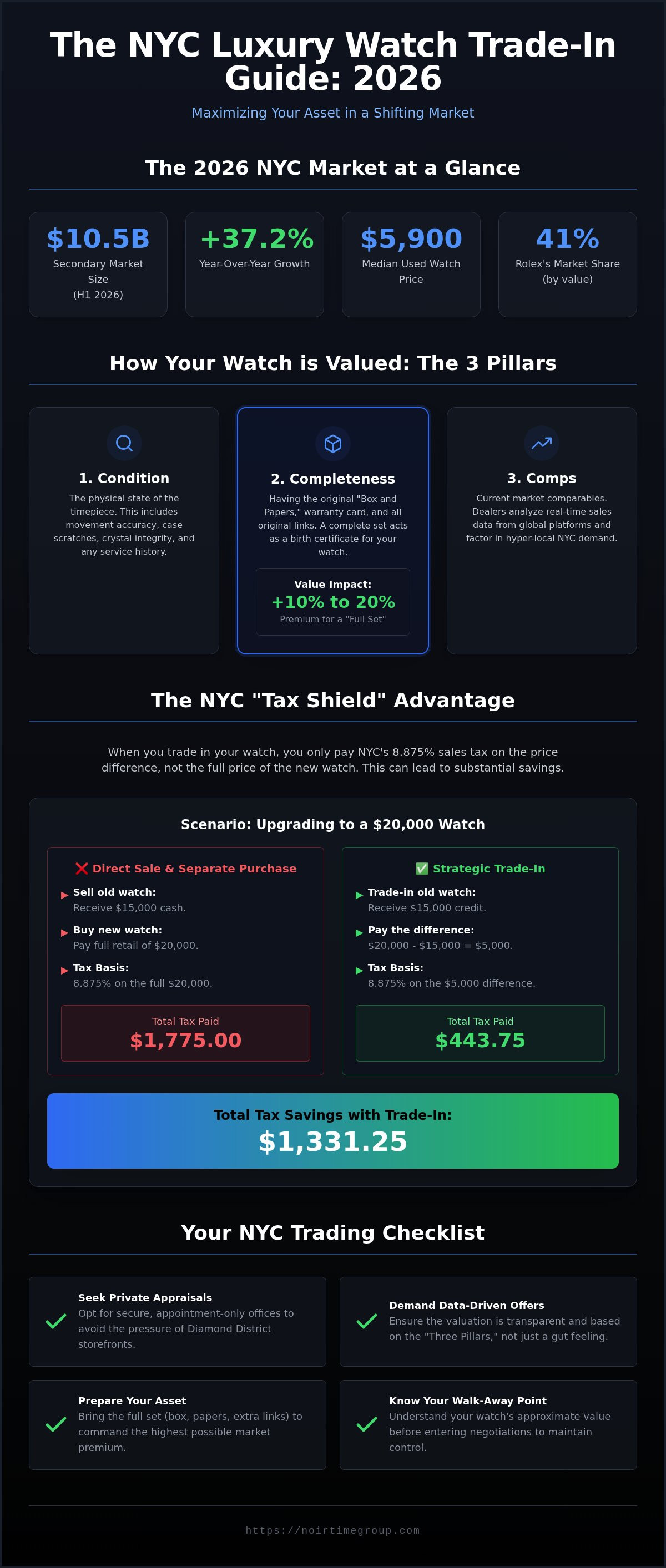
In Manhattan, "Trade-In Value" often beats "Cash Value" because dealers are eager to acquire high-quality inventory like Rolex, which still commands 41% of the secondary market value. Trading in allows you to roll your equity directly into a new piece, often offsetting the cost of your next acquisition. With the median sale price of used watches sitting at $5,900 in early 2026, even entry-level luxury trades provide significant leverage for an upgrade.
Manhattan’s Trading Hubs: Beyond the Diamond District
Historically, NYC's Diamond District was the only game in town. While 47th Street remains a high-volume center, the experience has evolved. Many collectors now bypass the high-pressure storefronts for private, appointment-only suites. These modern boutiques, like Noir Time Group, offer a secure environment where you can discuss a trade without the chaos of a sidewalk pitch. Security is paramount when you're carrying a high-value asset. A professional office setting provides better insurance coverage and the discretion that Manhattan's elite collectors expect.
The 2026 Market Pulse: What’s Trading High?
What is moving the needle this year? While integrated bracelet sports watches from major luxury brands remain highly liquid, there's a surprising surge in dress watches among younger Manhattan professionals. We're seeing a "Barbell Effect." High-end pieces are breaking auction records, but the mid-tier market is experiencing a correction. This creates a unique window. If you're holding a "hype" model from a few years ago, trading it now for a timeless complication might be your smartest financial move. Local supply and demand in New York often move faster than global trends, so a local quote is always more accurate than an online estimator. The best place to trade watches NYC has to offer is one that understands these micro-shifts in real time.
How NYC Dealers Calculate Your Watch’s Trade-In Value
A professional appraisal is never a "gut feeling." It is a calculated formula. To find the best place to trade watches NYC collectors trust, you must look for dealers who base their offers on the Three Pillars of valuation: Condition, Completeness, and Comps. In a market where the median sale price for used watches has climbed 19% to $5,900 in early 2026, small details in these pillars can lead to thousand-dollar swings in your offer. Professional shops that adhere to NYC's official dealer regulations prioritize this data-driven transparency over high-pressure haggling.
Completeness remains a massive value driver in Manhattan. While a "naked" watch still has value, "Box and Papers" act as a birth certificate for your timepiece. In the 2026 NYC market, a full set often commands a 10% to 20% premium over a watch alone. This is because New York collectors are increasingly sophisticated; they want the security of a documented provenance. If you've kept your original receipt and warranty card, you're already ahead of the curve.
You also need to understand the "Dealer Margin." In the first half of 2026, the average time to sell a watch on the secondary market rose to 43 days. Because a dealer is taking on the risk of holding that inventory for over a month, they must build a margin into their trade-in offer. A fair spread usually accounts for the cost of authentication, insurance, and the 8.875% NYC sales tax they must manage. If you want to see how these factors apply to your specific piece, you can request a real-time market appraisal to see the current spread for your model.
The Role of Global 'Comps' vs. Local Demand
Dealers use platforms like Chrono24 and WatchCharts to establish a global baseline, but New York is its own ecosystem. A watch might sit for months in a smaller market but find a buyer in 48 hours in Midtown. This "Immediate Liquidity" factor can actually work in your favor. If a dealer has a client waiting for your specific Rolex or Patek Philippe reference, they may tighten their margin to secure your trade. Local demand for specific "New York" styles, like platinum dress watches or vintage GMTs, often outpaces global averages.
Technical Inspection: What Happens Behind the Loupe
The final number is always contingent on a technical review. Dealers look for "Frankenwatches"—pieces with aftermarket crystals, dial refinishing, or non-original hands—which can decimate a watch's trade-in value. They also use a timegrapher to check the movement's health. Movement amplitude measures the degrees of rotation in the balance wheel's swing, and in 2026, a low reading serves as a primary indicator of mechanical fatigue that can sharply reduce your final valuation. A healthy movement ensures you are getting the best place to trade watches NYC rates without deductions for an immediate overhaul.
Trade-In vs. Direct Sale: Strategic Moves for NYC Collectors
Deciding whether to sell your timepiece for cash or trade it toward a new acquisition is a strategic financial choice. In New York City, the math often favors the trade. While a private sale might technically net a higher raw number on paper, the "Tax Shield" offered by a trade-in can save you thousands of dollars instantly. Because New York City's combined sales tax rate is 8.875% as of July 2026, trading a $20,000 watch toward a $30,000 piece means you only pay tax on the $10,000 difference. This single move keeps nearly $1,800 in your pocket that would otherwise be lost to the state and city if you sold and bought in two separate transactions.
Speed is the other critical factor. Research from the first half of 2026 shows that the average time to sell a watch on the secondary market has risen to 43 days. Consignment might offer a higher payout, but you are essentially locking your asset in a display case for six weeks or more while waiting for a buyer. A trade-in provides an "Instant Upgrade." You walk into a professional suite with one watch and walk out with another, bypassing the 43-day wait and the safety risks associated with transporting high-value assets across Manhattan multiple times. The best place to trade watches NYC offers will prioritize this efficiency, allowing you to capitalize on 2026 luxury watch market trends that favor agility and liquidity.
Calculating the Real ROI of a Trade
When calculating your return on investment, you must account for the "Time Cost" of private sales. Managing inquiries, verifying funds, and ensuring secure shipping are significant burdens. Trading with a premier firm like Noir Time Group helps you build a "spend history." In the competitive NYC market, having a documented relationship with a dealer can grant you first access to rare Rolex or Patek Philippe references before they ever hit the public market. This long-term access is often worth more than the small margin difference between a trade and a direct sale.
When to Sell vs. When to Trade
The choice often depends on your ultimate goal for your collection. If you are looking to "exit" the hobby or downsize significantly, a direct sale is your best path to liquidity. If you are looking to "climb the ladder" by moving from niche, volatile brands into established "liquid" assets like the Rolex Professional line, a trade is the superior move. The 2026 market shows that Rolex still accounts for 41% of the secondary market value. Moving your equity into these high-demand models via a trade ensures your collection remains a stable store of value. The best place to trade watches NYC enthusiasts recommend is one that views your trade as a step in a larger collecting journey rather than a one-off transaction.
The NYC 'Diamond District' Survival Guide: Trading with Confidence
Walking onto 47th Street with a high-value timepiece requires more than just a watch; it requires a strategy. Before you even set foot in Midtown, you must document your asset. Take high-resolution photos of the dial, case back, and serial numbers. If you have original service records or a recent timegrapher report, keep digital copies on your phone. This preparation prevents any disputes regarding the condition of your watch once it leaves your wrist for inspection. Finding the best place to trade watches NYC offers means identifying dealers who respect this level of transparency from the start.
Security is a primary concern for collectors transporting assets in Manhattan. To stay safe, avoid carrying your watch in its original bulky box while walking through Midtown. Instead, use a discreet, padded travel pouch tucked inside a non-descript bag. Only reveal the timepiece once you are inside a secure, monitored environment. Reputable firms prioritize your safety by operating out of upper-floor suites with controlled access rather than street-level booths exposed to heavy foot traffic.
Vetting Your Dealer in 2026
The regulatory landscape in New York is shifting. As of September 8, 2026, the NYC Department of Consumer and Worker Protection (DCWP) no longer requires Secondhand Dealer General licensees to submit fingerprints or execute a surety bond. While this streamlines business for dealers, it puts more responsibility on you to verify who you are working with. Look for modern social proof that goes beyond static star ratings. Check for active memberships in professional horological guilds and look for dealers who maintain a consistent, physical presence in the city. A professional office signifies a long-term commitment to the market, whereas a "flipper" booth may vanish overnight. To ensure a secure experience, you should trade your luxury watch with a trusted professional who operates in a private, high-security setting.
The Negotiation Framework
Negotiation is an art, not a battle. When you present your watch, lead with its strengths, such as a recent service or a rare dial configuration. The "Walk Away" power is your strongest tool. If an offer feels low or the dealer uses high-pressure tactics, leave. You should never feel forced to trade on the first offer you receive. Be wary of common traps like "The Quick Polish," where a dealer suggests your watch needs expensive cosmetic work, or "The Movement Scare," where they claim the amplitude is failing without showing you the timegrapher screen. The "Bait and Switch" tactic occurs when a dealer quotes an inflated price over the phone or online only to manufacture "mechanical issues" during the in-person inspection to justify a lower final offer. The best place to trade watches NYC has to offer will always be willing to explain their valuation process in detail without the theatrics.
Why Noir Time Group is NYC’s Trusted Trading Partner
Noir Time Group represents the modern standard for luxury watch trading in Manhattan. While traditional shops on 47th Street often rely on high-pressure tactics and opaque pricing, we prioritize a transparent, data-driven approach. We understand that your collection is a significant financial asset. That's why we provide real-time market appraisals based on the latest global and local data. Our secure, Manhattan-based operations offer a sanctuary for collectors who value discretion and safety. If you're searching for the best place to trade watches NYC collectors trust for high-stakes transactions, Noir Time Group delivers a professional environment that respects your time and your timepiece.
Our trade-up programs are specifically designed for the "Big Three"—Rolex, Patek Philippe, and Audemars Piguet. We don't just facilitate a sale; we help you curate your collection. By leveraging our deep expertise in these major luxury brands, we ensure you receive a competitive valuation that reflects the true market pulse of 2026. Whether you're moving from a steel sports model to a precious metal complication or simply refreshing your daily wearer, our process is seamless and secure. We position ourselves as the modern alternative to the old-school shops, focusing on client-first trading experiences that prioritize long-term relationships over single transactions.
The Noir Time Advantage
What sets us apart is our bespoke approach to the modern collector. We maintain an exclusive global network that allows us to source rare references that aren't always available on the open market. Every watch that enters our inventory undergoes rigorous in-house authentication and technical verification. This gives you total peace of mind, knowing that the piece you're trading for meets the highest standards of mechanical integrity and authenticity. We focus on a professional environment where your goals dictate the pace of the transaction. There's no pressure; just expertise and a commitment to market-based valuations.
Start Your Trade Today
Beginning your journey is straightforward. We offer preliminary digital quotes so you can understand the ballpark value of your asset before visiting our private suite. This saves you time and provides a baseline for your strategic planning. When you're ready for your appointment, bring your watch along with its box and papers to facilitate a same-day trade. Our goal is to make the transition between timepieces as efficient as possible while maintaining the highest level of professional service. Ready to upgrade? Get your trade-in estimate from Noir Time Group now. By choosing a specialist who understands the nuances of the 2026 market, you ensure that you're working with the best place to trade watches NYC has to offer for serious horological enthusiasts.
Take the Next Step in Your Horological Journey
Trading a luxury timepiece in 2026 requires a blend of market awareness and strategic timing. You now understand how the 8.875% NYC sales tax shield can save you thousands on your next upgrade. You've also seen why choosing a secure, appointment-only environment is safer than navigating street-level booths. Finding the best place to trade watches NYC has to offer isn't just about the dollar amount; it's about the transparency of the appraisal and the security of the transaction.
Noir Time Group provides expert appraisals for Rolex, Patek Philippe, and Audemars Piguet from our secure Manhattan location. We prioritize your equity with transparent, 2026 market-based offers that reflect the true value of your asset. Don't leave your trade-in to chance in a high-pressure environment. Secure the highest trade-in value for your watch at Noir Time Group today. Your collection deserves a partner that values your time as much as your timepiece. We look forward to helping you secure your next great acquisition.
Frequently Asked Questions
Is it better to trade or sell my watch in NYC?
Trading is typically the smarter financial move if you're planning to acquire another timepiece because of the significant tax advantages. In New York, you only pay the 8.875% sales tax on the price difference between your trade and the new watch. If you're looking for immediate liquidity without a new purchase, a direct sale is the better path to exit your position.
How do I know if I'm getting a fair trade-in price in the Diamond District?
You'll know you've found the best place to trade watches NYC has to offer when the dealer provides a transparent appraisal based on global "comps." A fair dealer will show you current market data from 2026 and explain how your watch's condition impacts the quote. Always check for a professional technical inspection that includes a timegrapher reading to verify movement health.
What documents do I need to trade in a luxury watch in New York?
You must bring a valid government-issued ID to comply with NYC Department of Consumer and Worker Protection regulations. To secure the highest value, you should also bring the original box, warranty card, and any service records. While you can trade a watch without these items, a "full set" typically commands a premium of 10% to 20% in the Manhattan market.
Can I trade in a watch that is still under financing?
Yes, you can trade a financed watch, though the process requires a few extra steps to clear the title. The dealer will coordinate with your lending institution to determine the exact payoff amount. Once the loan is settled, the remaining equity in your timepiece is applied directly toward your new purchase, making it a seamless way to upgrade your collection.
Which watch brands hold their trade-in value best in 2026?
Rolex, Patek Philippe, and Audemars Piguet continue to dominate the secondary market, with Rolex alone representing 41% of total market value in early 2026. Independent watchmakers like F.P. Journe are also seeing remarkable growth, with sales in that category up 89% year-over-year. These brands offer the most reliable store of value for collectors looking to trade up.
How long does the watch appraisal and trade-in process take?
A professional trade-in process usually takes between 30 and 60 minutes from start to finish. This timeframe allows the specialist to perform a thorough physical inspection and verify the movement's mechanical integrity. Most reputable NYC dealers are equipped to handle same-day transactions, allowing you to walk in with one piece and walk out with your upgrade.
Is it safe to trade a watch worth over $50,000 in Manhattan?
Trading high-value assets is very safe if you choose a dealer with a secure, private office rather than a street-level booth. Professional firms use controlled-access suites and have comprehensive insurance coverage for high-stakes trades. We recommend using a non-descript travel pouch for transport and scheduling an appointment to ensure a private, secure environment for your transaction.
Do I have to pay sales tax on a watch trade-in in New York?
You only pay the 8.875% NYC sales tax on the net difference between your trade-in allowance and the price of the new watch. This "Tax Shield" is one of the primary reasons why trading is the most cost-effective way to rotate your collection. It essentially provides an immediate discount on your new purchase that you wouldn't get through a separate sale and buy.
