

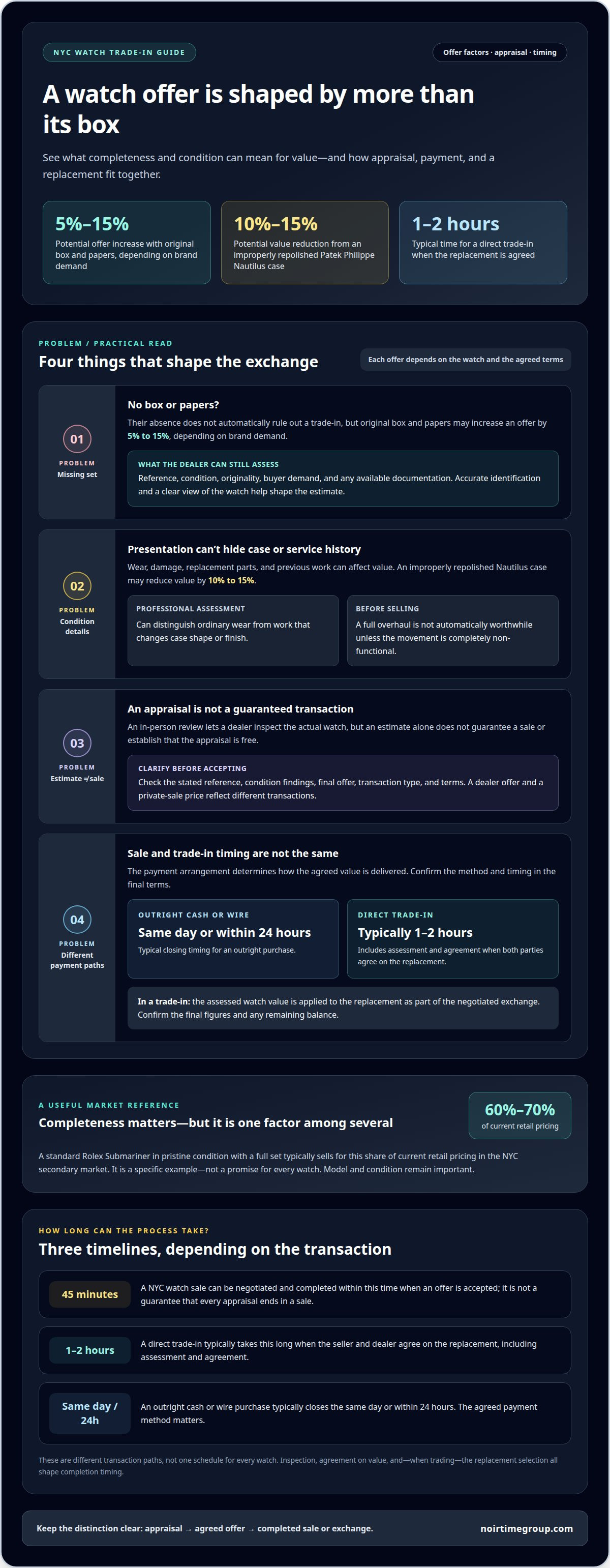
The box can strengthen a watch’s offer, but it isn’t the only factor. In the watch trade-in process in NYC, original boxes and papers may increase a sale offer by 5% to 15%, depending on brand demand. A direct trade-in with an agreed replacement typically concludes within 1 to 2 hours.
It’s understandable to want a clear picture of what you’ll receive before parting with a valuable watch. This guide explains whether the box and papers are essential, what happens during an appraisal, and how payment timing relates to your final offer.
You’ll also learn what can affect the offer, when it becomes final, and how dispatch of the replacement watch fits into the process. That way, you can follow each step from appraisal to agreed exchange with a clearer sense of what to expect.
Key Takeaways
- Find out how missing box and papers can affect an offer, and why their absence doesn’t tell the whole story.
- Understand how an immediate sale differs from a trade-in when you’re weighing payment timing against a replacement watch.
- Learn which condition details can influence appraisal deductions, including the importance of careful case assessment.
- Know what to clarify before accepting the final offer, including how the new watch’s dispatch fits into the exchange.
Do I need my watch’s box and papers?
No. A missing box or papers doesn’t automatically rule out a trade-in, but it can affect the offer. Original box and papers can increase a watch’s NYC sale offer by 5% to 15%, depending on brand demand. A standard Rolex Submariner in pristine condition with a full set typically sells for 60% to 70% of current retail pricing in the NYC secondary market. That comparison shows why completeness matters, while also making clear that condition and model remain important.
NYC dealers assess luxury watches from brands such as Rolex and Patek Philippe. Acceptance and value depend on the specific reference, condition, originality, and buyer demand. During the watch trade-in process, a professional can inspect the watch, assess its condition, and review any available documentation. Even without papers, the watch can still be evaluated; accurate identification and a clear view of its condition help shape the estimate.
Condition can outweigh presentation. Wear, damage, replacement parts, and previous work can affect how a dealer values a watch. For example, an improperly repolished Patek Philippe Nautilus case can reduce value by 10% to 15%. A professional assessment can distinguish ordinary wear from work that changes the case’s shape or finish. A Certified Watch Repair service is relevant when a watch needs repair, but a full overhaul before selling isn’t automatically worthwhile unless its movement is completely non-functional.
For comparison, iPhone trade-in value also depends on the device’s condition, function, model, and battery health. The 40-80 rule describes keeping an iPhone’s charge between 40% and 80% to help prolong its lifespan and maintain its value. A watch estimate follows different criteria: the dealer examines its reference, originality, condition, and completeness. The professional can then explain how those factors shape a competitive offer, including the effect of missing box and papers.
How long does it take to receive my payment?
Timing depends on whether the transaction is an outright sale or a trade-in. The assessment and agreed terms determine when payment is made.
Immediate Assessment and Payment
During an in-person assessment, a professional inspects the timepiece, identifies its reference, and evaluates its condition. The dealer then considers the watch’s details and the transaction type before presenting an offer. In a direct trade-in, the seller and dealer agree on a replacement watch. That process typically concludes within 1 to 2 hours, including assessment and agreement.
For example, a Patek Philippe Nautilus and another luxury watch may require different condition assessments. An inspection helps inform a clear offer, but it doesn’t make every transaction identical. Before accepting, understand whether the proposed amount is for an outright purchase or will be applied toward a replacement. That distinction shapes the payment you receive and any remaining balance in the exchange.
Receiving Payment
An outright cash or wire purchase typically closes the same day or within 24 hours. Those are distinct payment routes, so the agreed method matters when planning your next steps. For a trade-in, the watch’s assessed value is applied to the replacement as part of the negotiated exchange. Confirm the final figures and transaction terms before completing the deal.
Brands, model references, condition, and documentation all inform assessment, while the payment arrangement determines how the agreed value is delivered. If you’re trading toward a specific watch, a Watch Sourcing Service can support the search for a suitable replacement.
Payment Timing
For an outright purchase, the transaction can close the same day or within 24 hours. A direct trade-in typically takes 1 to 2 hours when both parties agree on the replacement. These timelines describe different transaction types, not a single schedule for every watch. The inspection, agreement on value, and selection of the replacement all shape when the exchange is completed.
Ask for the payment method and timing to be stated clearly in the final terms. This helps distinguish a completed purchase from a trade that still depends on agreement about the replacement. Once the offer and exchange details are settled, you’ll know what payment to expect and when the transaction concludes.
How long does a typical sale process take from formal appraisal to final cash payout?
A NYC watch sale can be negotiated and completed within 45 minutes. The appraisal considers the reference, condition, and transaction terms before a seller accepts an offer. That speed depends on reaching agreement, not on a guarantee that every appraisal will end in a sale.
A dealer’s offer and a private-sale price reflect different transactions. A dealer weighs resale potential, the watch’s condition, and the work involved in handling its next sale. A private seller negotiates directly with a buyer. Offers for luxury watches in NYC’s secondary market can vary, and a dealer offer should not be treated as a fixed discount from a private-sale price.
Condition can change the appraisal. For example, an improperly repolished Patek Philippe Nautilus case can reduce value by 10% to 15%. A professional assessment should account for visible wear, case shape, originality, and service needs. A full overhaul before selling isn’t automatically worthwhile unless the movement is completely non-functional. That distinction can help avoid unnecessary work and hassle.
An in-person appraisal lets the dealer inspect the actual watch rather than estimate its value from a description. The estimate should connect the watch’s reference and condition to the proposed trade-in offer. An appraisal alone doesn’t guarantee a sale or establish that the appraisal is free. Ask for clear offer terms so you can distinguish the valuation from the completed transaction.
A NYC dealer can explain the factors behind an offer and its terms. Appraisals may differ because each reflects a separate assessment. Compare the stated reference, condition findings, and proposed exchange rather than treating any estimate as a guarantee.
Tax treatment is separate from appraisal and depends on the transaction details and the seller’s circumstances. Keep the final sale or trade-in records, and seek tax advice for your specific filing rather than assuming the offer determines the tax owed.
Final trade-in offer and new-watch dispatch
The final offer should reflect the watch the dealer inspected, not just its initial description. Before accepting, review the reference, condition findings, and any adjustment to the preliminary estimate. For example, if the inspection reveals a difference in condition or originality, ask how it affects the offer. The agreed figure should be clear before the existing watch and replacement change hands.
If you’re upgrading to another luxury watch available in Manhattan, confirm how the trade value applies to the selected watch. The written terms should distinguish the value assigned to your watch from the replacement’s price. They should also state any remaining balance and when it’s due. A clear breakdown makes the exchange easier to understand than a single net figure.
Dispatch is separate from agreeing on the offer. The arrangement should specify whether the new watch will be handed over in person or sent, and what triggers dispatch. For example, the agreed terms might make dispatch conditional on completing payment or final trade documentation. State the process and timing directly rather than assuming they follow from the appraisal.
Before completing the exchange, confirm the replacement’s exact model and reference, the final trade value, the payment arrangement, and the delivery method. These details help prevent confusion if the selected watch differs from the one first discussed. Keep a copy of the final terms so you can refer to the agreed details during handover or dispatch.
A Watch Sourcing Service can help with finding a particular replacement before you settle the trade. To discuss your next watch step, explore a watch upgrade and clarify how the final offer connects to the selected timepiece.
Noir Time Group
Noir Time Group helps private collectors navigate watch trades and sales, then find a suitable replacement. Turn to the team to discuss your watch’s appraisal, understand the proposed exchange, or source a particular timepiece. Its Watch Sourcing Service can support your search, while Certified Watch Repair addresses repair needs related to your watch’s condition.
For an upgrade, available examples include the Rolex Submariner Date 126613LN and Rolex Submariner Date 126618LN. The right next step depends on your trade goals and the watch you want, not just its brand. Discussing both sides of the exchange can help clarify how your existing timepiece fits your plans.
Contact Noir Time Group to discuss your watch trade or sale.
Plan your next watch move
Before moving forward, decide what you want the exchange to achieve. Are you aiming to simplify a sale, put value toward another timepiece, or find a specific model? A clear goal helps keep the discussion focused on the trade and the watch you want next.
Planning a watch trade-in process in NYC also means thinking beyond the offer itself. Consider whether your next step is choosing from available watches or sourcing a particular reference. Noir Time Group offers the Rolex Submariner Date 126613LN and Rolex Submariner Date 126618LN, along with a Watch Sourcing Service for collectors seeking a specific timepiece. Those options can help shape a trade around your collecting priorities.
When you’re ready to discuss your watch and what you hope to find next, Contact Noir Time Group about your trade-in. A clear goal is a practical place to begin, and your next watch decision can follow from there.
Frequently Asked Questions
How can a professional dealer help me sell my watch?
A professional dealer can assess and authenticate your watch, then present a direct-sale or trade option. This can help if you’d rather have one point of contact than handle buyer inquiries and negotiations yourself. For example, a collector selling a Rolex while seeking another reference can discuss the sale and search for the next watch together. The dealer’s assessment also provides a reasoned basis for considering an offer.
Can the offer change after submission?
Yes, an initial offer can change if an in-person inspection reveals details that differ from the submitted description. A different reference, undisclosed damage, replaced components, or missing accessories can affect the assessment. The revised offer should explain which finding changed the valuation. Before agreeing, compare the new terms with the original estimate and decide whether to proceed with a sale or trade.
Do original accessories impact the price?
Original accessories can add to a watch’s completeness and appeal, but their influence depends on the model and what accompanies it. Keep related items together for assessment so the dealer can consider them as a set. For example, a complete presentation may be viewed differently from a watch offered alone. The final valuation still accounts for the watch itself and its condition.
Do original boxes and papers affect the offer?
Yes, original boxes and papers can strengthen an offer by supporting completeness and provenance. Their value varies with brand demand, so a missing box won’t affect every watch in the same way. If papers are unavailable, the dealer can still assess the timepiece by its reference and physical condition. Share any documentation you have to help the dealer evaluate the full package accurately.
How is the offer price determined?
The offer reflects the watch’s reference, condition, originality, completeness, and demand, as well as whether you’re selling outright or trading toward another watch. A dealer also considers the resale potential of that specific model. For a useful comparison, make sure the valuation and any credit toward a replacement watch are shown separately. This makes it easier to understand how the proposed exchange is calculated.
How does the watch trade-in process work in NYC?
The watch trade-in process in NYC typically moves from an initial description to an in-person inspection, an offer, and agreement on the sale or replacement terms. The dealer assesses the watch and explains the proposed value. If you choose a trade, both watches and any remaining payment are handled according to the agreed terms. Review the final paperwork before completing the exchange.
