
The watch market isn’t falling across the board. Whether watch prices are going down depends on the brand: in August 2025, Rolex prices fell 0.3% and Audemars Piguet prices fell 0.1%, while Patek Philippe prices rose 0.3%. The broader picture was mixed, too, with only five of the 25 most notable watch brands gaining value year to date in 2025.
It’s understandable to focus on a brand’s overall direction, but a market-wide dip doesn’t show how every collection is performing. Supply, demand, and differences between collections all shape the trend. As a result, prices can decline over one period and rise over another.
This article breaks down how watch prices moved in August 2025, which Rolex collections declined, and which collections led or lagged. You’ll also see how Rolex and Patek Philippe performed year to date, where Patek Philippe’s Nautilus fits into the picture, and why the figures are best read as trends rather than a single forecast for every watch.
Key Takeaways
- Read monthly moves alongside year-to-date performance: a short-term dip can sit within a broader upward trend.
- Within Rolex, the Daytona and Datejust showed different declines in August 2025, so collection-level comparisons matter.
- Use shifts in secondary-market supply and buyer demand to understand why prices can diverge between brands and collections.
- Compare the year-to-date leaders with the laggards: Patek Philippe’s Aquanaut and Nautilus gained value, while Blancpain moved lower.
- Put the U.S. outlook in context by separating recent market movement from longer-term price changes.
Overall watch market performance in August 2025
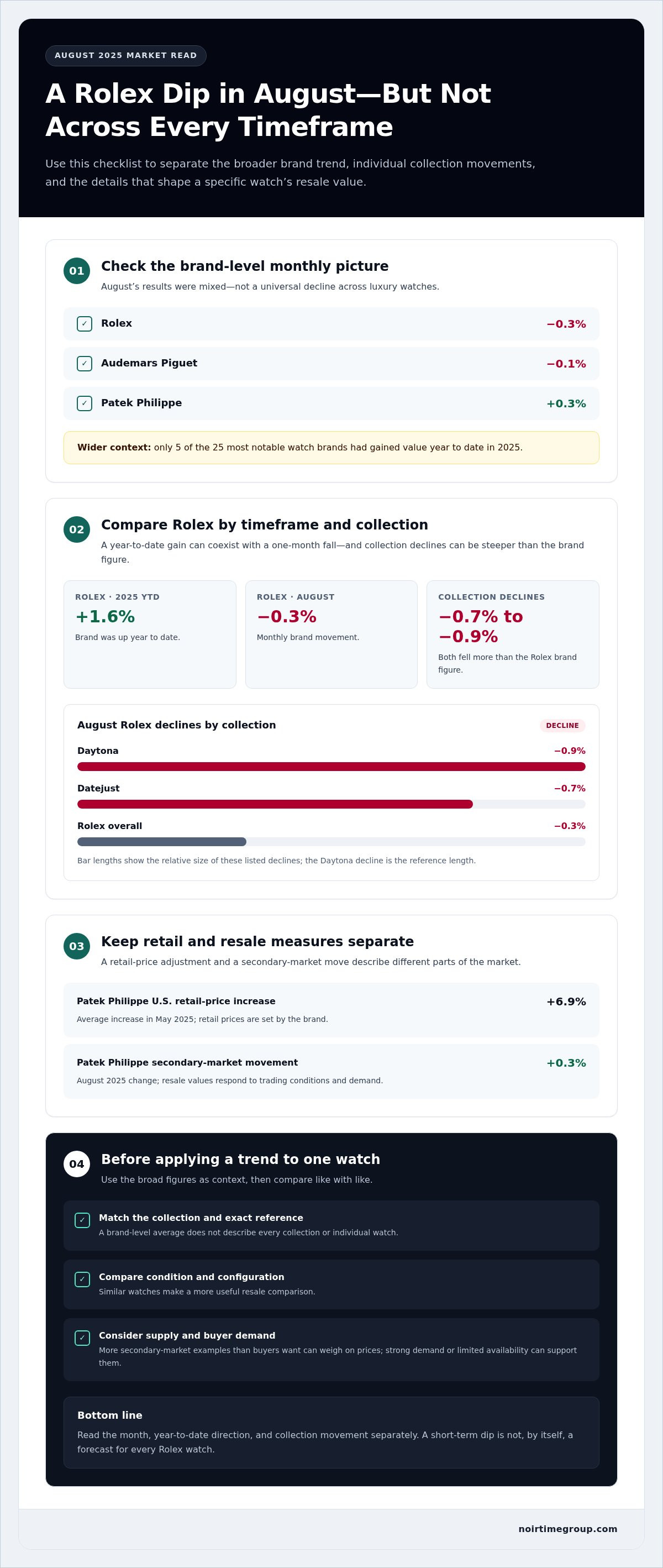
August 2025 brought different results across three major luxury watch brands. Rolex prices fell 0.3%, and Audemars Piguet prices slipped 0.1%. Patek Philippe prices moved in the opposite direction, rising 0.3%. These monthly changes show why a single market-wide label can be misleading: brand performance varied even within the same period.
Are luxury watch prices falling on the secondary market? In August 2025, prices declined for Rolex and Audemars Piguet, but rose for Patek Philippe. The clearest answer is mixed, not a universal drop. A buyer comparing brands should treat each result as a separate trend, rather than assuming one brand’s movement describes every luxury watch.
Are watch discounts increasing at U.S. retailers? The August 2025 brand-price movements don’t show that U.S. retail discounts increased. Secondary-market prices and retailer discounts are different measures. Retail discounting can depend on a retailer’s stock, buyer demand, and the specific watch, while brand-level market movement summarizes a broader trend.
Patek Philippe’s August increase also followed a notable retail-price change earlier in 2025. In May, the brand increased its U.S. retail prices by an average of 6.9%. That retail adjustment and the 0.3% secondary-market rise in August describe different parts of the market. Retail prices are set by the brand; secondary-market values respond to trading conditions and demand for particular watches.
The broader year-to-date picture adds another useful layer. Only five of the 25 most notable watch brands had gained value year to date in 2025. That means the August increases for Patek Philippe didn’t represent a general upswing across the tracked brands. A monthly gain can occur even when most brands are not ahead year to date, just as a monthly decline doesn’t automatically establish a long-term fall.
For a useful comparison, separate the evidence into three timeframes and measures:
- One month: August showed Rolex down 0.3%, Audemars Piguet down 0.1%, and Patek Philippe up 0.3%.
- Year to date: Check whether a brand’s broader 2025 direction matches its latest monthly move.
- Retail versus resale: Don’t treat a brand’s retail-price adjustment as proof of an equivalent secondary-market change.
This distinction matters when deciding whether to buy, sell, or wait. A Rolex owner might see a monthly decline while a Patek Philippe buyer sees a small gain over the same period. Neither figure reveals the value of every model. The collection, condition, and demand for a specific watch determine how a broad brand trend applies to an individual purchase or sale.
Rolex price declines by collection
Rolex’s August 2025 movement differed by collection. The Daytona declined 0.9%, while the Datejust fell 0.7%. Both dropped more than the overall Rolex market, which was down 0.3% that month. These figures show why a brand-level average can conceal sharper changes in individual collections.
Across 2025, Rolex prices were up 1.6% year to date, despite August’s decline. How have Rolex prices changed in 2025 and 2026? In 2025, the brand’s year-to-date gain coexisted with August declines, including larger drops for the Daytona and Datejust. For 2026, assess each collection’s current supply and demand rather than treating 2025’s figures as a forecast.
The difference between the Daytona’s 0.9% decline and the Datejust’s 0.7% decline is modest, but useful. It indicates that a buyer or seller shouldn’t apply one collection’s movement to every Rolex. A collection-level trend gives a more relevant starting point, while the specific reference, condition, and configuration help determine how closely an individual watch follows that trend.
For a practical comparison, keep these three layers separate:
- Brand trend: Rolex was up 1.6% year to date in 2025.
- Monthly movement: Rolex declined 0.3% in August 2025.
- Collection movement: The Daytona fell 0.9%, and the Datejust fell 0.7% that month.
Those periods answer different questions. The year-to-date figure places Rolex’s performance across 2025 in context. The August result captures one month. Collection figures show where declines were steeper during that same month. Combining them helps avoid mistaking a short-term dip for a full-year decline, or a brand-wide gain for growth in every collection.
When comparing watches, match the collection and reference first, then consider the condition and demand for that specific configuration. A broad index can’t describe every transaction. Buyer interest and the number of comparable watches available can influence how a watch’s resale value relates to the collection’s overall direction.
That distinction matters for Rolex Submariner Date models, too: the Daytona and Datejust figures don’t establish the direction of every other collection. Use the published collection movement as context, then assess the exact watch rather than assuming another model shares the same change. Readers comparing Rolex models can explore Rolex collection options as a next step.
Secondary-market supply and demand
New and pre-owned watch prices respond to different forces. Brands set retail prices for new watches, while secondary-market values reflect availability, buyer interest, condition, and reference. A pre-owned Rolex can sell above or below its retail price, depending on demand and supply for that model. Comparing the same reference in similar condition makes the assessment more useful.
Watch prices may fall if more examples reach the secondary market than buyers want. Strong demand or limited availability can support prices instead. For a practical comparison, check the exact reference and condition, review the number of similar current listings, and look at completed sales rather than relying only on asking prices.
Tariffs and inflation can affect different parts of the market through separate channels. Tariffs can add costs to imported goods, while inflation can raise operating and materials costs across a supply chain. The U.S. Consumer Price Index for All Urban Consumers rose 3.7 percent over the 12 months through September 2026, according to the U.S. Bureau of Labor Statistics. That broader inflation figure provides context, but doesn’t establish a matching change in any watch’s resale value.
Buyers should distinguish possible cost pressure from actual transaction prices. A change in a brand’s retail pricing can affect new watches, while pre-owned values also depend on the supply of comparable examples and how actively buyers pursue them. A sought-after Rolex reference, for example, may behave differently from another reference by the same brand. Market direction depends on supply and demand at the model level, not inflation alone.
A lower price is more likely when the exact watch you want has plenty of comparable examples available and sellers are competing for buyers. Compare condition, reference, and recent completed sales before deciding. Waiting may help if listings increase or demand softens, but a sought-after model won’t necessarily become cheaper just because time passes.
Use these steps to assess a specific watch:
- Match the reference: Compare like with like, not only watches from the same brand.
- Assess condition: Differences in wear and completeness can affect a pre-owned watch’s appeal.
- Read the market: Consider available comparable examples alongside buyer interest and completed sales.
- Separate price types: Keep brand retail pricing distinct from secondary-market transactions.
These checks explain why new and pre-owned prices can move differently, even for watches from the same maker. They also help buyers judge whether a current listing reflects a broader trend or the particular appeal of one reference.
Top- and bottom-performing watch collections
Performance varied sharply across the reported brands and collections in 2025. Patek Philippe prices rose 2.8% year to date, while Rolex prices gained 1.6%. Blancpain prices fell 12.6% over the same year-to-date period. These brand-level figures show different directions, but they don’t identify how every model within each brand performed.
Among the reported results, Blancpain had the steepest year-to-date decline. Which types of watches are seeing the biggest price drops? The clearest reported decline is Blancpain’s 12.6% year-to-date fall in 2025. That is a brand-level result, so it shouldn’t be mistaken for the performance of every Blancpain collection or individual reference.
Patek Philippe’s collection figures were positive, but varied. The Aquanaut gained 5.0% year to date in 2025, ahead of the Nautilus, which gained 2.2%. That difference illustrates why brand-level movement doesn’t always describe each collection’s pace. A buyer comparing these lines should use collection-level data where available, rather than assuming both rose equally because the brand gained value.
One Nautilus reference stood out over a shorter window. The Patek Philippe Nautilus 5712/1A rose 10.4% over the six months discussed in the update. That six-month change is not directly comparable with the collection’s 2.2% year-to-date gain. The figures cover different periods and different levels of detail: one specific reference versus the collection overall.
Keep comparisons organized by brand, collection, reference, and timeframe:
- Brand, year to date: Patek Philippe gained 2.8%, Rolex gained 1.6%, and Blancpain declined 12.6% in 2025.
- Collection, year to date: Aquanaut gained 5.0%, while Nautilus gained 2.2% in 2025.
- Specific reference, six-month period: Nautilus 5712/1A rose 10.4% over the six months discussed in the update.
This structure helps prevent misleading comparisons. For example, a Nautilus reference’s six-month rise doesn’t replace the collection’s year-to-date result. Likewise, a brand-level Blancpain decline doesn’t establish the direction of every model. Before using a trend to guide a purchase or sale, match the same reference and a comparable period wherever possible.
For buyers, the figures indicate uneven performance, not one direction across luxury watches. Patek Philippe’s reported collections gained, while Blancpain’s brand-level figure fell. These results describe past market movement, not a guaranteed direction for a future transaction. The most useful comparison matches the watch you’re considering, including its collection, reference, and timeframe.
Are watch prices going down in the U.S. in 2026?
In 2026, luxury watch prices don’t move in one direction across every brand, collection, and reference. The useful answer depends on the watch and the period being compared. Buyers should distinguish current U.S. retail pricing from pre-owned transaction values, then assess the specific model rather than treating the luxury market as one price.
One historical marker provides context, but not a 2026 forecast. At the time of the September 2025 update, Patek Philippe prices were still around 10% below their level two years earlier. That comparison describes a longer-term movement reported in 2025. It doesn’t establish where every Patek Philippe model, or the wider U.S. market, stands in 2026.
Inflation gives another point of context. The U.S. Consumer Price Index for All Urban Consumers rose 3.7 percent over the 12 months through September 2026, according to the U.S. Bureau of Labor Statistics. This measures broad consumer-price changes, not luxury watch prices. Watchmakers’ retail decisions and secondary-market transactions can respond to different pressures, so the CPI shouldn’t be treated as a direct measure of watch value.
For an individual watch, supply and demand remain central to understanding its direction. If comparable examples are plentiful while buyer interest is subdued, sellers may face greater pressure to compete. If buyers pursue a reference while available examples remain limited, its resale value may hold firmer. Condition and exact reference matter too, since watches from the same brand can attract different buyers.
Use these comparisons to judge a 2026 purchase or sale:
- Separate the market: Compare new retail prices with pre-owned transactions, not with one another as if they were identical.
- Match the watch: Look for the same reference and similar condition before judging a listing.
- Keep the timeframe clear: A longer-term comparison, such as Patek Philippe’s September 2025 update, doesn’t establish a current monthly move.
- Read inflation carefully: The September 2026 CPI figure describes consumer prices broadly, not a watch-specific change.
So, are watch prices going down in the U.S. in 2026? The answer depends on the watch and whether you mean retail or resale pricing. Use the reference, condition, market segment, and comparison period together. That approach prevents a broad economic indicator or an older brand trend from being mistaken for the current value of one particular watch.
Noir Time Group: Rolex Submariner Date 126613LN
Noir Time Group offers the Rolex Submariner Date 126613LN and 126618LN for buyers comparing specific Rolex models against broader market trends. If you’re seeking a different reference, its Watch Sourcing Service can help with a search. Certified Watch Repair is available for owners who need repair service, rather than market guidance.
Use collection-level price movements as context, then assess the exact watch you’re considering. A broad trend doesn’t describe every reference or determine what suits your needs. Exploring the listed Submariner Date models can be a practical next step if one matches your interests.
For details, visit Noir Time Group online.
Make Your Next Watch Decision With Confidence
If you’re weighing whether watch prices are going down, treat market trends as context, not as a substitute for deciding what you want from a watch. You might prioritize a particular reference, a specific collection, or a timepiece that suits your plans. Being clear about those priorities can make your next step more focused, whether you’re buying now or continuing to compare.
Noir Time Group offers the Rolex Submariner Date 126613LN and Rolex Submariner Date 126618LN, along with a Watch Sourcing Service for those seeking a particular timepiece. You can explore these options and discuss your watch interests directly, without assuming that a broad market trend determines the right choice for you.
Take the next step at your own pace: contact Noir Time Group to talk about your watch plans. A thoughtful comparison can help you move forward with clarity and choose a direction that feels right.
Frequently Asked Questions
Which watch brands have lowered prices recently?
Secondary-market prices declined for Rolex and Audemars Piguet in August 2025, falling 0.3% and 0.1%, respectively. Blancpain was down 12.6% year to date in 2025. These figures describe market value changes, not confirmed cuts to official retail prices. By contrast, Patek Philippe increased its U.S. retail prices by an average of 6.9% in May 2025, while its secondary-market prices rose 0.3% in August.
