

Precision escapement repair and watch servicing help a mechanical watch keep accurate time through movement inspection, disassembly, cleaning, lubrication, and regulation. Most mechanical watches need professional maintenance every three to five years. After reassembly, a watchmaker can test the movement over several days to assess its performance.
A watch that runs fast, loses time, or stops altogether can be frustrating. The right repair depends on its power source: mechanical and automatic watches rely on moving parts, while quartz watches use a battery-powered movement, so their servicing needs differ.
This guide explains what professional watch repair involves, how servicing supports timekeeping, and which signs may mean maintenance is due. You’ll also learn how repair approaches differ for mechanical, quartz, and automatic watches, what can affect a service, and how luxury watch repair fits into the process.
Key Takeaways
- Learn what happens during a mechanical movement service, from cleaning and lubrication to accuracy testing.
- Use the recommended three-to-five-year maintenance interval for most mechanical watches as a planning guide.
- Understand why repair needs differ across mechanical, automatic, and quartz movements.
- Recognize how escapement adjustments can affect a mechanical watch’s timekeeping.
- Explore Certified Watch Repair and watch sourcing options for luxury timepieces through Noir Time Group.
Mechanical movement disassembly, cleaning, oiling, and regulation
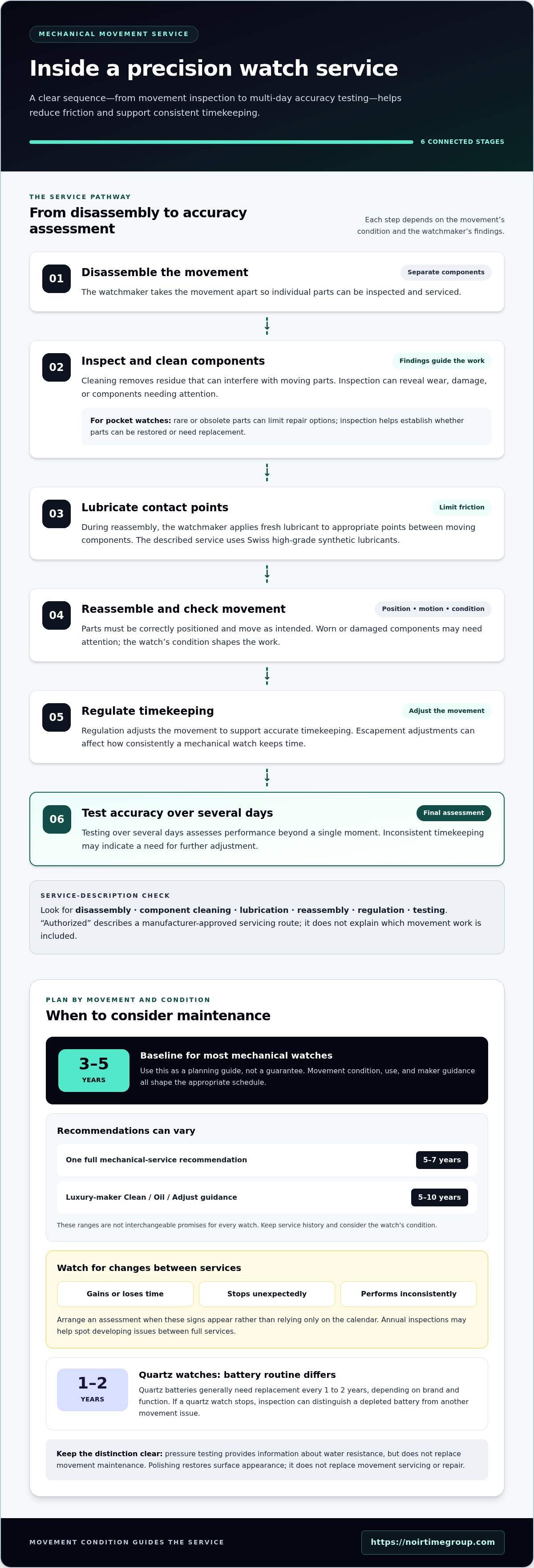
A mechanical service follows a clear sequence: disassemble the movement, clean its components, lubricate them, then reassemble and regulate the movement. Each step helps reduce friction and support consistent accuracy.
Movement Disassembly and Cleaning
The watchmaker separates the movement into components so each part can be inspected and cleaned individually. Cleaning removes residue that can interfere with moving parts, while inspection can reveal wear, damage, or components needing attention. Pocket watch servicing also involves cleaning the movement before applying fresh lubricants. The parts’ condition guides the next steps.
Lubrication and Movement Regulation
During reassembly, the watchmaker applies lubricant to appropriate contact points in the movement. The page describes the use of Swiss high-grade synthetic lubricants during reassembly. Correct lubrication helps limit friction between moving components. Regulation then adjusts the movement to support accurate timekeeping. Look for a process that includes careful lubrication and a final accuracy assessment, not cleaning alone.
Reassembly involves more than putting parts back in place. The watchmaker checks that components are correctly positioned and move as intended, since a misplaced or worn part can affect performance. After servicing, watchmakers test accuracy over several days. This extended observation assesses timekeeping beyond a single moment and may reveal inconsistent performance that needs further adjustment.
A mechanical overhaul addresses the movement as a connected system, not just the visible symptom. An automatic movement also relies on its winding mechanism to maintain power while the watch is worn. During an overhaul, the watchmaker can clean and inspect the movement, address worn or damaged components, then regulate and test it after reassembly. Luxury watches may need particular care when handling movement components and the case, but the service sequence still depends on condition.
Pocket watch servicing follows the same core steps: movement disassembly, cleaning, fresh lubrication, reassembly, and accuracy testing. Age and component condition shape the work. Rare or obsolete parts can limit repair options for antique and vintage pocket watches, so inspection must establish whether existing components can be restored or need replacement. A broken mainspring, for example, can stop a mechanical pocket watch completely.
These steps clarify what to look for in a service description: movement disassembly, component cleaning, lubrication, reassembly, regulation, and testing. “Authorized” describes a manufacturer-approved servicing route; it doesn’t explain what movement work is included. For a mechanical or automatic watch with irregular timekeeping, the movement’s condition and test results guide the appropriate repair.
Recommended service intervals
Delaying escapement repair can worsen timekeeping and leave moving parts operating with unnecessary friction. Continued operation may contribute to wear, making later servicing more involved than addressing the problem promptly.
Most mechanical watches need professional maintenance every three to five years. Treat that interval as a planning guide and watch for changes between services. If a watch starts gaining or losing time, stops unexpectedly, or performs inconsistently, arrange an assessment rather than waiting for the calendar. Accurate timing depends on the movement’s condition, not simply its age.
Suggested schedules vary. One service recommendation calls for a full mechanical-watch service every 5 to 7 years, while luxury watch manufacturers typically advise a Clean/Oil/Adjust restoration service every 5 to 10 years. These ranges aren’t interchangeable promises for every watch. The movement, its use, and the maker’s guidance all shape the appropriate schedule. Keep the watch’s service history, so the next interval can be considered against its previous maintenance.
Annual inspections can help spot developing issues, even when a watch seems to work normally. A yearly inspection may identify changes in timekeeping or visible condition before they become obvious failures. A pressure test can provide useful information about a watch’s water resistance, but service timing should also reflect its condition. Pressure testing doesn’t replace movement maintenance.
Quartz watches follow a different routine. Their batteries generally need replacement every 1 to 2 years, depending on the brand and function. A depleted battery stops the watch, but a stopped quartz watch shouldn’t automatically be treated as needing only a battery replacement. Inspection can distinguish a depleted battery from another movement issue. Battery replacement and movement servicing address different needs.
Use observable signs alongside calendar intervals. If a mechanical watch runs irregularly, stops, or no longer keeps its usual accuracy, arrange an assessment. A cracked crystal or visible case damage also deserves attention because it can affect the movement’s protection. Polishing restores surface appearance, but it doesn’t replace movement servicing or repair. Preserving a watch means attending to both function and exterior condition.
For a practical maintenance plan, note the last service date, track changes in timekeeping, and follow the interval suited to the watch. Most mechanical watches use a three-to-five-year baseline; yearly inspections help monitor condition between full services. For quartz watches, keep battery replacement in view, while treating unexplained stopping or irregular operation as a separate reason for assessment.
Do you repair luxury watch brands?
An independent watchmaker works outside a manufacturer’s authorized service network, while an authorized center follows that brand’s service system. The distinction concerns procedures, parts access, and brand-specific requirements, not an automatic measure of repair quality.
To find a qualified local watchmaker, search using your city, the watch’s brand, and its movement type. Look for clear experience with the specific timepiece and repair needs, such as escapement adjustment or moisture damage. An explanation of the proposed inspection and service steps can help you understand how the work relates to your watch.
Luxury watch servicing starts by identifying the watch and its movement, then examining the reported issue. A timepiece that loses accuracy may need adjustment, while a damaged crystal or signs of moisture point to different concerns. These symptoms don’t establish the cause on their own. The movement’s condition and the watch’s service history shape the repair plan.
Manufacturer-authorized servicing is relevant when the brand’s procedures, parts, or documentation matter to the owner. An authorized center works within the manufacturer’s system. Independent watchmakers may service multiple brands, but parts access and technical information vary by movement. Neither route suits every repair; the watch’s needs and the owner’s priorities matter.
Ask what the service covers before choosing a repair route. An accuracy complaint, for example, may call for movement inspection and regulation, while a broken component may need replacement. A service that addresses only the visible symptom may leave another movement issue unresolved. A clear explanation connects the observed condition with the proposed work.
The case and exterior condition matter too. Moisture inside a watch can affect components beyond the crystal, so inspection should include the case seals and movement. Polishing may improve the appearance of surface marks, but it doesn’t repair a movement or restore damaged internal parts. Keeping cosmetic work separate from mechanical servicing makes the scope easier to understand.
For a local search, include the exact brand and model rather than searching for “luxury watch repair” alone. Then narrow results to the relevant work, such as automatic movement servicing or escapement adjustment. A watchmaker’s experience with that movement, a clear diagnosis, and a defined service scope are useful signs of a suitable match.
Before authorizing work, make sure the diagnosis identifies the affected part or system and explains whether cleaning, adjustment, or replacement is involved. An escapement fault differs from a damaged crystal, for example, even if both affect a watch’s reliability. That distinction helps you compare authorized and independent service routes based on the repair your timepiece needs.
Escapement-related precision and timekeeping adjustments
The escapement transfers energy through a mechanical movement and helps regulate timekeeping. Diagnosis distinguishes an escapement fault from other causes of inaccurate running before adjustments or replacement parts are considered.
Escapement Diagnosis
A watchmaker examines the movement’s operation and compares its timekeeping with the reported symptoms. They inspect the escapement and related components for wear, damage, or irregular movement. The findings help distinguish an escapement problem from issues elsewhere in the movement. Ask for a diagnosis that connects the observed condition to the recommended repair.
Escapement repair costs in the United States depend on the movement, damaged components, replacement-part needs, and work required. A simple adjustment differs in scope from a repair involving worn or broken components, and those factors determine the service cost.
Balance and Escapement Adjustments
The balance wheel and escapement work together to regulate a mechanical watch’s operation. After inspecting the parts, a watchmaker may adjust how they interact, then assess whether the movement performs more consistently. The aim is to address the cause of the timing issue, not merely change the displayed time. Original components and their condition can influence the repair approach.
Accuracy testing after adjustment shows how the movement performs beyond the workbench. A watchmaker can test a serviced movement over several days, observe its timekeeping, and make further adjustments where needed. This testing is distinct from bracelet or clasp work, which changes fit rather than movement performance.
A full movement overhaul takes from a couple of weeks to two months. The repair’s scope, parts requirements, and testing affect the schedule. An escapement adjustment differs from an overhaul involving disassembly, repair, and reassembly, so the service steps determine the time involved.
Bracelet resizing and clasp adjustment address comfort and security on the wrist, not timekeeping. A watchmaker can remove or reposition bracelet links and adjust the clasp for a suitable fit. Keep removed links and original components together, especially when preserving a luxury watch. These external adjustments are separate from escapement maintenance and aren’t movement repairs.
Before servicing, describe when the watch gains or loses time, or stops, and share its maintenance history. This helps the watchmaker compare the symptom with the movement’s condition. Afterward, keep the service record, including any replacement parts and adjustments. A “certified” description alone doesn’t explain what was inspected or changed; the documented repair scope does.
Mechanical, quartz, and automatic watch repair
The movement type shapes the repair approach. Precision escapement repair and watch servicing address mechanical timekeeping, while quartz repairs often start with the battery and its connection to the movement. Identifying the power source helps distinguish a depleted battery from a mechanical-component fault.
A mechanical watch stores energy in its mainspring and releases it through the movement. If a pocket watch’s mainspring breaks, the watch can stop completely. Repair may involve examining the mainspring and related components, then restoring the movement’s operation. Careful diagnosis matters because a stopped watch can have more than one possible cause.
An automatic watch is mechanical, but its winding system also uses movement from the wearer’s wrist to maintain power. If it stops or runs irregularly, a watchmaker considers both the timekeeping mechanism and the automatic winding components. A winding problem, for example, may prevent the mainspring from receiving power, while an escapement issue affects how stored energy is released. Symptoms and inspection findings guide the repair.
Quartz repair follows a different path. A quartz pocket watch needs a battery to run, and it stops when that battery is depleted. Battery replacement is recommended every 1 to 2 years, depending on the brand and function. If a fresh battery doesn’t resolve irregular operation, the issue may involve another part of the movement. Quartz watches generally need less frequent servicing than mechanical pocket watches, but still need inspection for irregularities and battery replacement as needed.
Don’t open or attempt to repair a stopped pocket watch at home. Doing so can cause further damage, especially if small movement components are disturbed. A professional watchmaker can identify whether the cause is a depleted battery, broken mainspring, or another movement fault, then determine the appropriate repair.
Use this sequence to describe the problem accurately:
- Identify whether the watch is mechanical, automatic, or quartz.
- Note whether it stopped, runs inconsistently, or shows another timekeeping change.
- For quartz, record when the battery was last replaced.
- For mechanical or automatic watches, share known service history and describe when the issue occurs.
These details distinguish routine battery replacement from movement repair. A full movement overhaul takes from a couple of weeks to two months. Precision escapement repair and watch servicing may be relevant when a mechanical or automatic watch shows irregular timekeeping, but diagnosis must identify the cause. Quartz, mechanical, and automatic watches don’t share one repair process; their power sources and components determine the appropriate inspection and service steps.
Noir Time Group: Rolex Submariner Date 126613LN
Noir Time Group offers Certified Watch Repair for owners seeking professional service for a timepiece. If you’re considering a Rolex Submariner Date 126613LN or Rolex Submariner Date 126618LN, the team also offers a Watch Sourcing Service to help with a specific watch search.
Turn to Certified Watch Repair when your watch needs attention beyond routine care, such as assessment of a timekeeping or movement concern. If you’re exploring a particular Rolex model, sourcing is a separate option, focused on finding the timepiece you’re seeking.
Contact Noir Time Group to discuss Certified Watch Repair or watch sourcing.
Choose the Right Next Step for Your Watch
A useful repair conversation starts with a clear description of what your watch is doing. Note when timekeeping changes, whether the watch stops, and any recent service or incident. This gives the watchmaker a practical starting point for assessing the movement and explaining the work needed. For precision escapement repair and watch servicing, a diagnosis based on the watch’s condition is more useful than guessing from symptoms alone.
If you’re considering a luxury timepiece rather than arranging a repair, separate those goals. Noir Time Group offers the Rolex Submariner Date 126613LN and Rolex Submariner Date 126618LN, along with a Watch Sourcing Service for a specific search. Keeping the model you’re interested in and your reason for reaching out clear can make the next conversation more focused.
Whether your next step is discussing a repair or exploring a watch, take the time to explain what you’re looking for. Contact Noir Time Group to start the conversation and move forward with confidence.
Frequently Asked Questions
What Is Professional Watch Repair and Maintenance?
Professional watch repair involves examining a watch, identifying the cause of a problem, and carrying out appropriate work on its movement or other components. Maintenance also includes preventive inspection, even if the watch still runs. Keeping a record of service dates and accuracy changes, for example, helps a watchmaker distinguish a new fault from an earlier pattern.
Are watch repairs completed on-site?
Not every repair can be completed where a watch is received. The work may require movement diagnosis, component repair, replacement parts, or testing after servicing. Those steps shape the repair process. Before bringing in a timepiece, record its model and describe the problem clearly, such as whether it stops after winding or runs inconsistently throughout the day.
Can you restore vintage or heirloom watches?
Vintage and heirloom watches can be assessed for repair, but the available work depends on their condition and components. Rare or obsolete parts may limit options for antique and vintage pocket watches. Keep service records and any removed original pieces with the watch. These details help document its history and clarify which components changed during restoration.
What signs indicate my watch needs repair?
Arrange an assessment if your watch stops unexpectedly, develops inconsistent timekeeping, or shows visible damage such as a cracked crystal. Moisture inside the case also calls for prompt attention because it can affect internal components. Note when the symptom occurs and whether it follows winding, wearing, or a recent incident. A specific description gives the watchmaker useful diagnostic context.
When Do You Need Service?
Most mechanical watches need professional maintenance every three to five years. Use the watch’s service history to plan, and arrange an inspection sooner if its performance changes. Quartz watches have a separate battery schedule, with replacement generally needed every 1 to 2 years depending on brand and function. Keep the model, last service date, and observed changes together for reference.
Why isn’t my pocket watch working?
A pocket watch may stop because of a power source or movement fault. A depleted battery can stop a quartz pocket watch, while a broken mainspring can stop a mechanical one. Avoid opening or attempting to fix it yourself, since this can cause further damage. Note whether it stopped suddenly or after timekeeping problems, then arrange a professional assessment.
What does precision escapement repair involve in watch servicing?
Precision escapement repair involves examining the parts that regulate how energy moves through a mechanical watch. The watchmaker checks for wear, damage, or irregular operation, then determines whether adjustment or repair is needed. The service should connect the diagnosis to the observed timekeeping issue. Accuracy testing afterward helps assess the movement’s performance during continued operation.
What are the signs a watch escapement needs repair or adjustment?
Irregular timekeeping, repeated stopping, or a change in running behavior can indicate an escapement or another movement issue. These symptoms alone don’t identify the faulty component. Record whether the problem appears after winding, during wear, or at rest, and share that pattern during assessment. A watchmaker can compare your report with the movement’s operation to guide diagnosis.
