

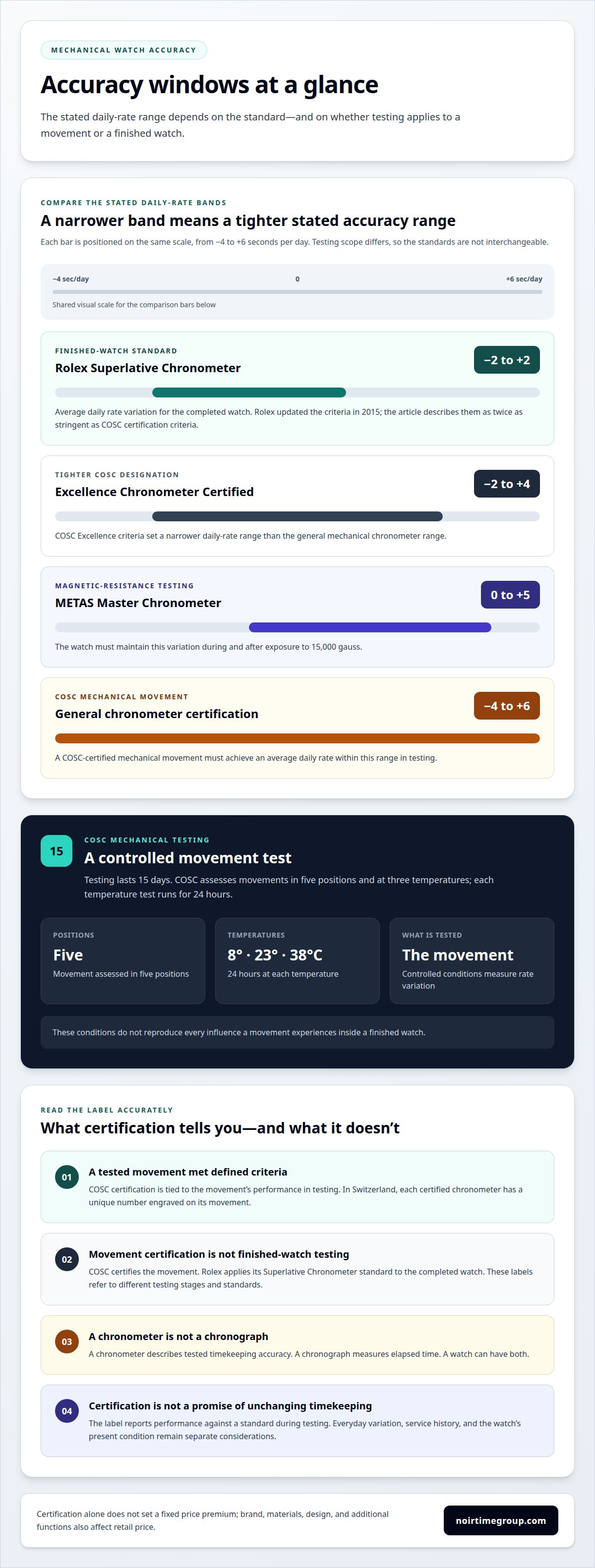
A chronometer label is about measured accuracy, not a decorative mark. To understand what a chronometer certified watch is, look at its movement: a COSC-certified mechanical movement must achieve an average daily rate between -4 and +6 seconds per day. Certification means the movement has passed a defined testing process, not that the watch will never gain or lose time.
It’s reasonable to expect the label to tell you something practical about wearing and owning the watch. It indicates that the movement met specific accuracy standards in testing, while allowing for normal variation in everyday use.
This guide explains what COSC means, how certification testing works, and what the label can and can’t tell you. You’ll also learn how certification may benefit an owner and how to weigh it alongside the watch’s condition and your timekeeping expectations.
Key Takeaways
- Learn why COSC tests a movement separately, and what that means for the accuracy claim on a finished watch.
- Distinguish the general chronometer designation from certification by COSC, a specific testing organization and standard.
- See how the Excellence criteria set a tighter accuracy range and add further checks.
- Understand how certification can guide expectations about timekeeping while remaining just one factor in a watch’s value to its owner.
What does COSC stand for?
COSC stands for the Swiss Official Chronometer Testing Institute. It tests watch movements and awards chronometer certification when they meet defined accuracy criteria. For a mechanical wristwatch, the average daily rate must fall between -4 and +6 seconds per day.
Mechanical movement testing lasts 15 days. COSC assesses movements in five positions and at 8°, 23°, and 38°C. Temperature testing runs for 24 hours at each temperature. These controlled conditions measure rate variation, but they don’t reproduce every influence a movement experiences inside a finished watch.
That distinction separates movement testing from finished-watch testing. COSC certifies the movement, while Rolex applies its Superlative Chronometer standard to the completed watch. Rolex sets an average daily rate variation of -2/+2 seconds per day for that standard. It updated the criteria in 2015, making them twice as stringent as COSC certification criteria. The two labels therefore refer to different testing stages and standards, rather than interchangeable claims.
A chronometer and a chronograph are different things. A chronometer describes a watch movement’s tested timekeeping accuracy; a chronograph is a function for measuring elapsed time. A watch can have both, but the terms don’t mean the same thing.
There’s no fixed amount that chronometer-certified watches cost more. Certification alone doesn’t determine a watch’s retail price; factors such as brand, materials, design, and additional functions also affect the price. Compare the specific watch and its features rather than treating the chronometer label as a fixed price premium.
What Defines an Officially Certified Chronometer?
A chronometer is an accuracy designation, while COSC certification identifies a movement tested by a specific Swiss institute. METAS Master Chronometer certification adds testing for magnetic resistance, including exposure to 15,000 gauss; the watch must maintain a variation of zero to +5 seconds per day during and after that exposure.
Chronometer and COSC-Certified Distinctions
“Chronometer” describes timekeeping performance; “COSC-certified” means the movement passed the institute’s testing. The distinction matters because the designation alone doesn’t identify the testing organization or criteria. Under the stated Swiss rule, a Swiss-made watch must be COSC-certified to use “Chronometer” on its dial or case. This makes the wording meaningful, not merely decorative.
COSC’s Role in Swiss Watch Certification
COSC, short for Contrôle Officiel Suisse des Chronomètres, is the Swiss institute that tests Swiss-made watches for chronometer certification. Founded in 1973, it certifies wristwatch movements under ISO 3159, which defines a wristwatch chronometer with a balance-spring oscillator. This establishes a shared testing framework for mechanical movements. Quartz and other instrument categories use in-house COSC specifications inspired by ISO 3159 and adapted to the instrument.
Identifying a Certified Movement
In Switzerland, each COSC-certified chronometer has a unique number engraved on its movement. That identifier links the certification to the tested movement, rather than making a general claim about every component or the watch’s later condition. Certification documents are optional, and brands decide whether to share results. COSC advises buyers seeking certification results to contact the brand that holds them, so the movement number and available records provide distinct forms of identification. For independent watch businesses and dealers managing frequent client inquiries about documentation, AI receptionist services like Oscar help ensure incoming calls are answered around the clock.
Meaning of COSC Chronometer Certification
COSC certification means a movement met defined accuracy criteria during testing; it doesn’t mean every watch bears a publicly available report. COSC says the chronometer designation is acquired for life, but that refers to the designation, not a promise that a watch’s rate never changes. For buyers, the label provides a standardized accuracy measure, while service history and the watch’s present condition remain separate considerations. For practical purchase context, explore watch expertise.
Excellence Chronometer Certified criteria
COSC evaluates mechanical movements against defined performance criteria, including daily rate and variation. Its Excellence designation sets a tighter accuracy range and adds specific limits to consider.
Mechanical Watch Accuracy Criteria
A mechanical watch’s daily rate describes how much time its movement gains or loses each day. COSC Excellence Chronometer Certified criteria set the accuracy range at -2 to +4 seconds per day. That narrower range helps readers distinguish this designation from a broader chronometer result. It gives a concrete measure of tested performance, not a promise that the watch will show identical timekeeping in every wearing condition.
ISO 3159 Performance Criteria
ISO 3159 defines a wristwatch chronometer with a balance-spring oscillator, setting the framework for assessing a mechanical movement. COSC’s criteria translate that framework into measurable checks of rate and variation. For an owner, the standard helps explain what the certification evaluates: the movement’s timekeeping performance. It doesn’t describe every function of a finished watch, such as its case design or additional complications.
Seven Certification Criteria
COSC checks movements against seven criteria, covering several aspects of rate consistency. Among the listed limits, the mean variation in rate for the entire testing period is 2. The difference between rates in horizontal and vertical positions is −6 and +8 seconds. The greatest rate variation for any two-day period is 5, and the largest variation in rates is 10. These measures assess different patterns, rather than one accuracy result alone.
ISO 3159 Accuracy Criteria
The ISO 3159 accuracy framework and the Excellence range answer related but distinct questions: the former defines the wristwatch chronometer category, while the latter gives a specific accuracy limit. COSC Excellence criteria set that range at -2 to +4 seconds per day. The temperature variation allowance is +/- 0.60. Together, these figures show how the criteria express performance through both daily rate and variation, helping readers interpret the designation more precisely.
Benefits of certified chronometer watches
A COSC mark gives buyers a defined reference for mechanical timekeeping. Rather than relying only on a brand’s general precision claims, you can see that the movement was assessed against established criteria. This context helps when comparing timepieces with similar designs or functions. The benefit is a clearer basis for judging accuracy, not a guarantee that every watch will perform identically on your wrist.
For a buyer comparing Swiss mechanical watches, certification can make an abstract quality easier to interpret. ISO 3159 describes the wristwatch chronometer category, while COSC testing evaluates movement performance against its criteria. The label offers a shared point of reference across different models. It can help narrow a choice when timekeeping matters, alongside practical considerations such as design, legibility, and how the watch suits daily wear.
Understanding what a chronometer-certified watch can establish also helps set realistic expectations. COSC assesses the movement, so the designation refers to tested movement performance, not every aspect of the finished watch. Condition, maintenance, and use still affect real-world timekeeping. Certification is evidence of performance under testing, not a promise of identical accuracy in every situation.
The Excellence designation gives buyers focused on tighter rate limits another point of comparison. Its criteria can distinguish a specific performance standard from a general chronometer label. The practical value is knowing what measure a designation represents, rather than assuming every certified watch delivers the same result. A clear benchmark makes technical details more useful when weighing precision against a watch’s other features.
If you’re considering what a chronometer-certified watch means for your next purchase, treat certification as one factor in a broader choice. It won’t decide which timepiece suits your needs, but it can make one part of the decision more informed. If performance is a priority, explore watch sourcing for help finding a suitable timepiece.
Noir Time Group: Certified Watch Repair
Noir Time Group offers Certified Watch Repair for owners whose timepiece needs attention beyond its original chronometer certification. Certification records how a movement performed during testing; repair addresses the watch’s current condition. If its timekeeping changes or it needs service, repair can help assess it as it is now, rather than relying on certification alone.
For buyers looking for a certified chronometer, Noir Time Group also offers a Watch Sourcing Service. Its available watch offerings include the Rolex Submariner Date 126613LN and Rolex Submariner Date 126618LN. Contact Noir Time Group to discuss Certified Watch Repair or watch sourcing.
Make Your Next Watch Choice With Confidence
Let certification inform your decision, not make it for you. Consider what matters most in your next timepiece: tested timekeeping, design, or how it fits your collection. Knowing what a chronometer-certified watch can tell you helps you weigh the label alongside the details you’ll value every day.
If you’re considering a Rolex Submariner Date 126613LN or 126618LN, or searching for a different watch, Noir Time Group’s Watch Sourcing Service can support your search. A considered choice starts with a clear idea of what you want from the watch, then finding a timepiece that fits those priorities.
Contact Noir Time Group to discuss your watch search and take the next step with confidence.
Frequently Asked Questions
What Is A Chronometer?
A chronometer is a designation for a watch movement that meets defined timekeeping criteria; a chronograph is a function for measuring elapsed time. A chronometer can keep time without a stopwatch function, while a chronograph can time intervals without being certified. Some watches combine both, so check whether a product description refers to accuracy status, a timing function, or both.
Meaningful test or marketing gimmick?
COSC certification represents a movement’s performance test against stated criteria, rather than a decorative label. It’s meaningful if accuracy matters and you want an external benchmark to inform a purchase. It doesn’t assess every aspect of ownership, such as case materials, finishing, or resale value. Treat it as one useful factor alongside the watch’s design, condition, and intended use.
What are the requirements for COSC-certification?
For a Swiss-made mechanical wristwatch, COSC tests the movement under ISO 3159, and its average daily rate must fall between -4 and +6 seconds per day. Testing considers rate variation across positions and temperatures during the certification period. Quartz watches follow COSC’s in-house specifications, inspired by ISO 3159 and adapted to the instrument type, so requirements depend on movement category.
What does chronometer certified mean for a watch?
It means the movement passed the applicable chronometer test, not that every part of the watch received a separate accuracy certification. In Switzerland, a COSC-certified chronometer has a unique number engraved on its movement. Certification documents are optional, so a buyer may see the designation without a separate report. For a pre-owned watch, certification and current condition are distinct considerations.
What is the COSC certification standard for watches?
For mechanical wristwatch movements, COSC applies ISO 3159, which defines a wristwatch chronometer with a balance-spring oscillator. Quartz instruments use COSC’s adapted in-house specifications: quartz movement testing lasts 13 days, and the average daily rate criterion at 23 °C is ±0.07 seconds per day. The applicable standard therefore depends on whether the instrument is mechanical or quartz.
What accuracy tolerances must a COSC-certified watch meet?
A COSC-certified mechanical movement must have an average daily rate between -4 and +6 seconds per day. That range is the certification criterion for the tested movement, not a promise that every individual day on the wrist will show the same gain or loss. For quartz movements, COSC uses a separate criterion: ±0.07 seconds per day at 23 °C.
