

Choosing between automatic and quartz luxury watches comes down to what you value most: quartz generally keeps time more accurately, while an automatic movement offers a mechanical experience that depends on winding and wear. Automatic watches often have a power reserve of 38 to 72 hours, so one left unworn beyond that may stop and need resetting. Neither movement is automatically the better choice for every wearer.
It’s worth looking beyond the purchase price. Battery replacements and routine care affect quartz ownership, while automatic watches need periodic servicing. A useful comparison considers how each movement works, its upkeep, and how often you plan to wear the watch.
This guide explains the differences between the movements, compares the factors that shape ownership costs, and clarifies what winding and power reserves mean in everyday use. You’ll come away with a practical way to choose the type that best fits your preferences and routine.
Key Takeaways
- Choose quartz for straightforward, dependable timekeeping; choose automatic for the appeal of a mechanical movement and the hands-on routine that comes with it.
- Understand what powers each watch: a battery and crystal regulate quartz, while wrist movement winds an automatic watch’s mainspring.
- Compare ownership costs by considering both the initial purchase and ongoing care, since battery changes and mechanical servicing affect the long-term value differently.
- Check an automatic watch’s power reserve against how often you wear it, so you know when it may need winding and resetting.
Quartz vs Automatic Movement: Which Watch Is Right for You?
Quartz usually wins on timekeeping precision, while an automatic movement offers mechanical character and a different wearing routine. Quartz batteries commonly need replacement every 3 to 5 years, and opening the case makes correct reassembly important for preserving its water resistance.
Accuracy and Timekeeping Trade-Offs
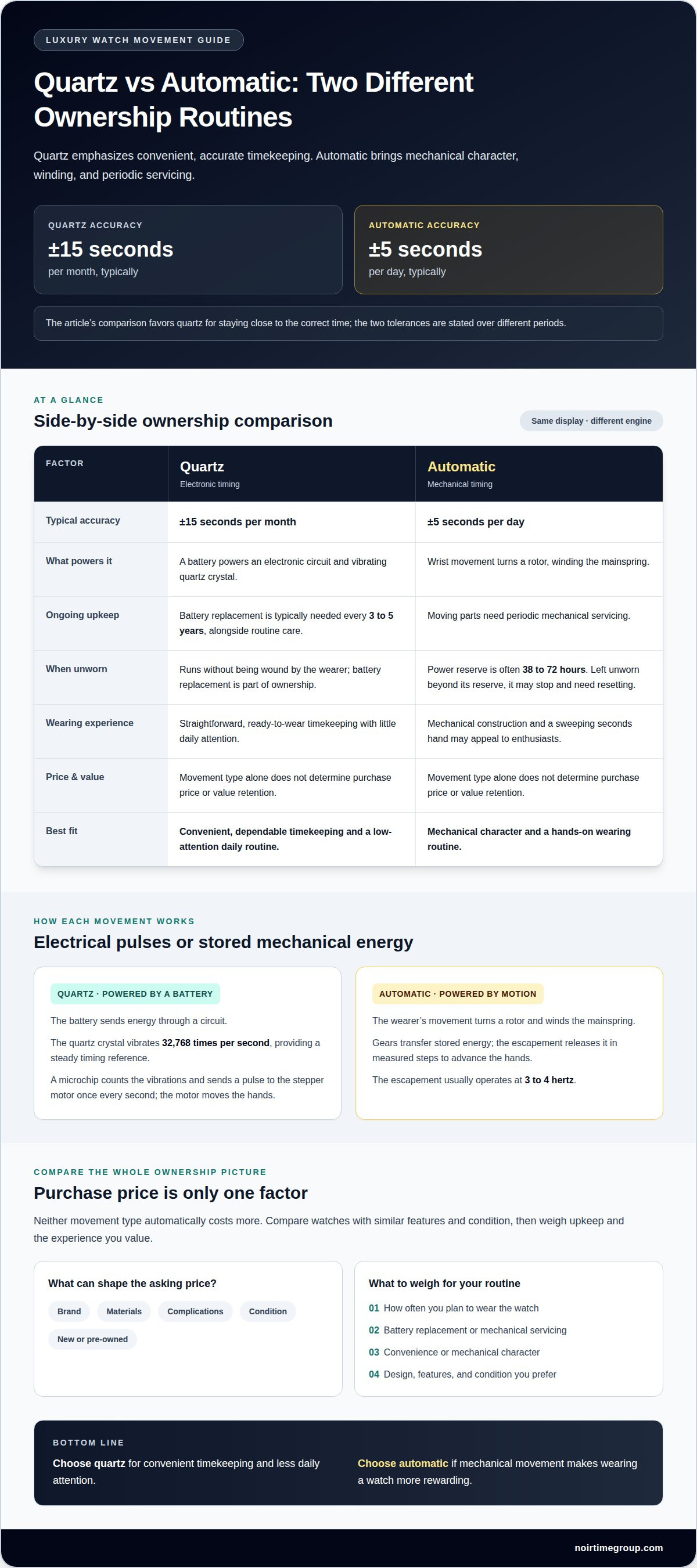
Quartz and automatic watches regulate time differently, so their typical accuracy tolerances use different periods. Quartz watches typically have accuracy of ±15 seconds per month; automatic watches typically have a tolerance of ±5 seconds per day. That comparison favors quartz for keeping close to the correct time. An automatic watch’s mechanical movement can vary, making occasional adjustment part of ownership.
Quartz Accuracy and Convenience
A quartz movement uses electronic pulses to regulate time, so it runs without being wound by the wearer. That makes quartz practical if you want to pick up a watch and wear it with little daily attention. Battery replacement is part of its upkeep, and because the case may need to be opened, the seals should be handled carefully to preserve water resistance.
Maintenance and Style Trade-Offs
Automatic watches replace battery changes with mechanical upkeep. Their moving parts need periodic servicing, while quartz ownership typically centers on battery replacement and routine care. The experience differs, too: enthusiasts may enjoy an automatic movement’s sweeping seconds hand and mechanical construction, while quartz offers straightforward, ready-to-wear timekeeping. Choose according to whether you value mechanical character or convenience more.
| Option | Typical accuracy | Ownership consideration | Best fit |
|---|---|---|---|
| Quartz | ±15 seconds per month | Battery replacement every 3 to 5 years | Convenient timekeeping |
| Automatic | ±5 seconds per day | Mechanical servicing | Mechanical character |
Choose quartz for convenient timekeeping; choose automatic if the mechanical movement makes wearing a watch more rewarding.
How quartz and automatic movements work
A watch movement is its engine: it converts stored energy into the seconds, minutes, and hours displayed on the dial. Quartz and automatic movements generate that energy differently, using an electrical circuit or a mechanical system.
Quartz Battery and Vibrating Crystal
A quartz movement uses a battery to send energy through its circuit. The quartz crystal vibrates 32,768 times per second, giving the circuit a steady timing reference. A microchip counts those vibrations and sends a pulse to the stepper motor once every second. The motor moves the hands forward. Battery replacement is part of ownership, typically every 3 to 5 years.
Automatic Battery-Free Movement
An automatic movement stores energy in a wound mainspring rather than drawing power from a battery. As the wearer moves, a rotor turns and winds the spring. Gears transfer that stored energy through the movement, and the escapement releases it in measured steps to advance the hands. Leave the watch unworn for a few days, and it may stop when its stored energy runs out.
Movements as Watch Engines
Both systems power the same display, but their internal processes differ. In quartz, electronic pulses drive a motor; in an automatic, gears and an escapement distribute mechanical energy. The automatic escapement usually operates at 3 to 4 hertz. That means the movement releases energy in regular intervals, rather than relying on a battery-powered motor to advance the hands.
Movement choice also matters across luxury brands. Current Rolex production models use in-house automatic calibers, combining a mechanical power source with the brand’s own movement design. For a specific reference, a luxury watch sourcing service can help connect your preferences with a suitable timepiece.
Purchase price and total cost of ownership
In the US, luxury quartz and automatic watches come at a range of price points. Brand, materials, complications, condition, and whether a watch is new or pre-owned all influence the price. Movement type alone doesn’t determine it. Consider the purchase price separately from ongoing upkeep and the features that matter to you.
Purchase Price Differences
A quartz movement doesn’t guarantee a lower purchase price, and an automatic movement doesn’t automatically command a premium. Brand, case materials, finishing, complications, and condition all affect the asking price. First compare watches with similar features and condition, then consider their movements. Exploring available models through established dealers like Watch Capital can help illustrate whether a price difference reflects the overall design or the movement itself.
Price and Accessibility
Accessibility depends on more than movement type. Quartz may suit someone who prioritizes practical timekeeping, while automatic watches may appeal to enthusiasts who value mechanical motion and watchmaking heritage. New and pre-owned examples of either type can differ in condition and included features, which is why knowledgeable dealers like Affordable Swiss Watches Inc. recommend carefully vetting authenticity and provenance. Set your budget around the attributes you want instead of assuming all quartz or automatic watches belong to one price tier.
Price and Value
Price and value aren’t interchangeable. An automatic movement may appeal for its mechanical construction, while quartz offers convenient, battery-powered timekeeping. Neither feature guarantees that a watch will retain its value. Consider how often you’ll wear it, whether its design suits your routine, and which movement you’ll enjoy. These factors make the decision more personal than a simple comparison of movement labels.
Total Cost of Ownership
Include upkeep in your ownership comparison. Quartz watches typically need battery replacement every 3 to 5 years, alongside routine care. Automatic watches require periodic servicing, so their upkeep involves mechanical attention instead of a battery change. The frequency and nature of care differ, which affects the ownership experience even when the initial purchase prices seem comparable. Choose the watch whose maintenance fits your expectations and wearing habits.
Power reserves and winding
A power reserve describes how long an automatic watch runs after its mainspring is wound. Most automatic movements have a reserve of 38 to 72 hours, but quartz watches draw power from a battery instead.
For automatic watches, power reserve shapes the wearing routine. Wear the watch or wind it to keep the mainspring powered. If it sits unworn beyond its reserve, it stops, and you’ll need to wind it and reset the time before wearing it again. Daily wear may keep it running through wrist movement, while rotating among several watches can mean more frequent resets.
Quartz ownership works differently. The battery powers the movement, so the watch doesn’t depend on daily wear or manual winding to keep time. It can continue running while unworn as long as the battery has power. Battery replacement is the main power-related task, rather than winding a mainspring.
Power reserve is one specification to weigh against your routine, not a measure of prestige or craftsmanship on its own. A longer reserve lets an automatic watch sit off the wrist for longer before stopping. The practical benefit depends on how often you wear it and whether you’re comfortable resetting it after a break. Wearing one watch regularly calls for a different routine than switching among several.
Quartz can be a practical route to low-effort timekeeping, while automatic watches appeal to people who enjoy the winding ritual and mechanical motion. Neither power source guarantees greater precision in every timepiece. Choose according to how you wear your watch, whether winding feels engaging or inconvenient, and how much reserve suits your rotation.
If you’re looking for a luxury watch that fits your wearing routine, explore luxury watch options.
Noir Time Group
Noir Time Group can help you move from comparing movements to choosing or maintaining a luxury timepiece. If you have a preferred brand, reference, or movement style in mind, its Watch Sourcing Service can help with the search. For a watch that needs professional attention, Certified Watch Repair offers a relevant next step. The distinction is practical: sourcing supports a purchase decision, while repair addresses the care of a timepiece you own. Consider which features matter most, such as quartz convenience or an automatic movement, then make that preference clear when discussing your needs. Noir Time Group also offers Rolex Submariner Date 126613LN and Rolex Submariner Date 126618LN. Contact Noir Time Group to discuss your watch preferences or repair needs.
Choose the Watch That Fits Your Routine
Let your everyday habits guide the decision. Do you want a watch that’s ready to wear after sitting unworn, or do you enjoy winding and mechanical motion? Then consider how its design works with your clothes and the occasions you have in mind. These preferences can be a better guide than the movement label alone.
If you’re still weighing automatic vs quartz luxury watches, narrow your options to features you’ll appreciate over time. A clear preference for a style, brand, or reference can turn broad research into a focused next step. Noir Time Group’s Watch Sourcing Service can help you find a specific timepiece.
Contact Noir Time Group to discuss what you’re looking for. Take the next step with a clearer sense of what suits you, and enjoy choosing a watch that feels right for your life.
Frequently Asked Questions
Which feels more luxurious?
Luxury depends more on design, finishing, brand, and personal taste than on movement type alone. An automatic may feel special if you enjoy its mechanical motion and winding ritual. A quartz watch can be equally refined in its materials, dial details, and case finishing. Consider how the watch looks and feels on your wrist, not just the technology inside.
How do automatic and quartz luxury watches work?
Quartz watches use a battery, an electronic circuit, and a vibrating crystal to keep time. Automatic watches rely on a mainspring, gears, and a rotor that winds the mechanism as the wearer moves. The difference becomes clear when a watch sits unworn: quartz keeps running while its battery has power, whereas an automatic can stop when its reserve runs down.
What are the main differences between automatic and quartz luxury watches?
The main differences are power source, timekeeping, and ownership routine. Quartz uses a battery and generally needs little attention between replacements. Automatic watches use mechanical parts and may need winding or resetting after a break in wear. Someone who rotates watches may value quartz’s ready-to-wear convenience, while a mechanical enthusiast may appreciate an automatic movement’s engineering.
Are automatic or quartz luxury watches more accurate, and by how much?
Quartz watches generally keep time more accurately. Typical figures are ±15 seconds per month for quartz and ±5 seconds per day for automatic watches. The periods matter: compare monthly variation with daily variation, not just the numbers. Actual performance can differ by movement and condition, but quartz is usually the stronger choice if minimizing time drift is your priority.
How much does it cost to service an automatic luxury watch compared with a quartz watch?
There’s no standard service cost for either type. An automatic’s service addresses its mechanical movement, while quartz care may involve battery replacement or attention to electronic components. Brand, caliber, condition, and the work required determine the final amount. Movement type is a useful starting point, but it isn’t enough to calculate a specific service bill.
How often do automatic and quartz luxury watches need maintenance?
Quartz watches typically need battery replacement every 3 to 5 years, plus routine care and periodic inspection. Automatic watches need periodic servicing to clean, lubricate, and regulate their movements. The appropriate service timing depends on the watch’s movement, condition, and use. Regular attention helps address wear or performance changes before they affect how reliably the timepiece runs.
