

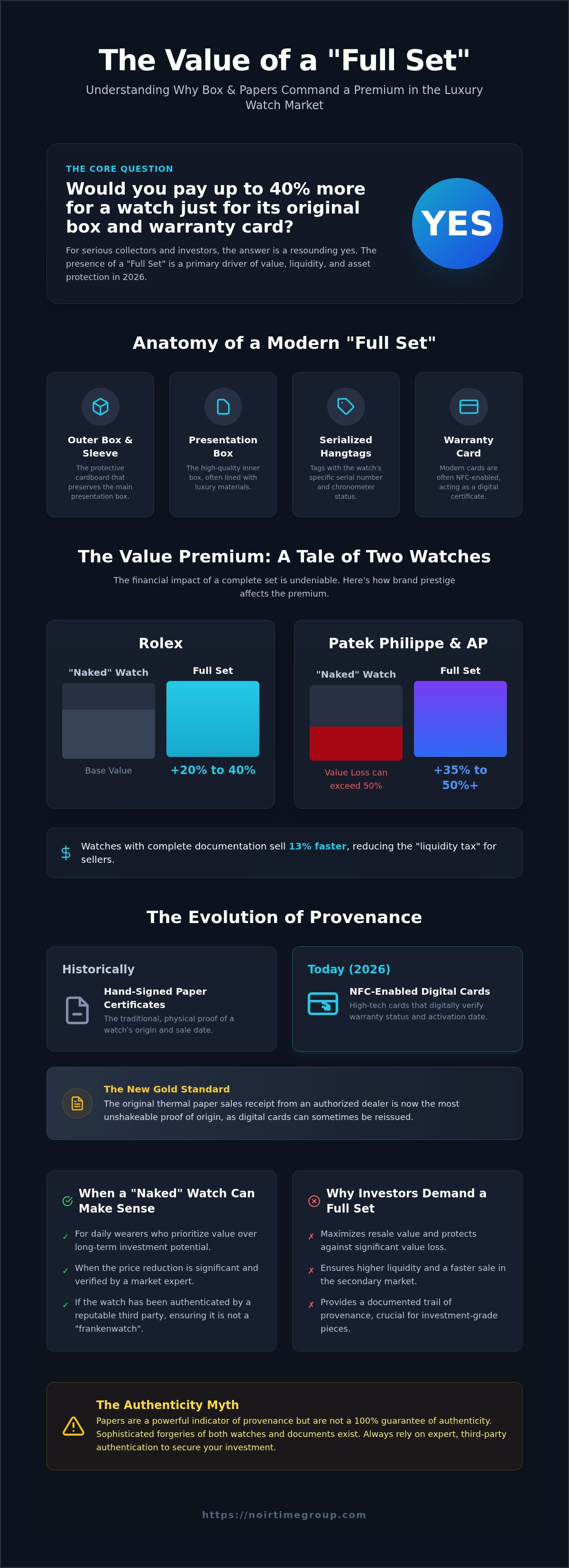
Would you pay 40% more for a watch just because it comes with the original cardboard box and a plastic warranty card? For serious collectors, that premium isn't just a suggestion; it's a market reality. In 2026, the presence of original documentation can increase a Rolex's resale value by 20% to 40%, while missing papers for a Patek Philippe Nautilus can lead to a price reduction of over 50%. It's natural to feel uneasy about "naked" watches or fear that you're overpaying for a piece that might lack proper provenance.
We understand that the pre-owned market feels like a minefield of "frankenwatches" and forged documents. This guide focuses on understanding watch box and papers value to help you protect your investment and avoid costly mistakes. While papers aren't a 100% guarantee of authenticity, they remain the primary driver of liquidity and asset protection. You'll discover the exact percentage-based value loss for watches missing their sets, the shift toward digital warranty cards, and what a true "Full Set" must include to command top dollar in today's market.
Key Takeaways
- Learn how a "Full Set" adds a 20% to 40% premium to Rolex models and why certain high-demand pieces can lose over 50% of their value without documentation.
- Master the nuances of understanding watch box and papers value to distinguish between essential warranty cards and less critical physical packaging.
- Discover why physical papers aren't a final guarantee of authenticity and how expert New York-based authentication protects you from sophisticated forgeries.
- Identify specific scenarios where buying a "watch only" piece makes sense for daily wearers while ensuring your investment remains liquid.
- Explore how specialized sourcing services help collectors secure investment-grade Patek Philippe and Audemars Piguet timepieces with complete provenance.
What Does "Box and Papers" Mean in Luxury Horology?
The term "box and papers" is often used interchangeably with "Full Set," but in the high-stakes world of luxury assets, it functions more like a title deed for a property. Understanding watch box and papers value requires looking beyond the physical cardboard to the provenance it represents. For a collector eye-ing a Rolex Submariner Date 126618LN or a Patek Philippe Nautilus, these items provide a documented trail from the manufacturer to the current owner. This "Full Set" status creates a psychological sense of security; it suggests the previous owner was meticulous and that the watch hasn't been passed through questionable channels.
While the physical box is a nice accessory, the "papers" are the true value driver. Historically, these were hand-signed paper certificates. Today, they have evolved into high-tech documents functioning as a Certificate of Authenticity that links the physical object to its specific manufacture date and original point of sale. Without this link, a watch becomes "naked," often resulting in a 20% to 40% reduction in market price for brands like Rolex.
The Anatomy of a 2026 Full Set
A modern full set is more complex than just a green or wooden box. To command the highest premiums, especially for models like the Audemars Piguet Royal Oak, the set should ideally include:
- The Outer Box and Shipping Sleeve: The white cardboard sleeve protects the "presentation box" from scuffs. Collectors pay a premium for sets that include even these disposable elements.
- The Presentation Box: The high-quality inner box, often lined with leather or velvet.
- Serialized Hangtags: Modern Rolex sets include a green "Superlative Chronometer" tag and a white tag that features the watch’s serial number.
- Warranty Cards: These are now NFC-enabled, allowing dealers to scan the card to verify the warranty status and activation date digitally.
Digital vs. Physical Provenance
The industry has shifted toward digital-first records. Brands like Audemars Piguet and Rolex now use NFC-enabled warranty cards that act as digital keys to a watch's history. Collectors who prioritize understanding watch box and papers value know that a missing shipping sleeve is a minor issue; however, a missing digital warranty card is a major dealbreaker in 2026. This digital shift has made the original sales receipt the "new gold standard." Because digital cards can be replaced or reissued in some specific circumstances, the original thermal paper receipt from an authorized dealer remains the most unshakeable proof of a watch’s origin story. This level of provenance is what separates a standard timepiece from an investment-grade asset.
The Value Premium: How Much Do Box and Papers Add?
The financial impact of a complete set is undeniable. In the secondary market, a watch sold without its original box and papers, often called "watch only" or "naked," typically sees a price reduction of 20% to 40%. This isn't just about the cost of the cardboard; it's about market confidence and liquidity. Data from September 2026 indicates that watches with complete documentation sell 13% faster than those without. In high-velocity markets like New York, this "liquidity tax" can be the difference between a same-day trade and a piece sitting in a display case for months. Understanding watch box and papers value is essential because you cannot simply "buy a box" later to reclaim that lost percentage. A replacement box found on an auction site lacks the serialized connection to the movement, failing to restore the watch's full investment potential.
Brand-Specific Value Gaps
The premium for a full set fluctuates based on brand prestige and model rarity. For mainstream luxury brands, having the box and papers generally results in a 10% to 20% increase in resale value. However, the stakes rise significantly with top-tier manufacturers:
- Rolex: The presence of the original box and papers can increase the resale value by 20% to 40%. For a professional reference like the Rolex Submariner Date 126618LN, collectors demand the full set to ensure the warranty card matches the rehaut serial number.
- Patek Philippe & Audemars Piguet: For highly desirable models like the Patek Philippe Nautilus or Audemars Piguet Royal Oak, the premium for a full set often reaches 35% and can exceed 50% for hyped references.
- Independent Brands: Provenance is critical here. While some brands offer an "Extract from the Archives," this document often confirms the watch's production details without serving as a full substitute for the original sales papers.
The "Naked" Watch Discount
Buying a watch without papers can be a strategic financial move if your goal is personal enjoyment rather than immediate resale. If you are looking for a "daily wearer" like the Rolex Submariner Date 126613LN, purchasing a naked piece allows you to enter the market at a significant discount. This "floor price" represents the intrinsic value of the watch itself. While your ROI upon resale will be lower, your initial capital outlay is also reduced. If you plan to keep the timepiece for a decade, the 20% to 40% savings today might outweigh the future premium, provided you verify the piece through a professional authentication service to mitigate the risks associated with undocumented assets.
The Authenticity Myth: Why Papers Aren’t a Guarantee
A common misconception in the secondary market is that a full set serves as a definitive shield against fraud. While understanding watch box and papers value is critical for pricing, documentation is only as reliable as the watch it accompanies. High-quality forgeries of Rolex warranty cards and Patek Philippe certificates have become increasingly sophisticated. It's possible to find a genuine box and authentic papers paired with a "Frankenwatch," which is a timepiece containing non-original internal parts or a movement swapped from a different reference. In these cases, the papers are technically real, but the asset they describe has been compromised. The presence of documentation often creates a false sense of security that can lead to expensive mistakes.
For high-value pieces like the Audemars Piguet Royal Oak, the focus should shift from the paper to the metal. A professional authentication service in New York acts as a vital bridge for watches, especially those missing papers. This physical verification ensures that every component, from the hairspring to the oscillating weight, matches the manufacturer's specifications for that specific serial number. Relying solely on a plastic card without examining the movement is a risk that serious collectors avoid.
Common Scams to Avoid
One prevalent issue involves blank warranty cards. These are original cards sometimes stolen from authorized dealers before being filled out with forged dates and serial numbers. For vintage collectors, the "mismatched era" trap is common. Sellers might pair a 1970s reference with a modern 2026-style box to inflate the price artificially. Modern digital registries and NFC-enabled cards are helping to curb these scams, but they're not foolproof. Collectors must also be wary of "re-printed" certificates that claim to be from the manufacturer but lack the necessary security watermarks or official embossing.
The Role of Physical Inspection
Physical verification remains the only way to ensure the watch matches its documentation. When collectors prioritize understanding watch box and papers value, they sometimes overlook the mechanical integrity of the piece. For a Patek Philippe Nautilus, a professional must verify the movement architecture and hand-finishing against strict factory standards. Modern tools like UV lights reveal hidden security features on Rolex warranty cards, while NFC scanners validate the digital signature of a modern set. When evaluating a Rolex Submariner Date 126618LN, experts look for the laser-etched crown on the crystal and the alignment of the rehaut engraving. A professional watchmaker’s expert eye provides the final layer of security that a piece of plastic never can.
Should You Buy a Watch Without Box and Papers?
Deciding whether to purchase a "naked" watch requires a clear-eyed assessment of your goals. If you're looking for a "daily wearer" like a Rolex Submariner Date 126613LN, the 20% to 40% discount on a watch-only piece is a significant financial win. You're effectively paying for the engineering and the aesthetic without the "collector's tax." However, if your target is an investment-grade Patek Philippe Nautilus or Audemars Piguet Royal Oak, missing papers are a major liability. In the high-end bracket, liquidity is tied directly to provenance. While understanding watch box and papers value helps you find deals, you must remember that a bargain today might be a difficult sell tomorrow.
The rules soften for vintage pieces. For watches over 50 years old, original sets are the exception rather than the rule. Owners in the 1970s often viewed boxes as disposable packaging. In these cases, the condition of the dial and movement architecture takes precedence over a cardboard box that likely didn't survive five decades of storage. For modern pieces, however, the "Buy the Seller" rule is your best defense against the risks of missing documentation.
When to Walk Away
There are specific scenarios where a missing set is a dealbreaker. Any modern Rolex produced after 2020 that lacks its NFC-enabled warranty card is a massive red flag. Since these cards are digitally activated at the point of sale, their absence often suggests the watch didn't come through legitimate retail channels. You should also be cautious of watches that only come with "Service Papers." While these confirm a manufacturer has recently touched the piece, they don't restore the value lost from missing the original 2026-era documentation. In some cases, a missing box is used to hide the fact that a watch is stolen, making professional verification essential.
Negotiating the Price
If you're comfortable with a naked watch, use the missing accessories as leverage. You can often negotiate a deeper discount by highlighting the "liquidity tax" you'll face when you eventually sell. Factoring in the cost and time required to obtain an "Extract from the Archives" for a Patek or AP is another valid negotiation point. At Noir Time Group, we apply a rigorous framework to valuing trade-ins without original sets, ensuring the price reflects the watch's intrinsic value while accounting for the missing provenance. If you're ready to add a verified, high-value timepiece to your collection, contact Noir Time Group to explore our current inventory of authenticated luxury watches.
Noir Time Group: Securing Your Investment in New York
Authentication is the backbone of the secondary market. While a physical warranty card provides a paper trail, our New York based team conducts a rigorous multi-point inspection on every reference to ensure the movement, case, and dial align with the documented history. Understanding watch box and papers value is only the first step; the second is finding a partner who can verify those claims in person. We serve as a critical bridge for collectors, especially when dealing with high-value assets like the Patek Philippe Nautilus or Audemars Piguet Royal Oak. Our experts look past the presentation box to verify the mechanical integrity of the timepiece itself.
We facilitate trades and acquisitions with a focus on transparency. If you are looking to trade in a piece that is missing its original set, we provide a fair market valuation based on the current "naked" discount rates. Conversely, for those seeking investment-grade assets, we prioritize sourcing watches with impeccable provenance. Every timepiece in our inventory undergoes a certified authentication process, regardless of whether the original 2026-era digital papers are present. This commitment to detail ensures that your capital is protected and your collection remains liquid.
Professional Watch Sourcing in NYC
Finding a "Full Set" for highly sought-after models requires more than just browsing listings. Our Watch Sourcing Service leverages a deep network of professional contacts to locate specific references that meet the highest standards of provenance. We specialize in vetting rare models, ensuring that the serialized hangtags, booklets, and warranty cards are era-appropriate and authentic. Whether you are hunting for a specific Rolex Submariner Date 126618LN or a vintage AP, we handle the due diligence so you don't have to. You can explore our curated inventory of Full Set luxury watches to see the level of quality we maintain.
The Noir Time Guarantee
We provide peace of mind for high-ticket purchases through our New York based professional authentication and certified repair services. For watches exceeding $40,000 in value, the risk of a "Frankenwatch" is too high to ignore. If you have a piece that is missing its papers, our experts can provide a professional condition report that serves as a substitute for lost documentation, helping to establish the watch's current state and authenticity. This level of service is essential for maintaining the value of professional models like the Rolex Submariner Date 126613LN. If you are ready to verify your asset, contact our New York office for a professional valuation of your timepiece today.
Protecting Your Horological Assets in 2026
Mastering the art of understanding watch box and papers value ensures that every addition to your collection is a sound financial move. While the premium for a "Full Set" can reach 40%, remember that provenance is about more than just cardboard and plastic. It's about the documented history and verified authenticity of a high-value asset. Whether you're targeting a Rolex Submariner Date 126613LN for your wrist or an investment-grade Patek Philippe Nautilus for your safe, the physical condition of the movement must always match the claims on the warranty card.
Securing a timepiece with a verified history shouldn't be a gamble. Noir Time Group specializes in Rolex, Patek Philippe, and Audemars Piguet, providing NYC-based professional authentication that serves as the ultimate security for your investment. Our expert sourcing service is dedicated to finding rare "Full Set" pieces that meet the strictest standards of quality and provenance. Sourcing the world’s most sought-after timepieces with verified provenance—Discover Noir Time Group. You can move forward in the pre-owned market with the confidence that your next luxury timepiece is as legitimate as the legacy it represents.
Frequently Asked Questions
Do watch papers expire or lose validity over time?
No, the warranty card or certificate serves as a permanent record of the watch's origin. While the manufacturer's specific warranty period eventually expires, the document itself remains a critical piece of provenance for the life of the timepiece. In 2026, collectors still prioritize these documents to establish the production year and original point of sale. These are permanent data points that don't lose their historical significance as the watch ages.
Can I get replacement papers from Rolex or Patek Philippe if I lose them?
No, major manufacturers like Rolex and Patek Philippe don't issue replacement warranty cards or certificates. Once the original documentation is lost, it's gone forever. This scarcity is a primary driver in understanding watch box and papers value. While you can sometimes obtain an "Extract from the Archives" for certain high-end brands, this is a different document that lists production details rather than acting as a replacement for the original sales guarantee.
How much does a missing box specifically devalue a Rolex Submariner?
A missing box generally devalues a Rolex Submariner by a smaller margin than missing papers, typically around 5% to 10% of the total value. However, selling a "watch only" piece without both the box and papers can lead to a 20% to 40% price reduction. For a professional model like the Rolex Submariner Date 126618LN, collectors expect a complete presentation to justify a top-market price during a resale or trade-in transaction.
Is a watch with only "Service Papers" considered a Full Set?
No, a watch with service papers is not considered a "Full Set." Service papers only document maintenance performed by a certified center at a later date. While they provide peace of mind regarding the watch's mechanical health, they don't replace the original warranty card issued at the first point of sale. A true Full Set requires the original 2026-era documentation, booklets, and packaging that accompanied the watch when it was first purchased.
Do digital warranty cards need to be physically present for a sale in 2026?
Yes, the physical presence of the digital warranty card is still required for a "Full Set" valuation. Even though modern brands use NFC-enabled chips and digital registries to track ownership, the physical card contains the specific serialized chip linked to that timepiece. Without the physical card in hand, the watch is treated as "naked" in the secondary market. This significantly impacts its liquidity and the overall understanding watch box and papers value.
What is an "Extract from the Archives" and does it replace original papers?
An "Extract from the Archives" is an official document from brands like Patek Philippe or Audemars Piguet that confirms the watch's production date and original configuration. It's a valuable tool for establishing authenticity, but it doesn't replace the original papers. Collectors view the extract as a secondary form of provenance. While it helps rebuild a watch's history, the original warranty certificate still commands a much higher market premium in the pre-owned space.
Why do some collectors prefer "unworn" watches with stickers over a standard Full Set?
Collectors value "unworn" watches with factory stickers because they represent a "time capsule" condition. These pieces are often part of a complete set but include the original protective plastics that authorized dealers now typically remove at the point of sale. In 2026, a watch in this "New Old Stock" condition can command a premium of 10% to 15% over a standard used Full Set, as it guarantees the case remains in factory-original condition.
Is it safe to buy a luxury watch in New York without papers from a private seller?
Buying from a private seller without papers carries high risk due to the potential for sophisticated forgeries or stolen property. Without a professional authentication service to verify the movement and serial numbers, you lack protection. It's safer to work with a New York based expert who can provide a certified inspection. This ensures the watch's internal components are genuine and that the piece hasn't been flagged in any global stolen-watch databases.
