

A prestigious name can draw attention, but it can’t guarantee what a watch will sell for later. The future resale value of luxury watches depends on more than brand reputation: model-specific demand, condition, provenance, and timing all influence what a buyer may be willing to pay. So what helps a watch hold value, and what may be short-term hype?
It’s sensible to consider resale before buying or selling, especially as availability and collector interest shift. But appreciation isn’t assured, even for sought-after watches. A more useful approach is to compare individual models using consistent criteria, and to keep expectations grounded in the watch’s condition and current demand.
This guide explains the factors that influence resale value in 2026, how to weigh demand against rarity and availability, and why original paperwork and service history matter when preparing for a future sale. You’ll also find practical ways to preserve ownership records and plan for resale, whether you’re evaluating a watch you own or considering your next purchase.
Key Takeaways
- Brand prestige alone doesn’t predict the future resale value of luxury watches. Model-specific demand and condition matter.
- Separate durable collector interest from short-lived hype by considering demand, supply, provenance, and market sentiment together.
- Compare like with like: match the reference, configuration, condition, completeness, and timing of the available transaction evidence.
- Keep ownership records and document your watch’s condition to support a clearer, more confident future sale.
- Careful preparation can strengthen resale readiness, but no comparison or record can guarantee appreciation or a particular sale outcome.
What Shapes the Future Resale Value of Luxury Watches?
A watch’s retail price, resale value, personal value, and investment return describe different things. Retail price is what it originally sold for at retail; personal value reflects the meaning or enjoyment it has for its owner. Investment return measures the financial result after costs and over a defined period. Resale value is what a watch may realistically achieve in a later transaction, based on its condition, demand, provenance, and selling context.
That distinction matters because a listed asking price isn’t proof that a buyer paid that amount. Completed transactions provide more useful evidence, but they still need context: a sale involving a different configuration or condition may not be a sound comparison. Past performance can’t guarantee a future result, and a respected brand name doesn’t tell the whole story.
Luxury watches are valued for a blend of technical craft, design, history, and cultural meaning. Horology, the study and practice of timekeeping, offers useful context for understanding that appeal. But appreciation for watchmaking doesn’t establish what a specific watch will sell for. The future resale value of luxury watches depends on evidence about the individual model and the circumstances of a potential sale.
Resale value, retail price, and investment return are not the same
A retail price records an original sale, while resale value concerns a later exchange between a seller and a buyer. Personal attachment may make a watch invaluable to its owner, but it doesn’t automatically increase what the market will pay. An eventual sale amount alone also doesn’t establish investment return, which depends on purchase cost, holding period, and expenses.
Use completed-sale evidence where available, not listings alone. An asking price shows what a seller hopes to receive; it doesn’t confirm that a transaction occurred at that level. Even verified past sales are reference points, not promises of future results.
Why the answer varies by watch model and selling context
Evaluate each watch across separate dimensions: brand, model, configuration, condition, and documentation. Two watches from the same prestigious brand may attract different buyers if their configurations, completeness, or physical condition differ. Provenance and service records can help establish the watch’s history, while missing or unclear documentation may leave buyers with unanswered questions.
Demand and timing matter, too. Collector interest can shift, and the route to sale may affect the audience reached and the terms of a transaction. A private sale, trade, or dealer purchase can produce different outcomes, so compare evidence from similar watches and selling contexts. Condition, provenance, demand, and timing can reinforce or offset one another; none is a standalone guarantee.
Four Market Forces That Can Shift Luxury Watch Resale Value
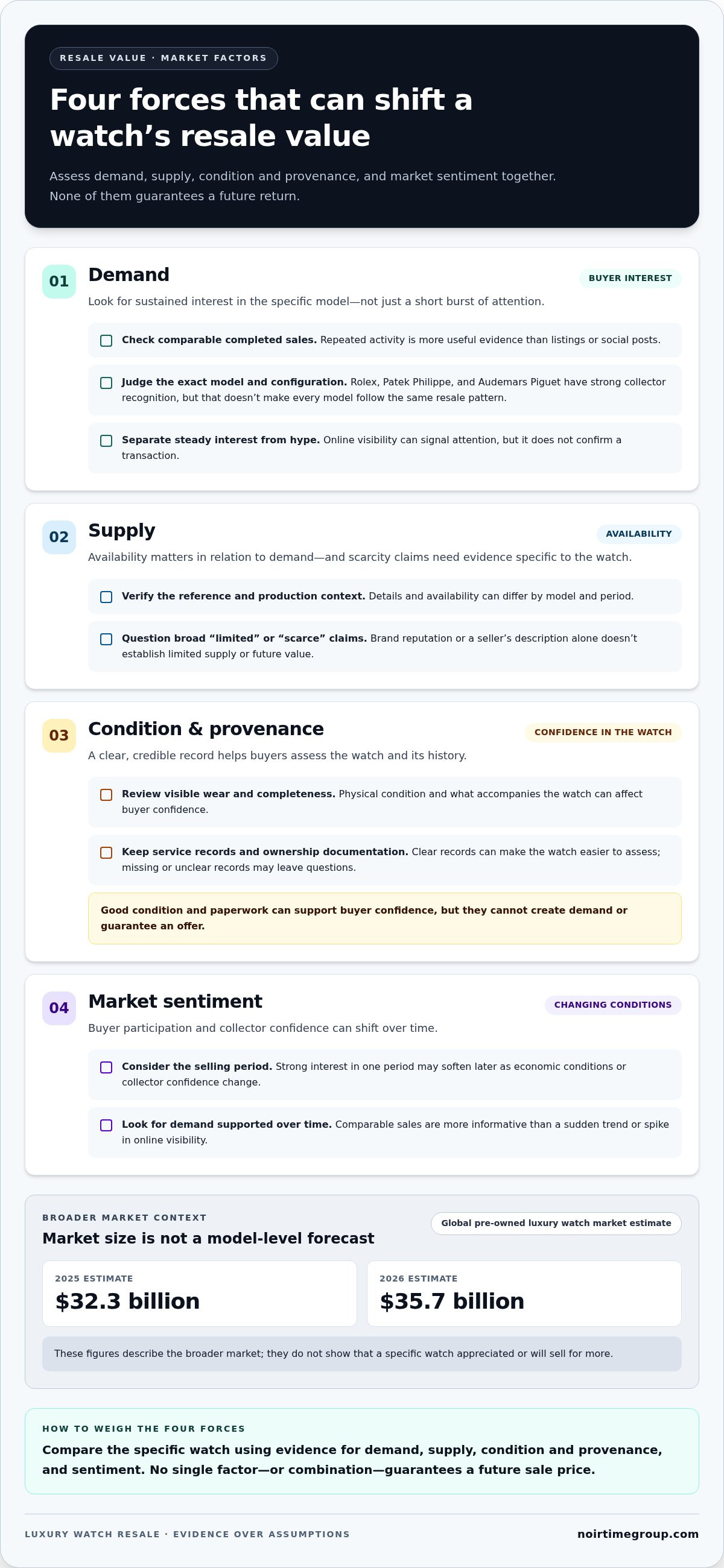
Four forces work together: demand, supply, condition and provenance, and broader market sentiment. None predicts a guaranteed return. A watch can attract collector interest yet face a softer market, while excellent documentation can build buyer confidence without creating demand on its own.
Demand: Look for sustained interest in a particular model, not just a burst of online attention. Repeated activity across comparable completed sales is more useful than social posts or asking prices, which show attention or seller expectations rather than confirmed transactions. Rolex, Patek Philippe, and Audemars Piguet have strong collector recognition, but that doesn’t mean every model or configuration from each brand follows the same resale pattern. Chubb discusses factors behind the rising demand for pre-owned luxury watches, including scarcity and exclusivity. These themes can help explain interest, but don’t establish a specific watch’s sale value.
Supply: Availability matters in relation to buyer demand. Claims that a particular model is scarce need model-specific evidence, not assumptions based on brand reputation or a seller’s description. Production details and availability can differ by reference and period, so general claims about limited supply don’t prove future value.
Market-wide figures offer context, not a shortcut to model-level conclusions. Grand View Research estimated the global pre-owned luxury watch market at $32.3 billion in 2025 and $35.7 billion in 2026 in a report dated July 15, 2026. That estimate describes the broader market; it doesn’t show that a specific watch appreciated or will sell for more.
Condition and provenance: Visible wear, completeness, service records, and credible ownership documentation may all affect how comfortable a buyer feels about a watch. A well-kept example with clear records can be easier to assess, but condition and paperwork can’t compensate for weak demand or guarantee a particular offer.
Market sentiment: Economic conditions and shifts in collector confidence can influence how actively buyers participate. A model that draws strong interest in one period may receive less attention later. Separate durable demand, supported by comparable sales over time, from temporary hype driven by a trend or sudden online visibility.
For a potential trade or sale, weigh these forces together rather than treating any one as a promise. Noir Time Group facilitates watch sales and trades and provides expert guidance. Learn more about luxury watch sales and trades.
How to Compare Luxury Watch Models for Resale Potential
A useful comparison starts with the specific watch, not the brand’s reputation. Record its exact reference and configuration, then compare it with similar watches using the same criteria. A Rolex Submariner, Patek Philippe Nautilus, and Audemars Piguet Royal Oak can each be evaluated this way, but naming a respected model category alone doesn’t establish its demand or predict its future resale value.
A consistent checklist for comparing references and configurations
Keep the comparison focused. Match reference, material, condition, completeness, and transaction timeframe as closely as the available evidence allows. Model popularity and configuration desirability are related, but they aren’t interchangeable: interest in a model doesn’t prove that every variation attracts the same buyers.
| Factor | What to compare | Questions to ask |
|---|---|---|
| Model demand | Comparable references, including a Submariner, Nautilus, or Royal Oak | Is interest visible across multiple completed sales, or mainly in online attention? |
| Configuration | Exact reference and material | Do the comparison watches match the example, or are they meaningfully different? |
| Condition | Wear and visible condition | Are the compared watches in similar shape? |
| Provenance | Completeness and available ownership or service documentation | Are records and included materials comparable? |
| Transaction evidence | Completed sales and their dates, where available | Is this a confirmed transaction, and how recent is it? |
Use the table to spot mismatches before drawing conclusions. A listing for a different reference or a watch in notably different condition may provide context, but it isn’t a direct comparison. Asking prices show seller expectations; completed transactions are stronger evidence of what buyers actually paid.
What market charts can and can’t tell a collector
Charts summarize the data they include, not the entire market. Check the date range, data source, number of transactions represented, and whether condition and completeness are accounted for. If those details are unclear, interpret the chart cautiously. Public transaction records may be incomplete or inconsistent, and a small or uneven sample can make a short-term move look more meaningful than it is.
Use charts to frame questions, not to make a forecast. A brief rise or decline doesn’t establish a long-term direction, especially if the underlying sales involve different configurations or selling conditions. The examples here illustrate a consistent evaluation method, not a ranking of models or a prediction of future returns.
How to Preserve Resale Readiness While You Own a Luxury Watch
Resale readiness comes from consistent ownership habits, not last-minute fixes. Clear records and thoughtful care can help a future buyer understand a watch’s condition and history, but they can’t guarantee a sale price or appreciation. Use this routine to keep the important details together.
- Save purchase and warranty documents. Keep receipts, warranty papers, and any records that identify the watch and its original purchase. Store digital copies securely while retaining the original documents.
- Keep original components together. Retain the box, papers, accessories, and any components that came with the watch. Keep them in good condition and note what is included if you later consider a sale.
- Document its condition. Take clear, dated photographs when you acquire the watch and periodically afterward. Capture the dial, case, bracelet, and any existing marks in consistent lighting. These images help track changes but don’t replace an in-person assessment.
- Record service and repair work. File invoices or service documents and note what work was performed and when. A coherent record helps a future buyer follow the watch’s care history rather than rely on memory.
- Choose care based on the watch. Service needs depend on the timepiece and its condition, so don’t assume every watch follows the same schedule. Document repairs and use qualified service appropriate to the watch. Noir Time Group provides certified watch repair.
Make careful service and sale-timing decisions
Before authorizing polishing, repair, or another intervention, consider the watch’s condition and how the work may affect its original appearance. Some buyers may prefer an untouched example, while others may value appropriate repairs; the right choice depends on the specific watch and the work involved. Avoid modifications based only on the assumption that they’ll improve resale appeal.
When a sale becomes realistic, review current evidence for comparable references and configurations instead of relying on old headlines or a past peak. Recheck condition, completeness, and documentation alongside recent completed transactions where available. This gives you a more grounded view of the future resale value of luxury watches without mistaking a market snapshot for a promise.
If you’re considering service as part of preparing your watch, explore certified watch repair from Noir Time Group.
Planning a Luxury Watch Trade or Sale with Noir Time Group
Once you’ve gathered the watch’s records and compared it with relevant market evidence, decide what you want from ownership. You might keep a watch you enjoy, trade it toward another timepiece, or sell it as your collecting priorities change. An expert discussion can help put those options in context without treating the future resale value of luxury watches as guaranteed.
What an expert evaluation can help clarify
A thoughtful assessment considers what makes one watch different from another: its reference and configuration, physical condition, available provenance, and current demand for comparable examples. Authentication and documentation review can help establish confidence in what the watch is and what is known about its history. Noir Time Group guarantees the authenticity of its timepieces and provides expert guidance to collectors considering their next step.
Purchase documents, service history, and original components help tell a more complete story. Market comparisons add another layer, but their usefulness depends on how closely the examples match and whether the evidence reflects completed transactions or only asking prices. An assessment can clarify relevant factors; it shouldn’t be mistaken for a promise of a specific valuation, sale price, or transaction outcome.
Choosing between keeping, trading, or selling
Start with your own priorities. If the watch remains central to your collection, personal enjoyment may outweigh an uncertain market opportunity. If you’re ready for a different timepiece, a trade may be worth considering. If you no longer plan to wear or keep it, a sale may make sense. In each case, compare current evidence with your ownership goals rather than relying on a past peak or a headline about a brand.
Noir Time Group works with collectors on watch sourcing, trades, and sales. These options can support different collecting plans, whether you’re looking to move on from a watch or source another one. The right choice depends on the watch, available market evidence, and what you want from ownership. Resale outcomes remain market-dependent, and appreciation or profit isn’t assured.
Explore Noir Time Group’s luxury watch inventory and services to consider a trade, sale, or next addition to your collection.
Make Your Next Watch Decision With Confidence
The future resale value of luxury watches isn’t determined by brand prestige alone. Model-specific demand, condition, provenance, and timing all shape what a watch may bring in a later transaction, and none can guarantee appreciation. Compare like with like, use completed-sale evidence where available, and keep clear ownership and service records to make decisions with a better understanding of the watch you own.
Whether you’re considering a sale, trade, or new addition to your collection, Noir Time Group offers expert guidance and facilitates watch sourcing, trades, and collector sales. Its timepieces are guaranteed authentic, with certified repairs and after-sales care to support ownership.
Explore luxury watches and collector services with Noir Time Group, and take your next step with realistic expectations and a clear view of your collecting goals.
Frequently Asked Questions
Do luxury watches usually increase in resale value over time?
No, luxury watches don’t reliably increase in resale value over time. Some models may attract stronger demand during certain periods, while others sell for less than their original retail price. The future resale value of luxury watches depends on the specific reference, condition, documentation, buyer demand, and timing. Past sales provide context, but they can’t guarantee appreciation or predict what a future buyer will pay.
Which factors have the greatest effect on a luxury watch’s resale value?
Model-specific demand, condition, provenance, configuration, and timing are key factors. A well-known brand may draw attention, but a particular reference and configuration still need buyers. Wear, missing components, or unclear service history can affect buyer confidence. Broader market sentiment can also shift, so assess these factors together and compare the watch with similar examples rather than relying on brand prestige alone.
Can a pre-owned luxury watch retain its resale value?
Yes, a pre-owned luxury watch can retain value, but its age alone doesn’t determine resale performance. Buyers may consider its reference, configuration, condition, completeness, service history, and current demand. Authentication and credible ownership records can make its history easier to assess. Compare it with similar pre-owned watches and relevant completed transactions, while remembering that market evidence describes past activity rather than guaranteeing a future result.
How do box, papers, and service records affect a watch’s resale value?
Original components and clear records can help a buyer assess a watch’s completeness and history. Box and papers may support provenance, while service records document care and repairs. Their presence doesn’t guarantee a higher sale price, and their impact can vary by model and buyer. Keep purchase and warranty documents, service paperwork, and original components together so you can present a consistent ownership record if you sell.
Does servicing or polishing a luxury watch improve its resale value?
Not automatically. Appropriate service can address a watch’s needs and provide a documented care history, but the right decision depends on its model and condition. Polishing may affect the watch’s original finish, and some buyers may prefer an example that hasn’t been polished. Avoid unnecessary work done only to raise resale value. Keep service documentation, and consider certified repair when care or repair is needed.
Are Rolex, Patek Philippe, and Audemars Piguet watches likely to hold value?
These brands have strong collector recognition, but that alone can’t predict how an individual watch will perform. Demand can vary by reference, configuration, condition, and selling period, even within the same brand. Compare relevant completed transactions and assess the watch’s provenance and completeness. Treat brand reputation as one consideration, not a promise that every Rolex, Patek Philippe, or Audemars Piguet will retain or gain value.
How can I estimate the future resale value of my luxury watch?
Start with the exact reference and configuration, then compare completed sales of similar watches, matching condition, completeness, and transaction timeframe as closely as possible. Treat asking prices as seller expectations, not confirmed sale values, and use market charts cautiously if their data is limited. Include service and ownership records in your assessment. Noir Time Group offers expert guidance and facilitates collector sales and trades, without guaranteeing a particular outcome.
