

A watch’s fair market value isn’t simply its highest asking price. If you’re getting a fair market value for your watch, the goal is to estimate the price that a willing buyer and seller, neither under pressure and both reasonably informed, would agree on. A credible appraisal uses the market where that type of watch is most commonly sold to the public.
It’s understandable to want one definitive number, especially when considering a sale, donation, insurance matter, or financial report. But the right valuation depends on the purpose, the market being assessed, and evidence such as completed sales of comparable watches. This article explains how fair market value works, what can shape a watch’s appraisal, and why asking prices may differ from sale prices. You’ll also learn how to choose a valuation standard for your needs and what to expect from a professional appraisal.
Key Takeaways
- Fair market value reflects a transaction between willing, informed parties who aren’t compelled to buy or sell, using the market where the watch is most commonly sold.
- Choose the valuation standard to match the purpose, since a sale, donation, insurance matter, or financial report may call for different approaches.
- Use completed sales of comparable watches, not asking prices alone, and compare like with like on model, condition, and selling market.
- Condition, age, service history, and whether the original box and papers are present can all affect how buyers assess a watch.
- A professional appraisal should explain its market research and valuation reasoning; Noir Time Group’s watch offerings and sourcing service may be relevant when you’re considering a specific Rolex model.
What Is Fair Market Value (FMV) and How Does It Work?
Getting a fair market value for my watch means estimating what informed, willing parties would agree on without pressure to transact. The estimate should reflect the market where that type of watch is most commonly sold to the public.
Fair Market Value Basics
Fair market value is the price a willing buyer and seller would agree on when neither is compelled to act and both know relevant facts. NACVA and USPAP standards adopt this definition, and IRS Revenue Ruling 59-60 codifies it. For someone getting a fair market value for my watch, the definition matters because it separates a reasoned market estimate from an asking price or forced-sale amount.
For a single item of personal property, an appraiser should ask for the watch’s purchase price, source, and date, then include those details in the appraisal. That history provides context, but the conclusion still needs support from the relevant market.
Watch Identification and Valuation Factors
An appraisal identifies the exact watch and assesses the details that distinguish it from comparable examples. Brand, model, reference, condition, age, box, and papers help describe the watch accurately. Their importance depends on the timepiece and the available market evidence.
When a watch has no established market or recorded sales, an appraiser may use comparable items in related markets to support an opinion. The report should consider whether a discount is appropriate if the watch has less market presence than an item with a sales history. This makes the reasoning clear instead of treating a loosely similar item as an exact match.
Sales Comparisons and Online Valuation Tools
Reliable online valuation tools and marketplaces show completed transactions with enough detail to identify the watch, its condition, and the sale context. Treat automated estimates as research aids, not stand-alone conclusions. Comparables should come from the market where the watch is most commonly sold. Don’t mix evidence from different markets.
An appraiser should explain value-relevant differences and justify upward or downward adjustments against each comparable. Widely dispersed results can make the mean unpersuasive, while the mode can help identify the value that appears most often. The appraiser should still explain why that measure supports a credible conclusion.
Professional Watch Appraisals
For a U.S. personal-property appraisal, USPAP Standard Rule 7-5(b) calls for analysis of relevant prior sales or transfers. Standard Rule 8-2(a)(x)(3) addresses summarizing those sales and transfers when needed for credible results. If relevant data is unavailable, the appraiser must document efforts to obtain it; if irrelevant, explain why.
For a donation reported on Form 8283, the form must include the fair market value of each donated item or group of similar items. To check authenticity and parts originality, have the watch examined by a qualified watch professional and compare its components with the identified model. Private-sale risks include payment fraud and disputes, so keep transaction records and use a secure payment method.
Choosing a valuation standard by purpose
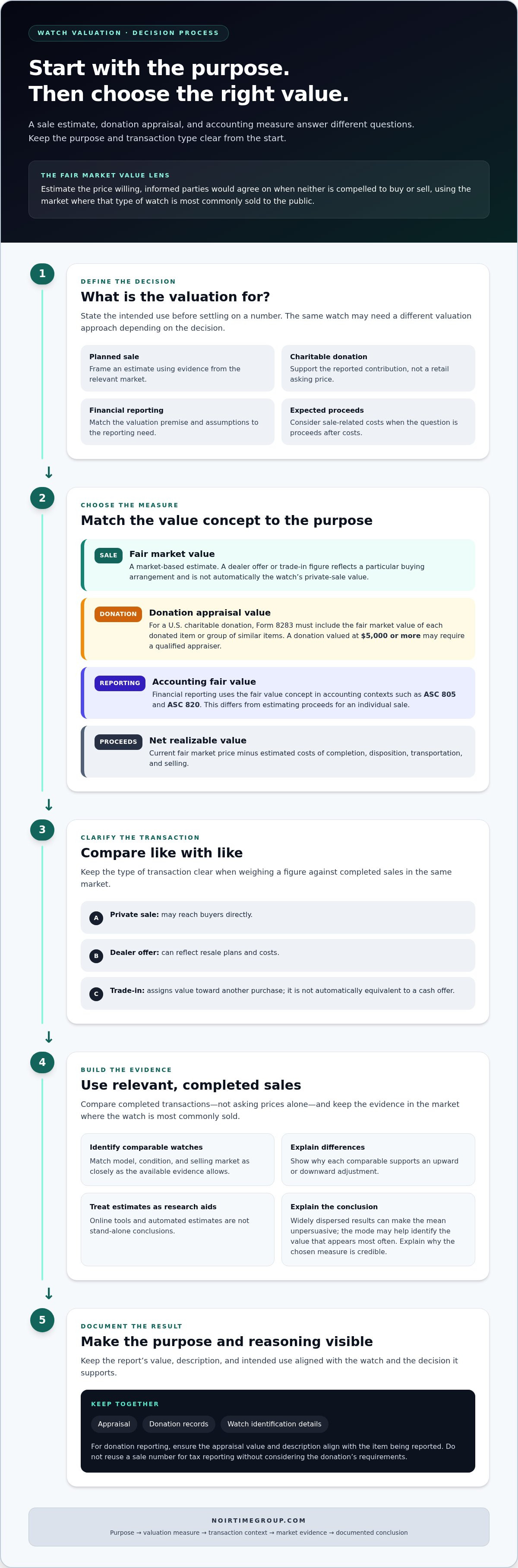
The purpose of a watch valuation determines which value concept answers your question. A sale estimate, charitable donation appraisal, and accounting measurement may describe different things.
Match the standard to the decision
For a planned sale, fair market value can help frame an estimate based on relevant market evidence. A dealer offer or trade-in figure reflects a different transaction: it’s the amount offered in a particular buying arrangement, not automatically the watch’s private-sale value.
A private sale may reach buyers directly, while a dealer’s offer can reflect resale plans and costs. Compare each figure with completed sales in the same market, and keep the transaction type clear. A trade-in also assigns value to the watch toward another purchase, so don’t treat it as a cash offer without accounting for that arrangement.
Donations and tax reporting
For a U.S. charitable donation, a watch valuation supports the reported contribution rather than setting a retail asking price. A donation valued at $5,000 or more may require a qualified appraiser. Form 8283 must include the fair market value of each donated item or group of similar items.
That distinction makes the intended use important from the outset. Keep the appraisal, donation records, and watch identification details together, and ensure the report’s value and description align with the item being reported. A number prepared for a sale should not simply be reused for tax reporting without considering the donation’s requirements.
Accounting and other value measures
Financial reporting uses the fair value concept in accounting contexts such as ASC 805 and ASC 820. That purpose differs from estimating proceeds for an individual sale, so the valuation premise and assumptions should match the reporting need.
Net realizable value is another distinct measure: it is an asset’s current fair market price minus estimated costs of completion, disposition, transportation, and selling. For a watch, those deductions matter when the question concerns expected proceeds after sale-related costs, rather than the market price alone. The valuation standard can depend on the transaction, so state the purpose clearly.
Document the watch for valuation
Prepare a concise record with the brand, model or reference, serial details, purchase source and date, service records, and a list of included items. Photograph the dial, case, caseback, clasp, and accessories in clear light, including close-ups of wear or damage. These records help an appraiser identify the watch and compare its condition consistently.
Keep original files and avoid filters that alter color or conceal marks. If your next step is finding a particular watch, a watch sourcing service can help connect that search with a clearly defined purchase goal.
Where can I find recent sales prices for the same watch model and condition?
Start with completed transactions, then narrow the results to watches that match the reference and condition. A listing price shows what a seller hopes to receive, not what a buyer paid. Useful comparisons also identify the marketplace and transaction type, so dealer purchases and end-user sales aren’t treated as interchangeable evidence.
Search by exact model and reference
Begin with the brand, model, and reference number shown on the watch or its records. Add distinguishing details, such as dial, bracelet, or material, when they separate versions of the same model. A broad model-name search can return different configurations, making the displayed prices poor comparisons.
Review each result individually. Confirm that the listing describes the same reference and a comparable condition, rather than relying on a search page’s headline or estimate. Save the sale date, description, photographs, and marketplace details. This record helps you determine whether a transaction genuinely supports your watch’s valuation.
Use completed sales, not asking prices
A fair market value appraisal should use completed sales rather than asking prices. Look for records indicating that a transaction concluded, and distinguish sold results from active listings or withdrawn offers. An unsold listing may reveal a seller’s target, but it doesn’t establish that buyers accepted that amount.
For each sale, note whether the price reflects the watch alone or a bundle with accessories. Compare sales from the market where that model is most commonly sold to the public, and don’t combine data from different markets. Differences in sales channels can make otherwise similar prices misleading.
Assess marketplace and buyer type
Online marketplaces, auction results, and dealer records can each provide useful leads when they show completed transactions and enough detail to identify the watch. Reliability depends on the evidence shown, not the platform’s estimate. Prefer records with clear model descriptions, condition information, sale status, and transaction context.
An appraiser should establish, as far as possible, whether comparable sales were end-user transactions rather than dealer purchases for resale. A dealer’s purchase price can reflect a resale purpose, while an end-user sale reflects a different kind of transaction. Keep those categories separate in your notes.
Make comparisons explainable
Build a small set of genuinely comparable transactions instead of combining every result returned by a search. For each one, record the matching details and differences, then consider whether those differences support an upward or downward adjustment. A comparable with a different condition or configuration needs an explanation before it can support a credible conclusion.
If sale results vary widely, a simple average may not produce a defensible value. An appraiser should explain the selection process, marketplace, and adjustments in the report. That reasoning shows why one completed sale carries more weight than another.
What factors affect a watch's fair market value, including condition, age, box, and papers
A watch’s value reflects how buyers assess its specific identity, condition, and completeness. An appraisal compares those details with relevant sales, then explains which differences support adjustments.
Condition and visible wear
Condition describes the watch’s physical state, function, and consistency with its original design. Scratches, dents, damaged crystals, loose bracelets, and worn clasps can distinguish one example from another. A photograph may show exterior wear, but it can’t establish how the movement performs.
Describe each issue plainly rather than relying on labels such as “excellent” or “like new.” For example, note a scratch on the case side, a replacement crystal, or a loose-feeling bracelet. These details help an appraiser compare the watch with sales involving similar condition and explain any upward or downward adjustment.
Age, model, and production details
Age alone doesn’t determine value. A watch’s brand, model, reference, configuration, and demand in its relevant market can matter more than its year of manufacture. Two watches from the same period may differ because they have different dials, materials, or components.
Identify the exact reference and any distinctive features before comparing sales. A vintage example may attract interest for a particular configuration, while another watch of similar age may have little comparable evidence. The appraisal should use available sales for the closest match and explain how any differences affect the conclusion.
Box, papers, and provenance
The original box and accompanying papers can help show completeness and support the watch’s history. Their effect depends on the specific model and how comparable watches were sold. A box alone doesn’t prove authenticity, and papers should be checked to see whether they correspond to the watch.
Keep the warranty card, receipts, service documents, and box together when presenting the watch. A dated purchase record, for example, can provide source and ownership context, while service paperwork may document work performed. An appraiser can consider those records alongside market evidence rather than treating any single document as conclusive.
Service history and originality
Service history can help explain the watch’s current function and condition. Provide available invoices or service records, and describe known repairs or replaced parts. Documented repairs give more context than unexplained changes, but the valuation still depends on the watch and comparable sales.
Originality also matters when components differ from the model’s expected configuration. Note replacement parts, refinishing, or modifications, and have uncertain details examined by a qualified watch professional. A clear report should identify relevant differences and explain their effect on comparability rather than applying an unexplained adjustment.
How can I get a professional watch appraisal, and how much does it cost?
A professional watch appraisal is a written opinion supported by identification, market research, and a stated valuation purpose. Its cost depends on the work involved, including examination, research, and reporting requirements. Define the intended use first, because a sale estimate and a donation appraisal may need different documentation.
Choose an appraiser suited to the assignment
Look for an appraiser whose work covers watches and personal property, rather than relying on an automated estimate alone. The assignment should identify the watch, the requested valuation standard, and the intended use. A charitable contribution, for example, calls for documentation suited to donation reporting; a sale decision needs market evidence relevant to the selling market.
Ask for a written scope that describes the examination, research, and final report. This makes the expected work clear before the watch is assessed. For a U.S. charitable donation valued at $5,000 or more, a qualified appraiser may be required.
Prepare the watch and supporting records
Provide the brand, model or reference, known purchase source and date, and any service history. Include available receipts, warranty papers, and records of repairs or replaced parts. These details help the appraiser identify the watch and understand its history alongside a physical examination.
Photograph the dial, case, caseback, bracelet, clasp, and any visible wear. Include the box and papers if they accompany the watch. Keep the original files and label documents clearly, so the appraiser can match each record to the watch instead of inferring details from incomplete images.
Understand what shapes the fee
Appraisal fees reflect the assignment’s scope, not simply the watch’s value. A straightforward identification and report may require different work from an assignment involving difficult-to-verify details, extensive comparable-sale research, or a specific reporting format. The examination method and intended use also shape the work required.
Request a written fee arrangement that describes the deliverable and any separate examination or research charges. The report should identify the watch, state its valuation purpose, summarize market data, and explain the marketplace selection and research process. Discuss the fee to clarify what the final document will contain.
Review the report’s reasoning
Read the report for a clear description of the watch, its condition, and the valuation date or context relevant to the assignment. The analysis should explain how the market data supports the conclusion and why the selected sales compare with the watch being appraised. Relevant differences should have reasoned adjustments, not unexplained figures.
Keep the completed report with photographs, receipts, and service records. If you’re preparing to sell, use the appraisal as a documented opinion, then distinguish it from any later dealer offer or private-sale result. This preserves the report’s purpose and makes the valuation easier to interpret.
Noir Time Group: Rolex Submariner Date 126613LN
Noir Time Group is a natural next step if your research has clarified the Rolex model you’re considering. Its offerings include the Rolex Submariner Date 126613LN and Rolex Submariner Date 126618LN, giving you specific models to compare as you refine your search. If you’re looking for a particular timepiece, its Watch Sourcing Service can support that search.
A valuation and a watch purchase serve different purposes: the appraisal estimates value, while model details and condition guide your buying decision. For a watch that needs attention, Noir Time Group also offers Certified Watch Repair. Keep your appraisal records and repair documentation together so you can distinguish the watch’s assessed condition from later work.
Contact Noir Time Group to discuss its watch offerings or sourcing service.
Make Your Valuation Useful for the Decision Ahead
An appraisal is most useful when you connect it to a clear next step. Decide whether you’re preparing to sell, documenting ownership, or choosing a watch to buy, then keep the valuation and supporting records together. That gives you a consistent reference as you compare options or revisit the decision. If you’re getting a fair market value for my watch, treat the result as a tool for making that decision, not a substitute for deciding what matters most to you.
If your next step is exploring a specific timepiece, Noir Time Group offers the Rolex Submariner Date 126613LN, Rolex Submariner Date 126618LN, and a Watch Sourcing Service. You can bring your priorities into that conversation, such as the model you’re seeking or the features you value, and use them to guide your search.
Contact Noir Time Group to discuss your watch interests and take the next step with clarity.
Frequently Asked Questions
What is FMV, and how does it work?
Fair market value (FMV) is an estimate of the price an informed, willing buyer and seller would agree on without pressure to transact. For a watch, the appraiser identifies the specific model and considers evidence from its relevant selling market. For example, an estimate for a particular dial or bracelet configuration should rely on sales of closely matching watches, not just the broader model family.
Why is calculating FMV important?
Calculating FMV gives you a reasoned reference point for decisions involving your watch. It can help you assess whether a purchase offer fits the evidence, explain a value used in a financial or donation context, or compare options without confusing a seller’s asking price with an agreed transaction. Keep the valuation’s purpose clear, since a figure prepared for one decision may not answer a different question.
Which online watch valuation tools and marketplaces are reliable?
Reliable online tools and marketplaces show completed transactions with enough detail to identify the watch, its condition, and the sale context. Use them as research aids, compare sales from the market where the watch is most commonly sold, and don’t rely on automated estimates alone.
What are the risks of selling a watch privately, and how can I avoid scams?
Private sales can involve payment fraud and disputes. Keep transaction records and use a secure payment method.
