

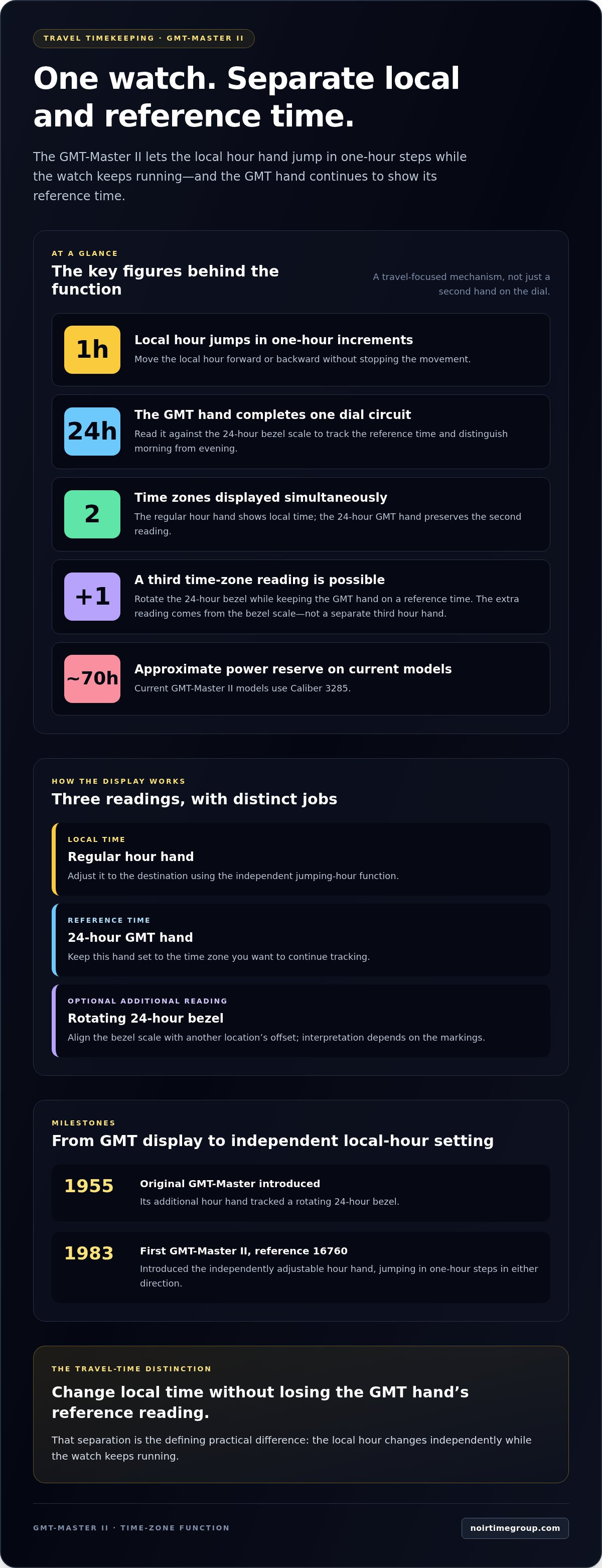
The GMT-Master II does more than display a second time zone: its local hour hand jumps forward or backward in one-hour steps while the watch keeps running. That makes it useful for travel, letting you adjust local time without stopping the movement.
Date-setting matters, too. The GMT-Master II adjusts the date through its jumping local-hour hand, rather than a separate date-only control. This guide explains how its time-zone display and date adjustment work, then outlines what to compare when considering alternatives. You’ll get a clearer sense of whether the GMT-Master II suits your routine or another watch belongs on your shortlist.
Key Takeaways
- Compare case, bezel, crystal, lume, and bracelet materials to find an alternative that fits your priorities for wear and style.
- Look beyond the GMT label: how a watch displays a second time zone and how its bezel works can shape its usefulness while traveling.
- Distinguish local-hour adjustment from date setting to assess the quickset-date question accurately.
- Choose an alternative by the function you value most, whether that’s travel-focused timekeeping or a different kind of Rolex watch.
What is a good watch to buy instead of the Rolex GMT-Master II?
A good alternative depends on which part of the GMT-Master II appeals to you: travel function, recognizable bezel, or build. Compare watches by case material, bezel operation, crystal, lume, and bracelet rather than choosing by color alone. For example, a second-time-zone watch with a simpler bezel may suit someone who values legibility over the Rolex’s rotating 24-hour scale. The right reference is the one whose functions and materials match how you plan to wear it.
Bezel colors also carry collector shorthand. “Pepsi” commonly refers to red and blue, while “Root Beer” describes brown and black. Rolex presented a brown-and-black Cerachrom bezel combination in 2018, then a red-and-blue ceramic-bezel GMT-Master II in white gold in 2014. Those colorways can help identify a reference, but they don’t establish authenticity by themselves. Compare the bezel’s color, insert, and design with the exact reference you’re considering.
Material history gives another useful comparison point. Rolex introduced aluminum bezel inserts in 1959, then ceramic inserts to the GMT-Master II range in 2007, replacing aluminum. Rolex introduced Cerachrom to the range in 2005 and presented its first two-color, single-piece ceramic bezel insert in 2013. The bidirectional bezel has a 24-hour graduated Cerachrom insert, while the cases are made from 906L Oystersteel. Check how an alternative handles bezel rotation and whether its case, crystal, lume, and bracelet suit your preferences.
When assessing pre-owned authenticity, compare the reference and serial markings, paperwork, and visible details with the watch’s specific configuration. Check the Cerachrom bezel, dial, hands, crystal, lume, and bracelet for consistency, and have a qualified watch professional assess the movement. Paperwork alone cannot authenticate a watch.
GMT-Master and GMT-Master II time-zone functions
The original GMT-Master and the GMT-Master II share a 24-hour hand, but their time-setting functions differ. Understanding the display helps you compare watches by how they show home, local, and additional time.
Two-Time-Zone GMT Function
Rolex introduced the original GMT-Master in 1955 with an additional hour hand that tracked a 24-hour rotating bezel. That GMT hand moves once around the dial every 24 hours, while the regular hour hand shows local time. Read the GMT hand against the bezel’s 24-hour scale to distinguish morning from evening in the second time zone. When comparing versions, check whether the dial is clear enough to read both hands quickly.
GMT-Master II Time-Zone Mechanism
The GMT-Master II displays two time zones simultaneously using its regular hour hand and 24-hour GMT hand. Its time-zone mechanism lets the wearer adjust local time separately from the GMT display. That separation is the key distinction to look for: changing the local hour need not erase the second time-zone reading. The movement, hand layout, and bezel insert together determine how easily you can track both displays.
A rotating 24-hour bezel can also help indicate a third time zone. Keep the GMT hand set to a reference time, then rotate the bezel to align its scale with another location’s offset. The extra reading depends on the bezel’s markings and the wearer’s interpretation, rather than a separate third hour hand. This makes the two-time-zone GMT function more flexible without changing the basic dial display.
For travel, compare how each watch handles local-time adjustment, how clearly its hands stand apart, and whether bezel rotation adds useful information. A chronometer designation concerns movement precision; it doesn’t itself indicate how many time zones a watch displays. To compare configurations, browse the available GMT-Master II references alongside these functional distinctions.
Independent jumping local-hour hand
Set local time without stopping the watch: the independent hour hand jumps forward or backward in one-hour increments while the movement keeps running. This is especially useful when crossing time zones. Ongoing care still means looking after the movement and the watch’s overall condition.
Independent Local-Hour Adjustment
Rolex launched the first GMT-Master II, reference 16760, in 1983 with an independently adjustable hour hand. Unlike a conventional hour hand that moves together with the minute hand, this hand can jump by one-hour steps in either direction. When comparing models, consider whether this independent adjustment matches your travel habits and how you prefer to preserve the displayed reference time.
Setting and Using the Hour Hand
After a time-zone change, use the jumping hour hand to set local time while the GMT hand continues to track its reference time. The GMT-Master II’s local hour hand moves in one-hour increments without stopping the watch. When traveling across several time zones, set the local hour to the destination time, then use the GMT hand to read the other time zone.
That separation also helps distinguish the GMT-Master II’s function from a standard dual-time display. The hour hand shows local time; the 24-hour hand preserves the second reading. Models such as the Batman illustrate how the mechanism appears across different bezel designs, including a ceramic bezel. A Jubilee or Oyster bracelet changes the wearing experience, not the independent setting action.
Keep the case, bracelet, and movement in sound condition, and seek professional attention if performance or operation changes. The reference, wear, and condition all matter when assessing a pre-owned watch. Don’t force the crown or hands if adjustment feels obstructed. With a smooth, deliberate setting action, the local hour hand jumps as intended while the watch continues running.
Alternatives to the Rolex GMT-Master II
The best alternative depends on which feature you want to keep: a second-time-zone display, an independently adjusted local hour, or a distinctive bezel. Use the Rolex GMT-Master II as a comparison point, not an automatic winner. Current models use Caliber 3285, with an approximately 70-hour power reserve. Compare another watch’s time-setting method, readability, case fit, and movement specification against the way you’ll use it.
Design can narrow the choice. Rolex presented a green-and-black Cerachrom bezel combination in 2022 on a left-sided crown model with its date at 9 o’clock. In 2024, it announced a black-and-gray Cerachrom bezel. Rolex also released its first ceramic dial for the GMT-Master II in 2025, using the green shade seen on the lower bezel half. These changes show how much a bezel or dial can shape a watch’s look.
For a more restrained alternative, prioritize legibility and case proportions over a familiar colorway. The GMT-Master II’s 40 mm Oyster case provides one clear sizing reference. Consider whether a different watch has a 24-hour scale, a separate GMT hand, and a setting mechanism that suits your travel routine. A watch without those features may still be a sound choice if your priority is everyday design rather than tracking another time zone.
Compare options in this order: identify the time-zone function you need, assess dial readability, then consider case and bracelet comfort. Check the movement specification and how its functions work, rather than focusing only on bezel colors. Collector nicknames such as “Batman” can help identify a version in conversation, but the reference and actual features matter more. This approach helps distinguish a functional alternative from a style-led one.
To compare Rolex configurations against those criteria, explore GMT-Master II references and focus on the details that fit your priorities.
Noir Time Group: Rolex Submariner Date 126613LN
Noir Time Group offers a next step if your comparison points toward a Rolex sports watch rather than another dual-time model. The Rolex Submariner Date 126613LN is one option to consider, alongside the Rolex Submariner Date 126618LN. These models are alternatives to explore for their own appeal, not substitutes for the GMT-Master II’s time-zone function.
If you have a particular watch in mind, Noir Time Group’s Watch Sourcing Service can help locate a specific timepiece. If a watch you own needs attention, the company also offers Certified Watch Repair. The right next step depends on whether you’re considering a different Rolex, seeking a specific watch, or arranging a repair.
Contact Noir Time Group to discuss your watch interests and the right next step.
Choose the Watch That Fits Your Next Chapter
Build your shortlist around how a watch fits your routine, not just how it looks in a photograph. Consider where you’ll wear it, which details you’ll enjoy seeing every day, and which functions you’ll genuinely use. This can clarify whether the GMT-Master II is the right match or another Rolex better suits your priorities.
Before deciding, narrow your preferences to the features that matter most, then compare specific references against them. A focused choice is easier to live with than one driven by a nickname or a passing trend. If you’re ready to explore the available options, browse GMT-Master II watches and take the next step at your own pace. The right watch is the one you’ll be glad to wear.
Frequently Asked Questions
Did the GMT-Master II Sacrifice the Quickset Date?
No. The date can be adjusted through the independently jumping local-hour hand, rather than by a separate date-only control. Move that hand forward or backward in one-hour steps; crossing midnight changes the date. This lets you correct the calendar while keeping the watch running and the 24-hour hand’s reference-time reading undisturbed.
Is the GMT-Master 2 discontinued?
No. The GMT-Master II remains in active production, with current references including the red-and-blue 126710BLRO and left-handed 126720VTNR. Older references have been discontinued as production has moved on, so a pre-owned example may have different specifications from a current model. Identify the reference number first when comparing production status, case details, or configuration.
Which One Holds Its Value Better for Collectors?
No single reference always holds its value better. Collectors compare each watch’s condition, provenance, completeness, and demand for its specific configuration. A rare material or recognized bezel color may attract interest, but the reference and actual condition matter more than a nickname alone. Compare like-for-like examples, including bracelet, dial, and service history, before assessing value retention.
What is the Rolex GMT-Master II and what are its key features?
The Rolex GMT-Master II is a mechanical watch designed to show two time zones. Its 24-hour hand works with a graduated rotating bezel, while the local hour hand can be adjusted independently. Current models use Caliber 3285, have a 40 mm Oyster case, and offer an approximately 70-hour power reserve. The bezel insert is Cerachrom ceramic.
How does the GMT-Master II dual time-zone function work?
Set the 24-hour hand to the time you want to track as a reference, then read it against the dial or bezel scale. The regular hour hand shows local time. For example, a traveler can keep the GMT hand aligned with home time while adjusting the local hour hand at the destination, making the two readings distinct.
What are the case size, materials, movement, power reserve, and water resistance of the GMT-Master II?
The current model combines a case, a ceramic bezel insert, and a mechanical movement. Its power reserve is approximately 70 hours. The listed water-resistance rating is 100 meters. These specifications describe the current model details; vintage references can differ in materials and construction, so identify the reference when comparing watches.
