
A fair watch price is supported by evidence, not a preset discount. When negotiating price when selling a watch, base a counteroffer on comparable listings, the watch’s condition, and its documentation. No single percentage applies to every pre-owned Rolex.
It’s natural to want room to negotiate, especially if a buyer points to a lower listing or visible wear. But the lowest advertised price may not be a true comparison if the watch differs in condition, completeness, or transaction terms.
This guide shows you how to compare like-for-like listings, account for condition and paperwork, and respond to an offer without weakening your position. It also explains common mistakes, including relying on the so-called “25% off rule” instead of the evidence for your specific watch.
Key Takeaways
- Build your negotiation around the watch’s specific reference, completeness, and condition rather than assuming every pre-owned Rolex has the same discount range.
- Use genuinely comparable sold listings to support your position, and account for differences that can explain a gap in asking prices.
- Organize service records and documentation, then weigh visible wear against the likely effect of repair needs on value.
- Avoid relying on a blanket discount rule or treating cash as automatic leverage; focus your counteroffer on evidence tied to your watch.
Can I negotiate the price of a pre-owned Rolex?
Yes, you can negotiate a pre-owned Rolex’s price, but the reference, condition, completeness, and payment terms all shape the discussion. Treat each offer as a proposal to assess, not an automatic reason to lower your price.
Set an Asking Price Above Your Minimum
- Set your minimum first, using comparable watches, condition, and included documentation. Decide privately which offer you would accept before discussing price. This keeps a buyer’s first counteroffer from becoming your reference point.
- Price above that minimum with an asking figure supported by comparable listings, not an arbitrary percentage. There’s no universal margin for every Rolex. The right gap depends on the evidence, the watch’s completeness, and how much room you’re willing to leave.
- State your asking price clearly and explain details that support it, such as matching paperwork or an included box. If the buyer proposes less, ask which comparable supports that figure before making a counteroffer. The key to negotiating price when selling a watch is linking your response to evidence about the specific piece.
Use Cash Payment in Price Negotiations
- Discuss the payment method separately from the watch’s value. A buyer may argue that cash deserves a discount, but payment type alone doesn’t establish a fair reduction. Compare the complete offer and terms, then decide whether any change still meets your minimum.
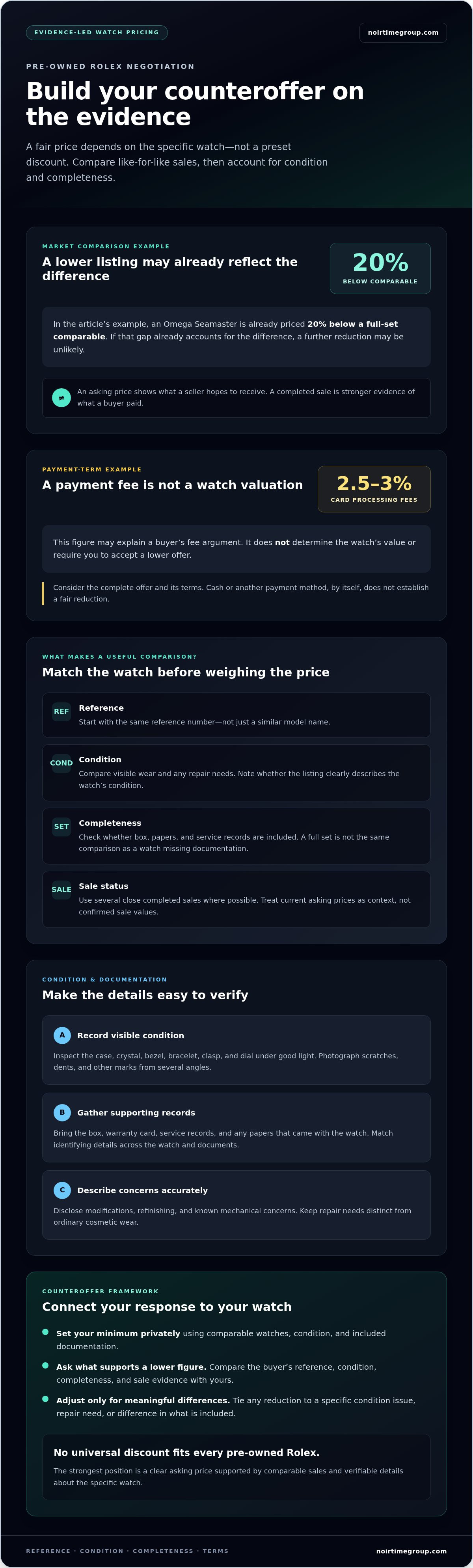
- Consider the actual payment costs in the proposed method. In a payment example, card processing fees are roughly 2.5-3%. That figure may explain a buyer’s fee argument, but it doesn’t determine the watch’s value or require you to accept a lower offer.
- Verify payment through your own bank or payment account before handing over the watch. Don’t rely on screenshots, email notices, or a buyer’s description of a transfer. Treat overpayment requests and demands to return part of a payment as warning signs.
- For an in-person exchange, choose a secure, staffed location and confirm funds before completing the handoff. For shipping, use tracking, document the watch’s condition and packaging, and ship only to the agreed address. Keep payment and delivery records.
Should I bring comparable watch listings to a store?
Yes. Gather a few comparable listings, then focus on exact references and completed sales rather than asking prices alone.
Compare Sold Listings and Market Comps
- Choose watches with the same reference number, rather than relying on a similar model name. Compare condition, included box and papers, and whether the listing shows a completed sale. A current asking price shows what a seller hopes to receive, not necessarily what a buyer paid.
- Use several close matches and note the differences that affect value. For example, an Omega Seamaster already priced 20% below a full-set comparable may have accounted for that gap in its asking price. Further reductions may be unlikely when the discount already reflects the comparison.
Consider a Reasonable Sale Discount
- Set a counteroffer from the strongest comparable sales, then adjust for differences in reference, condition, and completeness. There’s no single reasonable discount for every used watch. A discount is defensible when it reflects a meaningful difference, not simply because a buyer asks for one.
- Bring saved listing details or printed records to make the comparison clear. Match the reference first, then explain any difference in condition or included items. Avoid treating an unrelated model’s lower asking price as proof that your watch should sell for the same amount.
For a sale in the United States, taxes, fees, and legal requirements depend on the transaction and applicable rules. Don’t assume a private watch sale has the same tax treatment as every other sale.
A reasonable discount depends on the closest completed sales and the watch’s condition. If you only have asking prices to compare, use them as context, not as confirmed sale values.
Organize your comparable sales before discussing an offer. A watch market perspective can also help frame what makes two listings genuinely comparable.
How do condition and documentation shape the discussion?
Document the watch’s condition and gather supporting paperwork before discussing an offer. Specific observations help distinguish visible wear from repair needs.
Assess Condition and Documentation
- Inspect the case, crystal, bezel, bracelet, clasp, and dial under good light. Photograph scratches, dents, and other visible marks from several angles. A clear record helps both sides discuss the same details instead of relying on broad descriptions such as “excellent condition.”
- Gather the box, warranty card, service records, and any papers that came with the watch. Match identifying details across the watch and documents, and present the items together. Missing paperwork or a different service history can affect how a buyer compares your watch with a complete example.
- Describe modifications, refinishing, or known mechanical concerns accurately. Don’t polish away evidence or describe replacement parts as original. For a vintage watch, a missing crown can matter differently from ordinary surface wear because replacing it may require sourcing a compatible part.
Use Repair Costs to Support an Offer
- Identify each repair concern separately, then connect it to the specific area of the watch. Use that range as context for the bezel issue, not as an automatic deduction from every watch’s price.
- Consider the repair’s scope before countering. That example shows why a missing component may carry a different negotiation weight from a small cosmetic mark.
- Keep repair needs distinct from general wear. A buyer’s proposed reduction should relate to an identified issue, its likely remedy, and the watch’s overall condition. Avoid accepting a broad deduction that bundles unrelated concerns together.
- Present photographs, service records, and repair estimates as separate evidence. Clear documentation lets you explain which condition points are already reflected in your asking price and which may reasonably affect the offer.
Common watch negotiation mistakes
Negotiations can falter when a discount has no evidence behind it or the transaction terms are unclear. Use these steps to keep the discussion grounded in the watch and the proposed sale.
Dealers and consignment shops assess a watch for resale, authentication, and transaction terms; private buyers negotiate directly with you. With a private buyer, agree on the price, payment method, and delivery details before handing over the watch.
- Reject the so-called “25% off rule” as a default negotiating target. A flat discount ignores the watch’s reference, condition, documentation, and comparable sales. Set your counteroffer from evidence about your specific watch instead.
- Don’t treat one low listing as proof of market value. Check whether it matches your watch’s exact reference and condition, and whether it represents an asking price or a completed sale.
- Avoid making a concession before the buyer explains their offer. Ask what specific difference or concern supports the proposed reduction. Respond to that point rather than lowering your price without a reason.
- Don’t confuse payment convenience with watch value. Cash doesn’t automatically justify a lower price. Compare the complete offer, including payment and handoff terms, before deciding whether to accept.
- For a private sale, keep the exchange terms clear in writing. Confirm the agreed price, payment method, delivery plan, and the watch’s described condition. Don’t release the watch based on a screenshot or an unverified payment notice.
- With a dealer or consignment shop, clarify how the offer and transaction will work. Authentication and clear terms matter alongside condition and final price. Ask for the reasoning behind an offer, then compare it with your evidence before responding.
- Don’t let urgency replace your walk-away point. Decide your minimum before negotiations begin, and pause if a buyer changes payment or delivery terms after you agree on price.
Noir Time Group: Rolex Submariner Date 126613LN
Noir Time Group offers the Rolex Submariner Date 126613LN and Rolex Submariner Date 126618LN. Comparing these references can help Rolex owners think carefully about model identity and the details that distinguish one watch from another, rather than relying on broad brand-level comparisons.
If repair needs affect your watch’s condition, Noir Time Group offers Certified Watch Repair. Collectors looking for a particular timepiece can use its Watch Sourcing Service. These services address different needs: repair concerns a watch’s condition, while sourcing helps locate a desired watch.
Use the steps above to assess your watch’s documentation and the proposed sale terms. For questions about Noir Time Group’s watches or services, contact the team.
Make Your Next Watch Decision With Confidence
A strong negotiation doesn’t have to feel like a contest. Consider whether the offer, terms, and your priorities align. This makes negotiating price when selling a watch more deliberate: you can pause, weigh the proposal, and choose your next step without reacting to pressure.
Before moving forward, write down what matters most: reaching a particular outcome, completing a straightforward transaction, or keeping the watch. Clear priorities help you recognize when a counteroffer serves your interests and when it doesn’t. You don’t have to accept a proposal just because the conversation has started.
If you’re also considering a watch purchase or seeking a specific timepiece, explore how Noir Time Group can help with its available watches and Watch Sourcing Service. Explore your next step with Noir Time Group, and approach your next watch decision with clarity.
Frequently Asked Questions
Does paying in cash guarantee a better price on a luxury watch?
No, paying in cash doesn’t guarantee a better price. Cash may simplify payment, but it doesn’t establish the watch’s value. Before agreeing, compare the written total with your other options and request a receipt that identifies the watch and amount paid. Keep the payment method separate from any discussion of the watch’s condition or value.
How should you respond to a counteroffer?
Make a clear counteroffer tied to specific terms. For example, say, “I can accept that amount if we keep the agreed pickup and payment terms.” If the buyer’s figure doesn’t work for you, state the amount you would accept or politely decline. A concise reply keeps the conversation from drifting into unrelated requests or changing terms.
How should you use online asking prices?
Use online asking prices as context, and note when you viewed each listing. An active listing may reflect a seller’s current target, while a removed listing doesn’t show whether it sold or for how much. Save the details and note differences in condition or included items. This helps you avoid treating an old or unavailable listing as a current offer.
Is it normal to negotiate at a Diamond District watch store?
Yes, you can respectfully ask whether a Diamond District store will consider an offer on a particular watch. Keep the question specific and courteous: “Is there flexibility on this piece?” A store may have set terms or consider offers on selected models. Treat the displayed price as a starting point for discussion, not a promise of a discount.
What can you say when making your first offer?
Make a direct offer and briefly explain your reasoning without criticizing the seller. For example: “I’m interested in this watch and would like to offer a fair market price, based on its condition and what’s included.” State the amount clearly, then give the seller time to respond. Avoid adding conditions you haven’t considered, such as a different pickup or payment arrangement.
What does haggling mean in a luxury watch store?
Haggling means discussing whether the seller will accept a different price from the one displayed. In a luxury watch store, the conversation may also cover transaction terms or what comes with the watch. Keep it professional: make a considered proposal, listen to the response, and decide whether the final terms work for you.
