

Did you know that by mid-2026, the grey market price for a Rolex Cosmograph Daytona 126500LN has surged to over 141% above its retail MSRP? While the global luxury watch market is valued at a staggering $35.17 billion this year, many collectors are still struggling to separate genuine growth from fleeting hype. It's a challenging environment where a 15% US import tariff on Swiss watches has shifted the landscape, making the secondary market more vital than ever for preserving capital. This investment grade luxury watches guide is your roadmap to navigating these complexities with confidence.
You probably recognize that finding a stable alternative asset is harder than it looks; the rising risk of sophisticated fakes and high entry costs for top-tier brands can feel like a barrier to entry. We're here to bridge that gap. You'll learn how to identify, acquire, and maintain timepieces that don't just sit in a safe but actually grow in value over time. We will examine the 2026 shift toward "intentional collecting," the surprising renaissance of the dress watch, and how expert curation in the secondary market acts as your strongest defense against market volatility.
Key Takeaways
- Identify true "investment grade" assets by targeting timepieces that retain at least 85% of their retail value or show consistent appreciation over a five-year horizon.
- Use this investment grade luxury watches guide to master the four pillars of appreciation, prioritizing limited production and verifiable provenance over speculative market hype.
- Build a resilient horological portfolio using the 70/20/10 rule, which balances stable blue-chip giants with high-growth independent disruptors and carefully selected speculative pieces.
- Understand the distinct roles of the "Holy Trinity" and Rolex, treating the latter as a stable "S&P 500" foundation for your wearable assets.
- Protect your capital in the secondary market by leveraging expert curation and rigorous multi-step authentication to ensure every acquisition meets 2026 investment standards.
Defining 'Investment Grade' Luxury Watches in 2026
Entering the horological market without a clear set of criteria is a recipe for capital loss. For this investment grade luxury watches guide, we define an investment-grade timepiece as an asset that retains at least 85% of its original retail value or shows measurable appreciation over a rolling five-year period. While many watches are "collectible" due to their aesthetic or historical charm, only a small fraction qualify as true financial instruments. The 2026 market has moved past the era of speculative hype, where social media trends drove prices. Today, investors prioritize "blue-chip" stability, focusing on pieces with established auction track records and long-term desirability.
Liquidity remains the most overlooked factor in this asset class. An illiquid watch is just a hobby. If you can't exit your position within 48 to 72 hours at a fair market price, the watch isn't investment grade. At Noir Time Group, we act as the bridge between the casual enthusiast and the serious investor, emphasizing that a watch's value is only as real as your ability to liquidate it. We help clients distinguish between a watch that is simply "rare" and one that has a deep, active pool of buyers ready to transact in the secondary market.
The 2026 Market Landscape
The market correction of 2024 and 2025 served as a necessary filter, removing "weak" models that relied on artificial scarcity. In 2026, we see a more transparent environment. Manufacturers have increased their production data transparency, which has stabilized secondary market prices. This shift has created a unique "buyer's market" for specific vintage references that were previously overpriced. Buyers are now more discerning, taking their time to research. They're opting for pieces with documented service histories rather than chasing the latest "limited edition" release that lacks long-term substance.
Intrinsic vs. Market Value
Understanding value requires looking beyond the brand name. Using this investment grade luxury watches guide allows you to separate the "Mechanical Premium" from the "Brand Premium" when evaluating a potential acquisition. To truly appreciate why certain calibers hold value, exploring the history of watchmaking reveals how mechanical innovation creates long-term rarity. Materials also play a role; for instance, platinum models often offer better capital preservation than steel in 2026 due to their lower production numbers and higher intrinsic metal value.
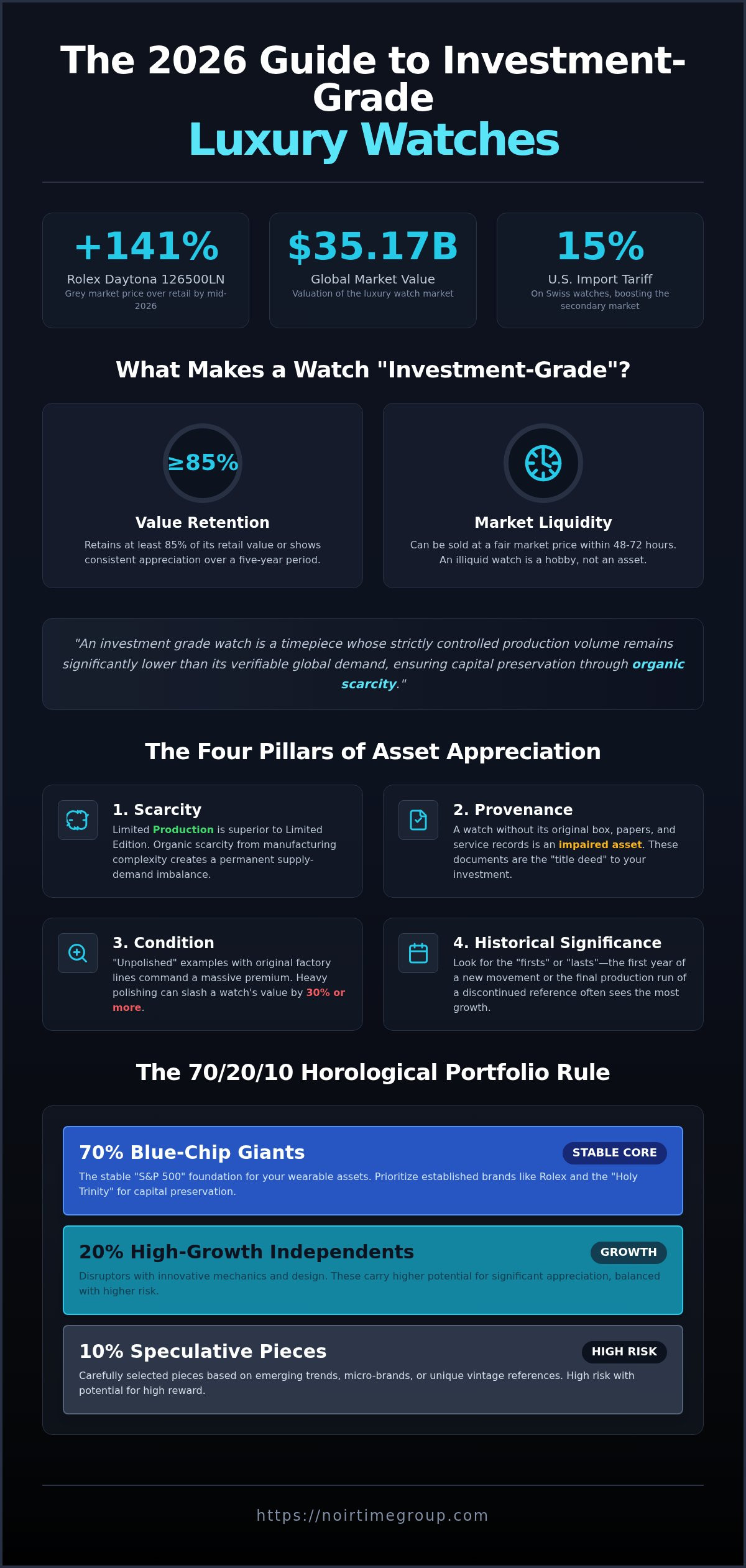
In 2026, an investment grade watch is defined as a timepiece whose strictly controlled production volume remains significantly lower than its verifiable global demand, ensuring capital preservation through organic scarcity.
The Four Pillars of Watch Asset Appreciation
Success in horological investment rests on a structured framework rather than chasing social media trends. This investment grade luxury watches guide identifies four critical pillars that determine whether a timepiece remains a hobby or becomes a high-performing asset. Understanding these factors is essential for anyone looking to preserve capital in the 2026 market. We focus on attributes that provide long-term stability, moving beyond the "hype" cycles that often lead to poor financial decisions.
- Scarcity: "Limited Production" is far superior to "Limited Edition." Organic scarcity occurs when a brand's annual output for a specific model is naturally low due to manufacturing complexity. While a "Limited Edition" is a marketing construct, limited production creates a permanent supply-demand imbalance that supports secondary market prices.
- Provenance: In 2026, a watch without its original box, warranty papers, and service records is considered an impaired asset. These documents serve as the "title deed" to your investment, ensuring the watch's history is verifiable and its value is protected.
- Condition: Auction results in 2026 show a massive premium for "unpolished" examples. Collectors want the original factory lines and bevels. A heavily polished case can slash a watch's value by 30% or more because it removes the original metal and character of the piece.
- Historical Significance: We look for "firsts" or "lasts." The first year of a new movement or the final production run of a discontinued reference often sees the most aggressive price growth. For instance, the discontinued Patek Philippe Nautilus 5711/1A-010 remains a high-value target precisely because its production run has ended.
The Scarcity-to-Demand Ratio
Evaluating an asset requires looking at the math behind the hype. We analyze waitlist lengths against annual production numbers to find the true scarcity-to-demand ratio. While Rolex produces approximately one million watches a year, the demand for specific steel professional models like the Daytona 126500LN remains so high that secondary prices stay 141% above MSRP. Analyzing current luxury watch market trends reveals that smaller case sizes (36mm to 40mm) are currently seeing the highest demand-driven appreciation. If you're looking for expert guidance on these ratios, Noir Time Group offers curated insights for serious investors.
Technological Authentication and Digital Passports
The 2026 market has embraced digital innovation to combat the risk of sophisticated fakes. Physical "Box and Papers" are now being supplemented by blockchain-based digital twins and NFT certificates. These digital passports provide an immutable record of ownership and service history, significantly reducing the "authenticity risk premium" that previously suppressed secondary market prices. By using this investment grade luxury watches guide, you can ensure your portfolio benefits from these technological safeguards, making your assets more liquid and secure. Digital verification has become the new gold standard for ensuring that what you buy is exactly what it claims to be.
Blue-Chip Giants vs. Independent Disruptors
Choosing between established powerhouses and rising independent masters is a defining choice for any serious collector. While the "Holy Trinity" of Patek Philippe, Audemars Piguet, and Vacheron Constantin continues to anchor the market, the 2026 landscape has seen a significant diversification. This investment grade luxury watches guide highlights that while Rolex remains the "S&P 500" of horology, providing unmatched stability and liquidity, the most explosive growth is often found in smaller, artisan-led brands. Noir Time Group acts as the bridge between the enthusiast and the serious investor, helping you weigh the safety of institutional giants against the high-ceiling potential of the "Indies."
The Institutional Brands (Rolex & Patek)
Rolex acts as the market's bedrock. On January 1, 2026, the brand implemented an average 7% price increase across the US, with gold models rising by 9% and steel by 5.6%. This dominance is reflected in their market share, as Rolex accounts for roughly one out of every three luxury watches sold this year. While the Patek Philippe Nautilus 5711/1A-010 remains a powerhouse with secondary prices between $110,000 and $163,300, we're seeing a pivot toward classic complications. Similarly, the Audemars Piguet Royal Oak 15500ST holds steady between $49,000 and $68,000. However, the "integrated bracelet fatigue" mentioned in the 2026 investment-grade watch report suggests that smart money is moving toward Patek's Grand Complications as the safest harbour for capital preservation.
The Independent Watchmaker Surge
Ultra-low production creates a permanent price floor that institutional brands can't always match. Brands like F.P. Journe, Akrivia, and H. Moser & Cie often produce fewer than 500 units annually. This extreme scarcity, combined with the "Artisan" appeal of hand-finished movements, drives the demand we're seeing from younger Gen Z collectors. These buyers are moving away from "hype" and toward "intentional collecting," favoring brands with clear design languages. While buying unproven independents carries volatility risk, the "Neo-Vintage" segment from the 1990s and early 2000s is currently the high-growth sector of 2026. These pieces offer the perfect mix of modern reliability and vintage charm, making them a cornerstone of any diversified investment grade luxury watches guide strategy.
- Rolex: High liquidity and consistent retail price hikes (7% in 2026).
- Patek Philippe: Dominates high-value secondary transactions, especially discontinued steel sports models.
- Audemars Piguet: Strong performance in core Royal Oak references despite shifting trends.
- Independents: High growth potential driven by artisan craftsmanship and sub-500 unit annual production.
How to Build and Protect a Luxury Watch Portfolio
Constructing a resilient collection requires more than just capital; it demands a strategic allocation of assets. This investment grade luxury watches guide recommends the 70/20/10 rule for 2026. Allocate 70% of your capital to blue-chip giants for stability. Dedicate 20% to high-growth independent watchmakers that offer artisan appeal. Reserve the final 10% for speculative pieces that might catch the next wave of collector interest. Balancing "Daily Wearers" with pristine "Safe Queens" ensures you enjoy your assets while protecting the majority of your capital.
Choosing the right source is the most critical decision in the acquisition phase. While Authorized Dealers offer the comfort of retail pricing, the secondary market provides immediate access and price transparency. Expert curation is essential when navigating the 2026 secondary market. You can consult with Noir Time Group to source authenticated pieces that meet strict investment standards. Always insist on a "Full Set," which includes the box, papers, tags, and all original links. In the current market, a missing link or a lost warranty card can decrease an asset's value by 10% to 15%.
Acquisition Strategy: Where to Buy
The 2026 market is filled with sophisticated fakes and "franken-watches" made of mismatched parts. Red flags in online listings include blurred serial numbers, lack of digital passport integration, or prices that seem disconnected from the Bloomberg Subdial Watch Index. Use grey market price transparency to your advantage; if a price is significantly below the established market average, the provenance is likely compromised. High-value transactions should always include a multi-step verification process to eliminate authenticity risk.
Storage, Insurance, and Security
Protecting your investment goes beyond a locked safe. Specialized watch insurance has evolved in 2026, with "Agreed Value" policies becoming the preferred choice over "Market Value" options, which can lag behind sudden price spikes. Climate-controlled storage is non-negotiable for long-term preservation. Fluctuations in humidity can degrade dial finishes and dry out gaskets, leading to costly service needs. Maintaining "Original Parts" during any service is the gold standard; replacing a vintage dial with a modern service dial can ruin a watch's investment potential. Use this annual checklist to maintain your portfolio's health:
- Review and update market valuations for insurance coverage.
- Verify the integrity of digital provenance certificates and blockchain "twins."
- Perform a pressure test on gaskets for any pieces not kept in long-term vacuum seals.
- Audit service records to ensure all maintenance was performed by brand-certified masters using original components.
The Noir Time Group Approach to Horological Investment
Successful investing in the 2026 market requires more than just capital; it demands a partner who understands the nuance between a popular watch and a high-conviction asset. We don't chase volume. Instead, we focus on timepieces that possess the mechanical integrity and provenance required to withstand market volatility. As the bridge between the enthusiast and the serious investor, Noir Time Group prioritizes expert curation over mass-market inventory. This investment grade luxury watches guide concludes by emphasizing that your acquisition strategy is only as strong as your authentication process.
Our multi-step verification process has evolved to meet 2026 standards, integrating physical inspection with digital provenance checks. We recognize that with the global luxury watch market reaching $35.17 billion this year, the risk of sophisticated fakes has never been higher. We mitigate this risk by focusing on "Grail" watches found through our strategic, off-market sourcing network. This allows our clients to acquire rare references that never reach public listings, providing a competitive edge in a market where one out of every three luxury sales is a Rolex. We view every transaction as the start of a long-term portfolio management partnership.
Why Provenance Matters to Us
We maintain rigorous standards for what we classify as investment grade. Every piece in our inventory must be a "Full Set," including the original box, warranty papers, and all factory links. For vintage and neo-vintage pieces, we verify the service history to ensure no "service parts" have compromised the watch's original state. We understand that in 2026, the secondary market is the most reliable indicator of true value. Our guarantee of authenticity and mechanical integrity ensures your capital is preserved in assets that meet the highest collector standards. We don't accept compromises because we know they lead to liquidity issues during an exit.
Start Your Investment Journey
Building a portfolio in 2026 requires a clear understanding of your specific acquisition goals. Whether you're targeting the stability of the "Holy Trinity" or the high-growth potential of artisan independents, our specialists provide the data-driven insights you need. We help you navigate the 15% US import tariff landscape by sourcing pre-owned assets already within the country, bypassing structural costs that inflate retail pricing. By leveraging our global network, you gain access to the 36mm to 40mm references that are currently dominating the "intentional collecting" trend among Gen Z and seasoned investors alike.
Explore our curated collection of investment grade timepieces at Noir Time Group and begin mastering the art of horological investment today.
Master Your 2026 Horological Strategy
The luxury watch market in 2026 is a sophisticated $35.17 billion landscape where success depends on identifying scarcity and maintaining impeccable provenance. It's no longer about chasing social media hype; it's about intentional collecting and understanding the scarcity-to-demand ratios that drive long-term appreciation. By following this investment grade luxury watches guide, you've gained the tools to navigate a market influenced by 15% import tariffs and a renewed focus on classic, understated designs. The path to a stable alternative asset is now clearer than ever.
Navigating these complexities requires a partner with 2026 market-specific valuation expertise and a commitment to expert secondary market curation. Noir Time Group provides the bridge you need, offering guaranteed authenticity on all timepieces to ensure your capital remains secure. You're ready to build a portfolio that combines historical significance with modern financial stability. Secure your next horological asset with Noir Time Group and begin your journey into the highest tiers of watch collecting with absolute confidence.
Frequently Asked Questions
What is the best entry-level investment watch under $10,000 in 2026?
Tudor and Cartier currently offer the most stable entry-level opportunities in this price bracket. The Tudor Black Bay and Cartier Santos are strong 2026 contenders because they align with the trend toward 36mm to 40mm case sizes. These models benefit from high liquidity and have avoided the aggressive 9% price hikes recently seen in top-tier gold models.
Do luxury watches really appreciate faster than the stock market?
Only specific high-demand references tend to outperform broad market indices. While the Bloomberg Subdial Watch Index saw an 8% gain in 2025, the stock market often provides more consistent long-term growth. You should view watches as a stable alternative asset for capital preservation and diversification rather than a total replacement for traditional equities.
How much does professional servicing affect a watch's resale value?
Maintenance is critical, but the quality of that work matters more than the frequency. Documented service by brand-certified masters using original components is the gold standard for any investment grade luxury watches guide strategy. Never allow a watch to be polished during service. Removing original metal to fix scratches can slash the resale value by 30% or more.
Is it better to buy a brand new watch or a vintage model for investment?
Neo-vintage models from the 1990s and early 2000s currently offer the best balance of reliability and growth potential. Unlike new watches that may face immediate depreciation once they leave the dealer, neo-vintage pieces have already established their market floor. This investment grade luxury watches guide recommends these for collectors seeking both historical character and capital security.
What are the biggest risks when investing in luxury watches?
Authenticity risk and market illiquidity are the primary concerns for 2026 investors. Sophisticated fakes now include cloned movements that can deceive casual observers. Additionally, the secondary market can become illiquid for "hype" watches during market corrections. This means you might not be able to exit a position quickly at your desired price when you need liquidity.
How do I verify the authenticity of a watch in the secondary market?
Verification requires a combination of physical inspection and digital provenance. Check for original warranty papers, matching serial numbers, and blockchain-based digital twins when available. Professional secondary market specialists use multi-step authentication processes to eliminate the risk of "franken-watches." These are pieces that contain non-original parts or mismatched components from different production years.
Which watch brands are expected to grow the most in the next 5 years?
Independent watchmakers producing fewer than 500 units annually, such as F.P. Journe and H. Moser & Cie, are expected to see the most significant percentage growth. Their extreme scarcity creates a permanent price floor that larger, mass-produced brands cannot replicate. While the "Big Three" remain stable, these artisan disruptors are capturing the attention of Gen Z collectors.
Should I wear my investment watch or keep it in a safe?
Wearing your watch is a personal choice, but "unworn" status carries a significant financial premium at auction. Most investors follow a balanced approach, keeping their most valuable blue-chip assets in climate-controlled storage while enjoying robust steel professional models as daily wearers. Excessive wear can lead to mechanical degradation and lower your eventual return on investment.
