

A perpetual calendar watch needs more than a routine timekeeping fix. Luxury perpetual calendar watch servicing in NYC may involve a thorough movement overhaul, cleaning, and lubrication. For collectors considering luxury perpetual calendar watch servicing NYC, the watch’s symptoms and movement condition help determine the appropriate work. A careful service plan also accounts for the complexity of its calendar mechanism.
It’s understandable to want intricate mechanics and a high-end watch handled with care. This article explains what servicing involves, how lubrication and replacement parts fit into the process, and what to consider when arranging expert care for Audemars Piguet and other luxury watches. You’ll also learn how to prepare for a visit by noting symptoms and service history, and how to distinguish mechanical repairs from work on the watch’s exterior finish.
Key Takeaways
- A stopped watch or a change in timekeeping can prompt an assessment of whether a movement overhaul, oiling, and lubrication are appropriate.
- Before arranging a visit, note the watch’s symptoms and relevant service history so you can describe its needs clearly.
- Understanding how manufacturer-approved parts are addressed can help you evaluate the scope of a repair and its documentation.
- Perpetual calendars and luxury brands such as Audemars Piguet call for careful attention to the movement and its specific complications.
Movement overhaul, oiling, and lubrication
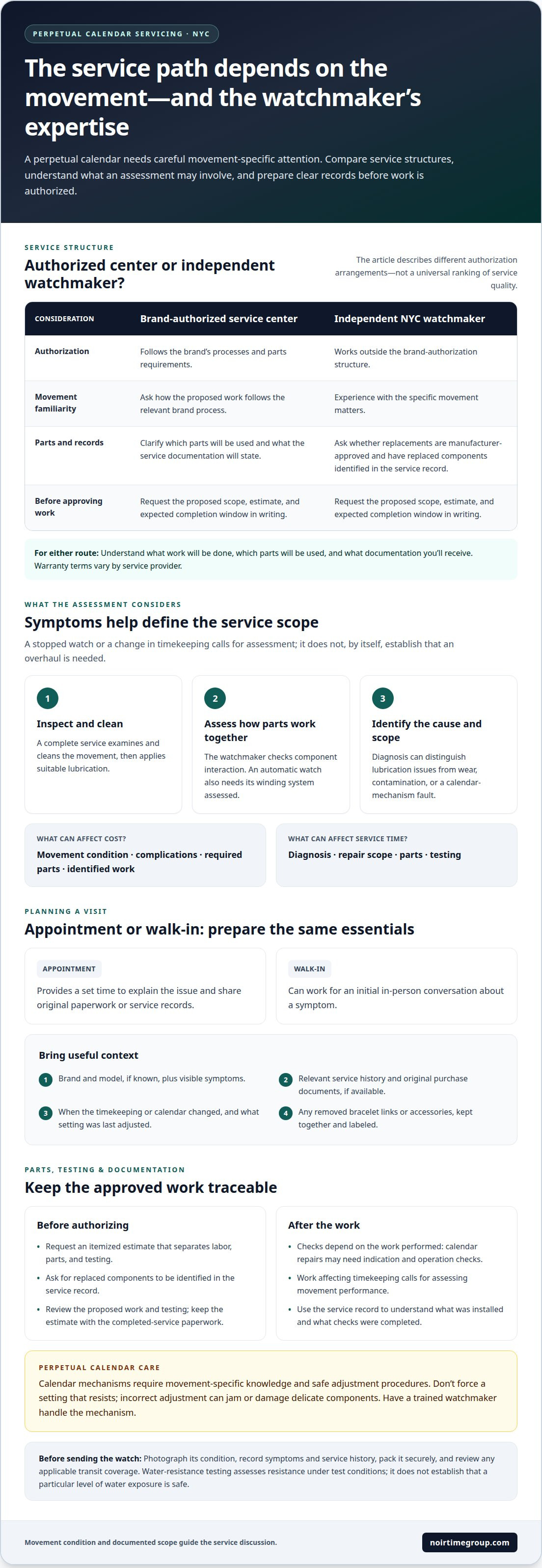
Routine maintenance addresses wear inside the movement, not just the watch’s appearance. During a complete service, a watchmaker examines and cleans the movement, applies suitable lubrication, and checks how its components work together. An automatic watch also needs its winding system assessed. The watch’s condition and the needs of its mechanism determine the service scope.
If a watch stops or its timekeeping changes, an assessment can determine whether a movement overhaul is appropriate. Diagnosis helps distinguish lubrication issues from wear, contamination, or a fault in the calendar mechanism. Cost depends on the movement’s condition, its complications, any required parts, and the work identified. The diagnosis, repair scope, parts, and testing also affect how long service takes.
Brand-authorized service centers follow the brand’s processes and parts requirements. Independent NYC watchmakers work outside that authorization structure, so experience with the specific movement matters. Either way, understand what work will be done, which parts will be used, and what service documentation you’ll receive.
Perpetual calendar servicing requires knowledge of the specific movement, its calendar mechanism, and safe adjustment procedures. Appropriate equipment includes movement-specific tools and instruments for assessing timekeeping. Incorrect calendar adjustment can jam or damage delicate components, so don’t force a setting that resists. Have a trained watchmaker handle the mechanism.
Before sending a watch, photograph its condition, record its symptoms and service history, and pack it securely. Review any transit coverage that applies to your watch. Before authorizing service, request the proposed work, estimate, and expected completion window in writing. Warranty terms vary by service provider. Water-resistance testing assesses resistance under test conditions; it doesn’t establish that a particular level of water exposure is safe. Tell the watchmaker if the watch has stopped, its timekeeping has changed, or the calendar is malfunctioning. Those details help with the initial assessment.
Appointment and walk-in contact information
For a complex calendar watch, plan your visit around the service details you need to discuss. An appointment gives you a set time to explain the issue and share the watch’s original paperwork or service records. A walk-in visit can work for an initial conversation, especially if you want to describe a symptom in person. Either way, bring the watch securely and keep loose accessories separate.
Before arranging your NYC visit, prepare a concise description of the problem. Note when the calendar or timekeeping changed, what setting you last adjusted, and whether the watch stopped. Include the brand and model, if known. These details keep the discussion focused on the actual concern rather than a broad request for a complete service.
- Write down the watch’s brand, model, and visible symptoms.
- Gather original purchase documents and relevant service records.
- Keep any removed bracelet links or accessories together and labeled.
- Choose an appointment for a planned discussion, or a walk-in for an in-person initial conversation.
At the visit, describe the issue in sequence. For example, say whether the date stopped advancing before or after you adjusted the time. Explain your priority, such as diagnosing the calendar display or discussing a complete service. Before authorizing work, review the proposed scope and written estimate. Keep a copy of the intake record and note the watch’s condition when you hand it over.
Bring only relevant documents, and avoid adjusting a malfunctioning calendar before the visit. A clear symptom timeline is more useful than repeated setting attempts. To plan the next step, review watch service information and prepare your notes before traveling in NYC.
Authentic manufacturer-approved parts
Parts must fit the specific movement and preserve its intended mechanical function. In a perpetual calendar, replacing a component can affect how the calendar indications interact with the rest of the movement. Ask the watchmaker to identify replaced components in the service record and distinguish manufacturer-approved parts from other replacements. That documentation clarifies what changed during the repair.
Before authorizing work, request an itemized estimate that separates labor, parts, and testing. For example, if a calendar component needs replacement, the estimate should specify that work rather than describe only a general overhaul. Keep the estimate with the final service paperwork. Comparing the two helps you check whether the completed work matches the approved scope.
- Record the brand and model shown on your watch documents.
- Ask for replaced parts to be identified in the service record.
- Review the proposed work and testing before authorizing service.
- Keep the estimate and completed-service documentation together.
Post-service testing helps assess the watch, but the relevant checks depend on the work performed. A calendar repair may require checking the indications and their operation, while work affecting timekeeping calls for assessing the movement’s performance. Ask for the service record to describe the work and checks completed. This gives you a practical reference for future maintenance and helps preserve the watch’s service history.
Clear parts documentation is especially useful when a luxury watch’s service history matters to you. Bring original purchase papers and previous service records, if available, so the watchmaker can review the model and its maintenance background. A part’s appearance alone doesn’t prove its source or approval. Instead, use the written service record to understand what was installed and what work was completed.
Audemars Piguet and other luxury brand servicing
In NYC, luxury perpetual calendar watch servicing is available through brand-authorized service centers and independent specialists. Focus on the watchmaker’s experience with your specific brand and movement, and whether they can explain the proposed work and parts documentation.
Audemars Piguet, Patek Philippe, and Rolex use distinct movement designs. A perpetual calendar adds interacting date indications, so the service plan should account for the exact model and complication. Before your visit, write down the brand, model, symptoms, and relevant service history. For example, note whether the calendar display changed after an adjustment or stopped advancing during ordinary wear.
Use the discussion to clarify what the service covers. Ask for a clear description of the movement work, any proposed parts replacement, and the testing planned after repair. If the watch has visible marks, discuss its exterior finish separately from its mechanical operation. Polishing changes appearance; it doesn’t repair a calendar mechanism.
- Bring the watch’s model details and available service records.
- Describe calendar, timekeeping, or winding symptoms in sequence.
- Review the proposed scope and parts documentation before approving work.
These steps help you compare service approaches without assuming every luxury watch needs the same treatment. A Royal Oak, for example, should be discussed in terms of its specific model and movement, not just its brand. Clear records also give the watchmaker useful context and help you keep a history of completed work.
If you’re considering service for an Audemars Piguet or another luxury watch, start a conversation about your timepiece and share its model and symptoms.
Consider a brand-authorized service center or an independent NYC watchmaker experienced with your watch’s specific brand and movement.
Noir Time Group: Rolex Submariner Date 126613LN
Noir Time Group offers Certified Watch Repair for readers seeking watch service, alongside its Rolex Submariner Date 126613LN. If you’re weighing repair options, the service is a relevant next step for discussing your watch’s condition and repair needs. For collectors looking for a particular timepiece, Noir Time Group also offers a Watch Sourcing Service. These offerings address different needs: repair for a watch you own, or sourcing when you’re looking for a specific model.
The Rolex Submariner Date 126618LN is another available model. Choose the path that matches your goal, whether you’re seeking repair or a timepiece. Contact Noir Time Group to discuss the next step.
Take the Next Step With Confidence
Choosing luxury perpetual calendar watch servicing NYC means deciding how you want to care for your timepiece over the years ahead. Make the conversation specific to your watch, its model, and the result you’re seeking. A clear starting point turns a complicated repair question into a practical discussion about next steps.
To discuss luxury perpetual calendar watch servicing NYC, share the watch’s symptoms and relevant service history with Noir Time Group. The company also offers a Watch Sourcing Service for collectors seeking a particular timepiece. Whether you need service or sourcing, focus on the decision in front of you and request the information that will help you move forward.
Contact Noir Time Group to discuss servicing, and take the next step toward informed care for your watch.
Frequently Asked Questions
What makes luxury watch repair different?
Luxury watch repair often involves movements with closely coordinated components and brand-specific construction. A fault in one part can affect other functions, such as the calendar display or automatic winding. The watch’s model and complications therefore shape the repair approach. A perpetual calendar, for example, requires attention to its calendar mechanism, while concerns about the exterior finish are separate from movement repair.
Do Rolex, Patek Philippe, Audemars Piguet, and other brands offer authorized service in NYC?
Authorized service depends on the specific brand and provider; a NYC watchmaker’s experience with Rolex, Patek Philippe, or Audemars Piguet doesn’t by itself mean that the watchmaker is brand-authorized. Before choosing a service route, distinguish authorized service from independent repair and understand who will perform the work. That distinction can matter to collectors prioritizing brand-specific procedures or service documentation.
What is included in a full perpetual calendar watch overhaul?
A full overhaul generally treats the movement as a system: the watchmaker assesses its condition, cleans and lubricates components, and evaluates any parts that may need replacement. The movement is then reassembled and checked for proper operation. For a perpetual calendar, the work also focuses on the calendar indications and how they interact with the movement. The assessment determines the final scope.
How often should a luxury perpetual calendar watch be serviced?
Start with the watch brand’s maintenance guidance, then consider the timepiece’s condition and use. A watch that stops, changes its timekeeping, or develops a calendar fault needs attention based on those symptoms, not a generic schedule. Keep service records together: they help track previous work and give a watchmaker useful context when planning future maintenance.
