

The counterintuitive choice may be the slower one: selling privately can leave you with more from a watch sale, but only if the extra work and risk are worth it. The pros and cons of selling a watch privately come down to your likely net proceeds, not just the asking price; pre-owned watch vendors typically seek a 15% to 25% resale margin. A dealer offer may be lower, while offering a quicker, simpler route to cash.
It makes sense to want the strongest return while hesitating to handle a high-value transaction with a stranger. This guide compares the pros and cons of selling a watch privately with selling to a dealer or trading it in, looking at resale value, fees, effort, timing, and cash in hand. You’ll learn what shapes a realistic resale price, how marketplace costs and payment risks can narrow the gap, and when convenience may matter more than maximizing the sale amount. The aim is to help you choose the route that fits your priorities, whether you need cash for another purchase or simply want fewer steps.
Key Takeaways
- Compare likely net proceeds, not just asking prices: dealer margins and marketplace fees can change what you actually keep.
- Choose a private sale if you’re prepared to price the watch, find a buyer, handle negotiations, and manage payment and shipping carefully.
- Build a realistic estimate from comparable listings, the watch’s condition, and included documentation and accessories.
- Prioritize a dealer offer or trade-in when speed and a simpler transaction matter more than pursuing the highest possible sale price.
Comparing private-sale value with dealer speed and convenience
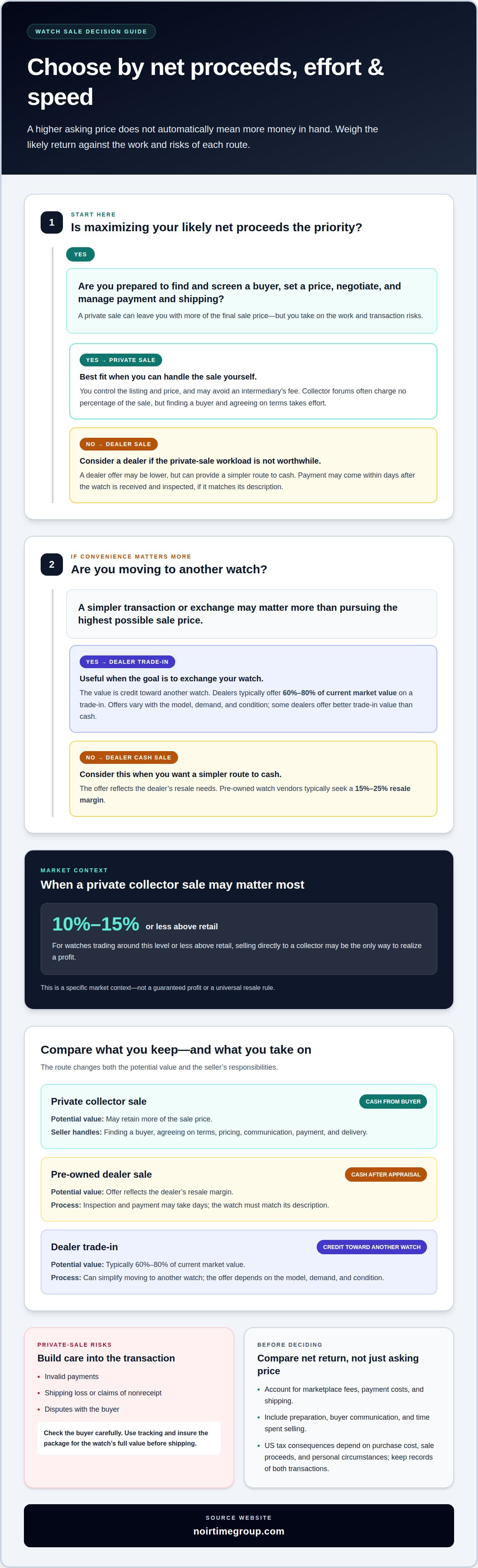
A private sale may preserve more of the final price, while a dealer can simplify the transaction. For watches trading around 10% to 15% or less above retail, selling directly to a collector may be the only way to realize a profit. Collector forums often charge no percentage of the sale, but finding a buyer and agreeing on terms takes effort.
A specialist pre-owned watch dealer buys with resale in mind. Vendors typically seek a 15% to 25% margin and may pay within days of receiving and inspecting a watch that matches its description. A trade-in can suit someone moving to another watch, though dealers typically offer 60% to 80% of current market value on a trade-in. The offer varies with the model, demand, and condition; some dealers offer better trade-in value than cash.
| Option | Potential value | Speed and effort | Cash or trade |
|---|---|---|---|
| Private collector sale | May retain more of the sale price | Seller finds buyer and manages terms | Cash from buyer |
| Pre-owned dealer sale | Offer reflects resale margin | Inspection and payment can take days | Cash after appraisal |
| Dealer trade-in | Offer depends on watch and demand | Can simplify moving to another watch | Credit toward another watch |
Choose a private sale when maximizing proceeds matters and you’re prepared to screen buyers, negotiate, and manage payment. Choose a dealer sale or trade-in when you value a simpler transaction or want to exchange your watch.
US tax consequences depend on the watch’s purchase cost, sale proceeds, and your circumstances. Keep records of both transactions and seek tax advice suited to your filing situation.
Private sellers should be alert to invalid payments, shipping loss, claims of nonreceipt, and disputes. Check the buyer carefully, use tracking, and insure the package for the watch’s full value before shipping.
Balancing sale price, fees, effort, and time
A higher asking price is worthwhile only if fees, preparation, and time still leave you with a worthwhile net return. Compare the likely amount in hand with the effort each route requires.
Private-Sale Price Potential
A private sale may let you keep more of the final sale price by avoiding an intermediary’s fee, depending on the payment method. That offers more upside than a sale with platform charges, but leaves you responsible for pricing the watch and attracting buyers. For a watch in strong demand, a competitive listing and clear evidence of its condition can help support your asking price.
Consider the whole transaction, not just the listing price. The example shows how a promising sale price can translate into a much smaller gain after costs.
Fees, Effort, and Selling Time
Marketplace fees vary, and eBay sellers may face listing and payment fees, disputes, and shipping costs. A private seller also handles photos, messages, negotiation, payment, and delivery. On Chrono24, a listing may take longer to attract buyers if its price is uncompetitive or its photos are weak.
The extra work affects your effective return: time spent answering inquiries or resolving a dispute has value, even if it carries no stated fee. Selling to a dealer may reduce your tasks, while a marketplace gives you more control over the listing and price.
Preparation matters, but avoid changes that could reduce a watch’s appeal. Vintage watches generally shouldn’t be polished before sale, since buyers may prefer their original condition. Minor repairs may improve an evaluation before a sale or trade, while non-authentic parts can reduce value. For servicing, use an authorized dealer.
Before listing, take clear photos, describe what you know, and compare your price with similar listings. Weigh expected net proceeds against preparation, buyer communication, and selling time, then choose the route that best fits your priorities.
Estimating a watch’s realistic resale value
Start with the watch itself, then compare its condition and included items with similar examples. Retail prices alone don’t show what a buyer may pay on the secondhand market.
Condition and Resale Value
Condition affects value through both function and appearance. Note whether the watch works, describe visible wear accurately, and record any known repairs. A working watch with physical wear isn’t equivalent to a similar example in better condition, so compare like with like.
Accessories matter, too. Original boxes, papers, extra links, and other included items can add value for a buyer. For instance, a complete set for a Rolex Submariner ref. 126610LN commands a stronger price than a bare watch, but you should treat this as a specific example, not a universal benchmark.
Market Research and Resale Pricing
To estimate market value, compare listings for the same model in similar condition, accounting for differences in documentation and accessories. An authorized dealer evaluation is another way to assess the watch. Asking prices show what sellers hope to receive, not necessarily what a completed sale will bring.
Use these steps to build a grounded estimate:
- Identify the exact model and describe its working condition and visible wear.
- Compare similar listings, including what boxes, papers, and extra links are included.
- Set an asking price that reflects those differences, rather than copying the highest listing.
Keep your comparisons consistent. A listed watch with complete papers and little visible wear isn’t a direct match for one with missing accessories or more wear. This helps prevent an inflated estimate, repeated price cuts, and unnecessary hassle.
In a private listing, describe the watch’s condition and included items plainly. Accurate details help buyers assess the same factors you used to estimate a realistic resale price.
Selling privately for cash
A private sale gives you control over the terms, but selling a luxury watch requires careful buyer screening. Online collector forums and marketplaces reach a focused audience, while local sales let you meet face to face.
For an online sale, use a watch marketplace or collector forum where your listing can reach interested buyers. New forum members may need to build trust through participation or references. For a local sale, arrange to meet in a staffed public place and avoid sharing unnecessary personal details.
Online and Local Sale Options
Online listings can reach collectors beyond your area, but distance adds payment and delivery risks. Use clear, original photos and accurately describe what you know about the watch. Avoid stock images: buyers need to assess the actual item, and mismatched photos can undermine trust.
A local sale lets the buyer inspect the watch in person, which may help address questions about its condition and authenticity. It also means coordinating a meeting and handling a valuable item face to face. Choose the route that suits your comfort with shipping, direct meetings, and the size of your potential buyer audience.
Buyer Meetings and Payment
For an in-person exchange, meet in a public, staffed setting and consider bringing someone you trust. Let the buyer inspect the watch while you keep it in your control, and agree on the price and payment method before meeting.
For an online payment, don’t ship based only on a screenshot or payment notification. Confirm through your payment provider that the funds have reached your account before handing over the watch. Delayed or invalid payments can leave you without the watch or the money, so keep transaction messages and shipping records.
Before publishing, prepare the watch’s description, photos, and asking price, then decide how you’ll handle inspection, payment, and delivery. If you’re also considering buying a timepiece, explore luxury watch options as another route for your next purchase.
Noir Time Group: Rolex Submariner Date 126613LN
Noir Time Group offers the Rolex Submariner Date 126613LN and 126618LN for buyers considering a different route to their next watch. If you’re looking for a particular timepiece rather than selling your current one, its Watch Sourcing Service can help with that search. A Certified Watch Repair is also relevant if your watch needs servicing before you decide what to do next. These options suit readers whose plans involve buying, sourcing, or repairing a watch, rather than completing a private sale. Comparing your priorities with these offerings can help clarify your next step. For details, contact Noir Time Group.
Choose the Next Move That Fits Your Watch Goals
Before deciding, consider what you want the sale to make possible: freeing up funds, changing watches, or finding a particular model. For business owners considering asset sales to raise capital, exploring commercial financing options via Lending Box can provide an alternative route to liquidity without parting with prized personal possessions. Weighing the pros and cons of selling a watch privately is easier when your next step is clear. It helps you decide whether a potentially higher return is worth the time and care involved.
If you’re considering a different watch, Noir Time Group offers the Rolex Submariner Date 126613LN and Rolex Submariner Date 126618LN, along with a Watch Sourcing Service for locating a specific timepiece. These options may suit a plan to move from selling into buying or sourcing. They aren’t a substitute for a private sale, but can help if your goal is to find your next watch.
Take the time to choose the route that matches your priorities, then contact Noir Time Group to explore its watch offerings and sourcing service. A clear next step can make your decision feel more manageable.
Frequently Asked Questions
When is selling smarter?
Selling privately makes more sense when the expected net proceeds justify managing the transaction yourself. It may be worthwhile for a sought-after model trading only slightly above retail, where a dealer’s margin could absorb the potential profit. This route also suits owners who can spend time presenting the watch clearly, responding to serious buyers, and arranging a secure transaction without needing an immediate sale.
What are the pros of selling a watch privately?
The main advantages are greater control over the terms and the possibility of keeping more of the final sale price. The pros and cons of selling a watch privately differ for an owner with time to reach collectors and someone who needs a straightforward transaction. A focused audience may appreciate the watch’s details, and you decide how to present its history and included items.
What are the cons and risks of selling a watch privately?
Private sellers are responsible for buyer screening, authenticity questions, payment, and delivery. A buyer may hesitate without a professional intermediary, even when the watch is genuine. Online transactions can also involve delayed or invalid payment, shipping loss, or claims that the parcel never arrived. Keep records of messages and agreed terms, and don’t release the watch until payment is verified.
How much more can you get selling a watch privately versus to a dealer or jeweler?
There’s no fixed amount you’ll make; compare the private sale’s net proceeds after platform or transaction costs with the dealer’s actual offer. Start with comparable watches in similar condition, then use what a buyer is prepared to pay, not the highest asking price, as your practical benchmark. A private listing price alone doesn’t show how much extra you’ll keep.
What fees and costs apply when selling a watch privately in the US?
Costs depend on how you sell. A collector forum may charge no percentage, while an online marketplace may charge listing or transaction fees. Shipping and payment handling can also reduce your net proceeds, and a dispute may bring extra shipping costs or a lost sale. Before choosing a channel, identify each applicable charge and subtract it from your expected proceeds.
How do you price a used watch for a private sale?
Set your price by comparing the same model in similar condition, not by relying on its original retail price. Separate your asking price from the minimum net amount you’ll accept after transaction costs. Describe the watch accurately and account for its working condition, visible wear, documentation, and accessories. If qualified buyers show little interest, revisit your comparisons and adjust the asking price.
