
The Swiss watch industry loses nearly $1.9 billion annually to counterfeit timepieces, a figure that makes even seasoned collectors hesitate. It's natural to feel a mix of excitement and anxiety when you're searching for the right questions to ask when buying a used Rolex. You want the prestige of a Submariner or a GMT-Master II, but the fear of sophisticated "super-clones" or looming service costs can quickly turn a dream into a headache. We know you aren't just buying a watch; you're securing a piece of horological history that should maintain its value for decades to come.
To navigate the secondary market safely, you must move beyond a simple visual inspection and use a professional vetting process. This guide provides a comprehensive script to protect your investment and ensure total transparency from any seller. We'll walk you through 15 critical inquiries covering everything from randomized serial numbers to the true impact of original "box and papers" on resale value. By the end of this checklist, you'll have the tools to interview any dealer with the confidence of an industry expert, ensuring your next timepiece is a genuine, high-performing asset for your collection.
Key Takeaways
- Master the specific questions to ask when buying a used Rolex to verify the authenticity of the "box and papers" documentation.
- Learn how to assess service history so you don't get stuck with hidden maintenance costs that can easily top $1,500.
- Understand why it's vital to check for excessive polishing, as it can significantly lower the watch's long-term resale value.
- Discover the security advantages of choosing an established dealer who's prepared to offer an in-house authenticity guarantee.
- Get a clear roadmap for handling high-value logistics, from secure payment methods to specialized shipping insurance.
The Rolex Due Diligence: Why Your Questions Determine Your ROI
The secondary market for luxury timepieces is complex. While a vintage or pre-owned model offers immediate availability, it requires a level of scrutiny that retail purchases don't. Knowing the right questions to ask when buying a used Rolex is the only way to ensure your Return on Investment (ROI) remains intact. In this context, ROI represents two distinct values: the emotional satisfaction of owning a masterpiece and the financial liquidity the watch maintains over time. A safe deal occurs when these two factors align perfectly through rigorous vetting, starting with the specific questions to ask when buying a used Rolex that we outline below. Understanding the Rolex brand history helps collectors appreciate why certain references hold value better than others, but only direct inquiry protects your capital.
To evaluate a potential purchase, you should focus on three fundamental pillars:
- Provenance: The documented history and ownership trail of the timepiece.
- Condition: The physical and mechanical state of the watch, including service records.
- Dealer Trust: The reputation and reliability of the person or business standing behind the sale.
The High Stakes of the Pre-Owned Market
The rise of "super-clones" has changed the game. These high-end counterfeits are often indistinguishable from the real thing to the untrained eye, making expert vetting mandatory. This is why seasoned collectors often say you should "buy the seller" before you buy the watch. If the dealer can't answer technical questions about the movement or the case's history, the risk is too high. Provenance is the verified chronological record of the watch's ownership and origin, serving as the ultimate proof of its life before it reached your wrist.
Setting Your Expectations for a $20k+ Purchase
When you're looking at a high-ticket item like the Rolex Submariner Date 126618LN, the price difference between a private seller and a certified boutique retailer reflects the level of security provided. Private sales might save you a few dollars upfront, but they lack the authenticity guarantees found in professional NYC boutiques. Peace of mind is a valuable commodity in transactions exceeding $20,000. If you have a specific reference in mind that isn't currently in stock, our professional watch sourcing service can bridge that gap. We leverage industry networks to find pristine examples, ensuring you don't have to compromise on quality or authenticity while searching for the perfect addition to your collection.
Checklist Part 1: Questions About Provenance and Paperwork
When you start your search, the initial questions to ask when buying a used Rolex should focus heavily on documentation. Paperwork isn't just a receipt; it's a certificate of authenticity that directly impacts the watch's market value. If a dealer can't produce a clear ownership trail, you're looking at a higher risk profile. You want to know exactly who owned the watch before it reached the display case. A documented history of ownership, or provenance, provides the transparency needed to justify a premium price point, especially for high-ticket models like the Rolex Submariner Date 126613LN.
The "Full Set" Premium
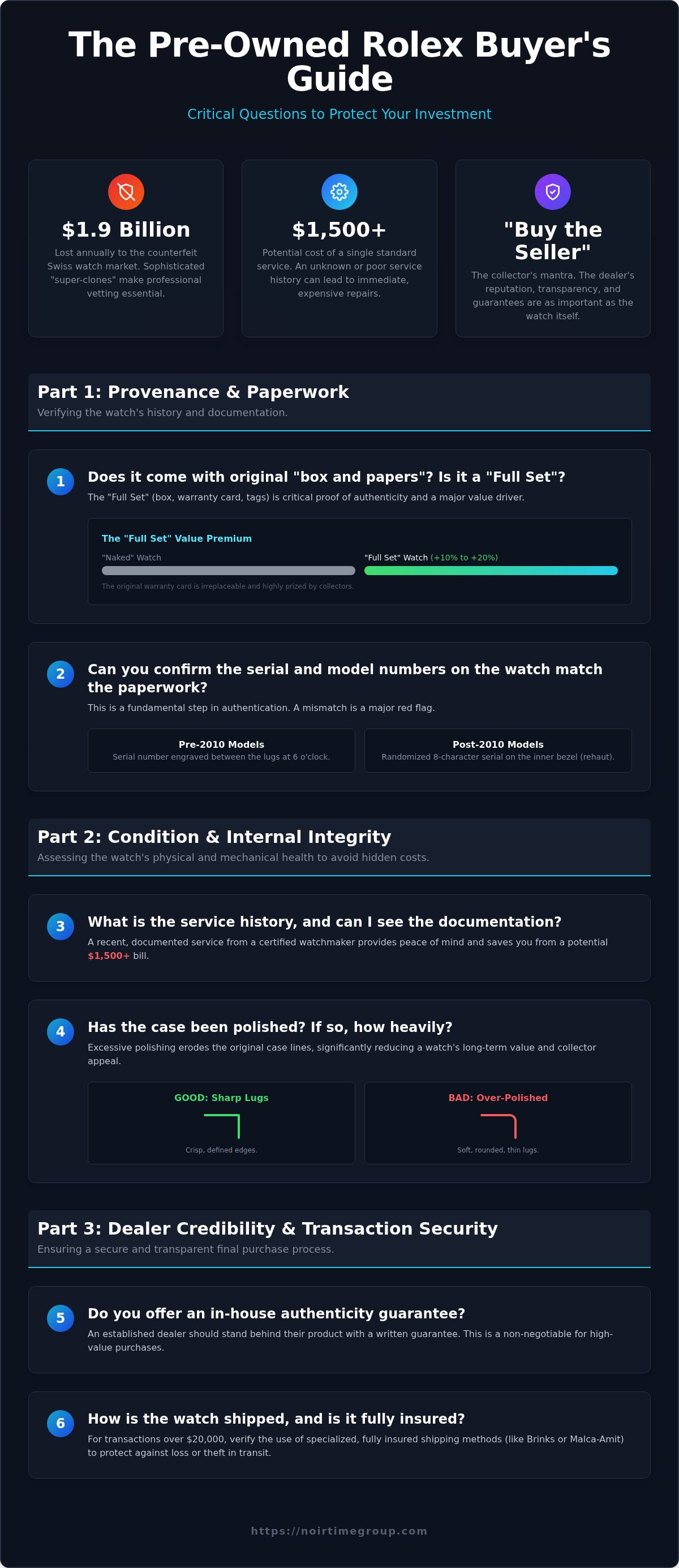
In the collector market, a "Full Set" typically includes the outer box, inner presentation box, warranty card or papers, and the original hangtags. Having these items can increase the watch's value by 10% to 20% compared to a "naked" watch. Collectors prioritize the original warranty card because it's the one component that cannot be replaced. While you can buy a period-correct box on the secondary market, a missing warranty card is a permanent gap in the watch's history. If the papers are missing, ask the dealer if there's a service guarantee from an authorized center or an archive extract. Be wary of "period-correct" boxes; while they match the era, they aren't the actual box the watch was originally sold in, which matters to discerning buyers.
Verifying the Serial and Model Numbers
You must verify that the numbers on the watch match the paperwork exactly. Ask the dealer to show you the model number, usually located between the lugs at 12 o'clock, and the serial number. For watches produced after 2010, Rolex transitioned from engraved serials between the lugs at 6 o'clock to randomized 8-character serials on the inner bezel, known as the rehaut. This change means you can no longer use the serial number alone to determine a specific production year without official records. Authentication begins with these numbers. If the serial number on the rehaut doesn't align perfectly with the warranty card, it's a primary red flag for "franken-watches" where parts from different timepieces are joined together. If you're struggling to find a specific reference with its original kit, a professional watch sourcing service can help locate verified examples with complete provenance.
Finally, check if the warranty card is original, named, and dated. A card with a specific date and the original authorized dealer's name provides a solid starting point for the watch's history. This level of detail is what separates a speculative purchase from a sound investment. Ensuring the warranty card hasn't been tampered with or "blanked" is essential for maintaining the long-term resale value of your timepiece.
Checklist Part 2: Questions About Condition and Internal Integrity
While the box and papers provide historical context, the physical watch tells the current story of its life. When considering the questions to ask when buying a used Rolex, you must look beneath the surface. A Rolex is a precision instrument; its value depends on its mechanical integrity and the preservation of its original form. Visual beauty is often skin deep, but a sound investment requires a movement that performs to factory specifications and a case that hasn't been compromised by aggressive maintenance.
The Polishing Debate: "Unpolished" vs. "Refurbished"
Collectors often pay a significant premium for "unpolished" watches. This term means the case retains its original factory bevels, sharp edges, and satin finishes. You should ask the dealer directly: "Has this watch been polished, and if so, was it done by a Rolex-certified technician?" Over-polishing is a major value-killer. When a watch is polished too many times, the lugs become thinned and asymmetrical, and the bezel teeth lose their sharp, grippy texture. A "refurbished" watch might look shiny to a novice, but a seasoned collector sees the loss of the watch's original silhouette. Always prioritize a watch with honest scratches over one that's been buffed into a rounded, soft version of its former self.
Mechanical Health and Service Records
Don't accept a vague statement like "it runs great" as proof of health. Instead, ask the dealer for "Timegrapher" results. A Timegrapher measures the movement's heartbeat. You're looking for an amplitude between 270 and 310 degrees and a beat error as close to 0.0ms as possible. These metrics prove the movement is healthy and doesn't require an immediate overhaul. A standard Rolex service at an authorized center typically costs between $800 and $1,600, so knowing the service history is a financial necessity. If the watch was serviced, verify if "period-correct" parts were used or if they were replaced with "service parts." While service hands or dials are genuine Rolex components, they aren't original to that specific production year, which can lower the resale price by thousands of dollars.
At Noir Time Group, our Certified Watch Repair service ensures every timepiece we handle meets these rigorous factory standards. We evaluate the internal integrity of every model, from a stainless steel Datejust to a solid gold Submariner, so you don't have to worry about hidden mechanical failures. If a dealer can't provide a clear answer on the last service date or the origin of the internal components, it's a sign to proceed with extreme caution. Your goal is a watch that is as pristine on the inside as it is on the outside.
Checklist Part 3: Questions to Evaluate the Dealer’s Credibility
Vetting the seller is the final stage of your due diligence. While online marketplaces offer convenience, they often lack the accountability of an established brick-and-mortar institution. When finalizing your list of questions to ask when buying a used Rolex, shift your focus toward the dealer’s history and their commitment to your satisfaction after the payment clears. A reputable dealer shouldn't just sell you a watch. They should be willing to buy it back or facilitate a trade in the future, especially for high-demand models like the Rolex Submariner Date 126613LN.
The Advantage of a New York Boutique
A physical NYC showroom provides a level of security that digital-only storefronts cannot match. When you visit a boutique like Noir Time Group, you aren't just looking at a screen. You're interacting with experts who have a tangible presence in the luxury watch industry. This physical footprint ensures accountability. Additionally, established boutiques offer a robust watch sourcing service for clients seeking specific references, such as a Patek Philippe Nautilus or a rare Audemars Piguet Royal Oak. These networks are built over years and provide access to inventory that never hits the public market. After-sales care, including appraisals and certified repairs, builds long-term value that anonymous sellers simply can't provide.
Guarantees and Return Policies
Always ask for the specific wording of the authenticity guarantee. A vague promise isn't enough. You need a written commitment that the watch is genuine in every detail. Inquire about the "inspection period" for online purchases. A confident dealer will allow you a window to have the watch verified independently. A written warranty from the dealer is another sign of confidence. It shows they've inspected the movement and stand by its performance. Ask about their policy on future buy-backs and trades. This transparency proves they believe in the long-term value of their inventory and are willing to stand behind the pieces they sell. If you're looking for the right questions to ask when buying a used Rolex, start by asking how the dealer protects you if the watch doesn't meet your expectations.
Choosing the right partner is just as critical as choosing the right watch. If you're ready to add a masterpiece to your collection with total confidence, contact Noir Time Group to explore our current inventory and sourcing capabilities.
Finalizing the Transaction: Logistics and Security
Once you've vetted the watch and the dealer, the final hurdle is the transaction itself. This phase requires as much precision as the movement inside the case. When discussing the final questions to ask when buying a used Rolex, you should focus on payment security and the logistics of high-value transport. These aren't just administrative details; they're the final layer of protection for your capital. A professional dealer will have established protocols for handling five and six-figure transactions, ensuring that both the funds and the timepiece are handled with total transparency.
Secure Shipping and Insurance
For a high-ticket item like the Rolex Submariner Date 126618LN, standard shipping is insufficient. You must confirm the dealer uses fully insured transit through specialized carriers. Ask if the packaging is discreet and tamper-proof. A box that clearly indicates it contains a luxury watch is an unnecessary target. At Noir Time Group, we prioritize these security protocols for all our Direct Sales inventory. You also need to ask for a detailed, itemized invoice. This document is essential for your private insurance policy, as it provides a clear record of the watch's condition, serial number, and purchase price. Without a proper invoice, you may struggle to prove the watch's value in the event of a claim.
The Next Steps in Your Collection Journey
Buying a Rolex is often the start of a long-term relationship with a trusted advisor. If you have a piece you're looking to move, ask about the trade-in appraisal process. A professional NYC boutique will offer a transparent valuation based on current market trends. Over time, you can leverage this relationship for future acquisitions. Whether you're looking for a Patek Philippe Nautilus or want to use a watch sourcing service for a specific reference not in stock, having a dealer who knows your collection's history is invaluable. Professional appraisals should be updated every few years to reflect market shifts, ensuring your investment remains fully covered as prices fluctuate. Ask about accepted payment methods as well. High-value transactions usually require bank wire transfers for maximum security, though established boutiques can often facilitate trades to offset the cost of your next acquisition.
The right partner makes the acquisition process as rewarding as the watch itself. Contact Noir Time Group in NYC for an expert consultation on your next Rolex purchase.
Secure Your Next Investment with Confidence
Buying a luxury timepiece should be a milestone, not a source of stress. By mastering the right questions to ask when buying a used Rolex, you've moved from being a casual observer to a sophisticated collector. You now understand that a "full set" with original paperwork is more than just paper; it's a protector of your capital. You've also learned why internal mechanical health and the preservation of factory case lines are the true markers of a sound investment.
When you're ready to take the next step, partner with an established NYC-based boutique that prioritizes your security. At Noir Time Group, our luxury experts stand behind every timepiece. Every watch is guaranteed authentic, and our on-site certified professional repair center ensures your investment remains in peak condition for years to come. Whether you're looking for a specific reference or browsing our latest arrivals, we provide the transparency you deserve.
Browse Noir Time Group’s Curated Rolex Inventory and find your perfect timepiece today. Your journey into high-end horology is just beginning, and with the right vetting process, your collection will thrive.
Frequently Asked Questions
Is it safe to buy a used Rolex without the original papers?
Buying without papers is safe if you choose a reputable dealer with a physical New York boutique. While original documentation adds financial value, a professional authenticity guarantee from an established seller provides the security you need. Experts at Noir Time Group verify every component before a sale. You'll receive a watch that is verified for authenticity, even if the original owner misplaced the paperwork over the years.
How can I tell if a used Rolex has been over-polished?
You can identify over-polishing by examining the symmetry and sharpness of the case. Original lugs should be thick and have crisp, defined edges. If the lugs look thinned or rounded, the watch has likely seen excessive buffing. Checking the bezel teeth for a sharp grip is another of the vital questions to ask when buying a used Rolex. Soft, smooth teeth indicate the metal has been significantly worn down.
What is the difference between a Rolex "Service Dial" and an original dial?
An original dial is the factory-installed component from the watch's production year. A service dial is a genuine Rolex replacement part installed during later maintenance. Collectors usually prefer original dials because they maintain the watch's historical integrity. While a service dial is authentic and often looks newer, it can reduce the resale value of vintage models. Always ask if the dial has been replaced to understand the watch's true market position.
How much does it cost to service a used Rolex after purchase?
A standard service at an authorized center typically costs between $800 and $1,600 for most models. More complex references, such as the Cosmograph Daytona, can see costs rise to $2,800 or more if internal parts require replacement. These figures vary based on the caliber's condition and whether the watch was worn daily. Professional maintenance ensures the movement remains within factory specifications and protects the long-term health of your timepiece.
Why do some used Rolex models cost more than new ones at retail?
Market demand for professional Rolex models often exceeds the supply available at authorized dealers. This scarcity creates long waitlists, driving buyers to the secondary market where they pay a premium for immediate availability. With the Rolex price index sitting about 55% above 2019 levels, models like the steel Submariner frequently trade above retail. This price delta reflects the intense global desire for iconic sport references that are currently unavailable at retail boutiques.
What should I look for in a Rolex authenticity guarantee?
A robust authenticity guarantee should be a written document covering every part of the watch, including the movement, dial, and bracelet. It should be backed by a dealer with a verifiable physical presence and a reputation for expertise. Look for guarantees that offer an inspection period, allowing you to have the timepiece verified by a third party. This level of transparency is standard for high-ticket transactions in the NYC luxury market.
Can I trade in my current watch for a Rolex at Noir Time Group?
Yes, Noir Time Group accepts watch trades for clients looking to upgrade or diversify their collections. The process involves a professional evaluation of your current watch to determine its market value. You can apply this value directly toward the purchase of another timepiece, such as a Rolex Submariner Date 126618LN or a Patek Philippe Nautilus. This margin-based service simplifies the acquisition process while ensuring you receive a fair deal for your existing watch.
How long is the typical warranty on a pre-owned Rolex from a dealer?
Most professional dealers offer a one-year mechanical warranty on pre-owned timepieces. This warranty typically covers the movement's accuracy and performance under normal wearing conditions. Asking about the specific terms of this coverage is one of the important questions to ask when buying a used Rolex. It ensures you have access to certified repair services if the watch requires adjustment shortly after purchase, providing peace of mind for your high-value investment.
